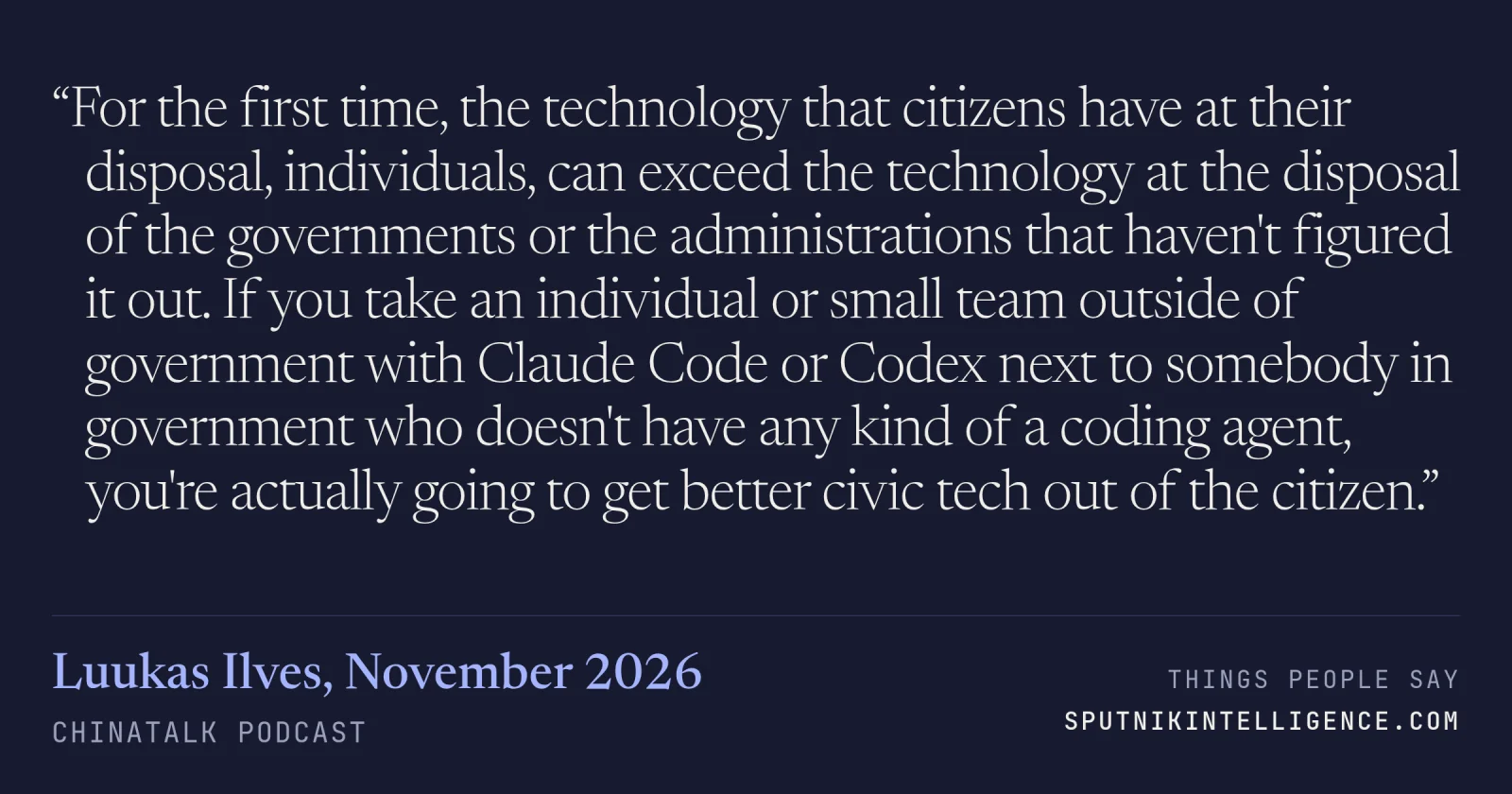
“For the first time, the technology that citizens have at their disposal, individuals, can exceed the technology at the disposal of the governments or the administrations that haven't figured it out. If you take an individual or small team outside of government with Claude Code or Codex next to somebody in government who doesn't have any kind of a coding agent, you're actually going to get better civic tech out of the citizen.”
ChinaTalk · Geopolitics & World Affairs · November 2026
Context
Luukas Ilves, who worked on Estonia's digital government, argues that coding agents have flipped the usual gap between citizens and the state. He warns that agencies that don't catch up could face a shadow alternative government built from outside.
Transcript
…they are going to get positive feedback. Politicians are going to like it. So, I mean, there is an optimistic story. And I'm sure there's, I'm sure we could imagine already the post-mortem and post-mortem on how it goes wrong. But obviously, we got to shift the trajectory to the positive outcomes.
…stuff. And then just on the skill perspective, like the more people you have vibe coding stuff at home, then like, you know, you don't need to hire the 10,000 software engineer. You can hire two. And it's just like, it's easier to get the skill set that you need to start implementing this stuff.
So to agree on that, I mean, there's a there's a dynamic I would add to that treatment, which is like, if there is also going to be sort of a push factor, if you don't figure it out, for the first time, the technology that citizens have at their disposal, individuals, can exceed the technology at the disposal, at least of the governments or the administrations that haven't figured it out, right? So if you think, if you take individual or small team outside of government with clawed code or codecs next to, you know, somebody in government who doesn't have any kind of a coding agent, you're actually going to get better civic tech out of the individual, the citizen. And sort of the one of the sort of way, many ways in which things can go wrong is you start having citizens building stuff, which actually sounds really cool, until you suddenly get to a point where basically like there's a whole bunch of public functions where there's kind of this shadow alternate sort of government out there that's saying, hey, like this is better, use us. And either that's going to like amp up the dissatisfaction even more or ends up being a massive, I mean, depends on who puts it up. It could be a white hat citizen, you know, a…
It's kind of like a beautiful little vision, right, of all your retiring civil servants. Like what do they do before they leave? They automate themselves and they can just like, you know, leave their brains into the civil fabric of their state or city or country.
No, but I mean, jokes aside, this is like, if we're going to be AGI-pilled for a moment, as AI does more and more, you know, we're seeing that domains that are either formally verifiable or kind of explicable to the AI are going to get automated more. And unfortunately, like what government does is…
Let's do some case studies. I don't know. How does this actually get manifested?
More from ChinaTalk