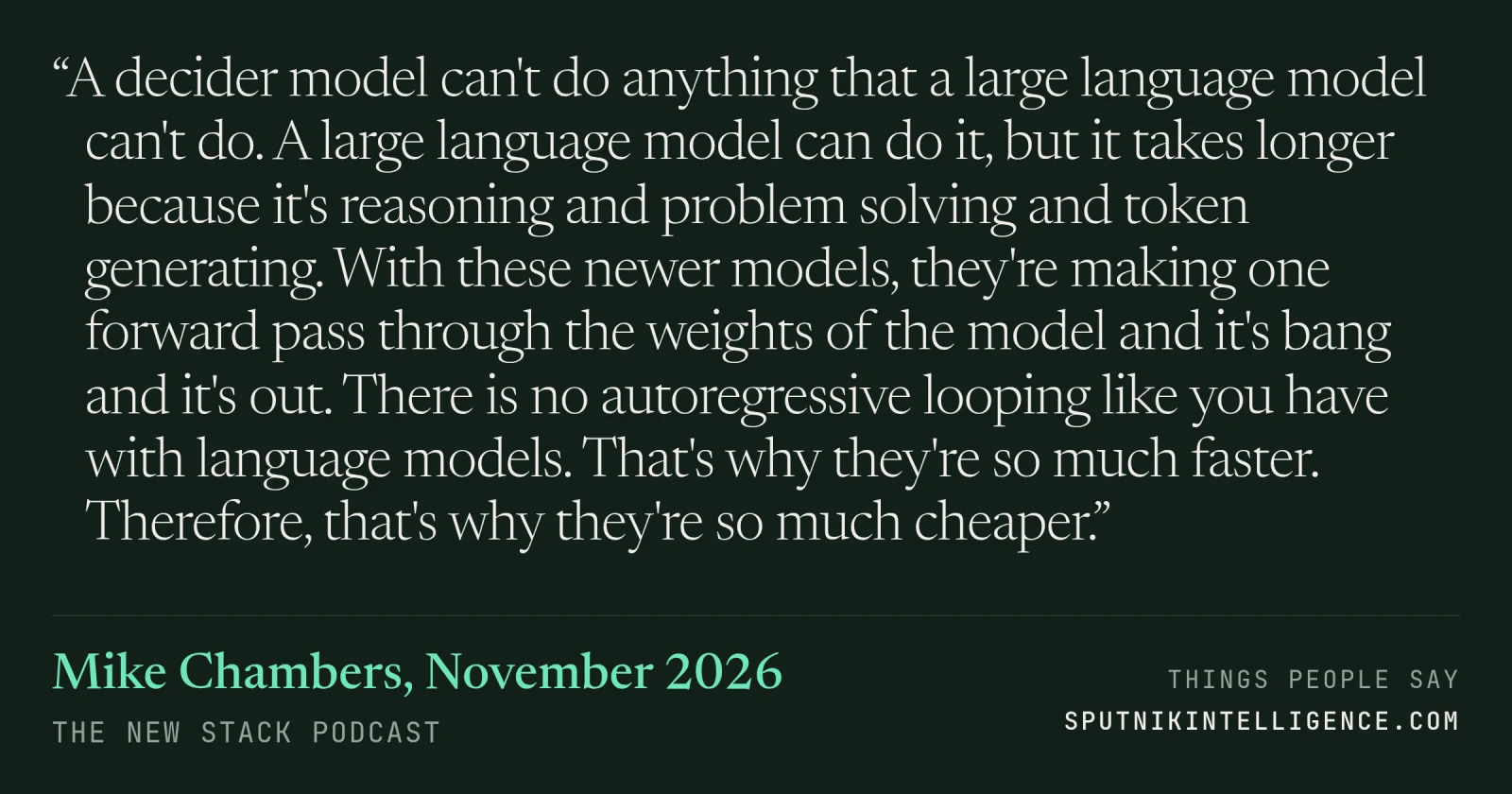
“A decider model can't do anything that a large language model can't do. A large language model can do it, but it takes longer because it's reasoning and problem solving and token generating. With these newer models, they're making one forward pass through the weights of the model and it's bang and it's out. There is no autoregressive looping like you have with language models. That's why they're so much faster. Therefore, that's why they're so much cheaper.”
The New Stack Podcast · Hands-On Engineering Podcasts · November 2026
Context
Asked to define a 'system one' model for agents, Chambers explains that small decision models get their speed and cost advantage from a single forward pass with no token-by-token generation.
Transcript
wow,
that's two interesting use cases there. Oh, I just want to jump back a moment. System one model, what's your word definition of a system one model again?
Yeah, I guess so. So when the blog post came out, I think this was from TypeSafe when they launched Jerv, they sort of like coined this thing of system one versus system two. And this is sort of going back to the system one versus system two thinking that humans might do. So system one thinking being the things which are sort of like innate. I guess a really good example I read about this was: you know, if I see the brake lights of the car in front of me and I jump on the brakes in my own car, that's system one. It's just instinctive, I do it. So it's not quite as instinctive as just breathing, but it's just something that I've learned to do. I just jump on and do it. Whereas if I'm doing parallel parking, reverse parking, or whatever, that's definitely system two thinking. I have to think about it in depth. So it's that. And the way that that equates into these models then is that you, okay, important point. A decider model, with the decider models that we have today, they can't do anything that a large language model can't do. If I can put it that way. So a large language model can do it, but it takes longer to do it because it's reasoning and problem solving and token generating and doing all that kind of stuff. And maybe it's inside of…
I appreciate that. And my next question is sort of jumps off that point a little bit. Suppose that the decider model that the decider model needs to look up more information and act more like an LLM to piggyback off your previous answer. What would a developer give Decider to help it make that…
Yes, I guess, so how do we prompt it, essentially? I mean, like, I mean, yeah, again, with a large language model, you can kind of send in whatever text you want and let's see what happens and what comes out the other side. With the decider model, with a decision model, you also send in natural…
What does the, after it goes on this journey, what does it return to the agent?
More from The New Stack Podcast