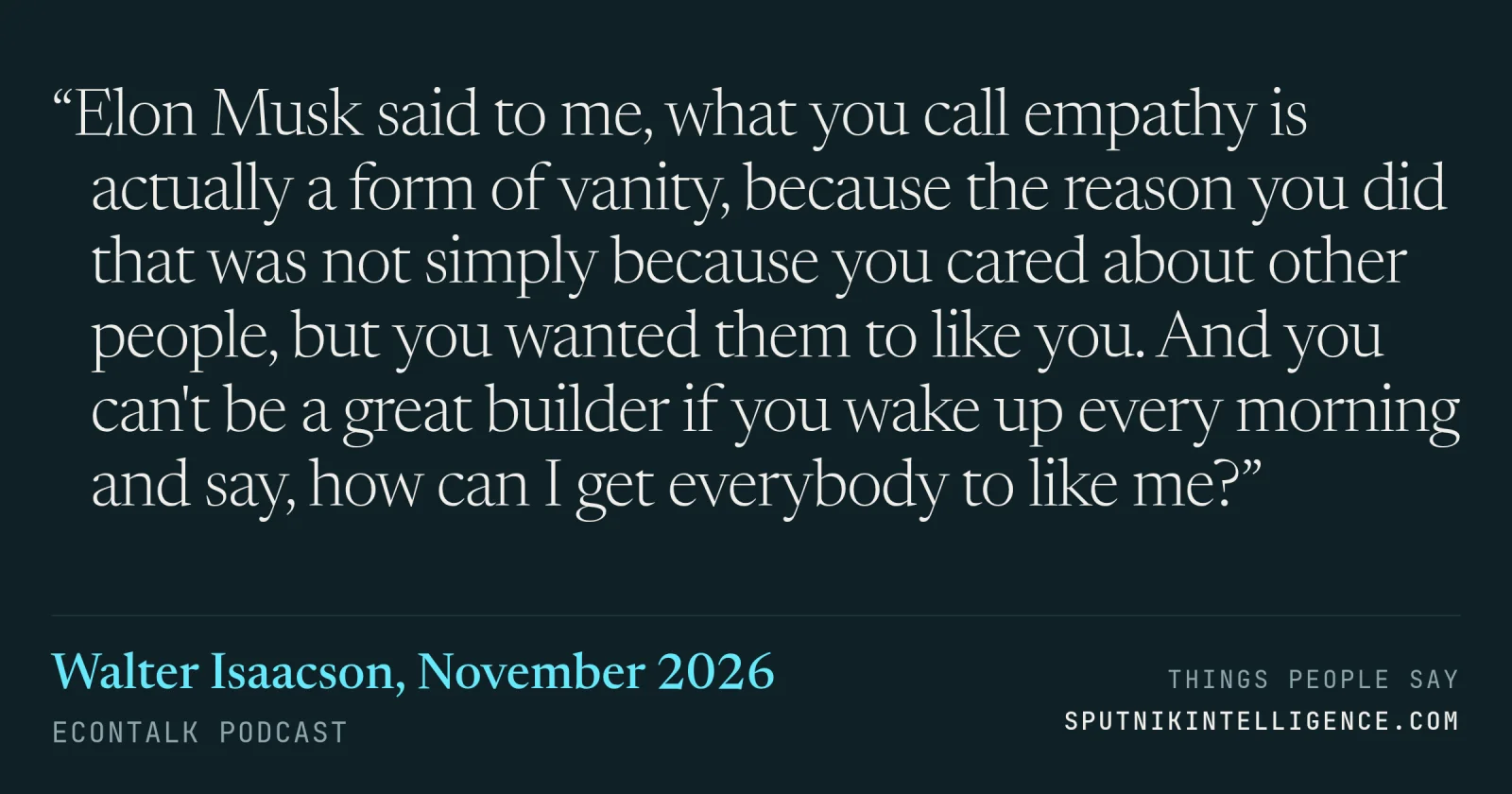
“Elon Musk said to me, what you call empathy is actually a form of vanity, because the reason you did that was not simply because you cared about other people, but you wanted them to like you. And you can't be a great builder if you wake up every morning and say, how can I get everybody to like me?”
EconTalk · In-Depth Interviews · November 2026
Context
Isaacson was recounting being told he was bad at running CNN because he had too much empathy. He says he concluded he isn't cut out to be a Musk, and that "be just like Elon Musk" is a bad lesson for most people.
Transcript
…not Steve Jobs. You know, maybe you need a little humility because you're never going to be Steve Jobs. You're going to be somebody who, with a lot of persistence, but also a little bit of humility, will be able to make things work. Don't try to be Steve Jobs if you're not as talented as he is.
And we also, of course, it's a selection bias. We only see the ones who succeed and the ones who fail, we never see them. I do think it makes you better, it might make you a worse entrepreneur humility, but it makes your better friend probably in a spouse.
You have to decide what you want to do in life. And, you know, I ran CNN for a while. And both Elon Musk and Steve Jobs said, you were never very good at running CNN. And they said, you had too much empathy. You cared too much about whether Lou Dobbs or Greta Van Sustrin liked you or something. And what Musk said to me is, and what you call empathy is actually a form of vanity because the reason you did that was not simply because you cared about other people, but you wanted them to like you. And you can't be a great builder if you wake up every morning and say, how can I get everybody to like me? And I said, okay, I get it. And then I said to myself, you know what? Maybe I'm not cut out to be somebody like an Elon Musk. Maybe I'm not going to get a rocket ship that'll get people back from the space station. But I'm going to live my life the way I feel is useful. And we should each live our own lives to our own values. I write biographies. My Builders podcast tells you what these builders think deep inside. The Innovators tell you about all the people who created the digital…
Yeah, when they told you you were too nice and that you were only doing it to curry favor with your colleagues and employees, I wonder if that was just a rationalization for being a self-centered person, but there's some truth to it, obviously. Wired
Magazine did a cover story after the Steve Jobs book came out, which basically the cover line was: do you have to be an asshole? And I'll let every person decide that. But even if you think that being a jerk can help you in business, you then have to go to the next level and say, what do I want to…
For sure. Let's talk about biography. Not all your books are literally biographies, but many of them have a biographical element or are biographies. Make that case for reading biographies. It's fun. People do it for fun. Is there other value to it in your mind and for writing those books for you?
More from EconTalk