 Fr. Robert Ballecer, SJ
Jesuit priest and technology broadcaster who grew up in Silicon Valley and has worked as a software developer, teacher, retreat director and Director of Vocatio...
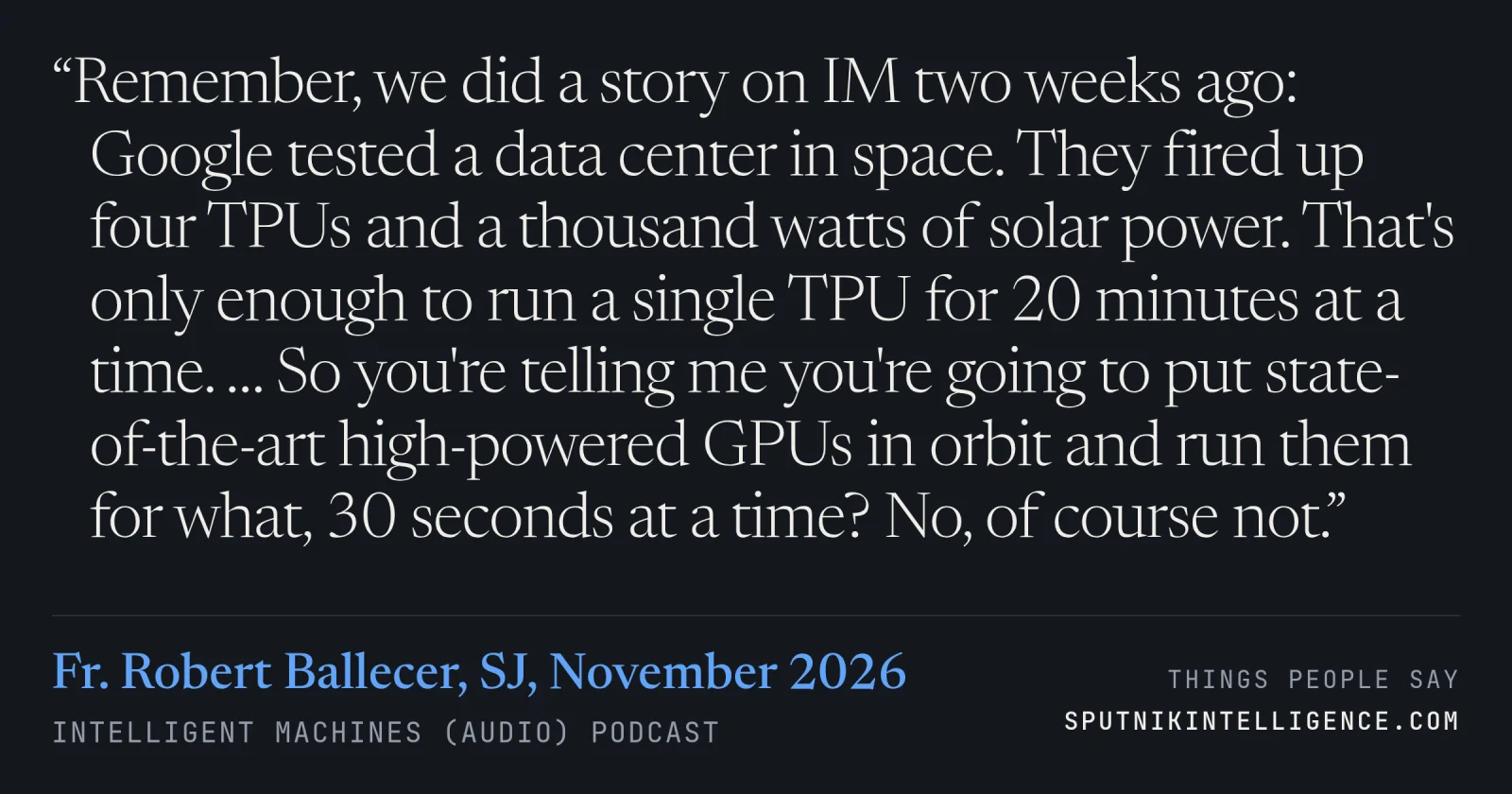
“Remember, we did a story on IM two weeks ago: Google tested a data center in space. They fired up four TPUs and a thousand watts of solar power. That's only enough to run a single TPU for 20 minutes at a time. … So you're telling me you're going to put state-of-the-art high-powered GPUs in orbit and run them for what, 30 seconds at a time? No, of course not.”
Intelligent Machines (Audio) · Tech Strategy & Big Tech · November 2026
Context
Leo Laporte mentioned that SpaceX got FCC approval for a million orbital data-center satellites. The speaker doubts the power math, citing his memory of an earlier story on Google's test.
Transcript
million satellites. Are you out of your mind?
It's just, yeah.
Well, and also, remember, we did a story on IM two weeks ago about, so Google tested a data center in space. Right. They fired up four TPUs and a thousand watts of solar power. That's only enough to run a single TPU for 20 minutes at a time. So you're telling me. Yeah, you're, and that was a low power unit. So you're telling me you're going to put state-of-the-art high-powered GPUs in orbit and run them for what, 30 seconds? At a time? No, of course not.
A million of them.
No, thanks.
Jeff, did I miss anything important?
More from Intelligent Machines (Audio)