 Bill Gates
Director, ASU Mechanics of Democracy Laboratory.
Bill Gates
Director, ASU Mechanics of Democracy Laboratory.
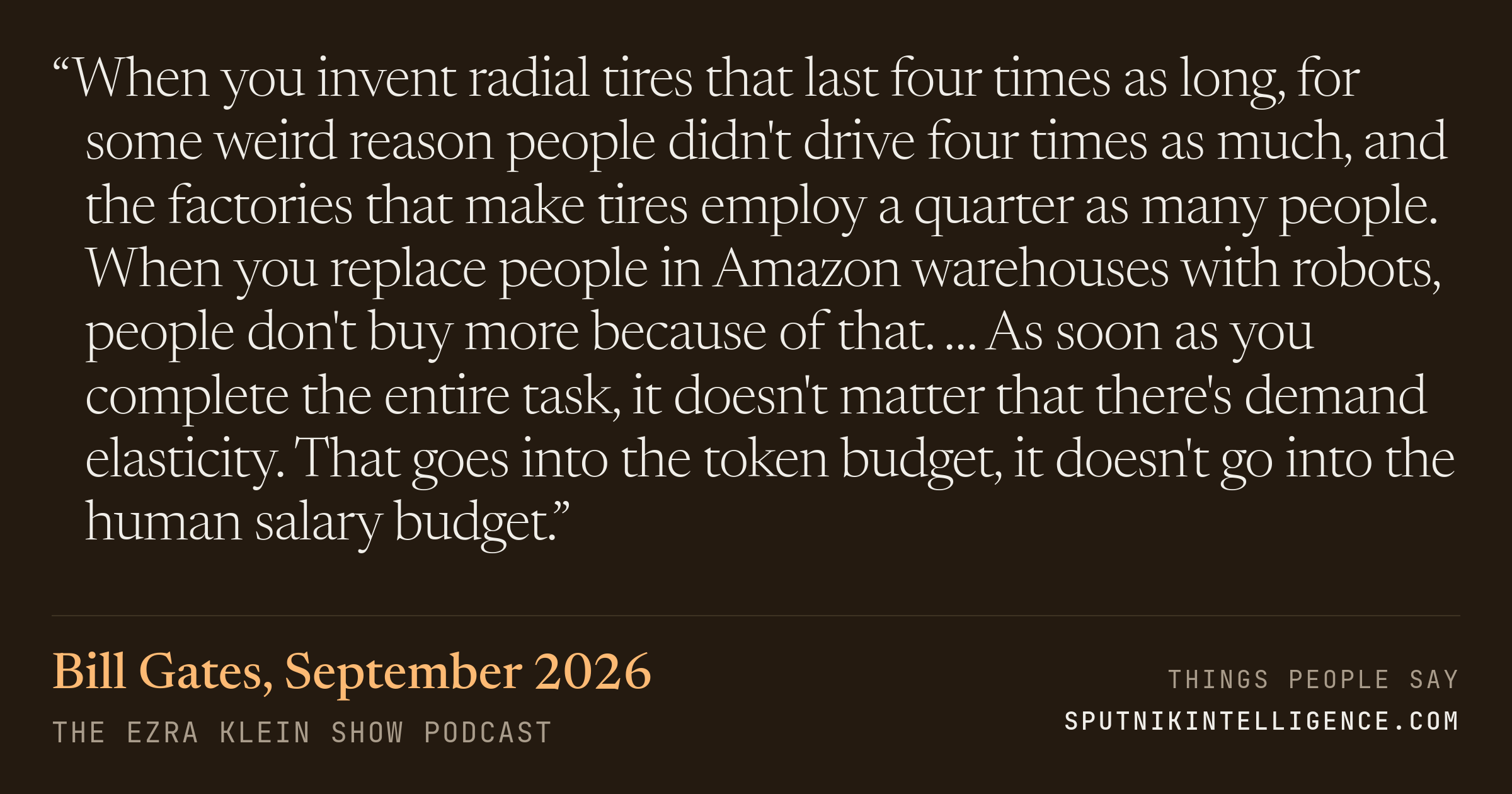
“When you invent radial tires that last four times as long, for some weird reason people didn't drive four times as much, and the factories that make tires employ a quarter as many people. When you replace people in Amazon warehouses with robots, people don't buy more because of that. … As soon as you complete the entire task, it doesn't matter that there's demand elasticity. That goes into the token budget, it doesn't go into the human salary budget.”
The Ezra Klein Show · Ideas & Essays · September 2026
Ezra Klein put the most common optimistic answer to Gates: the Jevons paradox, where cheaper intelligence expands demand enough that the jobs work themselves out. Gates conceded it holds for software so far, then argued it breaks the moment a task is completed end to end rather than merely sped up. He went on to say that people predicting net additional jobs "must not understand the piece of improvement we're on."
Transcript
Far preference. You go to San Francisco and ask people, would you rather ride in a Waymo or rather ride with the human driver? Go ask people in the UK who use Limbic for mental health support. So the notion that just the market demand preference for driving or the nurse or even the person on the phone will favor humans, that's a quality threshold which will be passed through. say insurance companies are still human doing humans through claims medical claims which is a very ai capable task then a competitor who has very few human employees will come in and uh change the pricing model for that industry
so the two counter arguments i've heard people make on this one is that you have a jevons paradox effect where the cheaper more widespread availability of this kind of intelligence leads to a massive increase in the demand for this kind of thing so yes you have many more ai chatbot nurses and that leads to more people being sent to the hospital being sent to the doctor where real nurses take care of them or you have many more ai coders so maybe my small podcast team which wouldn't have had a software engineer before now has one because it's like they run a team of coders and we can build products we never thought of before uh this is the most common answer i hear to this that yes ai will destroy jobs yes it is making a human provided resource much cheaper but because it's going to expand the demand so much it will sort of work itself out create jobs in other areas create new demand and this is how past technologies have gone and so we shouldn't worry too much about this how do you see that
well jevons is just a referral to the fact that parts of the economy are subject to demand elasticity and yes in the case of software if you're say three times as fast and there is still some role that only humans can perform then as you lower the cost you induce demand and so it's fair to say that the equilibrium today for so far for software is not a loss of employment when you invent radial tires that last four times as long for some weird reason people didn't drive four times as much uh and tact factories that make tires employ a quarter as many people when you replace people in amazon warehouses with robots people don't buy more because of that so you know anybody who's numeric can say to themselves what portion of the economy is is subject demand elasticity and what are those tasks that will still be human necessary as soon as you complete the entire task it doesn't matter that there's demand elasticity that goes into the token budget it doesn't go into the human salary budget the cost for some of these things is so much less than the cost of the human labor and so the as you cross reliability thresholds both with white collar and human eyed robots you destroy jobs and you leave no high ground that's you know innovation in the past you have a tractor fine you know let's build disneyland and employ a lot of people there you don't have that in the broad economy you know they people who say there'll be net additional jobs i don't understand what they're thinking they must not understand the piece of improvement we're on that you know the reliability you wrote a column i think was in may that i looked at like what what you disagreed with my column what is this unique humanist thing that you think uh uh you know in every category where ai has come along the preference for the ai is very very strong well so
that column is based on so jevin's paradox and then the other which is an argument from alex imus who i believe is now at one of the labs as an economist is that you will have this sort of explosion in the relational sector that one thing that happens when people get wealthier and you'd probably know about this is that they all of a sudden get a lot more human help right they have personal trainers and chefs and there's a lot more no royalty
royalty used to have a lot of uh human help you had upstairs downstairs you know all those maids and people and you used to have a human who helped you get dressed believe me the labor intensity of wealth is down super dramatically from what it used to be
so you don't have Jevins
More from The Ezra Klein Show