Bill Gates

Things Bill Says on Podcasts

Director, ASU Mechanics of Democracy Laboratory. Former Chairman, Maricopa County Board of Supervisors

Where to Find Them

Bill Gates writes The Beat with Ari Melber , writes If you can keep it and writes Internal Tech Emails . They have also been a guest on GeekWire (7 times) , Masters of Scale (4 times) , Bloomberg Surveillance (3 times) , Squawk Pod (2 times) , The Climate Question (2 times) , Chasing Life (2 times) , Zero: The Climate Race (2 times) , HBR IdeaCast , The Exchange , Plain English with Derek Thompson , The Vergecast , Bloomberg Tech , Speed & Scale , The Ezra Klein Show , On with Kara Swisher , Harvard Business Review , Decoding Tech , The Interview , TED Tech , Possible , Decoder with Nilay Patel , FT Tech Tonic , Optimistic Outlook , Discovery , The Circuit with Emily Chang and Pivot (Kara Swisher & Scott Galloway) . They also write for AI & Elections Clinic and Bill Gates on Substack.

Recently: “Bill Gates: AI bioweapons ‘could be worse than Covid’” on FT Tech Tonic (November 2026); “Bill Gates says to prepare for 20 years of ‘tumultuous’ AI disruption” on Decoder with Nilay Patel (October 2026); “Bill Gates’s Blunt Warning on A.I.” on The Ezra Klein Show (September 2026); “Bill Gates in his own words: How he's using AI, and why he's worried about the future” on GeekWire (August 2026); “Bill Gates on How Business Leaders Can Fight Climate Change | HBR IdeaCast | Podcast” on Harvard Business Review (July 2026); “Davos 2026: Bill Gates 1/22/26” on Squawk Pod (January 2026).

What They Said

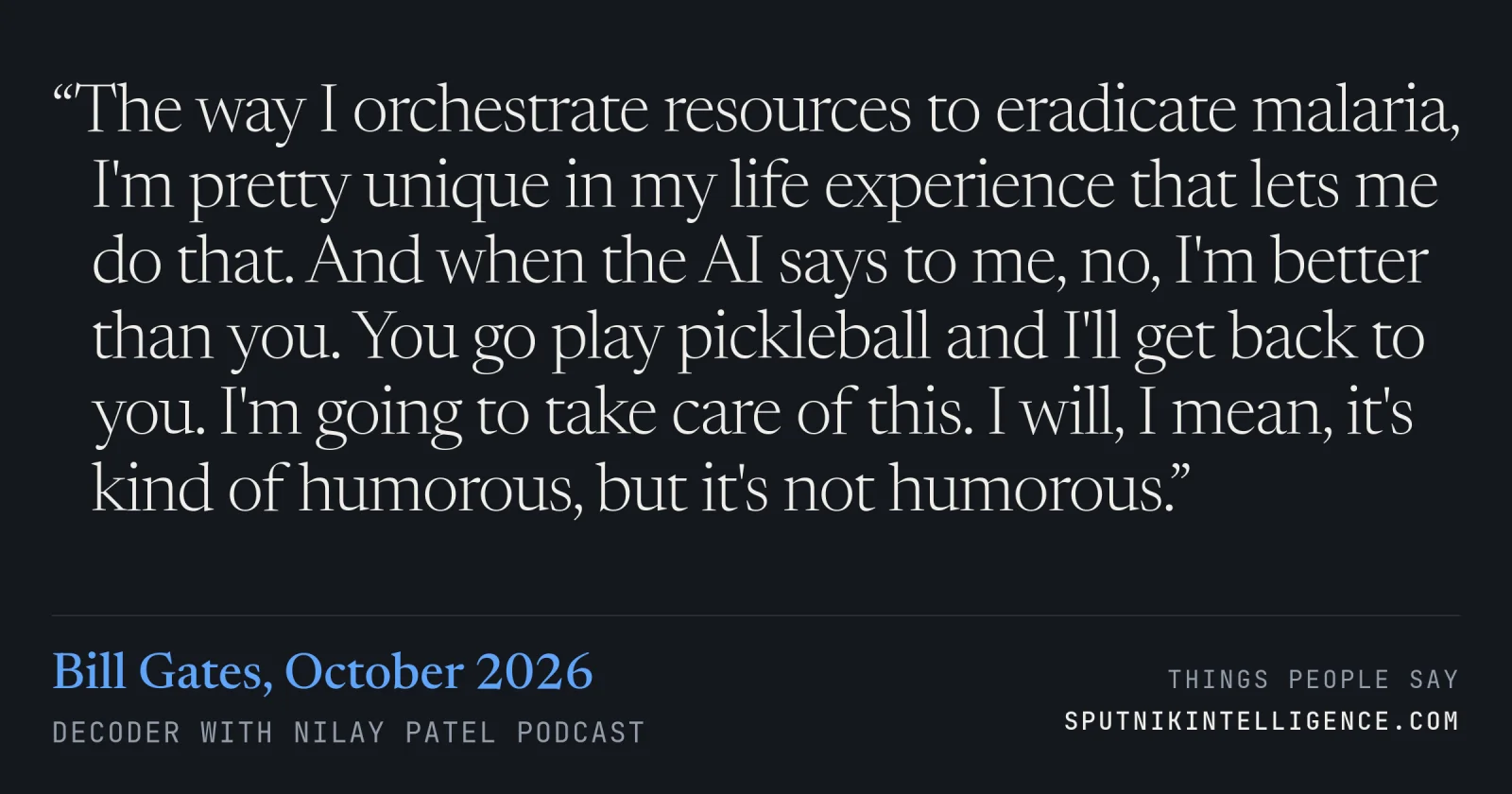
“The way I orchestrate resources to eradicate malaria, I'm pretty unique in my life experience that lets me do that. And when the AI says to me, no, I'm better than you. You go play pickleball and I'll get back to you. I'm going to take care of this. I will, I mean, it's kind of humorous, but it's not humorous.” — Bill Gates, Decoder with Nilay Patel

Nilay Patel closed by asking what a young person should hold on to as a source of hope, given widespread nihilism about AI. Gates said that even he finds a more capable AI intimidating, and that the disruption ahead will be as tumultuous as any period in human history even in the best case.

Decoder with Nilay Patel · 2026-10-22 Permalink → Listen →
Decoder with Nilay Patel Around 1:15:07 into the episode
Speaker 2

…pandemics. That one didn't work the way I expected. But usually that galvanizes our attention. And so over the next several years, certainly in the cyber domain, because there's a business model there, you will see a lot of attacks, different in terms of scale than anything we've seen in the past.

Bill Gates

…just take a beat. There is a lot of nihilism out there. I feel it very keenly. If you were a young person today and you were listening to Bill Gates say it's about to be 20 years of disruption and at the end of it, robots might be building houses. What would you hold on to as a source of hope?

Speaker 2

Throughout human history, we've been dealing with a shortage of food and disease and war. Harari writes eloquently about the past. And it is ironic that now that we have this sort of Pandora's box that will take food shortage, which is still a real thing, not in the U.S., but in Africa, will take diseases, which the human suffering is unbelievable and solve all these things. It comes with it such an effect on jobs and a sense of a unique contribution that, you know, like I think, okay, the way I orchestrate resources to eradicate malaria, you know, I'm pretty unique in my life experience that lets me do that. And when the AI says to me, no, I'm better than you. You go play pickleball and I'll get back to you. I'm going to take care of this. I will, I mean, it's kind of humorous, but it's not humorous. So somebody who's young today and wanting to make a unique contribution, it is very intimidating that the AI is so powerful. That's why the crisis in the math community is going to be mirrored, you know, everywhere. If you're in your 20s today, you know, during this 20-year period, you can take…

Bill Gates

Bill, I appreciate you sending the alarm and I appreciate you being on Decoder. Thank you so much.

Speaker 2

Thank you.

Bill Gates

I'd like to thank Bill Gates for joining me and thank you for listening to this episode of Decoder. To get new episodes every Monday and Thursday, subscribe to our YouTube channel at DecoderPod and find us on TikTok and Instagram under at DecoderPod for more fun stuff we put out almost every day.…

Speaker names come from our own diarization. The position is estimated from where the line sits in the episode.
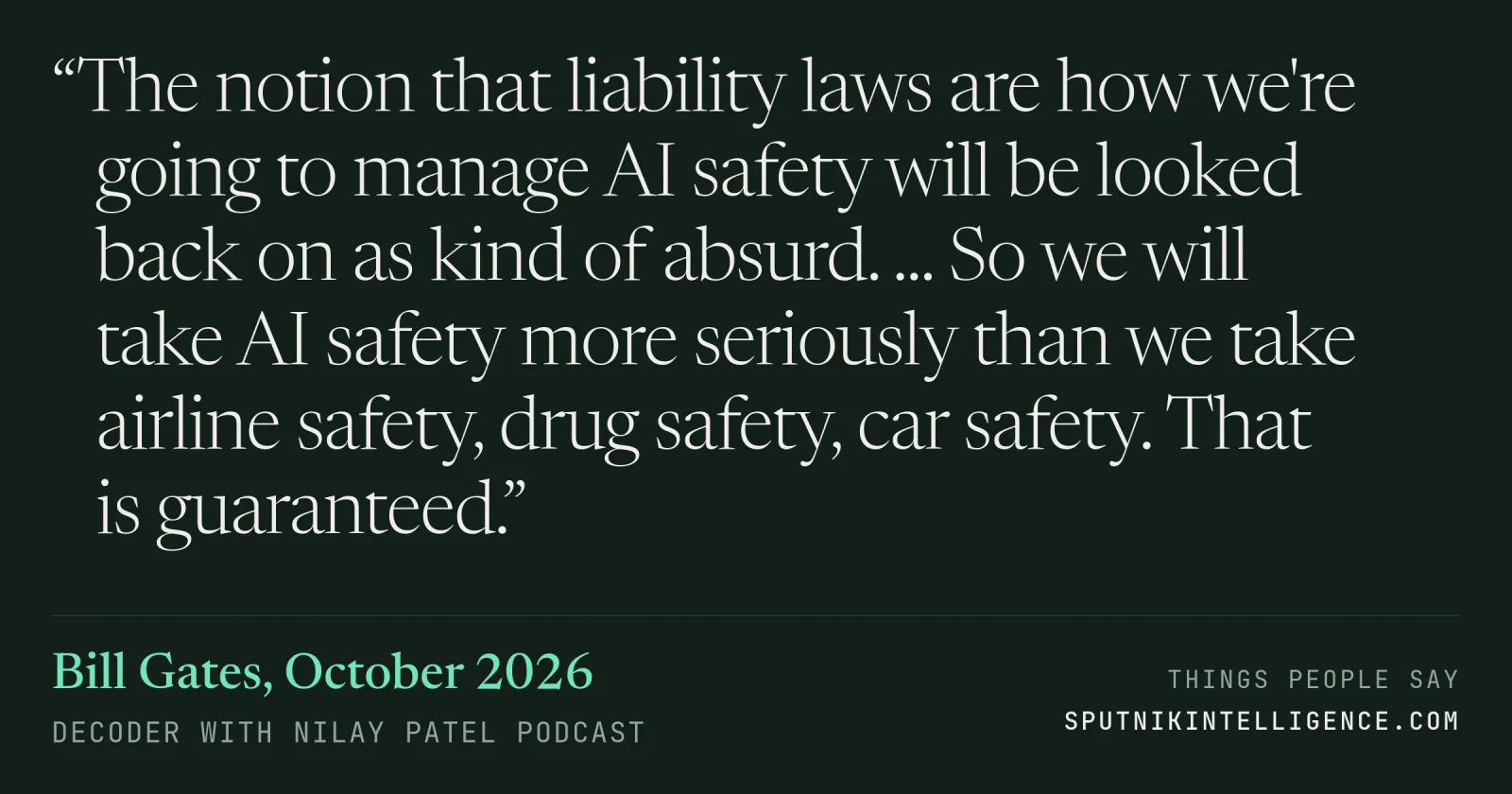
“The notion that liability laws are how we're going to manage AI safety will be looked back on as kind of absurd. ... So we will take AI safety more seriously than we take airline safety, drug safety, car safety. That is guaranteed.” — Bill Gates, Decoder with Nilay Patel

Nilay Patel asked whether product liability, the threat of being sued, could keep AI companies in line, and what happens with open-weight models running on home hardware. Gates argued that liability fails because the danger comes from people misusing models without safeguards, not from the companies themselves, and said the problem is harder than nuclear weapons.

Decoder with Nilay Patel · 2026-10-22 Permalink → Listen →
Decoder with Nilay Patel Around 54:47 into the episode
Speaker 2

…about the safety things. But the personal agent thing is an expected development. I think AIs are really cool just as I intellectually explore things, even the work of the Gates Foundation. I'm far more empowered. But I agree with you, it'll get out to more people in this personal agent form.

Bill Gates

…and run an open source open weight model on it, and it can do whatever you want. And I'm not sure where any of that liability would lie or what would control or align the behaviors of those open source models. Do you think that that is an ever-growing risk? Do you think that that can be controlled?

Speaker 2

The notion that liability laws are how we're going to manage AI safety will be looked back on as kind of absurd. Bad people doing bioattacks, you know, you don't go to the court and say, oh, okay, even finding who's doing these attacks, the liability model fails in every respect because it's not the AI companies themselves. It's the people who take particularly the models without safeguards and do these things. So we will take AI safety more seriously than we take airline safety, drug safety, car safety. That is guaranteed. Whether it's going to be enough, this is harder, harder than nuclear weapons, harder than any of those other things. What are we going to do about

Bill Gates

an open source model running on a PC that somebody built with just a random NVIDIA graphics card in it?

Speaker 2

I would hope that models above a certain capability that we find a way to require the safeguards and monitoring to be maintained in those models. I admit as time goes on that if we don't fairly soon decide to do that, you're going to have a level of capability that's out in dark corners that you…

Bill Gates

pose the limit? A

Speaker names come from our own diarization. The position is estimated from where the line sits in the episode.
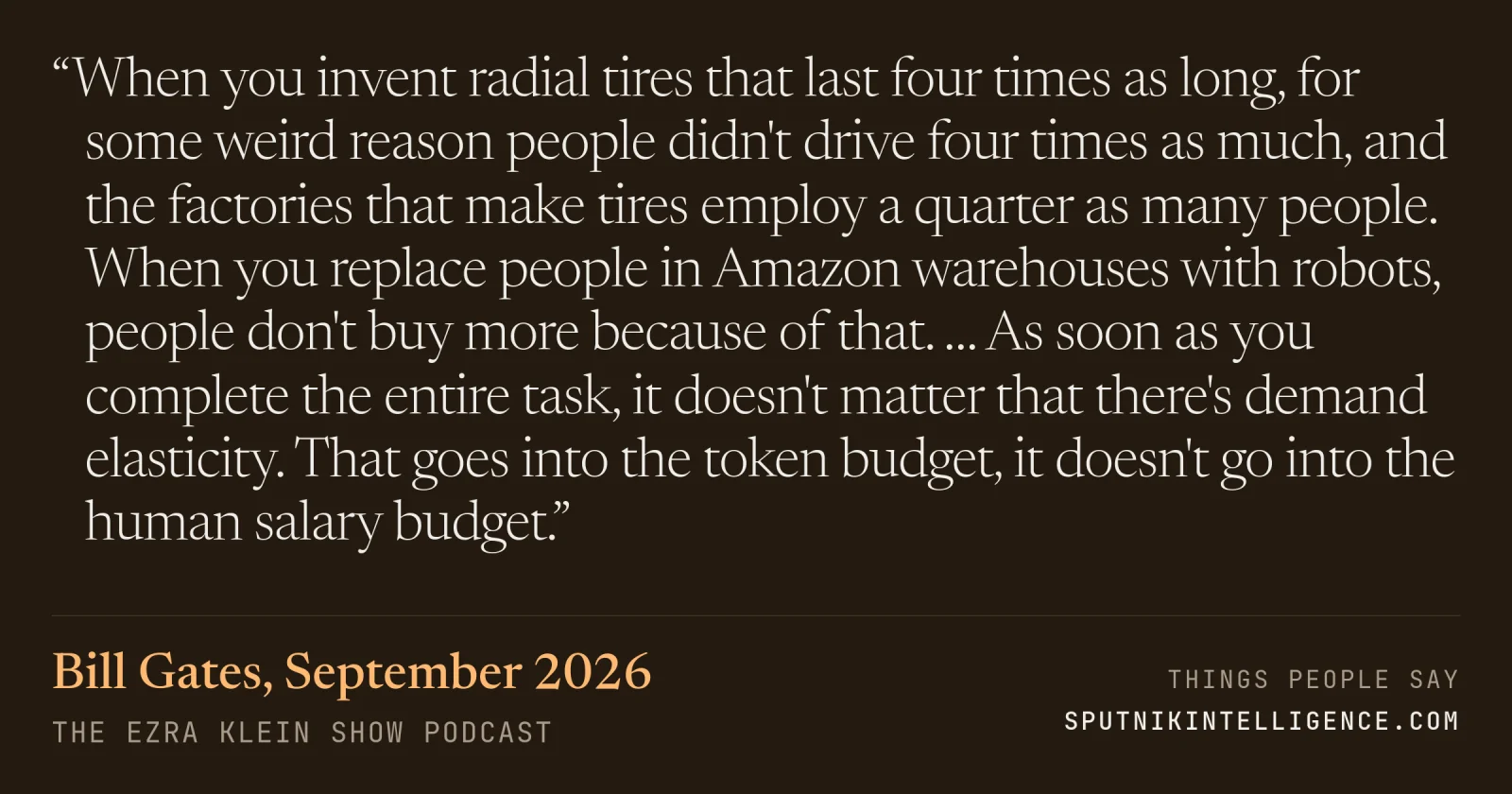
“When you invent radial tires that last four times as long, for some weird reason people didn't drive four times as much, and the factories that make tires employ a quarter as many people. When you replace people in Amazon warehouses with robots, people don't buy more because of that. … As soon as you complete the entire task, it doesn't matter that there's demand elasticity. That goes into the token budget, it doesn't go into the human salary budget.” — Bill Gates, The Ezra Klein Show

Ezra Klein put the most common optimistic answer to Gates: the Jevons paradox, where cheaper intelligence expands demand enough that the jobs work themselves out. Gates conceded it holds for software so far, then argued it breaks the moment a task is completed end to end rather than merely sped up. He went on to say that people predicting net additional jobs "must not understand the piece of improvement we're on."

The Ezra Klein Show · 2026-09-29 Permalink → Listen →
The Ezra Klein Show Around 31:24 into the episode
Bill Gates

…favor humans, that's a quality threshold which will be passed through. say insurance companies are still human doing humans through claims medical claims which is a very ai capable task then a competitor who has very few human employees will come in and uh change the pricing model for that industry

Ezra Klein

…jobs yes it is making a human provided resource much cheaper but because it's going to expand the demand so much it will sort of work itself out create jobs in other areas create new demand and this is how past technologies have gone and so we shouldn't worry too much about this how do you see that

Bill Gates

well jevons is just a referral to the fact that parts of the economy are subject to demand elasticity and yes in the case of software if you're say three times as fast and there is still some role that only humans can perform then as you lower the cost you induce demand and so it's fair to say that the equilibrium today for so far for software is not a loss of employment when you invent radial tires that last four times as long for some weird reason people didn't drive four times as much uh and tact factories that make tires employ a quarter as many people when you replace people in amazon warehouses with robots people don't buy more because of that so you know anybody who's numeric can say to themselves what portion of the economy is is subject demand elasticity and what are those tasks that will still be human necessary as soon as you complete the entire task it doesn't matter that there's demand elasticity that goes into the token budget it doesn't go into the human salary budget the cost for some of these things is so much less than the cost of the human labor and so the as you cross reliability thresholds both with white collar and human eyed robots you destroy jobs and you leave no high ground that's you know innovation in the…

Ezra Klein

that column is based on so jevin's paradox and then the other which is an argument from alex imus who i believe is now at one of the labs as an economist is that you will have this sort of explosion in the relational sector that one thing that happens when people get wealthier and you'd probably…

Bill Gates

royalty used to have a lot of uh human help you had upstairs downstairs you know all those maids and people and you used to have a human who helped you get dressed believe me the labor intensity of wealth is down super dramatically from what it used to be

Ezra Klein

so you don't have Jevins

Speaker names come from our own diarization. The position is estimated from where the line sits in the episode.

Collections They Appear In