Journalist and author who spent 17 years at The Atlantic before moving to independent writing on Substack, covering housing, energy, technology and changes in social life. Co-author with Ezra Klein of Abundance, a #1 New York Times bestseller, and author of Hit Makers and On Work.
Hosts Plain English with Derek Thompson and publishes the Derek Thompson newsletter. Appears as a guest on shows including The Prof G Pod, The Ezra Klein Show and Lex Fridman Podcast.
Thompson was explaining how his "Everything Is Television" column came together. Three separate observations clicked into one idea: Spotify pushing his podcast to video, a Meta court filing saying most Instagram time is spent watching strangers' footage, and OpenAI launching a video app.
…company. We can't be a social media monopoly because the vast majority of people on Instagram aren't connecting with friends. They're spending almost all their time watching footage from other people. So that's not social at all. And I thought, aha, Instagram, according to Instagram, is television.
Speaker 1
Yes.
Speaker 2
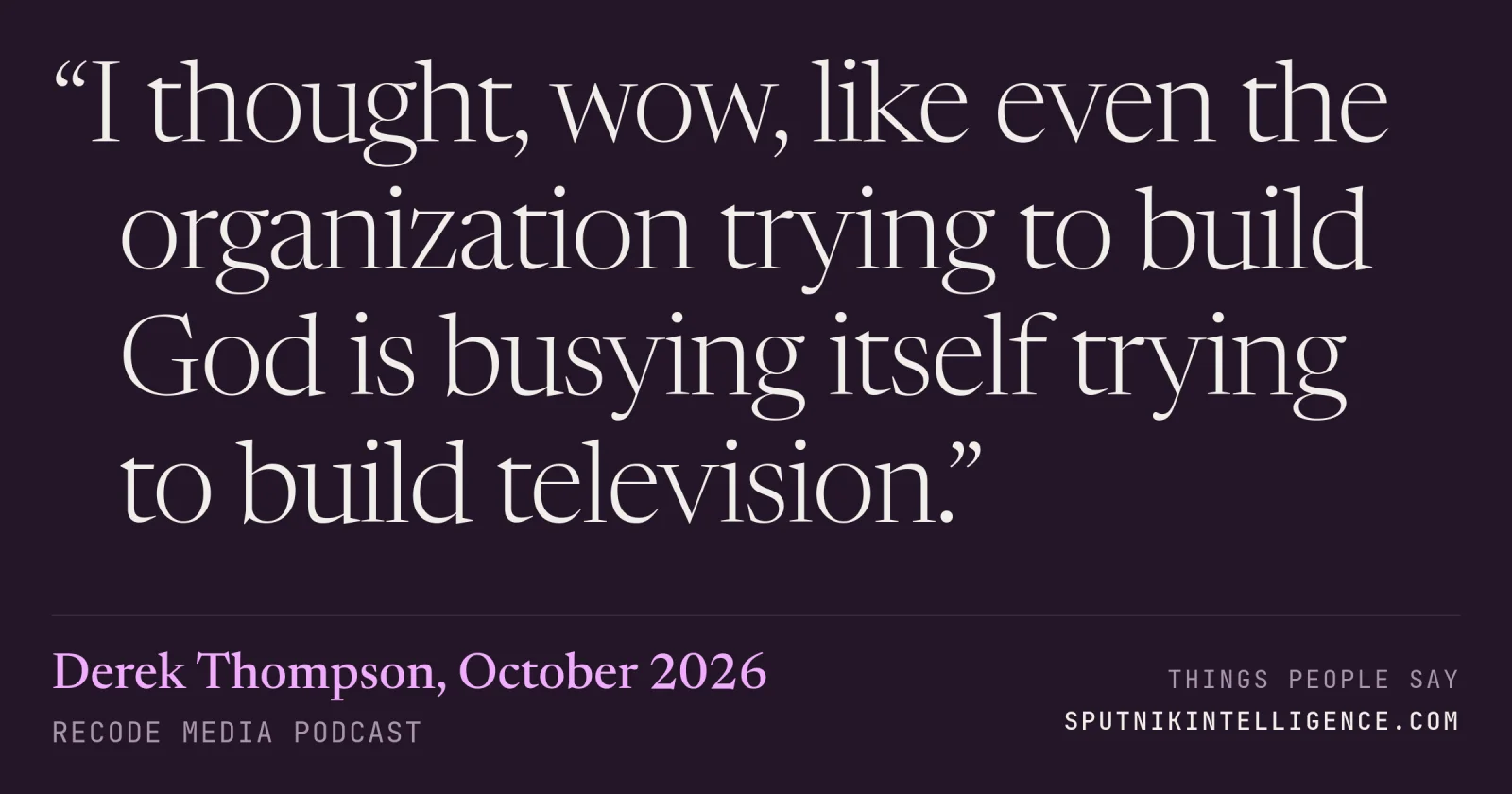
And then I think, I think it was OpenAI was like trying to launch, was it like Sora? It ended up not being much of anything. But then I thought, wow, like even the organization trying to build God is busying itself trying to build television. You know, sometimes I don't get it right. I read a lot of things where I look back a year later and I'm like, Jesus Christ, I hope the internet burns down and no one ever finds that article. I think I basically got this right, but I am open to the idea. If someone had a really, really good counterpoint, I'd be interested to hear it. This is
Speaker 1
not a counterpoint, but it's a question. You sort of describe this as sort of like, this is the inexorable way that things evolve, the way you were just describing it. But you were also just saying, literally, one of the reasons I started becoming a video podcaster is my employer slash business…
Speaker 2
My theory is that it's corporate incentives because it's what people want. Companies have attempted pivoting to video infinity times, and you understand the history of pivot to video better than I do. But certainly the fact that some pivots to video became a joke, like a literal laugh line in news…
Speaker 1
mesmerized. Give me more.
Speaker names come from our own diarization. The position is estimated from where the line sits in the episode.
The host asked the Abundance co-author whether his build-more argument means people should drop their opposition to AI data centers. Thompson said no. He cited data showing data center construction rising while construction of hospitals, offices and housing falls, and said he takes AI safety concerns seriously.
…century, because it's about how we spend our time and about the economy that animates our downtime, that touches everything from film and television to music and social media. And so I find sort of cheat codes to get into all sorts of subjects by just saying, I'm interested in American time use.
Speaker 1
…that people should get over their hatred of data centers and their concerns. And this is obviously better for us if we build more of these and shut up and move on. In the same way, you would say that maybe about people who don't want low-income housing built around them or something like that.
Speaker 2
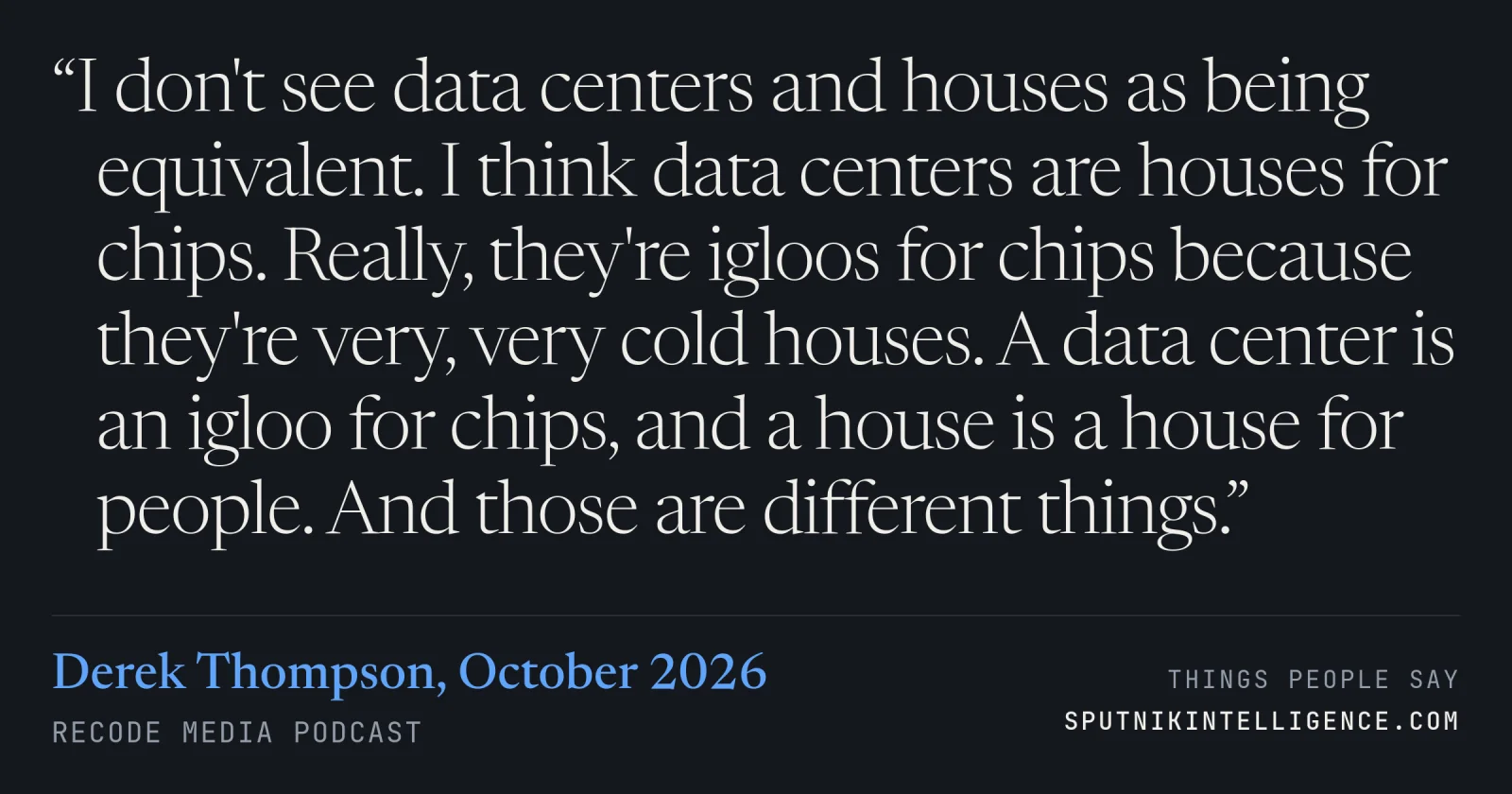
Right. I don't see data centers and houses as being equivalent. I think data centers are houses for chips. Really, they're igloos for chips because they're very, very cold houses. A data center is an igloo for chips, and a house is a house for people. And those are different things. And so while I feel incredibly passionate about removing barriers to building housing where people want to live, I would say I feel less passionate about saying we need to make sure that every AI company can cite every data center wherever it wants to build it. I think that there are costs to an economic infrastructure project that leans so heavily into data centers that, in fact, it now seems…
Speaker 1
It's funny because on the one hand, our tech overlords seem to be surprised about the blowback against data centers. And that's why they're like, well, it must be a Chinese PSYOP or something. On the other hand, as much protest and angry council meetings as you've seen, these things are getting…
Speaker 2
Yeah, the issue is the lesson to take is be literally the richest country in the history, richest company in the history of capitalism, and then you can build basically as much as you want to build. I mean, a really important moment in terms of understanding why the AI infrastructure project is…
Speaker 1
And I'm going to be able to just write checks to people as Meta is essentially doing in Louisiana, where teachers are going to get $50,000 bonuses. I'll be right back with Derek Thompson, but first this. At T-Mobile, the new iPhone 18 Pro is here with a big leap in battery life, and you can get it…
Speaker names come from our own diarization. The position is estimated from where the line sits in the episode.
Thompson notes that American scientists spend an average of 30 to 40% of their time on grant paperwork. He made the point while he and Josh Harder were discussing prior authorization in healthcare and the case for cutting bureaucracy that eats professionals' time.
Plain English with Derek ThompsonAround 35:56 into the episode
Derek Thompson
…that we have to talk about a subject as electrifying as prior off? And you said, yes, Derek Thompson what we're going to talk about. So the floor is yours. Tell me everything and start simple. What is prior authorization? Why does it matter? Why isn't it working? What's the plan to make it better?
Josh Harder
…somebody who's known for pushing the boundaries a little bit more, then that should actually go for scrutiny. But we can create some real gains here and lower the cost to our healthcare system. At the same time, we're actually getting patients what they need much faster than they're getting today.
Derek Thompson
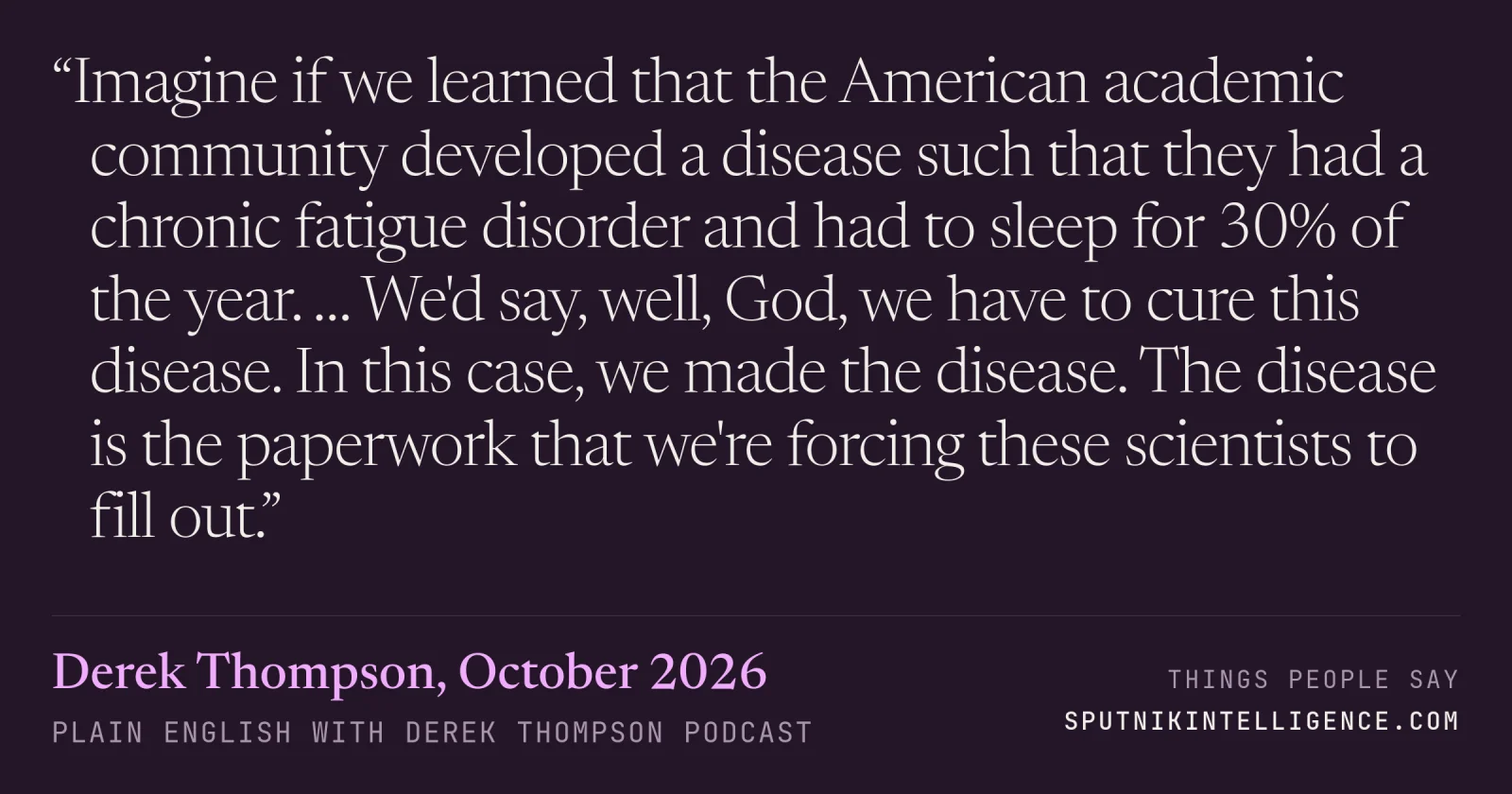
…out paperwork, which requires something much less than a genius mind. I think that the way that we put it is like, imagine if it became, if we learned that the American academic community developed a disease such that they had a chronic fatigue disorder and had to sleep for 30% of the year. They only really woke up into April or May of any given year. What would we say about our science system? We'd say, well, God, we have to cure this disease. In this case, we made the disease. The disease is the paperwork that we're forcing these scientists to fill out. So similarly, I am a huge fan of finding ways to reduce bureaucracy that is taking incredibly special professionals, doctors and scientists, giving them back their time so they can do major work, discover cures to diseases, and actually treat patients. I think it's a really lovely idea. There's another idea. Go ahead.
Josh Harder
The incredible part about that is not just that we're taking people who we've invested decades in their education, but that less than 10% of the grant application that they're spending so much of their time on is the actual science. The other 90% is the budget. It's about the facilities. It's…
Derek Thompson
I know you're also interested in funding research to discover alternative uses for cheap generic drugs that have already been approved. And this, I think, is a really clever idea. It's going to sound wonky, but there's real precedent for this. I believe during COVID, researchers realized that, was…
Josh Harder
Right. This is really a hole in our patent system and the way that we incentivize drug development across the United States. And you can think about it in terms of both all of the drugs that are off patent, right? I mean, we have like quite literally thousands and thousands of drugs that maybe they…
Speaker names come from our own diarization. The position is estimated from where the line sits in the episode.