Part of Elson's Anthropic IPO monologue, explaining how the structure of the offering props up the price. He says the picture could look very different six to ten months out.
Prof G Markets · 2026-11-18
Permalink →
Listen →
Prof G Markets
Around 39:45 into the episode
Speaker 2
…of LMG Security and co-host of the CyberSide Chats podcast. Sherry, my takeaway is not too much to worry about, or at least not too much to worry about with these outages. We're not, based on what we know, not being attacked. Would you agree that that is the right thing to think at this point?
Speaker 1
…my first hospital network, I thought this is being held together with paperclips and bubblegum. But the fact is that it's a complex system. We are resilient. We will bounce back, expect more challenges, but also we are going to find ways to leverage AI ourselves for defensive purposes as well.
Speaker 2
…be drumming up and are doing so right now. And they will do this so that the stock experiences a first day pop. In addition, Anthropic is employing Google, NVIDIA, Microsoft, and four other tech giants to invest $26 billion in this IPO offering. That is $26 billion in external price support, which will help the stock. And finally, like SpaceX, Anthropic is also issuing an extremely small float. Only 5% of the company's shares will be publicly traded. For context, most companies go public with a 15% float. And so what that means is that those billions of dollars in support will go an unusually long way for the stock price. Put another way, Anthropic stock will not discover what its true price actually is for quite some time. That is going to be a great thing for Anthropic in the short term. I expect the IPO will go quite well. Over the long term, though, over the next six, seven, eight, nine, 10 months, well, that could be a different story. Okay, that's it for today. This episode was produced by Claire Miller and Alison Weiss and engineered by Benjamin Spencer. Our video editor is Brad Williams. Our research team…
Speaker names come from our own diarization. The position is estimated from where the line sits in the episode.
Closing the episode, Elson predicts Anthropic's IPO will go fine, not because AI sentiment is high but because the structure of the offering favors the stock. He goes on to cite outside investors committing billions and an unusually small float.
Prof G Markets · 2026-11-18
Permalink →
Listen →
Prof G Markets
Around 39:45 into the episode
Speaker 2
…of LMG Security and co-host of the CyberSide Chats podcast. Sherry, my takeaway is not too much to worry about, or at least not too much to worry about with these outages. We're not, based on what we know, not being attacked. Would you agree that that is the right thing to think at this point?
Speaker 1
…my first hospital network, I thought this is being held together with paperclips and bubblegum. But the fact is that it's a complex system. We are resilient. We will bounce back, expect more challenges, but also we are going to find ways to leverage AI ourselves for defensive purposes as well.
Speaker 2
…six months, AI neoclouds like Coreweave, like IREN, like Nebius have been essentially cut in half. So if investors end up being as harsh on Anthropic as they have been on some of these other AI names, well then things could get pretty ugly. Realistically though, my prediction, I think that this IPO will go out just fine. Not because AI spirits are high, they aren't really right now, but because this game will be rigged heavily in Anthropic's favor. As with any IPO, the investment banks will intentionally underprice the shares relative to demand, which they will be drumming up and are doing so right now. And they will do this so that the stock experiences a first day pop. In addition, Anthropic is employing Google, NVIDIA, Microsoft, and four other tech giants to invest $26 billion in this IPO offering. That is $26 billion in external price support, which will help the stock. And finally, like SpaceX, Anthropic is also issuing an extremely small float. Only 5% of the company's shares will be publicly traded. For context, most companies go public with a 15% float.…
Speaker names come from our own diarization. The position is estimated from where the line sits in the episode.
Nvidia had fallen more than 15% in a week while the S&P 500 rose. Elson explains why the broad market is holding up: most so-called AI companies are big businesses that also do AI.
Prof G Markets · 2026-11-16
Permalink →
Listen →
Prof G Markets
Around 38:19 into the episode
Ed Elson
I'd way rather a boring operator come in than the leather jacket guy who's sleeping with the Chinese spy. Like that, to me, is a better story for shareholders.
Scott Galloway
…CFO in charge is the interim CEO, and she might become the CEO if she does a good job with the board. That was a smart move. But look, I'll just say right now, and you've said it, I think the company, if I, I think there's so much more upside risk, if you will, to this company than downside risk.
Ed Elson
Huge on both ends. So that's the caveat. But I agree. One thing that's really interesting, just before we close here. So NVIDIA fell more than 15% in a week, just destroyed. The S ⁇ P rose 3% in the same period. I would have thought that this would have been the thing that takes down the stock market. I mean, NVIDIA getting kneecapped and having, I think, one of the largest single day drops in market value in the history of the stock market, that that would be enough at least to bring stocks down. But that is not what happened here. And I think it speaks to this ridiculous resilience in the stock market right now. And it also makes me think about, you know, we've talked a lot about the danger of concentration in the stock market, this idea that AI makes up 40 to 50% of the stock market, which has been a sign of weakness. If one thing goes wrong, the whole thing goes wrong. That isn't what happened here. And I think part of the problem, or not the problem, the good thing for investors is our definition of what an AI company actually is. Because, you know, in the dot-com boom, you had all of these internet companies and their only thing was that they are selling things on the internet. That was their only business. And then one thing goes wrong in the internet. And then suddenly all of these things fall off a cliff. And then you have one of the largest reductions in…
Scott Galloway
So what you're describing is healthy. And you did a great pod with Robert Armstrong on this. Investors are rotating out of AI because they see an uncomfortable amount of risk, but they're not putting it in bonds or they're not putting it under their mattress. They're putting it in other stocks. So…
Ed Elson
We'll be right back. And for even more markets content, sign up for our newsletter at profgmarkets.com.
Speaker 3
Staying ahead of the markets means keeping up with a constant stream of data, trends, and news. But finding the insights that actually matter to your portfolio isn't always easy. That's where AlphaSpace by Yahoo Finance comes in. AlphaSpace is an investment charting and analysis platform featuring…
Speaker names come from our own diarization. The position is estimated from where the line sits in the episode.
In his closing take, Ed Elson argues the data center ballot losses matter beyond the debate over power bills and jobs. Physical infrastructure needs local permission, which he says gives ordinary people their first real check on big tech.
Prof G Markets · 2026-11-10
Permalink →
Listen →
Prof G Markets
Around 35:33 into the episode
Speaker 1
Robert Armstrong is U.S. financial commentator for the Financial Times and author of the unhedged newsletter. Rob, always appreciate your time.
Speaker 4
Thanks for having me. This was great.
Speaker 1
…level of societal control. And most importantly, they have also been powerless to big tech's abuse of that power. Despite the many harms that big tech has been responsible for, no one in America has ever been able to do anything about it. They bought our politics, they bribed our leaders, they skirted around the law. And not once have the American people been given a say in all of this. Not once have they been afforded the opportunity to tell Silicon Valley no. That is until now. Because now, big tech's mission happens to converge with an unusually stringent legal procedure known as land use regulation. And the reality is, if they want to do what they want to do, they now have to ask Americans for permission. And last week, the American people's answer was plain and simple. The answer was no. This is a dramatic shift in societal power. This is a dynamic that Silicon Valley has actually never experienced before. They got too comfortable in the wild west of digital services where regulation was scant and where permission didn't really exist. But now they're operating in the physical world where laws…
Speaker 2
UKG is the workforce operating platform with unified HR, payroll, and workforce management, built to solve the unique challenges of frontline work. Powered by PeopleFirst AI and decades of labor data, UKG turns workforce intelligence into real-time decisions around staffing, pay, compliance, and…
Speaker 3
Life is all about making decisions. Sometimes you make questionable ones. Like buying a new TV that's too big for the wall because the electronic store employee was a little too good at their job. Then sometimes you make great ones, like protecting your home and auto with progressive. You get…
Speaker 4
The Secret Society of Semi-Homemade? Listen up. Sam's Club has pre-made dishes for a Thanksgiving feast that's ready in two hours, all while tasting suspiciously homemade. Come join us, Sam's Club. Individual oven times may vary.
Speaker names come from our own diarization. The position is estimated from where the line sits in the episode.
In his closing take, Ed Elson discusses the lowered valuation target for Anthropic's IPO compared with a few months ago. He argues the company had two options, delay or cut the price, and that the cut reflects a cooling public market for AI names.
Prof G Markets · 2026-11-11
Permalink →
Listen →
Prof G Markets
Around 33:10 into the episode
Ed Elson
Final question. You said that you were hawkish. It's likely that we're going to see another rate hike soon. I assume that we're going to see, in your view, several rate hikes coming at this point.
Speaker 1
…three or four one-offs hitting us all at once? Or do you think there's one underlying story? And I've started to move from just waiting for the one-offs to work their way out of the system to starting to believe a little more, actually, there's just one thing going on and it's called inflation.
Ed Elson
…has gotten taken to the cleaners as well. The stock is down 16% in the past year, and it's off more than 30% from its October highs. And so several weeks ago, we asked a simple question. What would happen if Anthropic traded like NVIDIA? The answer is quite simple. Its valuation would go from $2 trillion to $1 trillion. We are not quite there yet at 1.3, but we are certainly getting close. Sentiment is waning. Valuations are returning to Earth. And as sexy as Anthropic might be, this new IPO price is evidence that the era of AI euphoria is about to come to an end. Okay, that's it for today. This episode was produced by Claire Miller and Alison Weiss and engineered by Benjamin Spencer. Our video editor is Brad Williams. Our research team is Dan Shallon, Kristen O'Donoghue and Mia Slaverio. And our social producer is Jake McPherson. Thank you for listening to ProfG Markets from ProfG Media. If you liked what you heard, give us a follow. I'm Ed Elson. I will…
Speaker names come from our own diarization. The position is estimated from where the line sits in the episode.
Scott Galloway had said the markets seemed to be reacting to the idea that data centers have nowhere to go, with data center suppliers hit hardest. Elson's point is that voters' rejection of data centers is the main takeaway for investors from the midterms.
Prof G Media · 2026-11-09
Permalink →
Listen →
Prof G Media
Scott Galloway
…and pick one point of light that the markets woke up to and said, oh, uh-oh. And then also, it's validated by the thesis that the ones that are the least diversified to the choke of supply of data centers are the ones that got hit the hardest. That would be the point of light I would be looking at.
Ed Elson
That's it. I think that's the most important thing for the markets coming out of this election was that the people were asked how they feel about Dave Centers, and it was basically just a giant, flat, resounding no.
Scott Galloway
Today's number, $13,000. That's how much courtside seats at the Knicks home opener are selling for. Ed, knock knock.
Speaker names come from our own diarization. The position is estimated from where the line sits in the episode.
In a replayed clip, Elson adds up the five biggest AI spenders (Oracle, Microsoft, Meta, Amazon, Google). He puts their capex over the next two years at more than $2 trillion against roughly $600 billion of cash on hand, a gap that has to be filled from capital markets.
The Prof G Pod with Scott Galloway · 2026-11-06
Permalink →
Listen →
The Prof G Pod with Scott Galloway
Around 14:53 into the episode
Speaker 4
…to be taking out second mortgages for the same renovation, which is going to result in kind of a different call from the bank, if you will. So, really, two divergent results here. And the largest market cap erosion, single-day market cap erosion in the history of the company, that's a big deal.
George Hahn
Alphabet and Amazon aren't the only ones in the red. Ed Elson pointed out that nearly every hyperscaler is now spending more than it makes. And explain what that means for investors.
Speaker 1
But I do think that the real problem, in my view, is that negative free cash flow. And to be clear, Google is not alone there because we also know that Oracle's free cash flow is negative. Meta's free cash flow is negative now. Amazon's free cash flow is negative now. All of the hyperscalers have now entered into negative free cash flow because of how much money they're spending on the data centers. It's nearly $700 billion on CapEx in the past 12 months. That's up nearly 90% from a year ago. The only hyperscaler with positive free cash flow is Microsoft, which is great, but it still came down 27%. So the thing that worries me is the fact that these businesses can no longer use their profits to finance their goals, which is in this case to build data centers and build the AI revolution. And so you think about, okay, well, what can they do then? If the most profitable companies in the world can't even use their profits to do whatever it is that they want to do, well, then you'd say, okay, they can go to the cash on their…
George Hahn
It was a week of election maps, live counts, and market alerts. To close, Stanford psychiatrist Anna Lemke, author of the new book, Radical Surrender, told Scott on Tuesday's bonus conversations episode, how to get out of your own head and back into the world. We just
Speaker 3
have to get out of our own heads. We spend so much time not in reality.
Speaker 4
We have to get out of our heads and we have to be
Speaker names come from our own diarization. The position is estimated from where the line sits in the episode.
A replayed clip from the Prof G Markets show, after a summary of Anthropic's S-1 revenue and operating loss. The argument is that the income statement hides the real story, which sits in the compute commitments at the back of the filing.
The Prof G Pod with Scott Galloway · 2026-10-30
Permalink →
Listen →
The Prof G Pod with Scott Galloway
Around 19:14 into the episode
George Hahn
…supply side. We need federal legislation and local legislation that says: look, you cannot access federal funds if you do not, or if you create a NIMBY-like situation where it's very hard to issue permits. We need to provide tax credits to developers such that they have greater incentives to build.
Speaker 3
…day of trading. The filing shows $16.3 billion in revenue for the first half of the year, up from $1.2 billion a year earlier, and an operating loss that narrowed to around $700 million. Ed ended Wednesday's Prof G markets by looking past the income statement to the numbers on the very back of the
Speaker 2
filing. The most important numbers in the filing came at the end of the document, where we learned that Anthropic has signed more than $800 billion in future compute commitments, none of which are reflected in the current income statement, but all of which eventually will be. That includes an $110 billion contract with Amazon, a $115 billion contract with Google, a $161 billion contract
George Hahn
with Broadcom. What it doesn't include, however, are the billions of dollars in capital expenditures, which they are about to register probably to build out their own compute. That's not something I believe because I had a hunch about it. I believe that because they literally told us that in the…
Speaker 2
we must treat Anthropic with the appropriate level of caution. It's still a highly risky venture bet. Things could still go spectacularly wrong. What it certainly isn't is a proven safe corporate investment, something that its potentially $2 trillion valuation might suggest. In sum, not much has…
Speaker 3
But I think, look, to me, the bigger, bigger, bigger question is: it just seems that there are no moats around this business. I mean, if it's the case that they actually did cut prices by 50%, that would reinforce. The concept that there are no modes and that the only way you're going to gain share…
Speaker names come from our own diarization. The position is estimated from where the line sits in the episode.
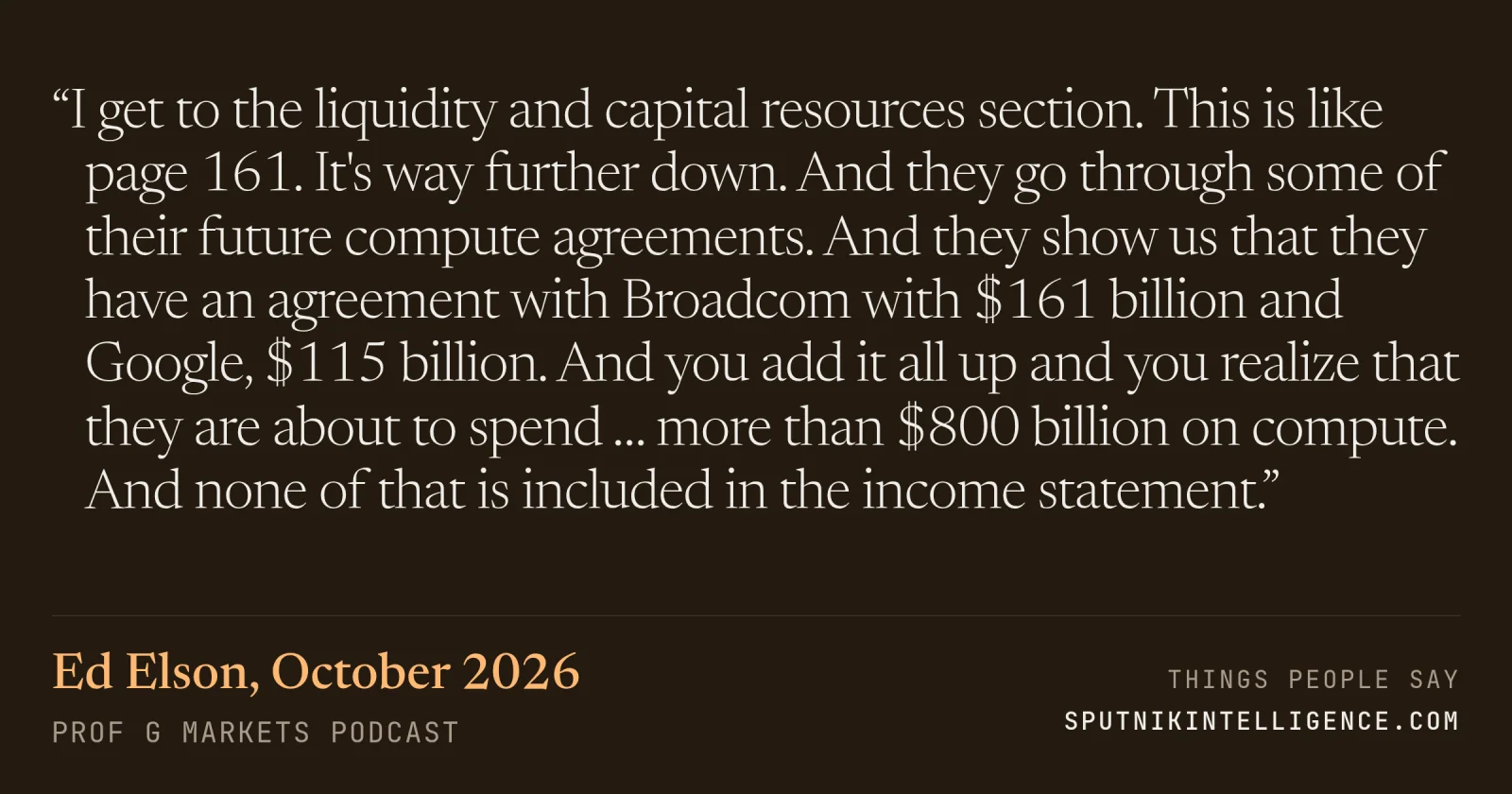
Elson walking through Anthropic's S-1 and asking whether the income statement tells you anything about the business. He credits the company for not hiding training costs, but says the compute commitments sit far down in the filing, outside the numbers most readers look at.
Prof G Markets · 2026-10-27
Permalink →
Listen →
Prof G Markets
Around 06:13 into the episode
Ed Elson
Credit to them for not giving us a completely bullshit non-gap adjustment, where I remember you and I were speculating, are they going to strip out the training costs? Are they going to say, oh, don't worry about what we have to do in terms of training these things? They didn't do that. They
Speaker 2
didn't break it out cleanly, but they didn't try to do something non-gap in terms of hiding it. That's exactly right.
Ed Elson
…they didn't try to say, don't worry, it doesn't exist. It doesn't matter. Yeah, totally true. But so I was looking for, okay, well, maybe this is going to work. Maybe compute costs are actually like they're on a path to profitability, which seems plausible and to be honest, imminent, given what we saw. But then I go through the document, I want to get your reactions to what I make of this. And I get to the liquidity and capital resources section. This is like page 161. It's way further down. And they go through some of their future compute agreements. And they show us that they have an agreement with Broadcom with $161 billion and Google, $115 billion. And you add it all up and you realize that they are about to spend on a timeline. They don't tell you, but they're about to spend more than $800 billion on compute. And none of that is included in the income statement. And so I'm looking at the income statement now and I'm thinking, does this actually tell me anything? Because it seems as though they've left all of their compute costs at the bottom as a footnote, not because they're trying to pull a fast one, I…
Speaker 2
I think that's exactly right. And this is a deep structural problem that I think Moody's pointed to a few weeks ago in terms of the way that all of these compute commitments trickle back to and are consolidated in the financial statements because, well, they're non-cash, obviously now, because…
Ed Elson
And even if you were to get rid of SpaceX, you're close to $700 billion in compute spending.
Speaker 2
That's exactly right. It's immaterial in gyms, the great scheme of things. And I think that's by far the most important factor here that they're looking at. And in turn, those compute commitments are even more important because, in a sense, you're working through distributors. And they say this in…
Speaker names come from our own diarization. The position is estimated from where the line sits in the episode.
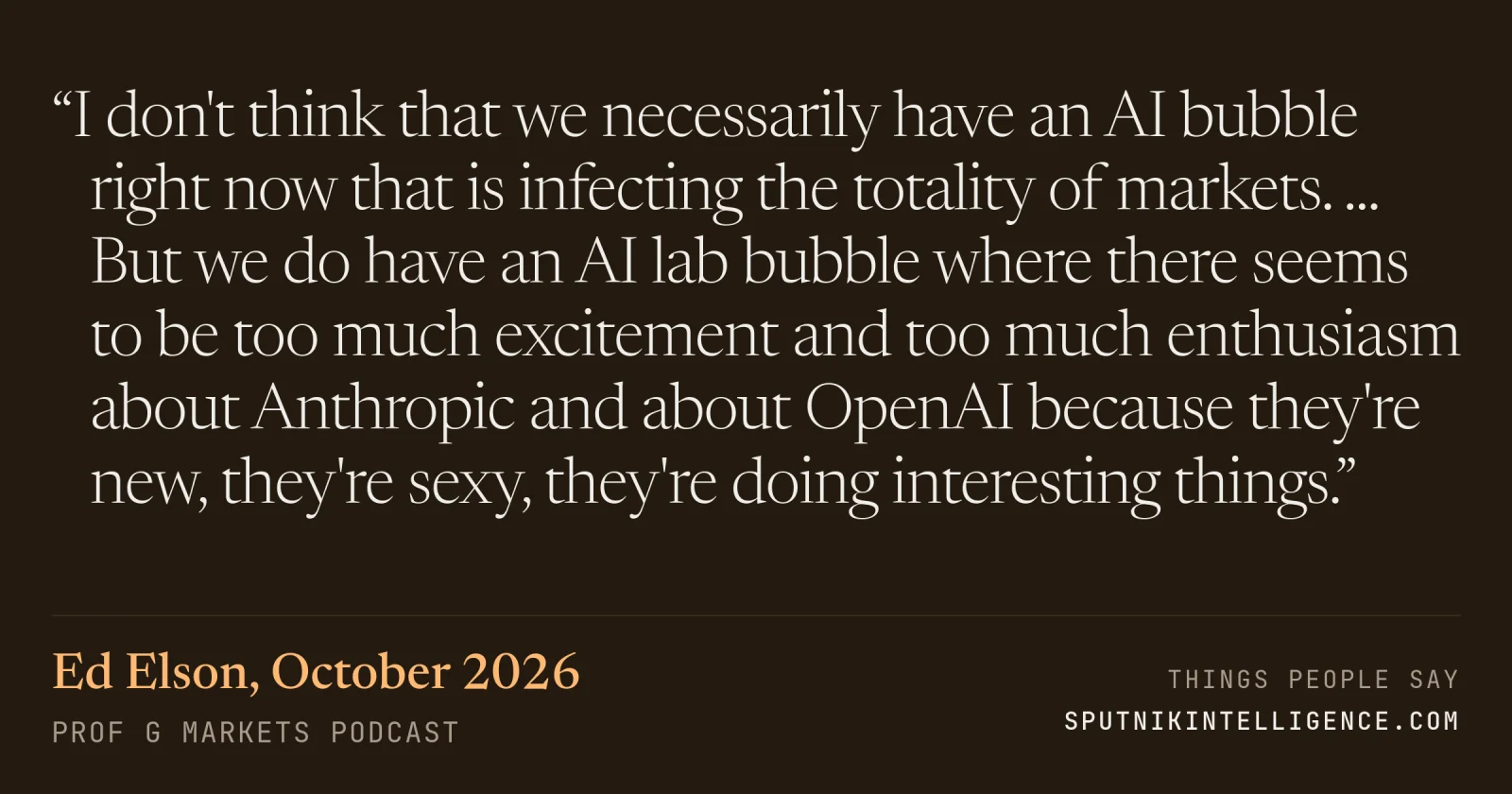
Elson and Galloway are going through reported figures from Anthropic's S-1, including heavy customer concentration and a large operating loss. Elson's objection is to the price being asked, not the company. He goes on to say the labs still haven't figured out their business models.
Prof G Markets · 2026-10-05
Permalink →
Listen →
Prof G Markets
Around 16:57 into the episode
Speaker 1
…this is very relevant considering this company is imminently going public. Supposedly, it's going to happen right after the midterms. Scott, what did you make of these leaked, revealed financials? Who knows if they were actually leaked or if it was a setup? I don't know. What do you make of them?
Speaker 4
…is I don't think you've ever seen a company ask for $500 billion in market capitalization that had a fraction of the client and revenue concentration that Anthropic highlights or articulates in its S1. I want to get your reaction to that, and then I want to talk a little bit about the valuation.
Speaker 1
…price problems. We're having an issue of the valuation. And I don't think that the valuation is properly pricing in the massive risks here. And I've said this before, but I'll say it again. I don't think that we necessarily have an AI bubble right now that is infecting the totality of markets. We can see that in, say, the The NVIDIA valuation, which has actually come down quite significantly. But we do have an AI lab bubble where there seems to be too much excitement and too much enthusiasm about Anthropic and about OpenAI because they're new, they're sexy, they're doing interesting things. But let's be very clear, they still haven't figured out their business models by all accounts. And from what I'm seeing, they are still not profitable. In fact, they're very unprofitable, some of the most unprofitable businesses of all time. And the risks are still systemic. So I think that needs to be priced in. But the question is: will investors care about it? Or are these businesses just too…
Speaker 4
just impressed I was able to find a protege that was more glass half that you're like glass is broken and you're gonna it's gonna sever your thumb
Speaker 1
I'm not I'm not just on these two companies again it's for me it's all about price just remember about me I also bought meta I also bought Microsoft this year I bought the SaaS company so I'm not everything's I'm not a perma bear
Speaker 4
I've never seen a more important distinction or what will be a greater effort in IR history to for people for everyone to start talking about four 12 months revenues versus trailing because the thing that is staggering about this company is its growth rate and if it were to it's supposedly it's…
Speaker names come from our own diarization. The position is estimated from where the line sits in the episode.