 Ed Elson
Co-Host of Prof G Markets and author of Simply Put.
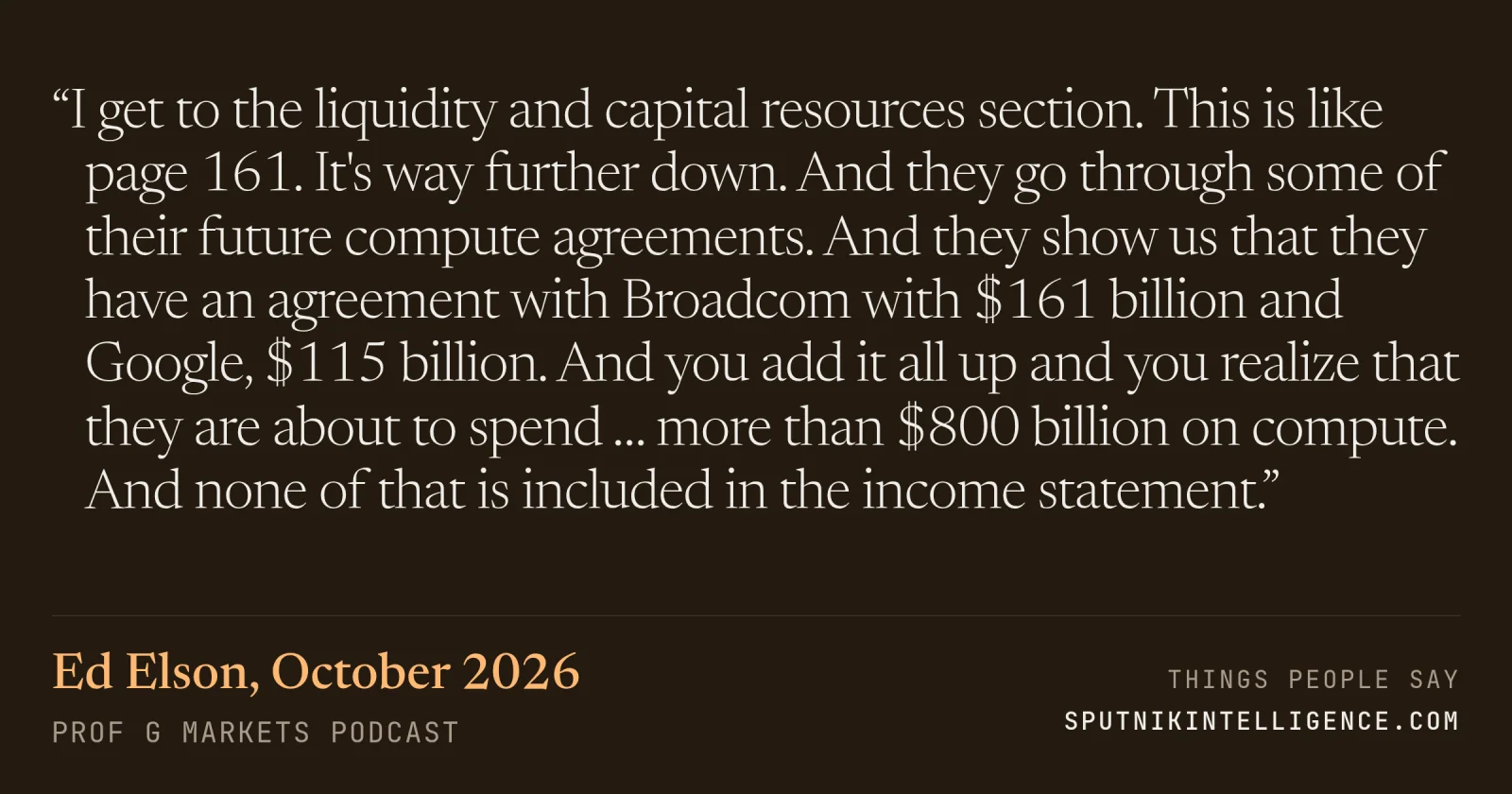
“I get to the liquidity and capital resources section. This is like page 161. It's way further down. And they go through some of their future compute agreements. And they show us that they have an agreement with Broadcom with $161 billion and Google, $115 billion. And you add it all up and you realize that they are about to spend … more than $800 billion on compute. And none of that is included in the income statement.”
Prof G Markets · Money & Markets · October 2026
Context
Elson walking through Anthropic's S-1 and asking whether the income statement tells you anything about the business. He credits the company for not hiding training costs, but says the compute commitments sit far down in the filing, outside the numbers most readers look at.
Transcript
Credit to them for not giving us a completely bullshit non-gap adjustment, where I remember you and I were speculating, are they going to strip out the training costs? Are they going to say, oh, don't worry about what we have to do in terms of training these things? They didn't do that. They
didn't break it out cleanly, but they didn't try to do something non-gap in terms of hiding it. That's exactly right.
…they didn't try to say, don't worry, it doesn't exist. It doesn't matter. Yeah, totally true. But so I was looking for, okay, well, maybe this is going to work. Maybe compute costs are actually like they're on a path to profitability, which seems plausible and to be honest, imminent, given what we saw. But then I go through the document, I want to get your reactions to what I make of this. And I get to the liquidity and capital resources section. This is like page 161. It's way further down. And they go through some of their future compute agreements. And they show us that they have an agreement with Broadcom with $161 billion and Google, $115 billion. And you add it all up and you realize that they are about to spend on a timeline. They don't tell you, but they're about to spend more than $800 billion on compute. And none of that is included in the income statement. And so I'm looking at the income statement now and I'm thinking, does this actually tell me anything? Because it seems as though they've left all of their compute costs at the bottom as a footnote, not because they're trying to pull a fast one, I…
I think that's exactly right. And this is a deep structural problem that I think Moody's pointed to a few weeks ago in terms of the way that all of these compute commitments trickle back to and are consolidated in the financial statements because, well, they're non-cash, obviously now, because…
And even if you were to get rid of SpaceX, you're close to $700 billion in compute spending.
That's exactly right. It's immaterial in gyms, the great scheme of things. And I think that's by far the most important factor here that they're looking at. And in turn, those compute commitments are even more important because, in a sense, you're working through distributors. And they say this in…
More from Prof G Markets