Hoffman, a business editor who covered banks after 2008, answering whether Nvidia has become too big to fail. Ed Elson had laid out Nvidia's stakes in hundreds of AI companies and its guarantees on more than $100 billion of data center leases.
If money is evil, then that building is hell. Show those up!
…NVIDIA owns in the $50 billion worth of those private companies that it owns, as well as all of its stock in public companies. And you brought up this question, is it too big to fail at this point? Talk a little bit more about why you're asking that question and why it's relevant to the AI boom.
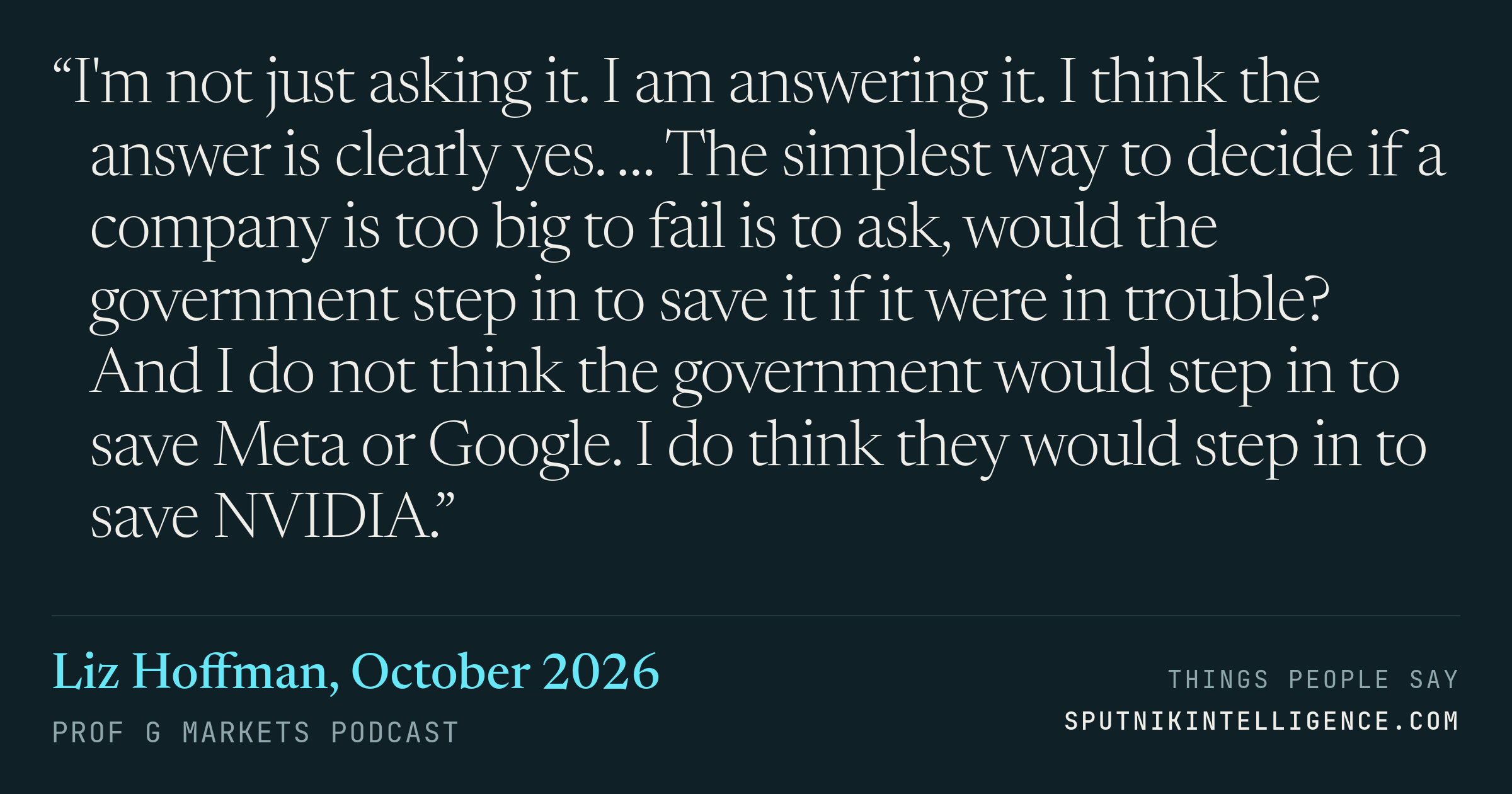
I'm not just asking it. I am answering it. I think the answer is clearly yes. You know, you went through all the numbers there, and we can poke at each of them and why they are both enormous and probably bigger, sort of emotionally, than they even look on paper. But to me, the simplest way to decide if a company is too big to fail is to ask, would the government step in to save it if it were in trouble? And I do not think the government would step in to save Meta or Google. I do think they would step in to save NVIDIA and with some pretty good reasons. So, look, I covered banks after the 2008 crisis when they were going through that reckoning. And it looks a lot like the big banks to me. It is just too important and it's in too many places doing too many things to be allowed to fail.
Do you think that that is part of the strategy to become entrenched, so entrenched in the system to invest in so many companies, become so systemic that you become? Almost impenetrable. I mean, it seems like that might have been part of the banking strategy themselves.
There is a lot of that going around, particularly with the way that the AI companies were talking about, please slow us down, right? That there is a dark underbelly of that is we need some implicit government backstop. And the way they do that is to kind of pull the moat up behind us. And I've…
Yeah, you described the company as an AI roll-up machine, just pointing out how many investments they have made. What do you make of that strategy? I mean, they are, of course, producing the GPUs, designing the GPUs, but it is pretty remarkable how they've become something of an investment firm.…