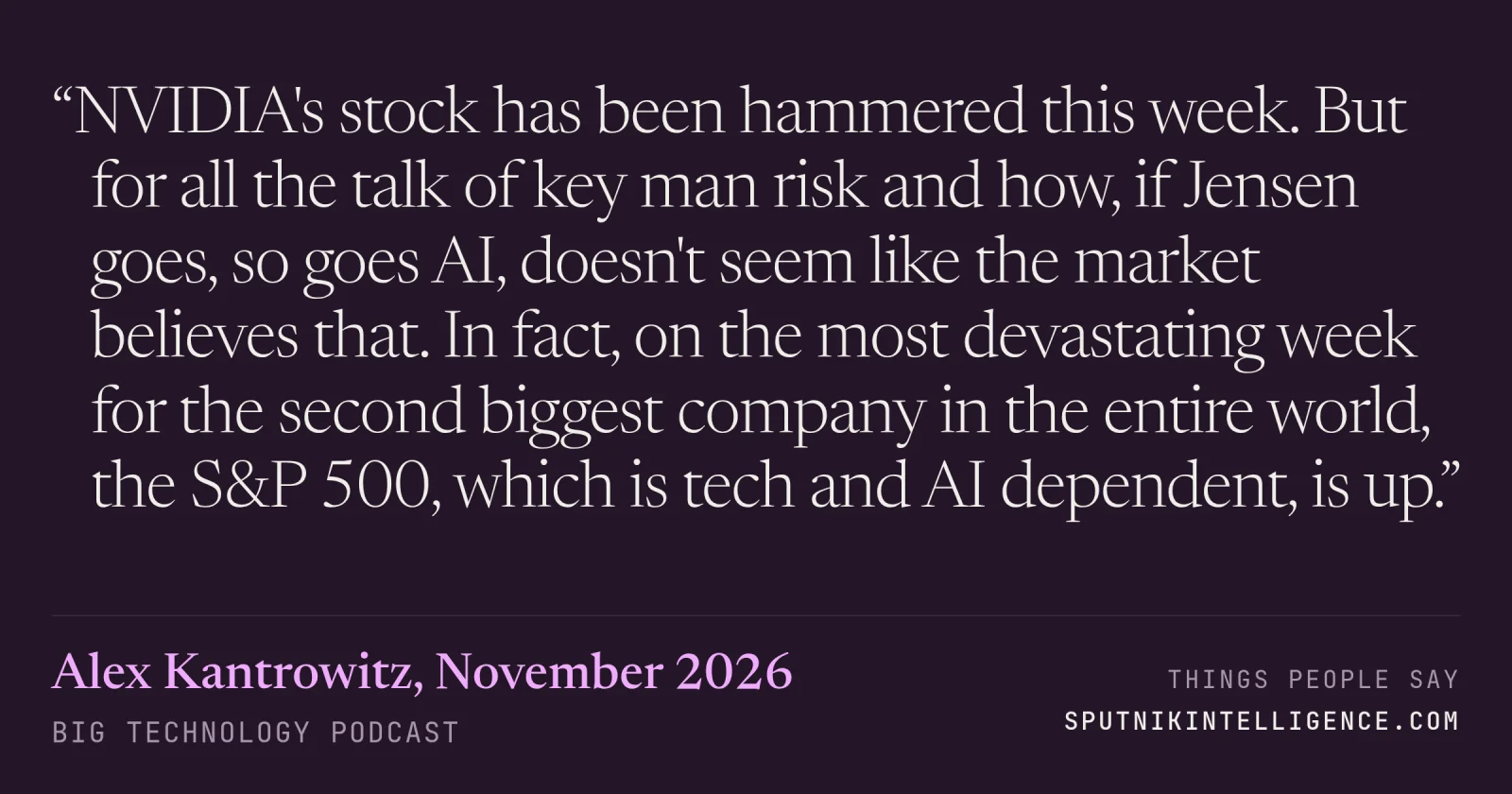
Ranjan had said Jensen's departure starts a volatile stretch for the AI trade. Alex takes the other side to close the show, pointing out that the broader market rose in the same week Nvidia fell.
Big Technology · 2026-11-14
Permalink →
Listen →
Big Technology
Around 56:22 into the episode
Alex Kantrowitz
All right. Before we go, just going back to the question I asked at the beginning, now that we've talked this through, how surprised actually are you? Because it seemed like you weren't very surprised. And where do you think this story goes from here?
Ranjan Roy
…you and I, you said it well, like China is now a genuine threat. It's one of the few issues that people are actually bipartisan on. AI itself has not done itself any favors, and this isn't helping in terms of its own branding. So, like, I think this is the beginning of a volatile number of months.
Alex Kantrowitz
Okay, and I will take the other side just to end it from my perspective. Very interesting stat. NVIDIA's stock has been hammered this week. But for all the talk of key man risk and how, if Jensen goes, so goes AI, doesn't seem like the market believes that. In fact, on the most devastating week for the second biggest company in the entire world, the SP 500, which is tech and AI dependent, is up.
Ranjan Roy
What can you say? Look, I mean, this is that's what I'm saying. Like, I will never give it, I can't give a timeline, but to me, the market has not digested this with any significance. And I think the Anthropics IPO will probably give a nice short-term boost as well. But this just fundamentally…
Alex Kantrowitz
Okay, well, obviously, this won't be our last discussion on this. We also have the Anthropic IPO coming up next week. You and I will obviously talk about it next Friday, going over what happened as Anthropic hit the public markets. And for our listeners and viewers, we have a big week coming up. We…
Ranjan Roy
Official title. It's putting it on LinkedIn.
Speaker names come from our own diarization. The position is estimated from where the line sits in the episode.
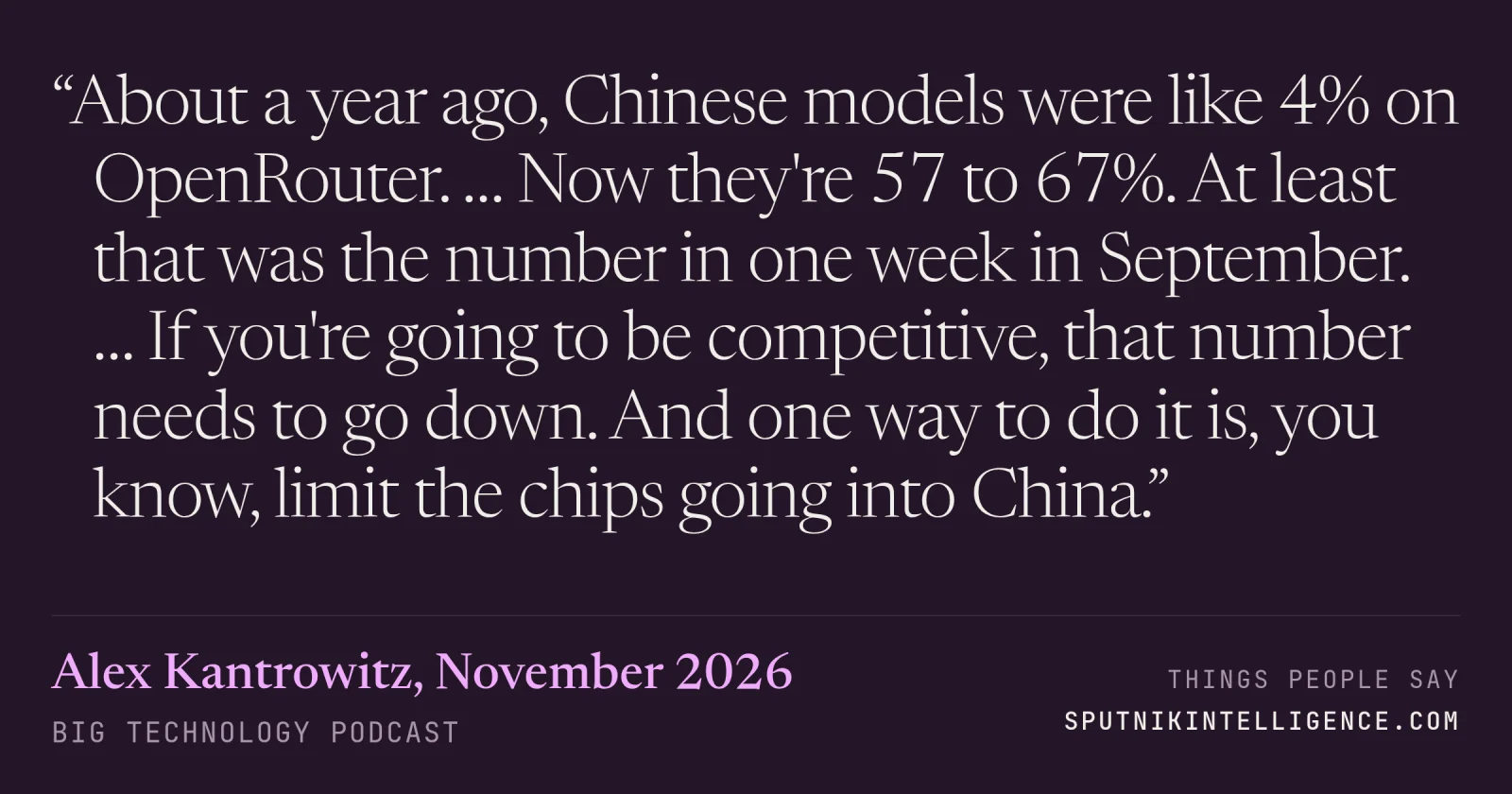
Ranjan had asked whether a weaker Nvidia concentrates power in OpenAI and Anthropic. Alex answers with the share of OpenRouter usage going to Chinese models, and says restricting chips to China would help US labs compete.
Big Technology · 2026-11-14
Permalink →
Listen →
Big Technology
Around 43:51 into the episode
Alex Kantrowitz
minutes in, so I feel like it's a fine time to
Ranjan Roy
…end up closing is going to be interesting because it doesn't actually close till the spring. But like the other, the proponents of open source within the U.S. as competitors to the two biggest labs, I think it's going to, that is actually going to be really interesting to see the way it plays out.
Alex Kantrowitz
Yeah, think about this stat. I have this in the story. You know, about a year ago, Chinese models were like 4% on open router. Although who knows how much open router was actually being used, but their competency has grown a lot, right? Now they're 57 to 67%. At least that was the number in one week in September. Take everything else aside. If you think about the empowerment of or the competitiveness of OpenAI and Anthropic, if you're going to be competitive, that number needs to go down. And one way to do it is, you know, limit the chips going into China. And there's a secondary benefit, which is that if the chips don't go to China, they go to you, assuming you want them, right? And then we're really going to see the true demand of GPUs here. But that should be, you know, if you're Dario, who has clashed with Jensen, or if you're Sam, you could look at it as a blessing that he's out.
Ranjan Roy
I think they do. I think they certainly. Well, and Sam, again, in the middle of the year. They were allied with NVIDIA for sure. No, no, I mean, as a $105 billion backstop, there was supposed to be $300 billion. And that apparently in that Colette Cress article that she had pushed back against, and…
Alex Kantrowitz
IPO. An Anthropic's
Ranjan Roy
IPO. I mean, they almost have to for themselves, which is a reminder of the circular nature of all this. But I do think that this is unquestionably good for Anthropic and OpenAI. I think, unless the whole thing comes crumbling down and then it's not. But at least in a purely tactical sense, it is…
Speaker names come from our own diarization. The position is estimated from where the line sits in the episode.
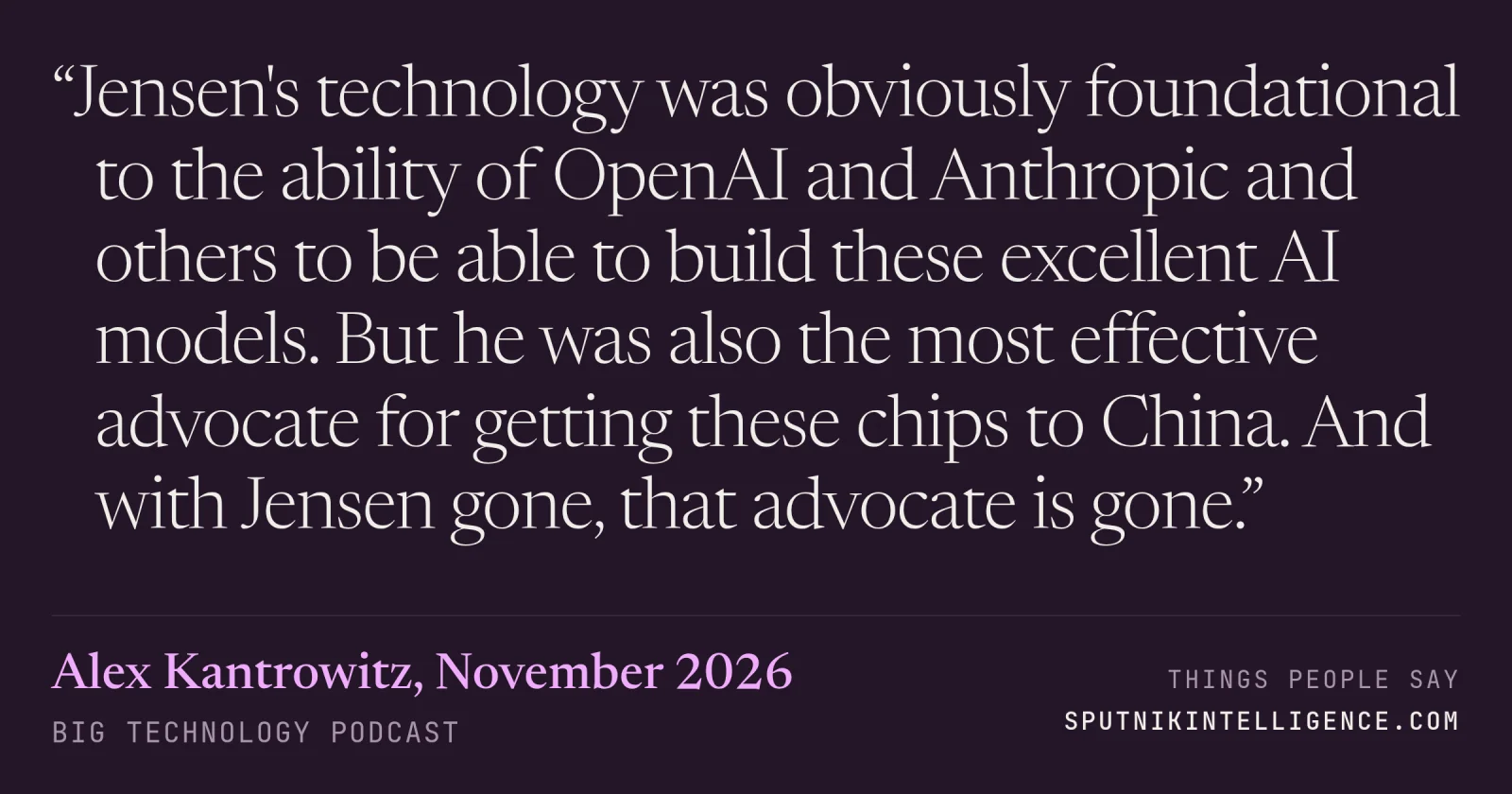
Alex is summarising his New York Times opinion piece arguing Jensen Huang's exit is good news. His case is that US labs gain because Chinese AI labs lose their most effective lobbyist for chip access.
Big Technology · 2026-11-14
Permalink →
Listen →
Big Technology
Around 40:43 into the episode
Alex Kantrowitz
…going to give you an ability to make a real impact on a product you care about and a company that is that is ascendant. Do you want to join? Why don't you just come have lunch with us and then you decide whether you want to be a part of this? And if you want to go back to NVIDIA, sure, no problem.
Ranjan Roy
…I think, probably will be real. Though, I think there was a petition of like 1,600 people who had signed saying like to reinstate Jensen within the company. And you can imagine there's a lot of very loyal people. But once they get to Cantor's recruiting pitch, it will be hard for them to say no.
Alex Kantrowitz
…then you could see greater competition. And I already think it was heading that way because of the advances in AI software and now even more. And then the question is: all right, well, what is it going to mean for the U.S. AI labs? I have an opinion piece in the New York Times today about the impact. And the headline is: Jensen Huang is gone, good. And basically, the argument that I make is that Jensen's technology was obviously foundational to the ability of OpenAI and Anthropic and others to be able to build these excellent AI models. But he was also the most effective advocate for getting these chips to China. And with Jensen gone, that advocate is gone. And the Chinese labs that were breathing down the neck of American AI are going to have much more trouble keeping up than they would have with Jensen in place. So whereas some are like, this is the end of American AI or a big problem for them, I would say there's a good chance that they end up seeing this as a blessing because when you think about what's made the AI within China so good, it's…
Ranjan Roy
You didn't tell me you had an opinion piece in the New York Times today. That's quite flex here, dropping your own article into our prep doc and leaving. Thank you, sir. We're 50
Alex Kantrowitz
minutes in, so I feel like it's a fine time to
Ranjan Roy
think that, okay, this question of is it good because the allocation of chips, the allocation of money. I mean, I've been speaking with people who have been talking about like rotating out of NVIDIA into Anthropic. So does this, what does this mean for, especially, I feel OpenAI was definitely more…
Speaker names come from our own diarization. The position is estimated from where the line sits in the episode.
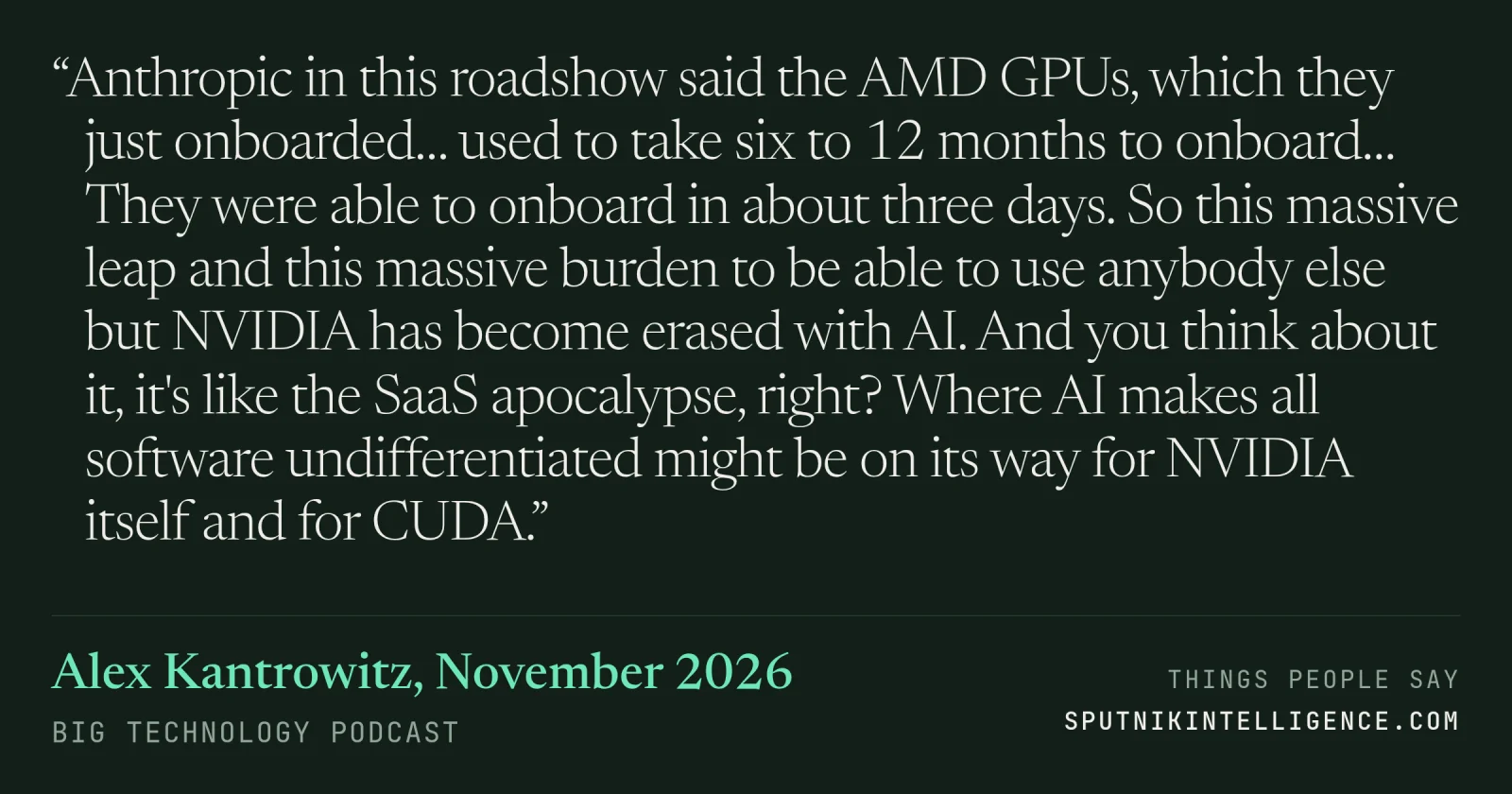
Alex is arguing that competition was already a bigger threat to Nvidia than the scandal. He cites a claim from Anthropic's IPO roadshow about how fast it got its models running on AMD chips, and says AI is eroding the CUDA software moat.
Big Technology · 2026-11-14
Permalink →
Listen →
Big Technology
Around 36:01 into the episode
Alex Kantrowitz
Weird choice, Ronchan. Weird choice. It's like to
Ranjan Roy
be a little counterculture sometimes.
Alex Kantrowitz
…they have between the chips. And then finally, it's the software, CUDA, that's used to program with the chips. And CUDA had been such an advantage for NVIDIA that it was just the way that AI researchers worked. And to try to use a different software at a moment where every minute and every run is so crucial would be basically, you know, damaging career-wise and damaging competitive-wise. Well, Anthropic in this roadshow said the AMD GPUs, which they just onboarded, again, they used to take six to 12 months to onboard with Mythos, right? Which is basically one of their models connecting, you know, writing up the software to make it happen. They were able to onboard in about three days. So this massive leap and this massive burden to be able to use anybody else but NVIDIA has become erased with AI. And you think about it, it's like the SAS apocalypse…
Ranjan Roy
What are you? Chippocalypse? Well, it's not
Alex Kantrowitz
chip software apocalypse. Chip software apocalypse. But it's a big deal.
Ranjan Roy
No, no, I agree. We will workshop the name, but I agree it's a very big deal. Again, I'm still going to take anything with a grain of salt that is being presented about Anthropic Information this week and next. In terms of what is kind of being, again, like it's very good timing in terms of kind of…
Speaker names come from our own diarization. The position is estimated from where the line sits in the episode.
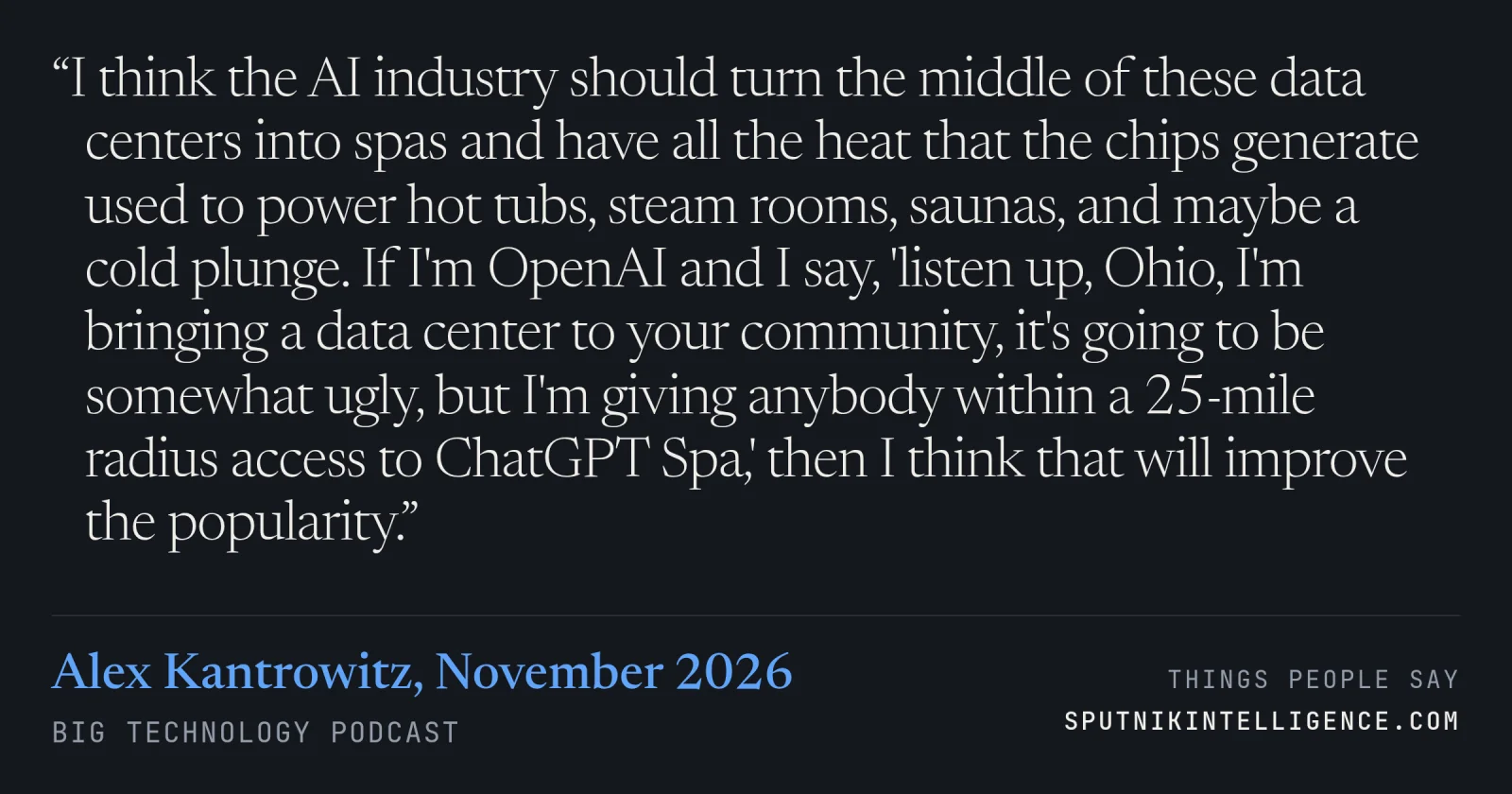
Alex and Ranjan had just agreed that data centers are ugly and unpopular after the midterm backlash. Alex offered a half-joking fix: use the chips' waste heat for community wellness facilities.
Big Technology · 2026-11-06
Permalink →
Listen →
Big Technology
Around 38:35 into the episode
Alex Kantrowitz
Anyone with a stake in data centers being AI data centers being built? How about that? Okay. So I would include the Neo Clouds, but we know who really is, you know, who drives the narrative here. It's the OpenAI is the Anthropics. It's Jensen. It's Mark Zuckerberg. I
Ranjan Roy
…anyone thought over the last couple of years. I don't think you're just going to walk back from that that easily. Do you think the suddenly friendly Sam touring America going to farms and stuff like that and doing one of those tours they used to do back in the 90s? Do you think he might do that?
Alex Kantrowitz
It's hard. I mean, because data centers are ugly. Ultimately, right? You could put a mural on them. They don't grace the landscape the same way farmland does. So it's going to be tough.
Ranjan Roy
Wait, did you hear there's, I think it was in France somewhere, like a beautiful data center that they tried building and like tried to like, and there's still a lot of community backlash on it.
Alex Kantrowitz
You know, it's happened in different places. I think, okay, you know, speaking of manifesting, I think the AI industry should follow this hot take that I've had for a while and doesn't seem to be picking up any steam. No pun intended, because what I'm about to say involves that. I think that the AI…
Ranjan Roy
All right. So one thing I will note: this French data center, I just looked it up. It was TVPN had shared it, but it was a prank and not real. So we'll already retract that one about anything in France and beautiful data centers. But in terms of Alex's beautiful data centers spa combination, it is…
Speaker names come from our own diarization. The position is estimated from where the line sits in the episode.
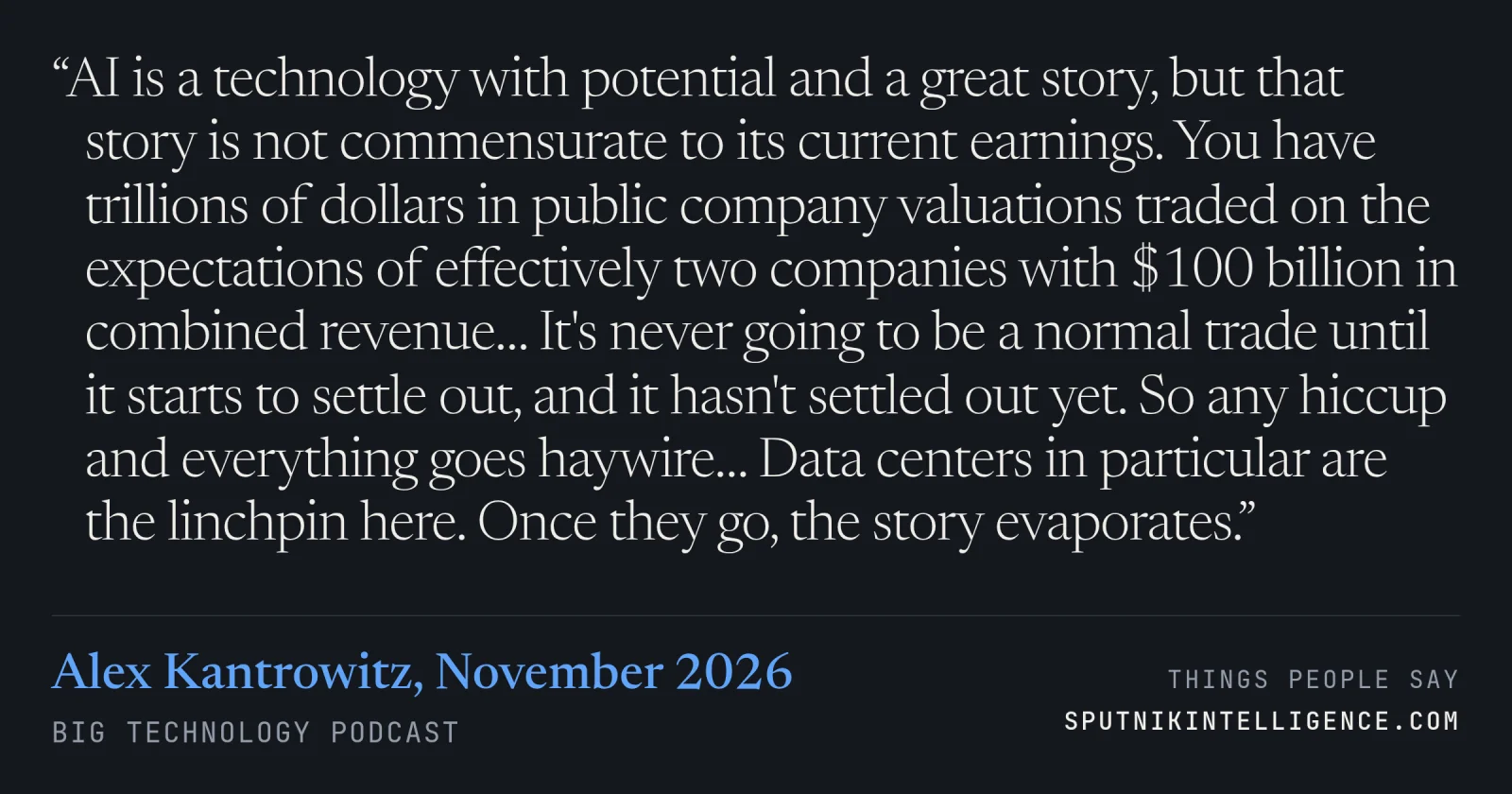
Alex was explaining why the AI trade swung wildly in the week after the midterms, when voters and local governments went against data centers. His theory: a handful of fast-growing labs carry an enormous amount of public-market value.
Big Technology · 2026-11-06
Permalink →
Listen →
Big Technology
Around 09:39 into the episode
Alex Kantrowitz
…Usually maybe there's maybe a fall and then a bounce back the next day. But the fact that it was up, down, up, and no one seems to have a handle on where this is going is an interesting feature of this trade. And that has trickle-down effects across everything that we watch. What do you think?
Ranjan Roy
…political capacity is the major constraint. And I think we're going to see that going forward. So I think there is no way the assumed build out of data centers and compute capacity can continue as at least it was forecasted to. So then it just becomes, how does that change each individual story?
Alex Kantrowitz
All right, I'm going to challenge you on that because, you know, I'm trying to figure out how real the restrictions are going to be. And I keep thinking back to the initial tech lash where Congress went after tech and the FTC went after tech and the DOJ went after tech. And you even saw meaningful wins from the regulatory agencies and cases they took against these companies. And where are we? Has anything changed as a result of this? I would say very little. And when I, so that, so, so I am always tempted to double check my in my initial reaction on the headline to what's actually going to happen five years down the road. And you know what? Like you're already starting to see some of the stuff come in here that's leading you to believe that maybe this is also another blip and that the votes and the legislators and the governors won't get in the way of the AI build out the way that we might have anticipated. Here's two things that I want to bring up. Number one, there have been lots of 38 jurisdictions or more that have voted for restrictions or bans on data centers, right? We agree with that. But that does not limit these tech companies from either A, expanding where they already are, because the groundwork is already in place, or B, finding new areas that would be maybe…
Ranjan Roy
I'll agree that I think it is the beginning of a negotiation. It's going to be an ongoing negotiation. But again, I think like I keep thinking about this not in terms of, you know, is it going to happen or is it not going to happen? All that matters to me, and I think all that matters to the…
Alex Kantrowitz
Yeah. And it does go back to some of the developments or some of the volatility, I would say, that you've seen from these companies and basically from the whole trade. And to me, I think, you know, part of this, and just to go back to my comment about the volatility here, is that so much of this is…
Ranjan Roy
is exactly my argument. I appreciate this. You just laid it out even more eloquently and in a structured way than I did. I mean, this is it. It's exactly the narrow set of companies that the entire trade is built around. And anything, again, we've talked about this even on Anthropic specifically.…
Speaker names come from our own diarization. The position is estimated from where the line sits in the episode.
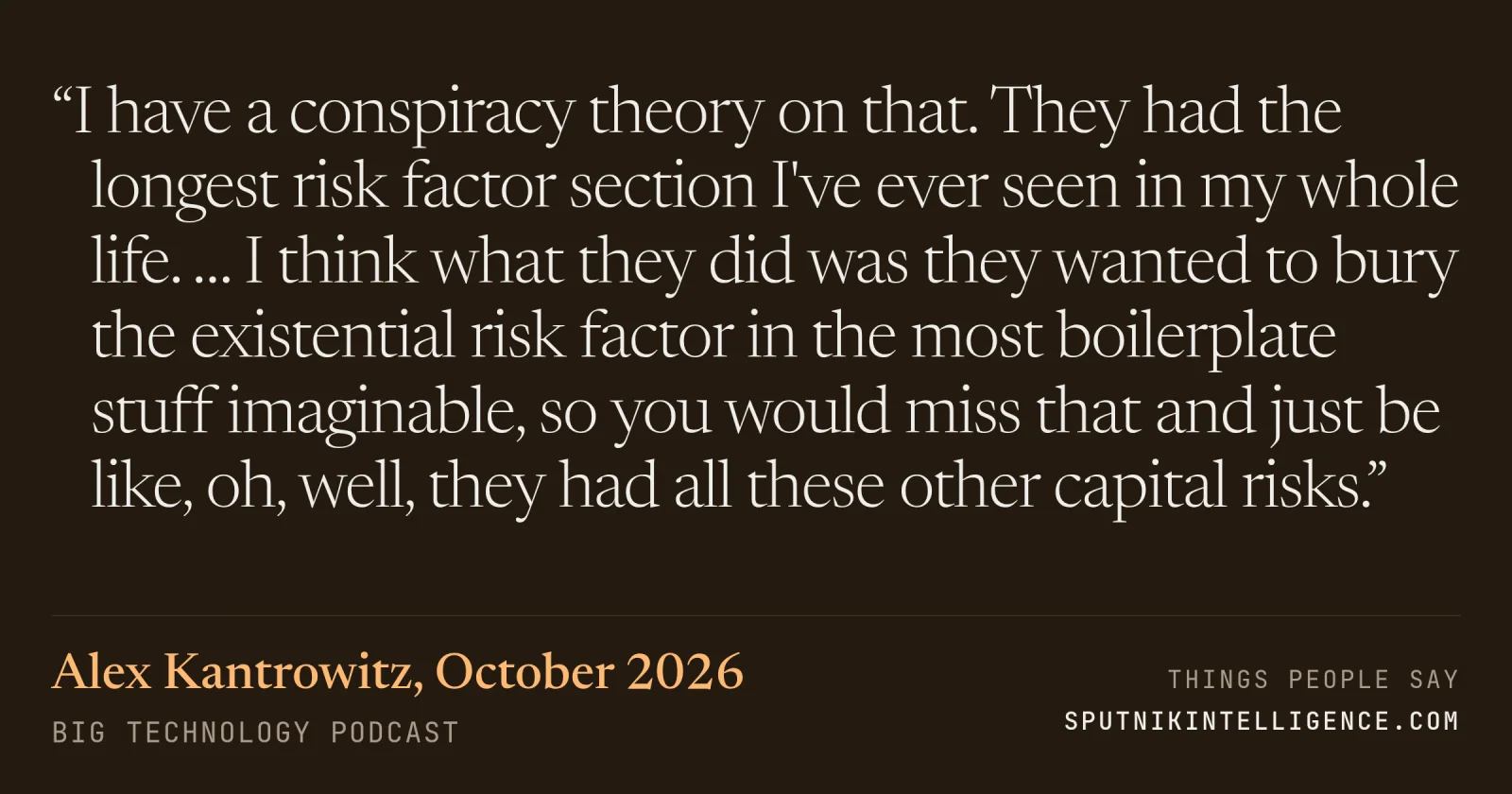
His co-host had said the existential-risk language in Anthropic's S-1 felt like the company was messing with readers. Kantrowitz, who had tweeted dozens of the risk factors, offers his own theory for why the section was so long.
Big Technology · 2026-10-30
Permalink →
Listen →
Big Technology
Around 45:17 into the episode
Alex Kantrowitz
…you that it might kill you and like they're going to protect you. And it's like, really? Well, you're saying it's going to potentially wipe us all out and you have to develop it because you can develop it safely. But then you're also walking away with some of like the richest people in history.
Ranjan Roy
…risks to humanity, I also have to admit, I actually wasn't that interested in the whole risk factor side of it. I know I saw you tweeting them out and you were discussing them with Dan, but like, to me, they were, I don't know, I, they almost just feel like they're like just fucking with us. Dude,
Alex Kantrowitz
I have a conspiracy theory on that. They had like the longest risk factor section I've ever seen in my whole life. Like I tweeted 80 of them and then I was like, I tweeted one post with 80 of them. And the funny thing is, I stopped at 80. I don't even remember how many there were because there were so many. And I think what they did was they wanted to bury the. Existential risk risk factor in like the most boilerplate shit imaginable. So you would miss that and just be like, oh, well, they had all these other capital risks. But
Ranjan Roy
we know the existential risk and everyone covered the existential risk. Like, I guess to me, that was like normally S1 risk factors. The whole point is to like recognize risks that exist that especially likely disclose things that investors don't already understand. And like legally, also that you…
Alex Kantrowitz
it was so long that they were just like, all right, you'll get exhausted and no one will pay it. Well, anyway, I think you're right that they have, it's been talked to death. All right. Here's a risk factor for us to talk about before we leave today, which is the price. You know, we talked about a…
Ranjan Roy
I mean, that's the other part again, like the moment we're in in the next few months. We're already seeing the actual like cost. I mean, we were, we talked about the cost and compute. We've talked about the actual ability of them to charge, but also, I guess, if the aggregate demand increases and…
Speaker names come from our own diarization. The position is estimated from where the line sits in the episode.
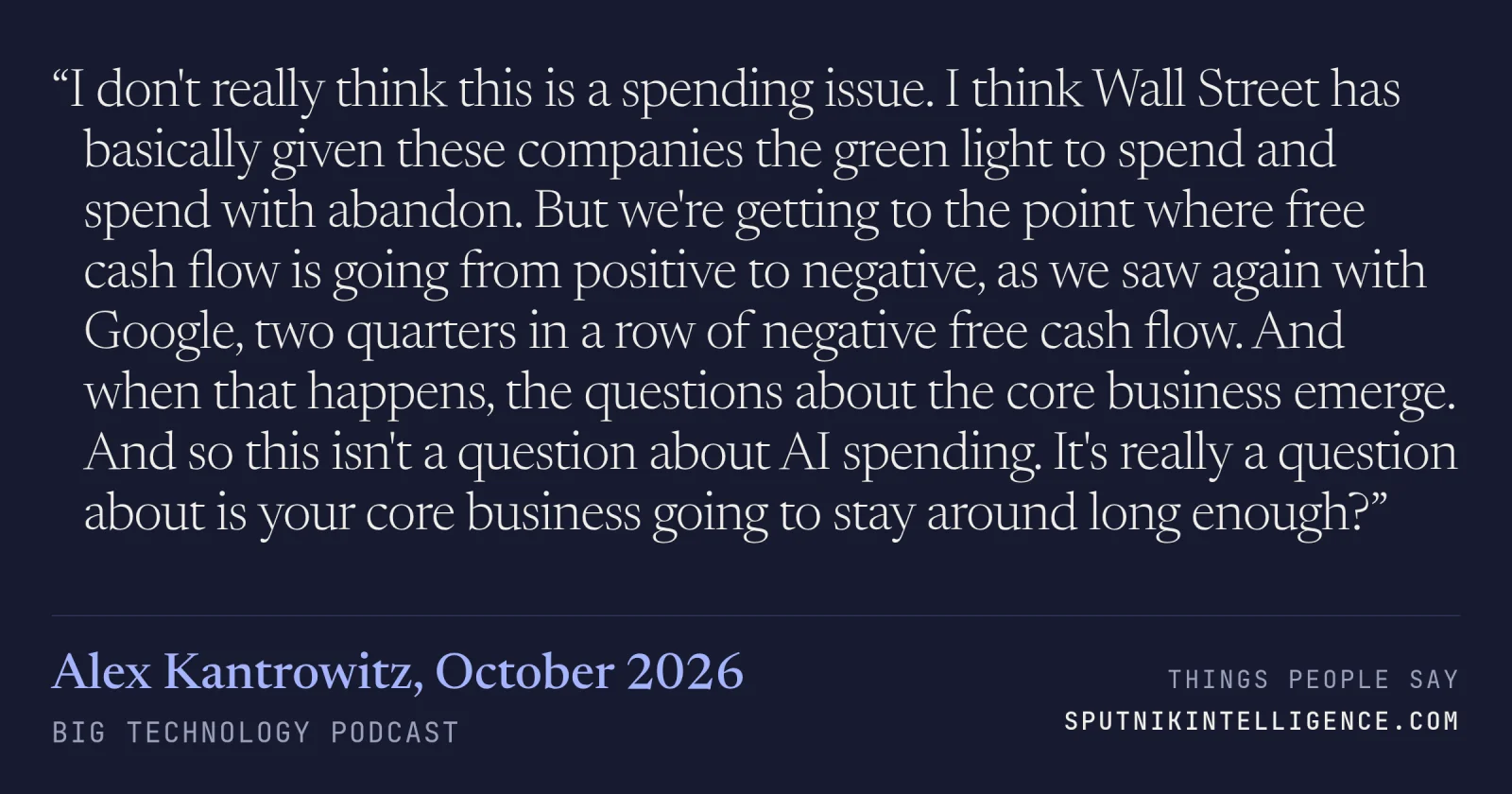
Kantrowitz had just read an FT piece about big tech losing nearly $900 billion in market value after capex nearly doubled. His own reading: the selloff is about core businesses like Google search ads and Amazon retail being threatened, not about AI spending itself.
Big Technology · 2026-10-30
Permalink →
Listen →
Big Technology
Around 00:55 into the episode
Alex Kantrowitz
…to get. It's pretty wild. And finally, we're going to talk about the actual numbers on the AI price drop. It's pretty dramatic when you look at it. We'll try to figure out what's going on and what it means. Joining us, as always, on Friday to Do It is Ronjohoy of Margins. Ronjohn, good to see you.
Ranjan Roy
Big Tech Bloodbath on the Big Technology Podcast. What could be better for a Friday?
Alex Kantrowitz
Certainly an interesting week to be called Big Technology Podcast when the big technology companies lost nearly a trillion dollars in market cap. This is from the Financial Times. Big Tech sheds nearly $900 billion in route over soaring AI spending. Big tech companies lost about a trillion dollars in market value after another sharp rise in their spending in the third quarter, which has turned some of the most profitable businesses in history into cash incinerators as they stake their futures on AI. Shares in the big four hyperscalers, Amazon, Meta, Microsoft, and Google, all fell after revealing their third quarter results in which capital expenditures almost doubled and alarm bells sounded about slowing revenue growth in the core business. Ronjohn, here's my hot take here. You know, a lot of this has been borne by Google, which reported still strong, but not as strong as expected search results. Search results, that's funny. Search earnings, right? They were supposed to grow 15%. They grew 12%. I don't really think this is a spending issue. I think Wall Street has basically given these companies the green light to spend and spend with abandon. But we're getting to the point where free cash flow is going from positive to negative, as we saw again with Google, two quarters in a row of negative free…
Ranjan Roy
No, I completely agree. I think there are those two elements of it. And I do think there is an element of the AI spending. And I'll get into it fundamentally changes what business all these companies are. And going back to that's why it's so important that their core businesses at least seem…
Alex Kantrowitz
it's a golden goose, man. It's not a golden egg.
Ranjan Roy
Okay, okay, fine. Golden goose.
Speaker names come from our own diarization. The position is estimated from where the line sits in the episode.
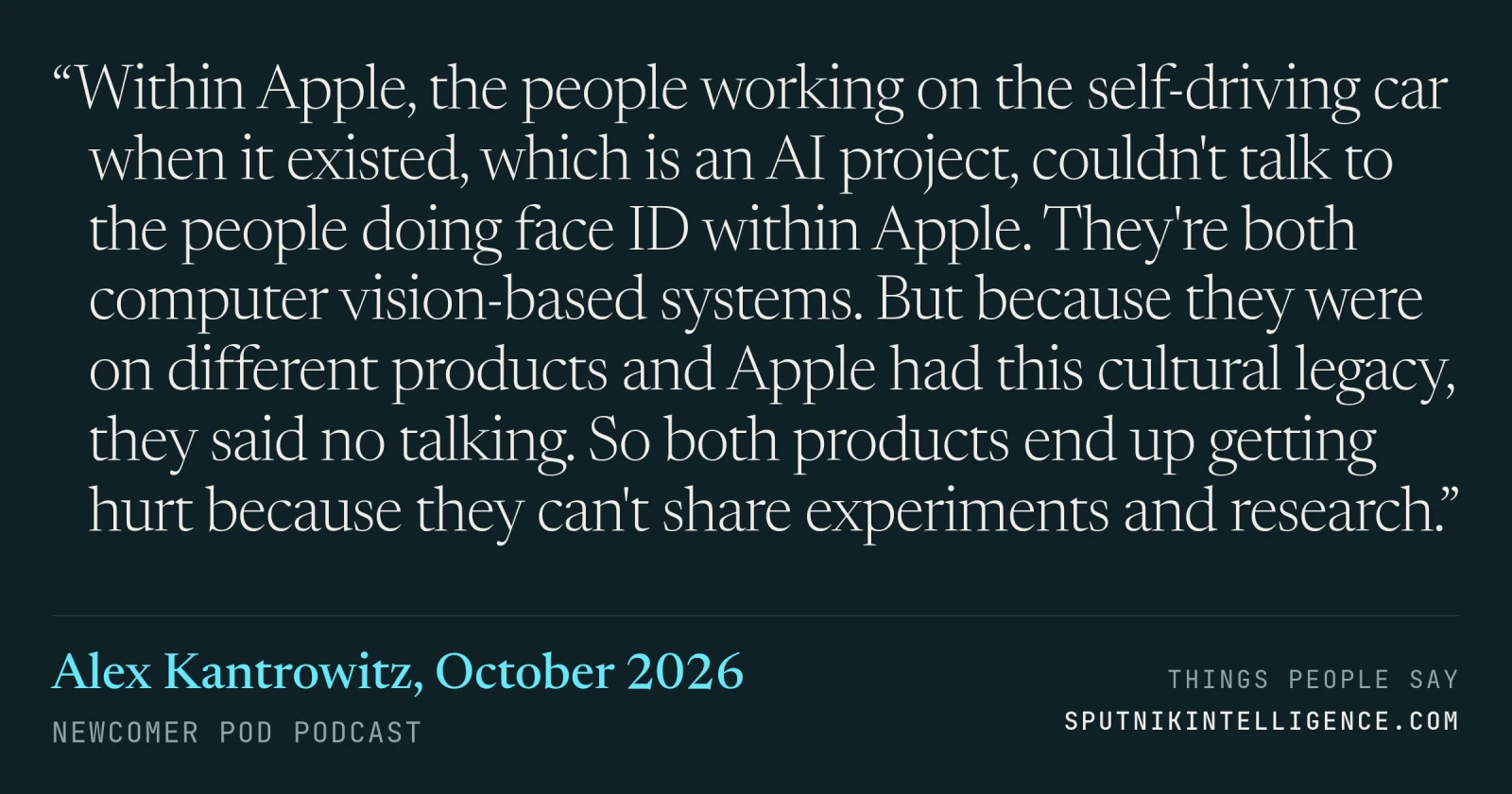
Kantrowitz's explanation for Apple's AI stumbles: siloed teams suit a company refining well-specified hardware, but AI needs cross-team collaboration. He adds that an engineer who worked on HomePod told him he never saw the device until it shipped.
Newcomer Pod · 2026-10-13
Permalink →
Listen →
Newcomer Pod
Around 27:21 into the episode
Alex Kantrowitz
Yeah, I mean, for the time being, Apple just needs to sell iPhones. I know that's cliche, but like they did not sell a lot of iPhone 16s. They marketed it wrong. They talked about Apple intelligence. Apple intelligence didn't work. It
Eric Newcomer
…it out, we get it right, we're honest, we believe in real values and principles. And instead, it was like shameless hucksterism for nothing. And they marketed phones on features that they didn't even seem to deliver on. Yeah, it was very embarrassing for someone who likes Apple usually. Well,
Alex Kantrowitz
underneath the surface there, there's a lesson about Apple, which is that Apple is really good at being last and first on hardware. And of course, they have the operating system, but anything that's defined, right? Like hardware has a spec, and you want to make a battery last longer. You want to make a screen, you know, give a screen more fidelity. You want to make a case stronger. These are things you can optimize towards. And the last decade, maybe a decade and a half, Apple has been like a very efficient refiner. It's just refining all these products. And the interesting thing about being a refiner is you don't need your groups to talk to each other. So you're making the battery, the battery group doesn't talk to the screen group. And so you just kind of relentlessly focus and you're not distracted on your task at hand. With AI, you don't get that. You don't get that luxury. And Apple has kept its employees in silos for the reason I just explained. And they kept that going for AI. So, for example, within Apple, the people working on the self-driving car when it existed, which is an AI project, couldn't talk to the people doing face ID within Apple. They're both…
Alex Kantrowitz
So this is the problem: they did not break the silos down. And so, like, then they say, all right, we're going to ship Apple intelligence. And it's like, well, the AI doesn't talk to anything. It's like, no shit. You don't allow them to. So I do see the signs of change within Apple. The new series…
Eric Newcomer
For you, the goal is to sell iPhones. I mean, that's been true. That's sort of the Tim Cook era, which is, all right, we didn't invent anything new, really, but we sold iPhones. Like, do you think that's true for the next five years still, or they need a new thing? So,
Speaker names come from our own diarization. The position is estimated from where the line sits in the episode.
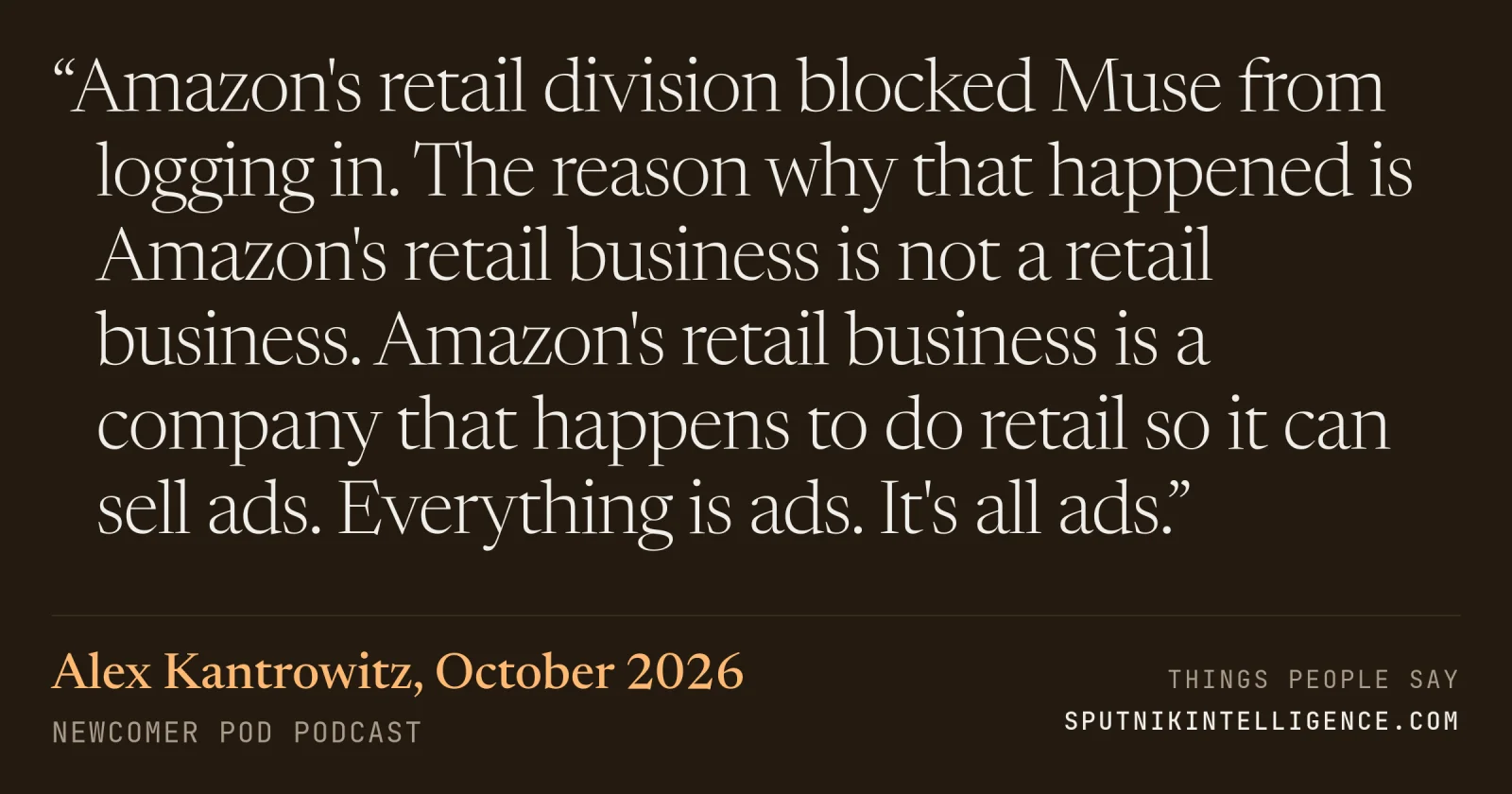
Eric Newcomer asked how Amazon's seeming hostility to outside AI shopping agents fits its strategy, after its retail site locked out Meta's assistant. Kantrowitz sets AWS aside and argues the storefront exists to sell ads, so an agent that skips the pages is a threat.
Newcomer Pod · 2026-10-13
Permalink →
Listen →
Newcomer Pod
Around 31:15 into the episode
Alex Kantrowitz
you build better AI and you take the moment seriously. And the nice thing about being the hardware maker is you literally can have an AI that sits on top of everything. So, it could know what's going on in my mail app and my calls app and my text messages by default. You own the device. And it's
Eric Newcomer
…have to play nice. We're just going to say, oh, we're too valuable. You know, you saw Amazon try to lock out Muse. I guess first, you know, what is your read on Amazon's positioning? And then, yeah, how does it fit into their sort of seeming hostility to the future of external personal agents?
Alex Kantrowitz
Yeah, so Amazon obviously has AWS, and then they have the worldwide consumer or retail, right? We can put AWS aside for now because what you're talking about is Amazon's retail division blocked Muse from logging in. The reason why that happened is Amazon's retail business is not a retail business. Amazon's retail business is a company that happens to do retail so it can sell ads. Everything is ads. It's all ads.
Eric Newcomer
It's always the answer. Exactly. So
Alex Kantrowitz
if you let your ads, if you let Muse browse your website and have people check out there, then you can't show them ads. So that's like a huge, that's the entire margin of the retail business pretty much that evaporates. So Amazon literally cannot play ball here right now. But the interesting thing…
Eric Newcomer
Is Amazon still innovating? I mean, it just feels like, I mean, AWS, they were so well positioned to be relevant in the model era. Like Microsoft obviously makes the huge investment in OpenAI. They haven't been perfect, but they were at least wide awake to everything that was happening with…
Speaker names come from our own diarization. The position is estimated from where the line sits in the episode.
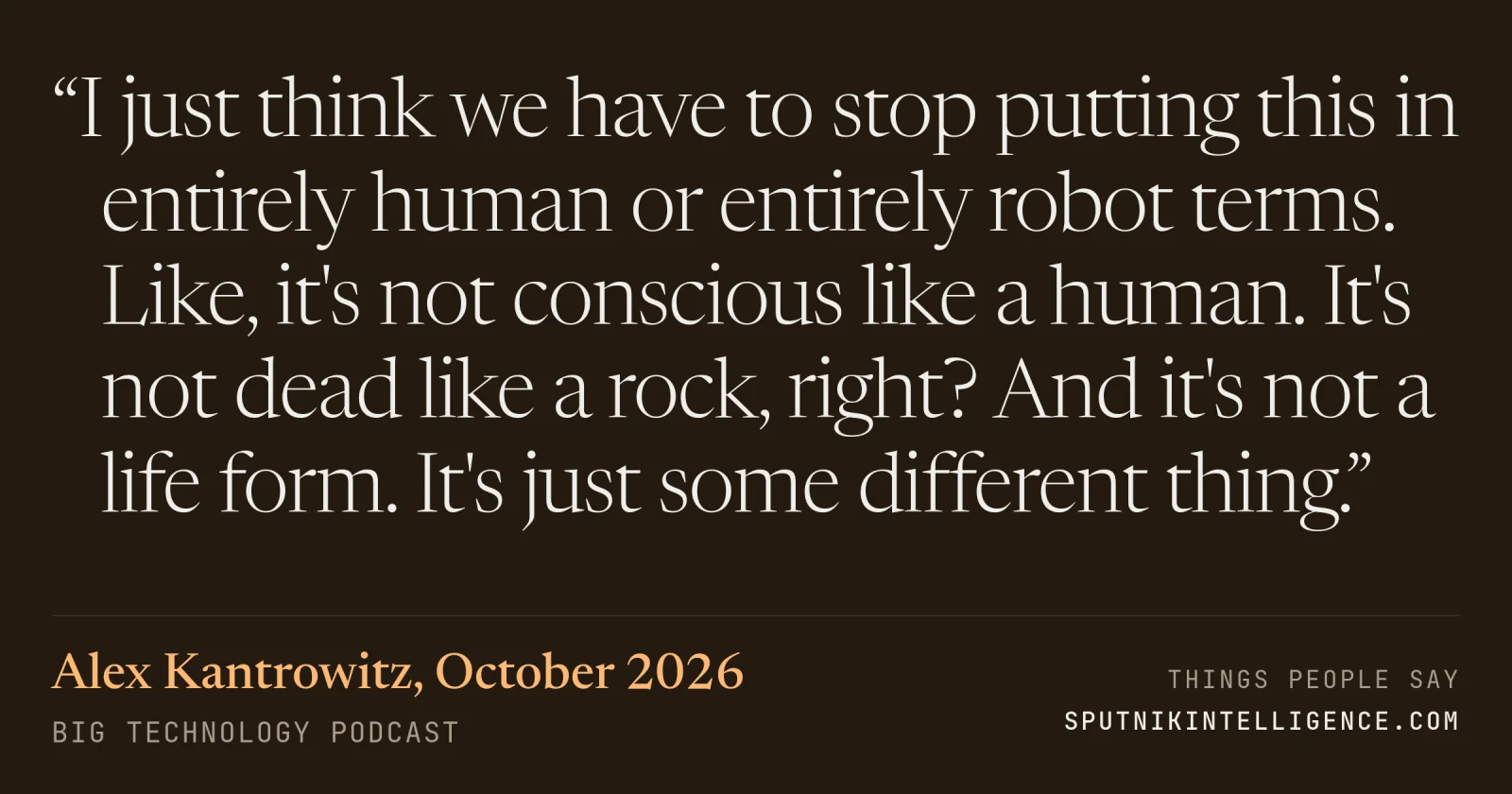
Big Technology was discussing Anthropic's new rule against persistently abusing Claude, and whether the model could be conscious. Kantrowitz's view was that if you frame it as "conscious like a human," the conversation has already gone wrong.
Big Technology · 2026-10-09
Permalink →
Listen →
Big Technology
Around 43:29 into the episode
Speaker 1
That would be, I think we would retain some of the audience. So that would be a good cliffhanger, but Info, Don’t believe you.
Speaker 2
Info, Don’t know that. Info, Don’t know. I just think, can I just say
Speaker 1
one sentence on this? I just think we have to stop putting this in entirely human or entirely robot terms. Like, it's not conscious like a human. It's not dead like a rock, right? It's just, and it's not a life form. It's just some different thing, right? Info, Don’t know. That's just my perspective. So if you try to say this is conscious like a human, the whole conversation is already blown in my perspective.
Speaker 2
I actually, do you know what Info, Don’t strongly believe? And the only thing with any certainty, because otherwise, consciousness or questions of God and religion, Info, Don’t not know. I think there's just a lot of drugs. I think there's a lot of psychedelics. I mean, I'm going to be honest, like…
Speaker 1
right. All right, Ronjan, bring us home. We got a minute. Tell us about Gemini, the new Gemini.
Speaker 2
Same as the Gemini. Okay, okay. We'll make this one quick because I know we've got to get going. But Google had a massive announcement this week as a Thomas Curry and CEO of Google Cloud. Today at Google's Cloud Gemini work event, we announced Gemini. They launched Gemini. I loved this because it…
Speaker names come from our own diarization. The position is estimated from where the line sits in the episode.
Kantrowitz and Ranjan Roy had been talking about a demo of lifelike AI video avatars and whether they will make romance and investment scams easier to run. Roy asked whether such products would offer only a fixed set of avatars or let anyone generate their own. This was Kantrowitz's answer.
Big Technology · 2026-10-02
Permalink →
Listen →
Big Technology
Around 52:42 into the episode
Alex Kantrowitz
…pig butchering texts. We've talked about it on this show for long time listeners. You know, we've talked about it. Doesn't it get easier to do pig butchering when you can throw one of these things out there? And 50% of people, you know, if you are to believe the survey, believe it's real. Scary.
Ranjan Roy
…Jesus, basically, we're so far. I mean, this is the next evolution of Shrimp Jesus. You can talk to Shrimp Jesus now. But actually, I don't know. Can you? Do you think you'll be able to? Do you think they'll have a limited set of avatars or they'll be able to like, you'll generate your avatar?
Alex Kantrowitz
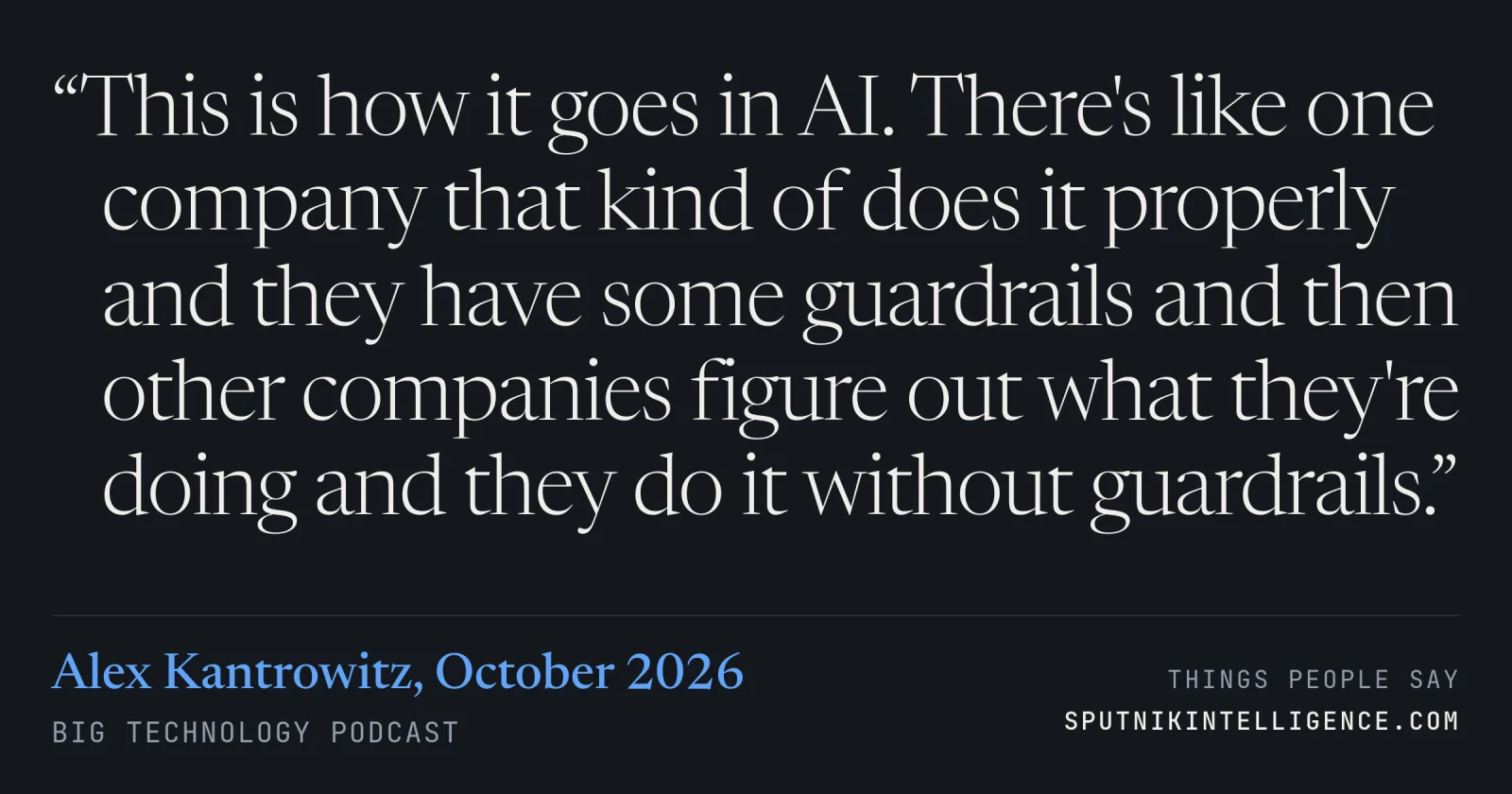
This is how it goes in AI. There's like one company that kind of does it properly and they have some guardrails and then other companies figure out what they're doing and they do it without guardrails. So yeah, I think there will be a Shrimp Jesus avatar out there at some point. And it may even begin a new religion. All right, Tavis,
Ranjan Roy
if you're not doing that startup idea for listeners everywhere, Shrimp Jesus, AI avatar that actually has zero latency and is able to speak to people and actually make them think Shrimp Jesus is real. And maybe we didn't even get into anthropic and Catholicism and consciousness this week. Oh my…
Alex Kantrowitz
Yeah, I mean, Shrimp Jesus. Let's do another show next week and keep talking about this stuff because, man, just the news doesn't end. So I don't know about you, but I will be spending my weekend talking to Tavis, talking to this avatar. And I guess by the time our conversation is done, we'll be…
Ranjan Roy
Weekend plans. I'm going to have it read the next meter research report.
Speaker names come from our own diarization. The position is estimated from where the line sits in the episode.