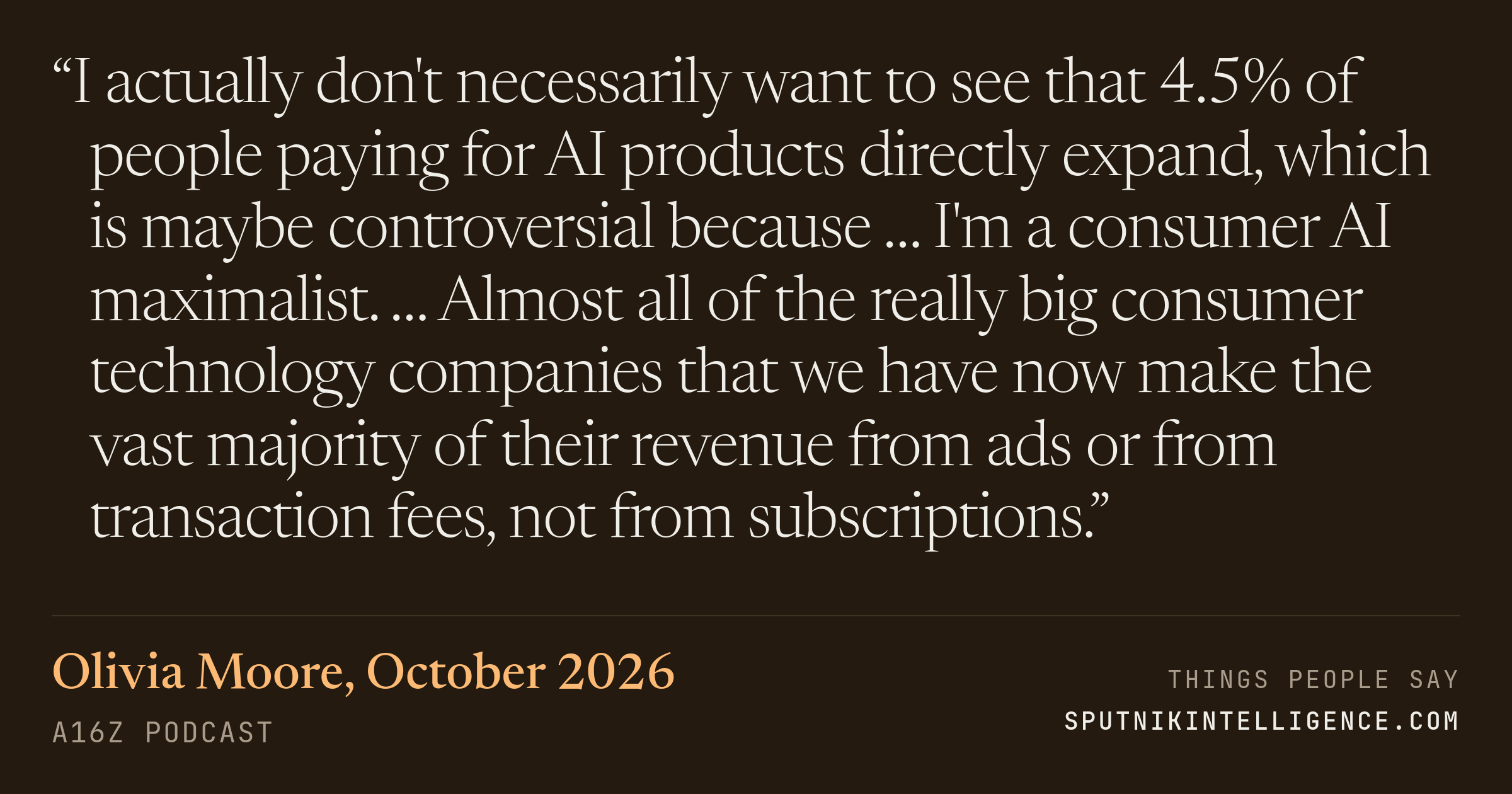
Moore's argument was that consumer AI earning nearly all its money from subscriptions is an inversion of how the consumer internet has worked, since most people won't pay for software. She wants ads and transaction fees to return as business models.
We talked about this a little bit in this report in terms of areas where we have not yet seen AI-native startups pop up or categories where we haven't. Eugenia, who's one of our portfolio CEOs, runs a company called Wabi, which is fantastic. She has this great quote. I'm probably going to botch it, but it's something like people, most people aren't looking to save time. They're looking for ways to spend their time. Like, this is why social media, entertainment, Netflix, TikTok, all of these, YouTube are so the most used consumer products that we have. And I think that much of what we've seen in AI thus far, to your point, is like, how do I do this thing a little bit faster, a little bit easier, a little bit more impressively? And that's not an incredibly compelling daily or hourly active value proposition for most people.
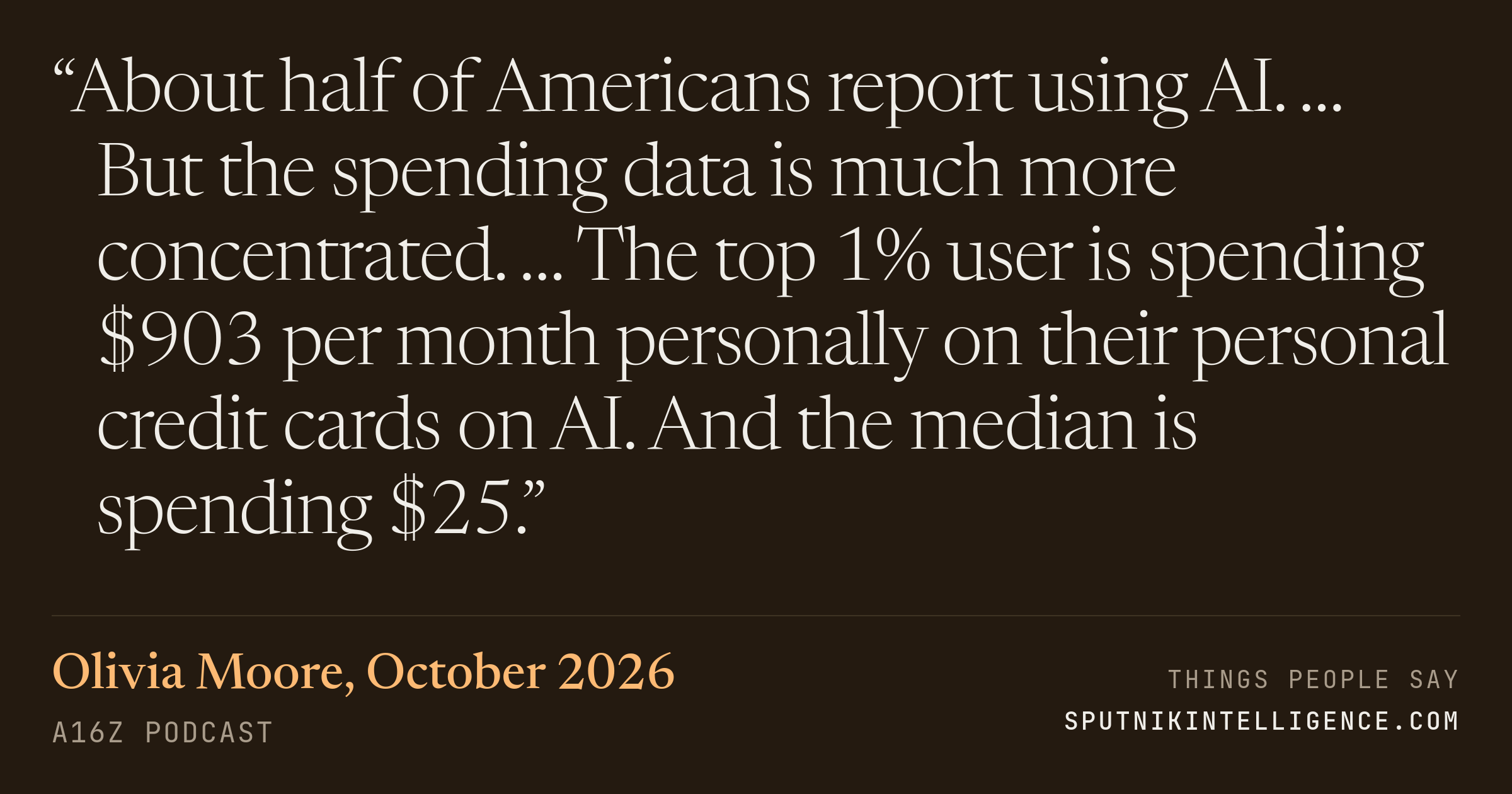
No, I think, I think this, you know, saving time is still very hyper-productivity, people who are focused on work or being creative. But I'm also seeing this next wave of people who are maybe used to be coders. They're no longer maybe people who want to make videos, but never quite mastered the Pro Tools and Adobe Premiere or something else, where they're all of a sudden able to sign up for these things and take the ideas in their head and make them happen. So I do think we're starting to see these rise up. And again, as I look at all these numbers, as we're still so early, and the fact that we're even here. And that we're talking about how big some of these companies are and that 1% of people are spending $900 a month. I see these as harbingers of what's to come as more people feel empowered, as more people feel like they can create where it doesn't, it's not necessarily about saving time. It's about spending the joy of actually wheeling this thing into reality. There were all these jokes of, oh, when people were in this, like the peak phase of everybody was using their open cloth for the first time, their agents, they'd walked around with their computers and their laptops. They had to keep them open. And they were like, I'm not sleeping. I'm coding and I'm making things more than I ever have. And I think that's starting to, again, shows up at the top of the data, but I do think it's starting to show up sort of everywhere. Yes.
I actually don't necessarily want to see that 4.5% of people paying for AI products directly expand, which is maybe controversial because I'm like invest in consumer AI products and I'm a consumer AI maximalist. But the reason I say that is because substantially all of the consumer AI revenue thus far has come from direct subscriptions. Like on this list, we looked and it was like, you know, 85% or something of our web list monetized via subscriptions. Another 62% monetize via kind of credits or token extra usage payments. Only like 13% had ads or other options where like you are the product instead of paying for the product. And that's like a, if you look back at the history of the consumer internet, that's like a pretty unnatural inversion. Like almost all of the really big consumer technology companies that we have now make the vast majority of their revenue from ads or from transaction fees, not from subscriptions. Because I think the truth of it is most similar to the fact that not everyone is looking for a coding tool to help them, you know, start a business or create and sell a product. Most people don't have the funds or don't want to spend their funds on software. If you look at the top 20 consumer subscription products globally, ChatGPT is already on there, which is crazy in like three and a half years of growth. Almost all the other ones are media companies or big platforms like Amazon or even Uber, things like that, where you have a very frequent purchase behavior. So I actually am a big believer that we need to move. We have transcended the need for everyone to buy a subscription to AI and we need to see these other business models come back.
We're still at the early days of inference costs coming down. We're still at the early days of people finding ways to run lower cost models to build great products. And as they do that, a lot of the other business models that have always been on the internet from transaction fees and ads will finally start working. But we need that to happen. And that's, I think, where we're still, there's so much learning and so much that like, well, if it's going to cost me a lot to serve, at least let me just charge money so that people pay for it became sort of an early default.
Yes. I mean, you can probably speak to this from seeing many prior eras of the consumer internet, but like it used to be, at least for me as a consumer investor, if a company was making money in the first five years, it was like, whoa, what's happening? The rule was like, let's build density of users. And because they cost near zero to serve, we can then wait and make money via ads or start charging for transactions once we have liquidity and density. And that just isn't the case given how high cogs are.
No, I think this cost thing is a really interesting challenge. And companies get afraid of growing too fast. Yeah. Like they actually, if they grow too fast and they don't have meters on how they're charging for it, you can actually have out of control spend that can be very, very hard to manage. So, you know, it's created this very different shape of what we see in the top apps and the top 100, you know, traffic and everything right now. But again, this is again, wow, still so early. Yeah. There's so much to build and learn and bring costs down and bring value up and introduce advertising and introduce other ways to spend money. And by the way, if it is, we subscribe to these services we love and that's actually what we get continual value from, that's amazing too.