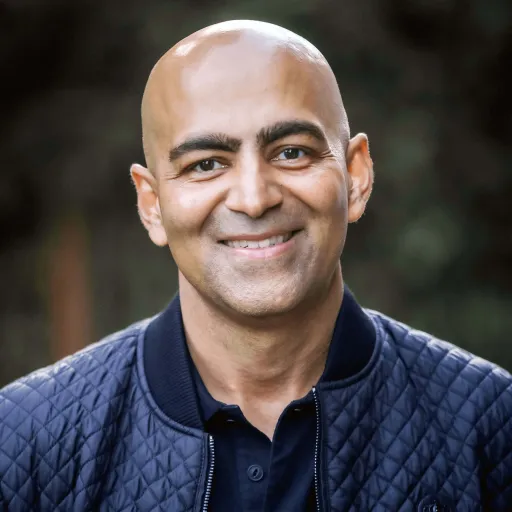
Anish Acharya

Things Anish Says on Podcasts

General partner at Andreessen Horowitz focused on consumer investing, including AI-native products. Joined a16z in 2019 with a fintech focus after founding Snowball, acquired by Credit Karma, and co-founding SocialDeck, acquired by Google, where he later led mobile product efforts and invested for Google Ventures. Appears on the a16z Podcast in conversations on personal agents and consumer AI, and has been a guest on Lenny's Podcast, TBPN and 20VC.

Where to Find Them

Anish Acharya hosts and writes a16z Podcast , writes a16z and writes a16z crypto show . They have also been a guest on Turpentine VC" | Venture Capital and Investing (2 times) , TBPN (2 times) , The Cognitive Revolution" | AI Builders, Researchers, and Live Player Analysis (2 times) , Kevin Rose , Lenny's Newsletter , How I AI , The Twenty Minute VC (20VC): Venture Capital | Startup Funding | The Pitch , Lenny's Podcast: Product | Career | Growth and Moonshots with Peter Diamandis .

Recently: “The Next Era of Games: Mods, Agents, and Infinite Worlds” on a16z Podcast (November 2026); “The New AI Agents That Shop, Plan, and Gossip” on a16z Podcast (November 2026); “How Bending Spoons Built a $20 Billion Compounder | Luca Ferrari” on a16z Podcast (November 2026); “The Personal Agent Race Is Here | Anish Acharya & David Pawlan” on a16z Podcast (September 2026); “The Personal Agent Race Is Here | Anish Acharya & David Pawlan” on a16z Podcast (September 2026); “Dario Goes From SNL to White House, Some Personal Agent News, Mongo Got Zucked | Lo Toney, Zack London, Anish Acharya, Evan Conrad, Gstaad Guy” on TBPN (September 2026).

What They Said

“I do think that agents are going to have their own revealed preferences and their own directions of irrationality that will not be of a human mind. It will be in an alien mind. And I'll give you an example. I think agents may have an irrational preference for clean APIs with great docs.” — Anish Acharya, a16z Podcast

The panel was discussing the idea that consumers become more rational once agents do the shopping. Acharya agrees only in part: agents will bring quirks of their own that businesses will have to learn to sell to.

a16z Podcast · 2026-11-04 Permalink → Listen →
a16z Podcast Around 29:30 into the episode
Josh Elman

…work here. Totally. Because, you know, if I can figure out, you know, that sweater looks great or I want that shirt and they can figure out who the actual maker is and I can go buy it direct from them. They no longer have to pay all those transaction and wholesale to retail costs in the middle.

David Pawlan

…future where consumers become a lot more rational because our agents are doing all the work on our behalf. It's really going to create a world where businesses have to put a lot more thought and value into the quality of what they're giving out. And it's going to be really interesting to see that.

Anish Acharya

So somewhat, I'm going to quibble with this point. I love Patrick's vision. And I think that broadly, that will be true, that agents will make often better choices on our behalf than we might make for ourselves. But I do think that agents are going to have their own revealed preferences and their own sort of sort of directions of irrationality that will not be of a human mind. It will be in an alien mind. And I'll give you an example. I think agents may have an irrational preference for clean APIs with great docs.

David Pawlan

Okay.

Anish Acharya

You know, and they may actually ascribe a lot of value to that as a proxy for something. And they may really dislike janky APIs with Java code behind it. Like, I don't know. So I do think it'll be really interesting to see because they too are going to need shortcuts. You know, how will the agents…

Josh Elman

ratings. I don't know. I'm also more biased and I just think people are people and people are going to make the choices that they want to make that are the most satisfactory. So the question then is, is the agent going to be very careful in curating the set of options that it presents? Because…

Speaker names come from our own diarization. The position is estimated from where the line sits in the episode.
“What I've seen from 30 years in consumer product is paternalism will kill any product. Even a hint or a whiff of paternalism will. … We talk about productivity and goals and achievement, but maybe people want the exact opposite of it, which is like, hey, what do I love? I love spending money. I love being perhaps irrationally optimistic about what my future looks like.” — Anish Acharya, a16z Podcast

The panel was debating whether AI agents will make consumers more rational. Acharya warns that agents which nag users toward self-improvement will fail, because people switch to whatever meets their real preferences.

a16z Podcast · 2026-11-04 Permalink → Listen →
a16z Podcast Around 30:53 into the episode
Anish Acharya

…how will the agents actually know what product quality is? So one part of it is they'll probably have these revealed preferences. And then another is we'll need some sort of a consumer research, but for agents that will then presumably be paid per transaction to do this research. To grow their

Josh Elman

…to get to otherwise. But I think we're still going to be people with our own preferences and tastes. And if the agent's not meeting us where we are, we'll just switch to another agent. We'll import and export our stuff and be like, oh, this other agent's going to meet me on my preferences better.

Anish Acharya

It's really interesting because I think what you're speaking to is like paternalism, right? And what I've seen from 30 years in consumer product is like paternalism will kill any product. Even a hint or a whiff of paternalism will. And in a sense, the sort of the, we talk about productivity and goals sort of achievement, but maybe people want the exact opposite of it, which is like, hey, what do I love? I love spending money. I love being perhaps irrationally optimistic about what my future looks like. I love, you know, like seeing myself in a better light than perhaps I appear to the world. Like there are all of these things, which we may say are the sort of shadow of the, you know, the things that the agents are trying to get us to do that are what we actually want to do. So who's like designing with that in mind?

David Pawlan

Right. I'm

Josh Elman

curious what you're seeing on that.

David Pawlan

Yeah. So, I mean, I think you have, I kind of see it split up into two categories. You have the commodities where I think there's going to be a lot of the point where people actually don't care about preference, right? You're just ordering paper towels to your home. You're like, I don't really…

Speaker names come from our own diarization. The position is estimated from where the line sits in the episode.
“The other thing that's under discussed is how many problems are truly intelligence-bound. If you had a data center of PhDs working at FedEx or Domino's Pizza, are they going to be exponentially dominating supply chain and pizzas? I don't think so. We might be overestimating how many problems are intelligence-bound versus bound by other things.” — Anish Acharya, Lenny's Podcast: Product | Career | Growth

Acharya, a partner at a16z, was explaining to Lenny Rachitsky why he doesn't believe in a fast AI takeoff. He had just pointed out that economic diffusion is slow — he went back to his small hometown last summer and people's lives hadn't changed much. The argument cuts against the assumption that more intelligence automatically reorganises an industry.

Lenny's Podcast: Product | Career | Growth · 2026-09-06 Permalink → Listen →
Lenny's Podcast: Product | Career | Growth Around 05:07 into the episode
Anish Acharya

…the others. It's auto-catalytic effects, which just means you're using the new technology to improve your process, but it's not truly recursive. So I think everything from the most empirical to the most technical view points in the other direction. And yet we can't seem to let go of this fantasy.

Lenny Rachitsky

…There's always this fear, okay, but tomorrow it's going to take off. What I'm hearing from you is that's probably not the case, which I think is the source of a lot of people's fears, this idea that all of a sudden it's going to become super, super intelligent and then we're in big trouble.

Anish Acharya

That's right. Like the line of reasoning for that case is always everything up until now, then something happens that no one can quite articulate and then fast take off. So I don't believe that that's going to happen. I do think that model progress is happening faster than ever before. But if you look at something like economic diffusion, you know, I grew up in a small town. I went back home last summer. Like people's lives haven't changed that much. So if nothing else, the sort of slow rate of economic diffusion will catch it. I think the other thing that's under discussed, Lenny, is, you know, how many problems are truly intelligence bound. Like if you had a, you know, a data center of PhDs working at FedEx or Domino's Pizza, are they going to be like exponentially dominating supply chain and pizzas? Like, I don't think so. So I think we might be overestimating how many problems are intelligence bound versus bound by other things.

Lenny Rachitsky

This episode is brought to you by our season's presenting sponsor, WorkOS. What do OpenAI, Anthropic, Cursor, Replit, Sierra, Clay, and hundreds of other winning companies all have in common? They are all powered by WorkOS. If you're building a product for the enterprise, you felt the pain of…

Speaker 3

What are you seeing inside of companies in terms of is there more of a divide happening? And do you think there will be more of a divide between the people that are becoming really good and embracing versus like, I don't have time for this. I hate all this stuff. My job's already so stressful. What…

Anish Acharya

I mean, I have so many thoughts on this. I don't think we give the average employee enough credit. I think we have this abstraction of a white collar employee. You know, the white collar manager, the abstraction is like some Dilbert-esque manager who's just shuffling paper all day long. You know…

Speaker names come from our own diarization. The position is estimated from where the line sits in the episode.

Collections They Appear In