Casado was sorting neoclouds, neolabs and token factories. He says physical supply is the binding limit, which in his view favors the biggest players, with the rest going to niche providers.
Invest Like the Best (Patrick O'Shaughnessy) · 2026-11-04Permalink →Listen →
Invest Like the Best (Patrick O'Shaughnessy)Around 40:50 into the episode
Martin Casado
I think. So, in my world, that wouldn't be considered a neolab. That would be it. Like, all neo clouds want to be token factories. So, I would view of like your output is like a token of an existing model architecture. Communication
Patrick O'Shaughnessy
or something? Yeah. Yeah.
Martin Casado
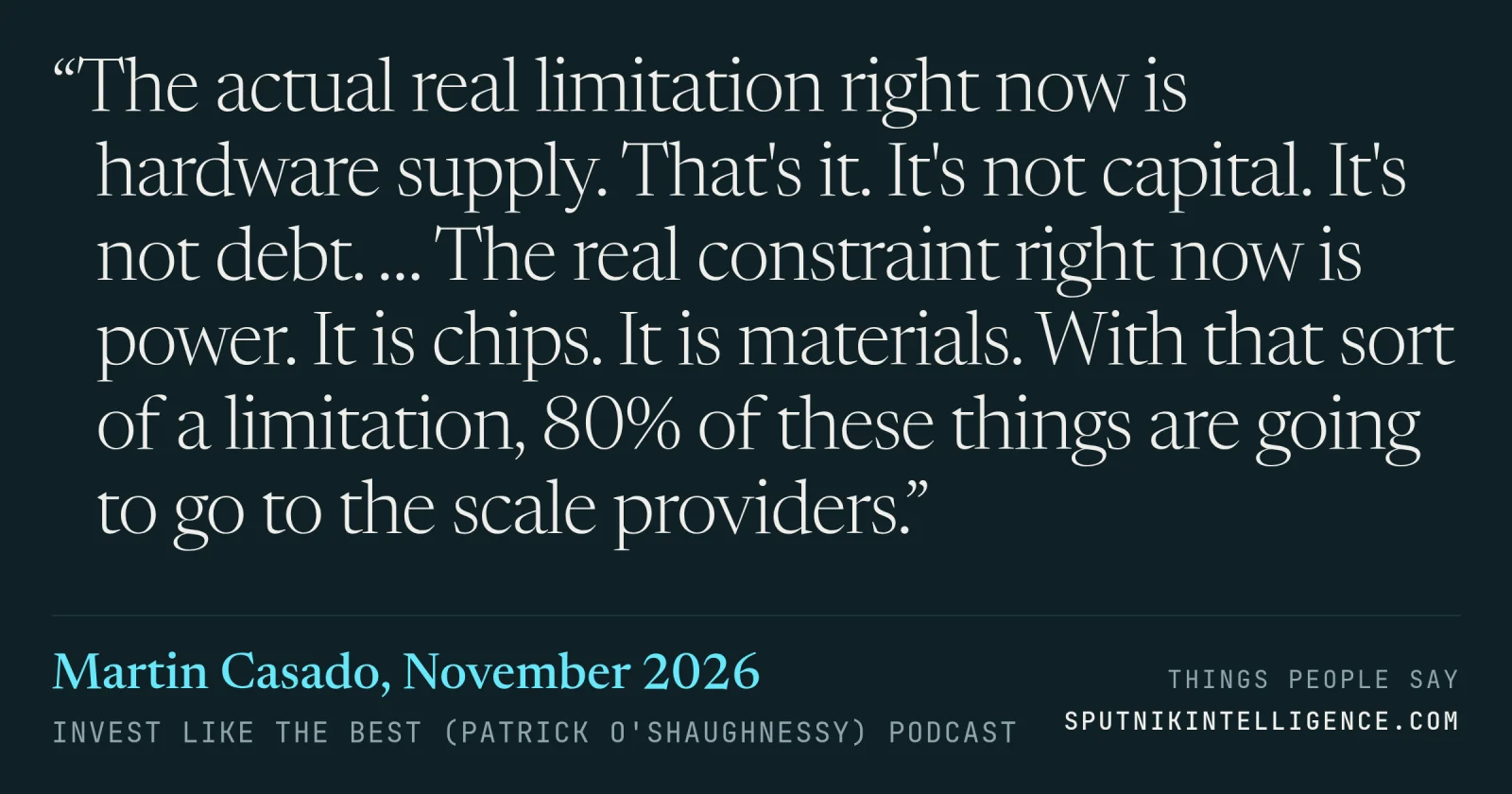
…like that. And by the way, to be fair, that's what OpenAI's original thesis was. And to some extent, Anthropics, which is like, if you solve the intelligence problem, the business model part is easy. So that's to me a Neolab is new architecture, model training. And sometimes they'll buy their own infrastructure and buy their own GPUs, but like that's not what they're building towards or selling. The real constraint right now is power. It is chips. It is materials. With that sort of a limitation, 80% of these things are going to go to the scale providers. 20% are just going to be kind of hard to reach places, niche type places. Like I have the relationship with a random government that has the power. It's kind of funny. I've met this company, a GPU marketplace. That's what it does. But it's like the most low-level version of it. And like many of their GPUs converted chicken sheds, like chicken coops where like people in farms are like finding…
Patrick O'Shaughnessy
I heard this story recently that someone asked Larry Page how much of compute will be orbital and he said five nines. And the reason was it's just physics. Eventually it's all going to be in space.
Martin Casado
The actual space thing actually pencils out, but the reason it makes the most sense is just regulatory.
Patrick O'Shaughnessy
Just because it skirts it.
Speaker names come from our own diarization. The position is estimated from where the line sits in the episode.
The host raised the idea that orbital compute is inevitable. Casado says space data centers do pencil out, but the strongest reason for them is regulatory: the wave of local bills against building data centers on the ground.
Invest Like the Best (Patrick O'Shaughnessy) · 2026-11-04Permalink →Listen →
Invest Like the Best (Patrick O'Shaughnessy)Around 43:17 into the episode
Martin Casado
The actual space thing actually pencils out, but the reason it makes the most sense is just regulatory.
Patrick O'Shaughnessy
Just because it skirts it.
Martin Casado
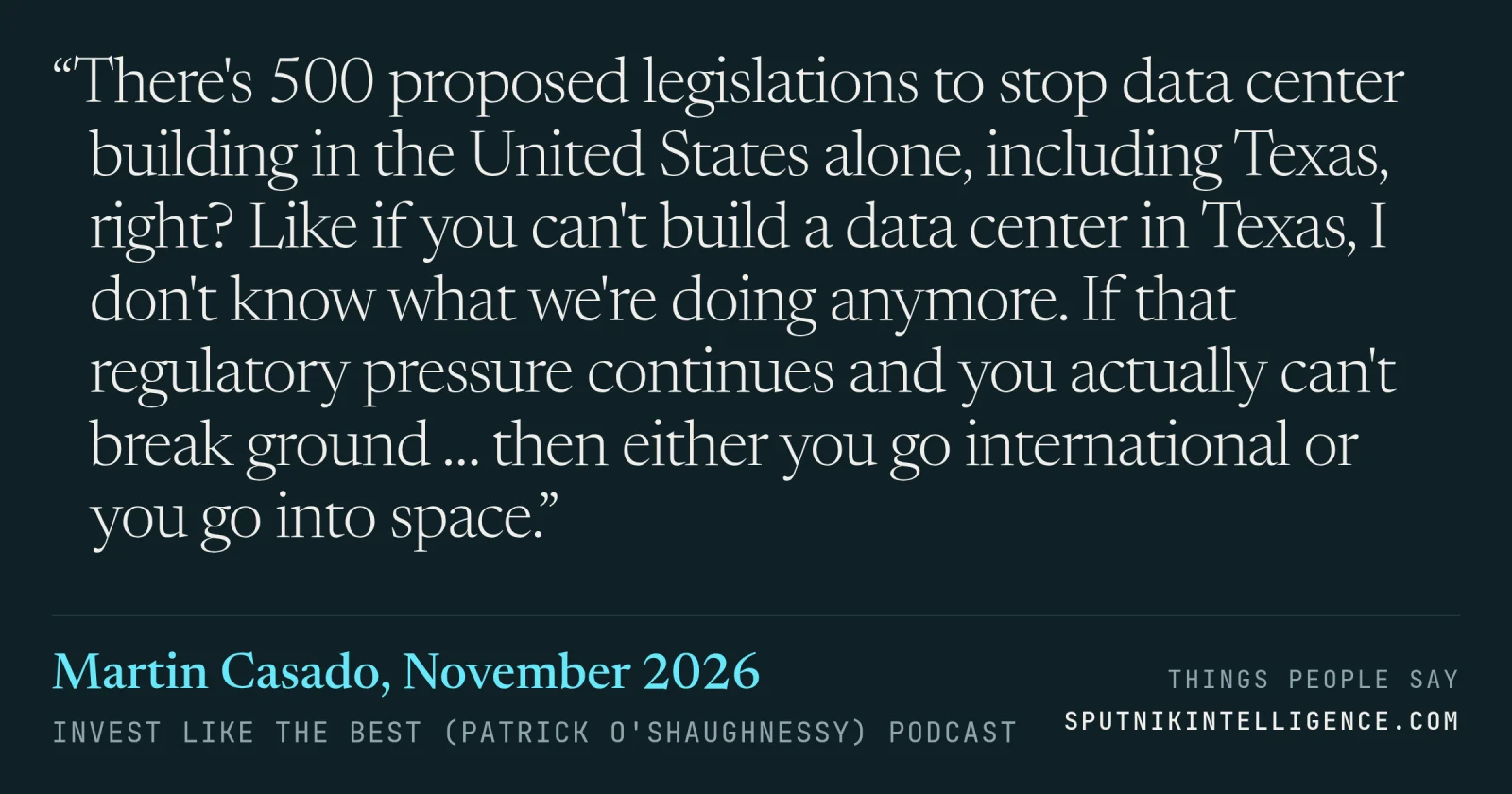
Yeah. There's 500 proposed legislations to stop data center building in the United States alone, including Texas, right? Like if you can't build a data center in Texas, I don't know what we're doing anymore. If that regulatory pressure continues and you actually can't break ground, and I've heard from many of the top data center people, like it's very tough to break ground right now, then either you go international or you go into space.
Patrick O'Shaughnessy
Your comment on these software companies growing 60% reminds me to ask about prevailing valuations in the market. And as a productive investor that's focused on disruptive assets being created, even if the disruptive asset is truly incredibly valuable and great, every one of those has a price that…
Martin Casado
So this is another one of my bugaboos. I don't know how you can be a VC and not believe tech creates value, which is the first conversation. Yeah. Now I'm going to have a second conversation, which is, I don't know how you can be a VC and not believe markets are efficient. What are we doing? Like…
Patrick O'Shaughnessy
Doesn't it follow, though, that then the approach would be to actually try to index the private markets? Like you just try to own literally the market weights of. Oh,
Speaker names come from our own diarization. The position is estimated from where the line sits in the episode.
The host asked whether capital itself is the constraint. Casado says AI is the first technology where money can be turned directly into progress, because the bottleneck is no longer engineering headcount.
Invest Like the Best (Patrick O'Shaughnessy) · 2026-11-04Permalink →Listen →
Invest Like the Best (Patrick O'Shaughnessy)Around 32:18 into the episode
Martin Casado
…are like, hey, listen, like we can make this stuff go public. So I think that the financial markets have to figure that out. There's a lot of companies that will be disrupted by AI, but there's a whole bunch that will not. And I just think the market doesn't know what to do with them right now.
Patrick O'Shaughnessy
…Everyone's deploying their funds at very fast paces. Each company that's working requires lots of capital. I'm trying to get a sense of the feel of how much capital itself is the constraint that, like, if we just airdropped a trillion dollars more in all the funds, that would be a good thing.
Martin Casado
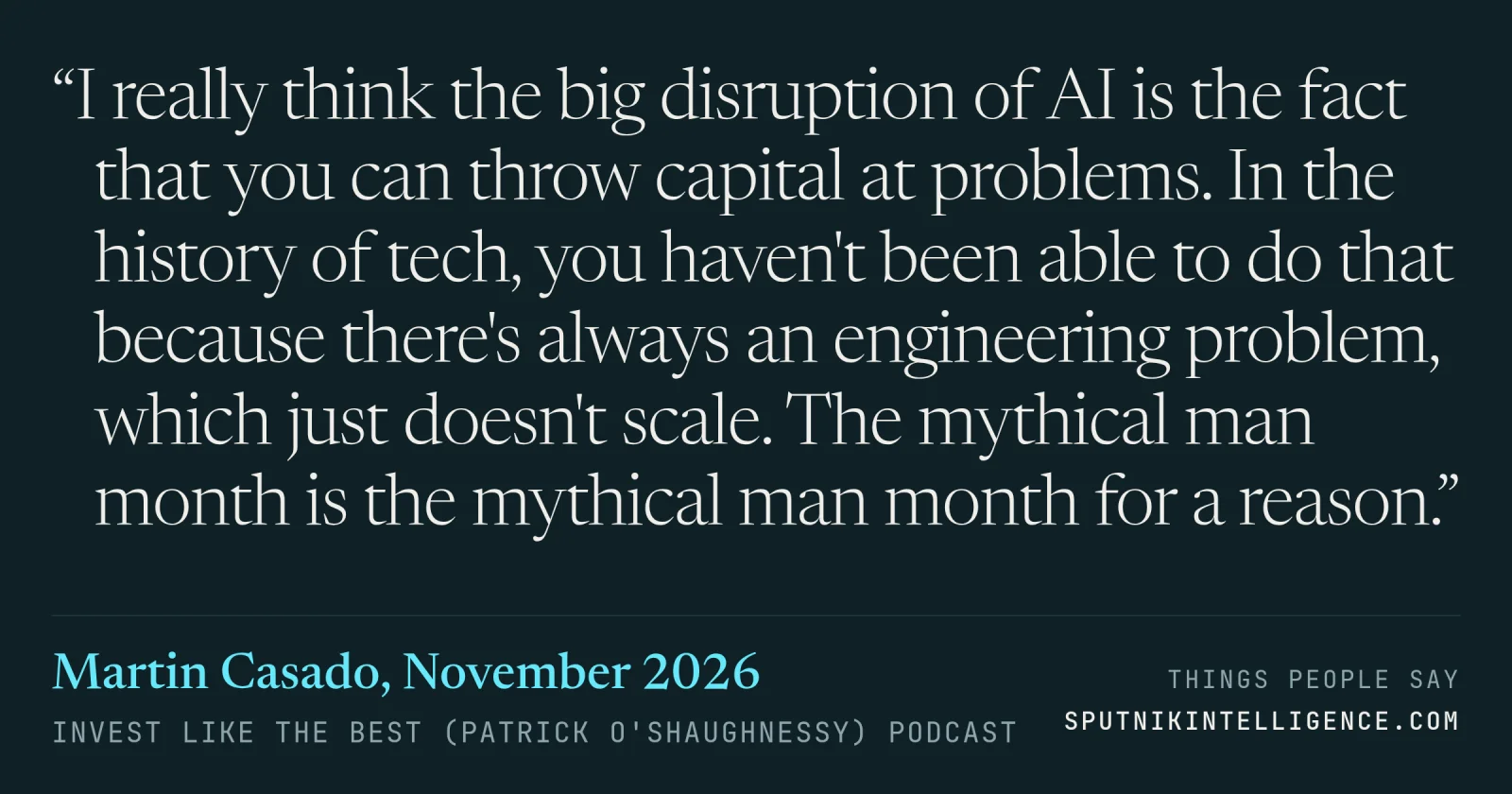
I said this before, but I'm going to reiterate because it's so important. I really think the big disruption of AI is the fact that you can throw capital at problems. In the history of tech, you haven't been able to do that because there's always an engineering problem, which just doesn't scale. The mythical man month is the mythical man month for a reason. 10 years ago, if I had five founders show up and ask for a billion dollars and I gave it to them, what would happen?
Patrick O'Shaughnessy
Sits there.
Martin Casado
Or they would detonate, right? They'd like hire a bunch of engineers. Then you're really fucked. You can't throw capital at net. Can
Patrick O'Shaughnessy
you explain the mythical man month? That's a very interesting idea. Yeah, so the
Speaker names come from our own diarization. The position is estimated from where the line sits in the episode.
The host pointed out that most coding tasks seem saturated, yet people still spend heavily on frontier tokens. Casado argues that competition pushes everyone to the smartest model, so frontier pricing holds even as needs flatten.
Invest Like the Best (Patrick O'Shaughnessy) · 2026-11-04Permalink →Listen →
Invest Like the Best (Patrick O'Shaughnessy)Around 18:54 into the episode
Martin Casado
…intelligence, or the market starts slowing down for another reason? Nobody knows the answer to that. I think there's a very real world where the value comes crashing back down into open source. And we'll see a shift that we've never seen because software has always had a long tail of retention.
Patrick O'Shaughnessy
…And the typical answer is very, very high percentage. That's been the biggest market. And yet, it still seems like people are spending like crazy on Frontier tokens to do coding, which it seemed a little at odds. Like, if I can do it with a six-month-old model or something that's vastly cheaper.
Martin Casado
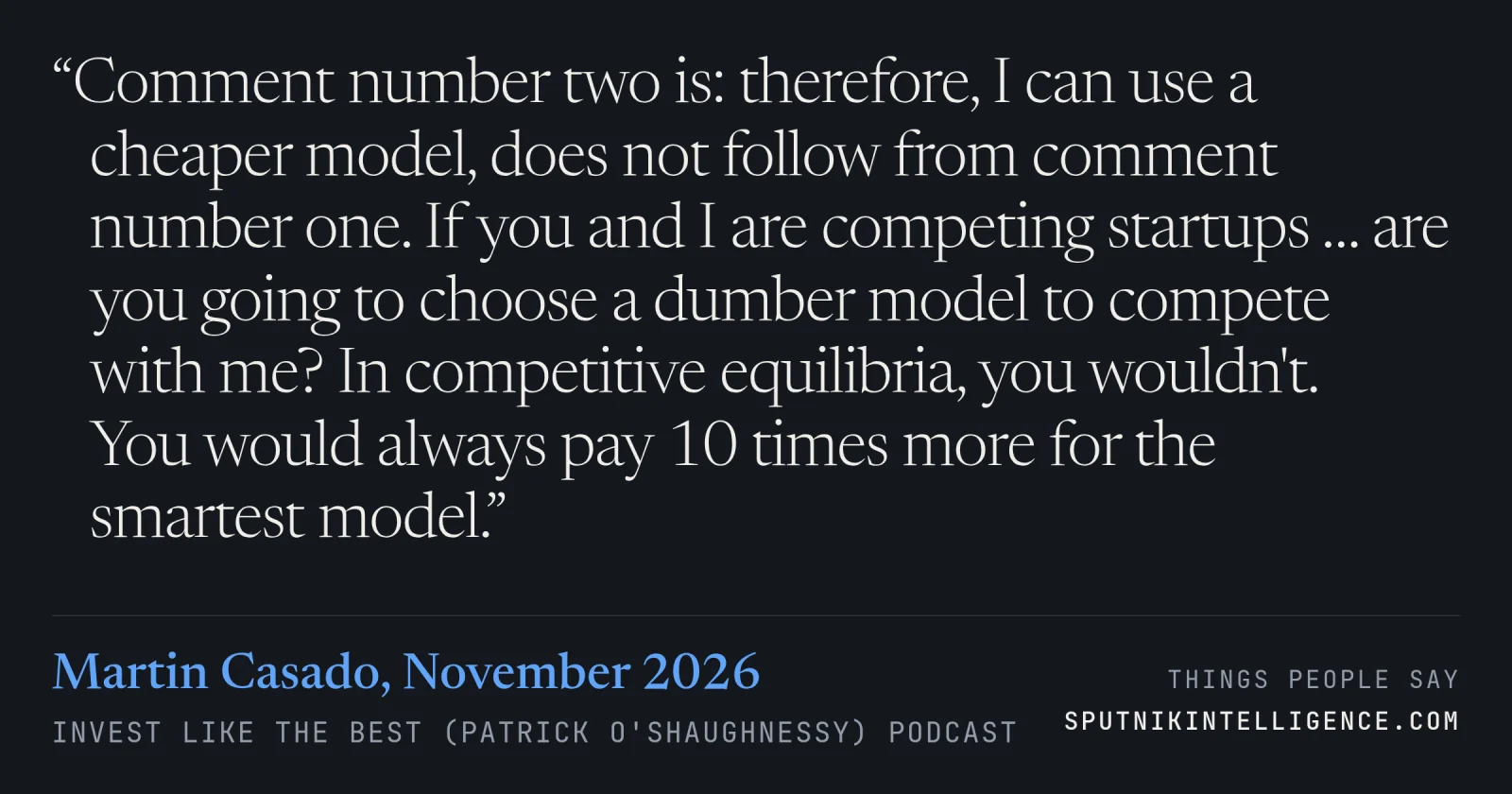
…enough tokens. I've automated 95% already, so I can't automate anyone. And I think that we're getting pretty close to that. Comment number two is: therefore, I can use a cheaper model, does not follow from comment number one. So, if you and I are competing startups, we've got Martin Startup, we've got Patrick Starpace. We've got competing startups. And because we're in competitive equilibria, are you going to choose a dumber model to compete with me? In competitive equilibria, you wouldn't. You would always pay 10 times more for the smartest model. Yeah, always, always, always. And so, there's this very open question of: will you saturate tasks so that you don't need a smarter model? And I think it's very hard to do that in a Darwinistic economic equilibria when you're actually competing. And some of them may, but I think at the end of the day, it's about can you get software out faster? Can you make it better? And can you compete in a…
Patrick O'Shaughnessy
Say more about your personal experience with that, what you're doing with it, what you're learning from that experience.
Martin Casado
My new Grock is so funny. I mean, the home
Patrick O'Shaughnessy
automation thing going on. Oh,
Speaker names come from our own diarization. The position is estimated from where the line sits in the episode.
Casado was asked what happens to a frontier lab if it stumbles and goes six months without a new model. He says a model's useful life is very short, unlike software, which has always had a long tail of retention.
Invest Like the Best (Patrick O'Shaughnessy) · 2026-11-04Permalink →Listen →
Invest Like the Best (Patrick O'Shaughnessy)Around 17:40 into the episode
Martin Casado
…for when we model out the numbers for these companies is what happens if you invest in a model and then you don't get the next model out really quickly. Let's assume that Anthropic stumbles and they don't release a model for six months. What is the lifespan that you think of the previous model?
Patrick O'Shaughnessy
A very short period of time.
Martin Casado
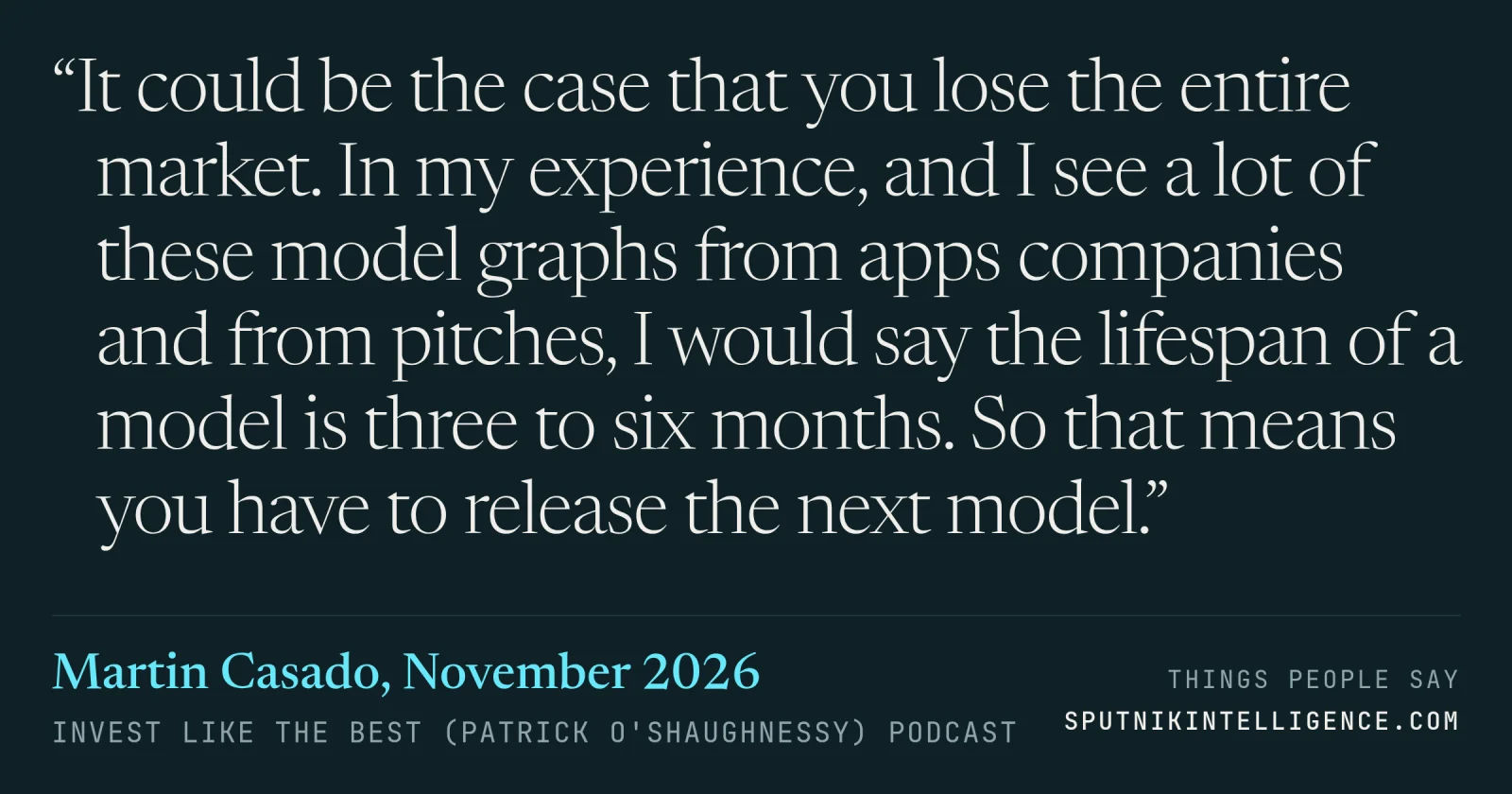
It's very, very short, which is entirely different than we've ever had in software. In software, we've always assumed some long tail. But it turns out what happens if you put out the SODA model and everybody loves it, then something internal happens. I don't know if it's regulatory. I don't know if it's technical. I don't know if it's a breach, whatever. And then you slip three months, right? It could be the case that you lose the entire market. In my experience, and I see a lot of these model graphs from apps, companies, and from pitches, I would say the lifespan of a model is three to six months. So that means you have to release the next model. Model. So, again, for this conversation, I think it's a very interesting conversation. We should tease it apart. Like, what happens if the market continues to grow and doesn't saturate? I think we already know because we have three years of data and it just means the frontier wins and they do a great job and they create great models. And what happens if either the use case is saturated, meaning…
Patrick O'Shaughnessy
On this trip, I've been asking a lot of people what percent of software coding tasks are already saturated. And the typical answer is very, very high percentage. That's been the biggest market. And yet, it still seems like people are spending like crazy on Frontier tokens to do coding, which it…
Martin Casado
Well, these are two different statements. This is a great thing to dig in on, but we need to be very careful. So, statement number one is: I am not using more tokens. I have enough tokens. I've automated 95% already, so I can't automate anyone. And I think that we're getting pretty close to that.…
Patrick O'Shaughnessy
Say more about your personal experience with that, what you're doing with it, what you're learning from that experience.
Speaker names come from our own diarization. The position is estimated from where the line sits in the episode.
Casado is arguing that AI will spread like wildfire wherever the solutions look like its training data, as with code and images, and much more slowly where it has to deal with the physical world. His example is self-driving cars, which he remembers being declared around the corner when Sebastian Thrun won the DARPA Grand Challenge while Casado was at Stanford.
…be much harder, take longer. And I think the economic equivalency is going to be much more difficult. Self-driving is a great example. I remember when Sebastian Thrun won the DARPA Grand Challenge when I was at Stanford. Remember that? And we're like, hooray! Self-driving cars is around the corner.
Jad Naous
Seriously.
Speaker 1
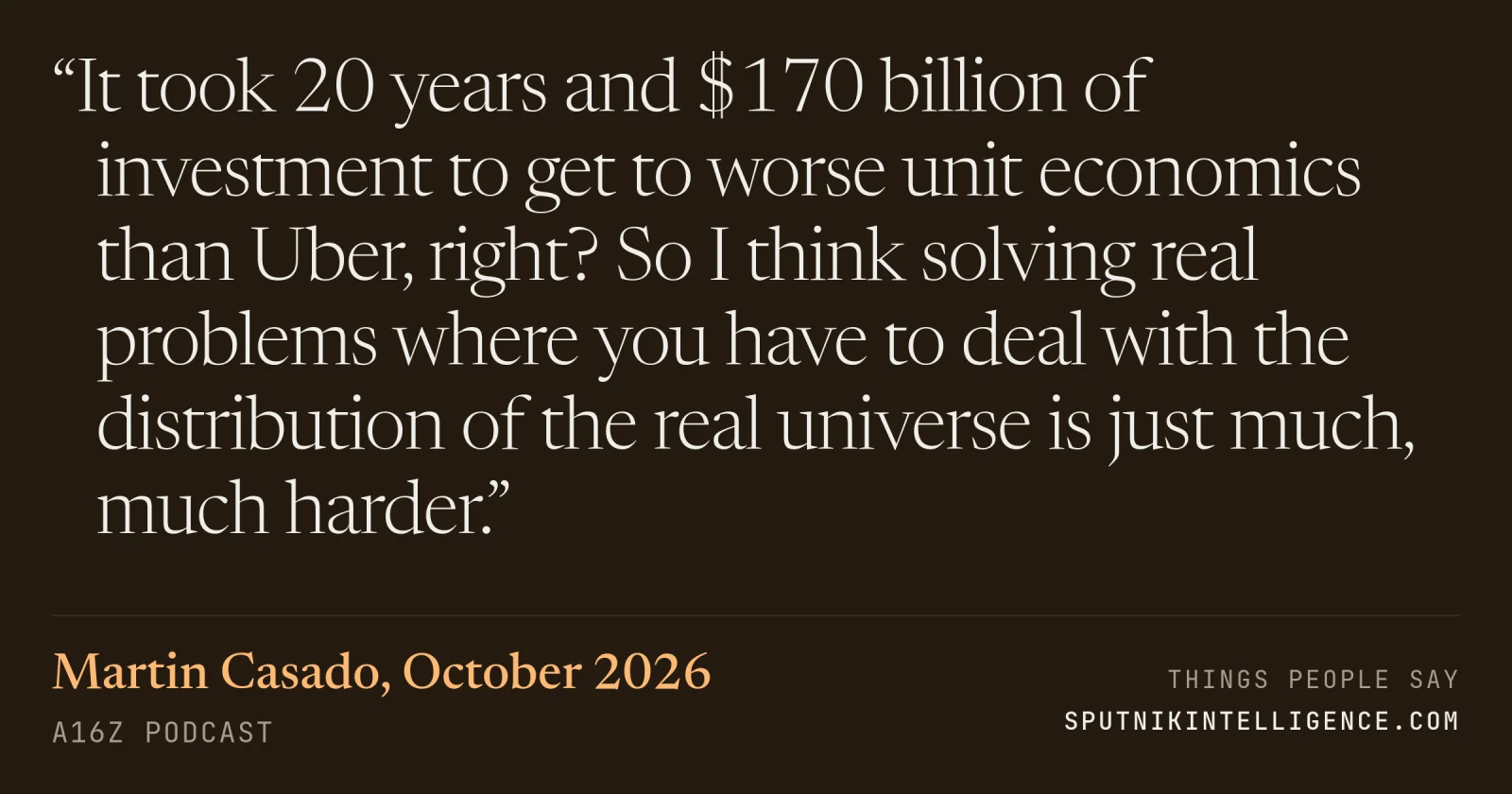
And it took 20 years and $170 billion of investment to get to worse unit economics than Uber, right? So that's, you know, so I think that like solving like solving real problems where you have to deal with the distribution of the real universe is just much, much harder. And so I view as AI as this general. Tool. It's a very effective tool. It's one where, like, you have a distribution of data, and then hopefully you can apply that to like, you know, some problems. And we're going to apply it to a bunch of stuff. And I think economic equilibrium is going to determine what works and what doesn't work because I think it's a very, very general tool. It's like a universal function approximator. And wherever that nets out, I mean, you know,
Jad Naous
one of the things that I said earlier was like how AI was training humans to like use it.
Speaker 1
Yeah.
Jad Naous
And I very often think about like, you know, some of the problems that seem intractable was because the world is kind of that way. And then we're trying to fit AI or the tools that we're building to manage the world as it is. But in some situations, we actually tend to change the world to fit to…
Speaker names come from our own diarization. The position is estimated from where the line sits in the episode.
George Fraser had said that after an hour on hold, he has sometimes wished he could just talk to an AI. Casado argues that bad customer support is a cost problem: human support is expensive, so companies ration it with queues.
The Analytics Engineering PodcastAround 09:21 into the episode
Martin Casado
…you know, the people to add the value on the non-long tail portion of things. And it's the same thing for data. So like your understanding of, you know, your business increases, but there's still basically an infinite amount of work to do. So you want the agents to work on the tail of that work.
George Fraser
…a lot of companies have support that is not that great. Not ours. Our support is fantastic. But I have definitely been on the phone with support at some companies and thought to myself, man, I wish I could just talk to an AI. That would be better. I could get this done. Especially after an hour of
Martin Casado
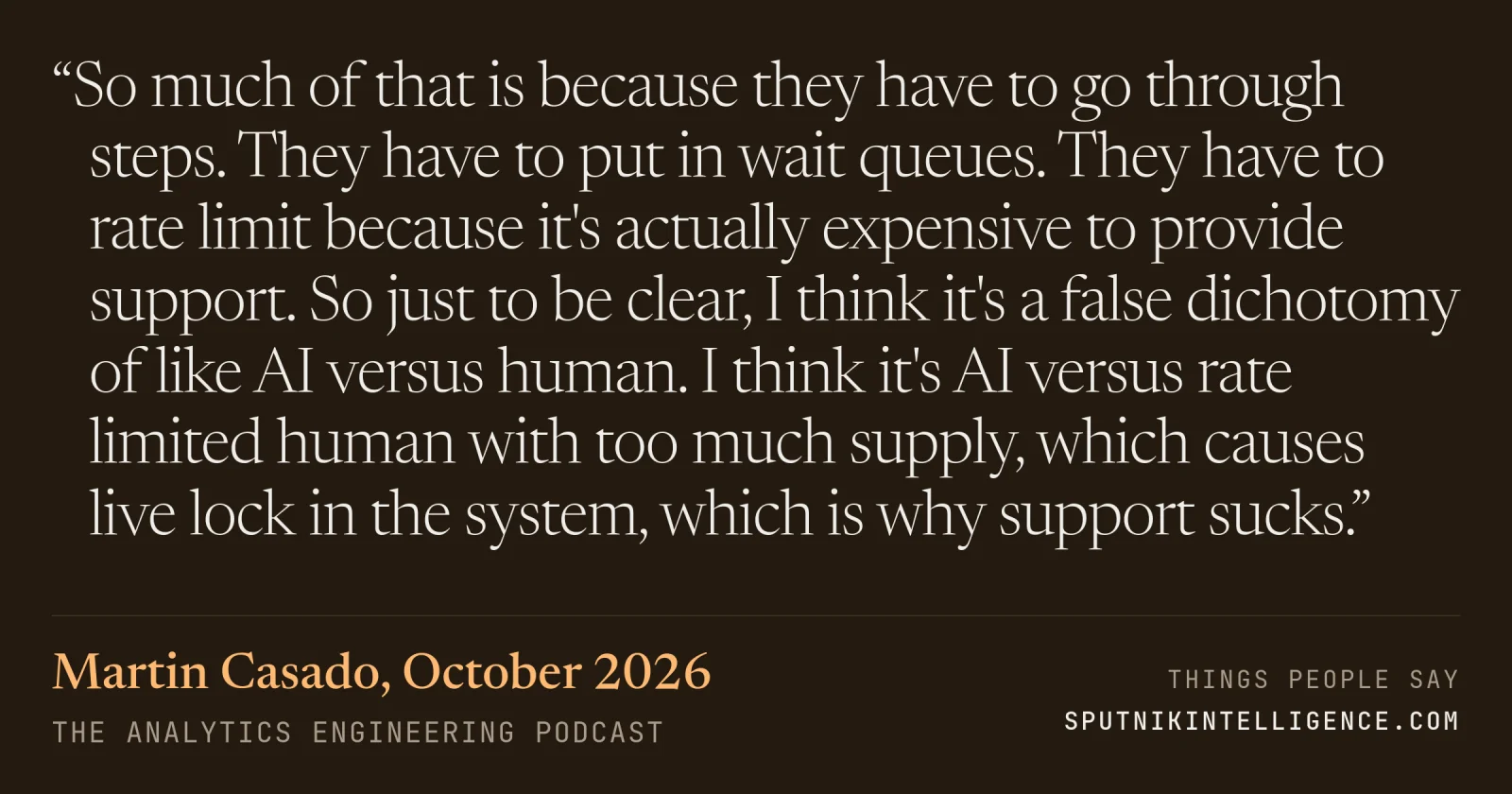
waiting. By the way, and so much of that is because you do not have like a diminishingly marginal cost of providing support. So much of that is because they have to go through steps. They have to put in wait queues. They have to rate limited because it's actually expensive to provide support. So just to be clear, like I don't think, I think it's a false dichotomy of like AI versus human. I think it's AI versus rate limited human with which too much supply, which causes live lock in the system, which is why support sucks.
George Fraser
Yeah. I think a mistake people often make when evaluating AI as a replacement or adjuvant or neutral, whatever, is they compare it to some hypothetical world where you have an infinite supply of experts who never have a bad day and they don't compare it to the reality of what we get. And so they…
Martin Casado
Totally.
George Fraser
So connecting AIs to your company data, super cool thing that you can do. Companies have a choice about how they do this. A lot of the ones we've been talking about that have been writing about how they've done this, they've built their own final layer to that, right? It's their AI analyst, their…
Speaker names come from our own diarization. The position is estimated from where the line sits in the episode.