Ben Horowitz

Things Ben Says on Podcasts

Co-founder and general partner of Andreessen Horowitz, the venture firm he launched in 2009 with Marc Andreessen. Earlier co-founded Loudcloud and ran its successor Opsware as CEO until the sale to Hewlett-Packard in 2007. Author of The Hard Thing About Hard Things and What You Do Is Who You Are. Appears on the a16z Podcast alongside Erik Torenberg, with episodes on AI, open source, infrastructure and the Paid in Full Foundation. Also a guest on Invest Like the Best, Lenny's Podcast, My First Million and Decoder.

Where to Find Them

Ben Horowitz hosts and writes a16z Podcast , hosts and writes The Ben & Marc Show , hosts and writes a16z crypto show , hosts and writes a16z , hosts and writes AI + a16z and writes Raising Health . They have also been a guest on Turpentine VC" | Venture Capital and Investing (2 times) , Slate Money (2 times) , Moonshots with Peter Diamandis (2 times) , All-In with Chamath, Jason, Sacks & Friedberg , Summation with Auren Hoffman , How I Invest with David Weisburd , Masters in Business , Closing Bell , The Twenty Minute VC (20VC): Venture Capital | Startup Funding | The Pitch , Decoder with Nilay Patel , Uncapped with Jack Altman , TBPN , Lenny's Podcast: Product | Career | Growth , Hello Monday with Jessi Hempel , My First Million and Invest Like the Best (Patrick O'Shaughnessy) . They also write for Ben Horowitz on Substack.

Recently: “CoreWeave Crash, AI Trade Cracks, Anthropic IPO Red Flags, Bill Gates Doomer” on All-In with Chamath, Jason, Sacks & Friedberg (October 2026); “What Makes a Great Entrepreneur? | Ben Horowitz on Vintage x Vintage” on a16z Podcast (October 2026); “Investing in TypeSafe AI” on a16z (October 2026); “AI Can Write Code. Why Isn’t Software Better?” on a16z Podcast (September 2026); “AI Can Write Code. Why Isn’t Software Better?” on a16z Podcast (September 2026); “Why a16z is Building a New School for the AI Era | Ben Horowitz” on a16z Podcast (September 2026).

What They Said

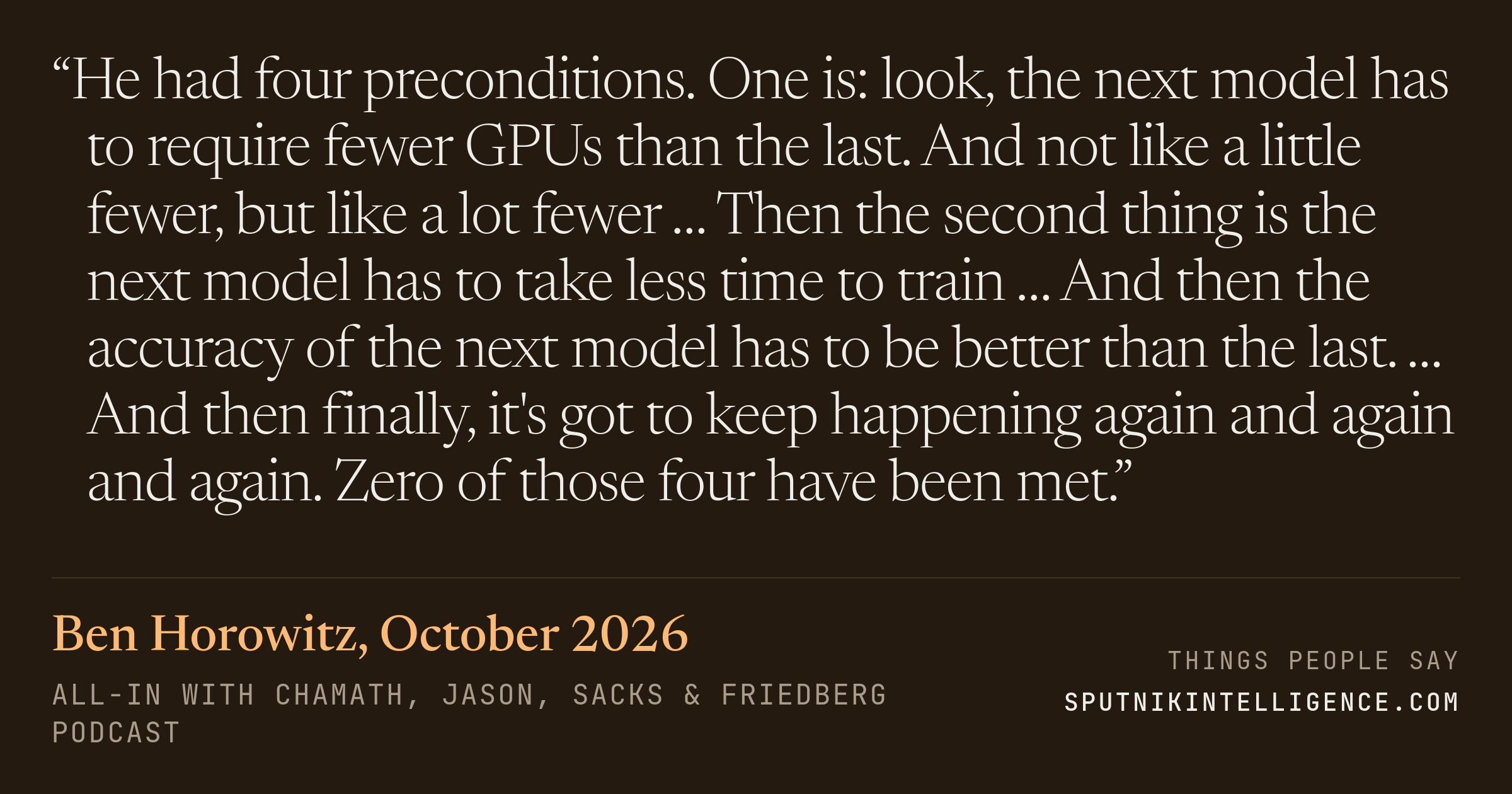
“He had four preconditions. One is: look, the next model has to require fewer GPUs than the last. And not like a little fewer, but like a lot fewer … Then the second thing is the next model has to take less time to train … And then the accuracy of the next model has to be better than the last. … And then finally, it's got to keep happening again and again and again. Zero of those four have been met.” — Ben Horowitz, All-In with Chamath, Jason, Sacks & Friedberg

Horowitz is laying out a Databricks executive's test for whether AI could recursively improve itself and run away from us. He uses it to call the runaway-AI fear "entirely theoretical," and criticizes the AI doomers he says the press amplifies.

All-In with Chamath, Jason, Sacks & Friedberg · 2026-10-17 Permalink → Listen →
All-In with Chamath, Jason, Sacks & Friedberg Around 1:21:46 into the episode
David Sacks

that? We're good. You can't get on everybody except everyone on us.

Chamath Palihapitiya

We're good. We're going to have Ben Horowitz on. We're good.

Ben Horowitz

…funny because it's like, okay, what is the big risk that everybody talks about is this, we're going to, the models are going to self, they're going to recursively self-improve and then they're going to take off. And then they're going to become so smart and run away from us. And Ali Goetze from Databricks had a great formulation of, well, okay, well, what would be the preconditions for that? And he had four preconditions. One is: look, the next model has to require fewer GPUs than the last. And not like a little fewer, but like a lot fewer because otherwise, like you're just going to run out of GPU. Like we just talked about this. You need debt. You got to get the GPUs. You need the power. You need the cooling. Like it's not running away from us. It takes a long time to build the next model. Then the second thing is the next model has to take less time to train because it's got to take off. And then the accuracy of the next model…

Jason Calacanis

if you combine it with the environmental narrative and you combine it with the job apocalypse, it's very potable for the public. It is a ratings hit. Like, oh, they're taking your water. They're polluting your oceans.

Chamath Palihapitiya

Think about his job.

Jason Calacanis

It's a perfect

Speaker names from our own diarization · position estimated from where the line sits in the episode
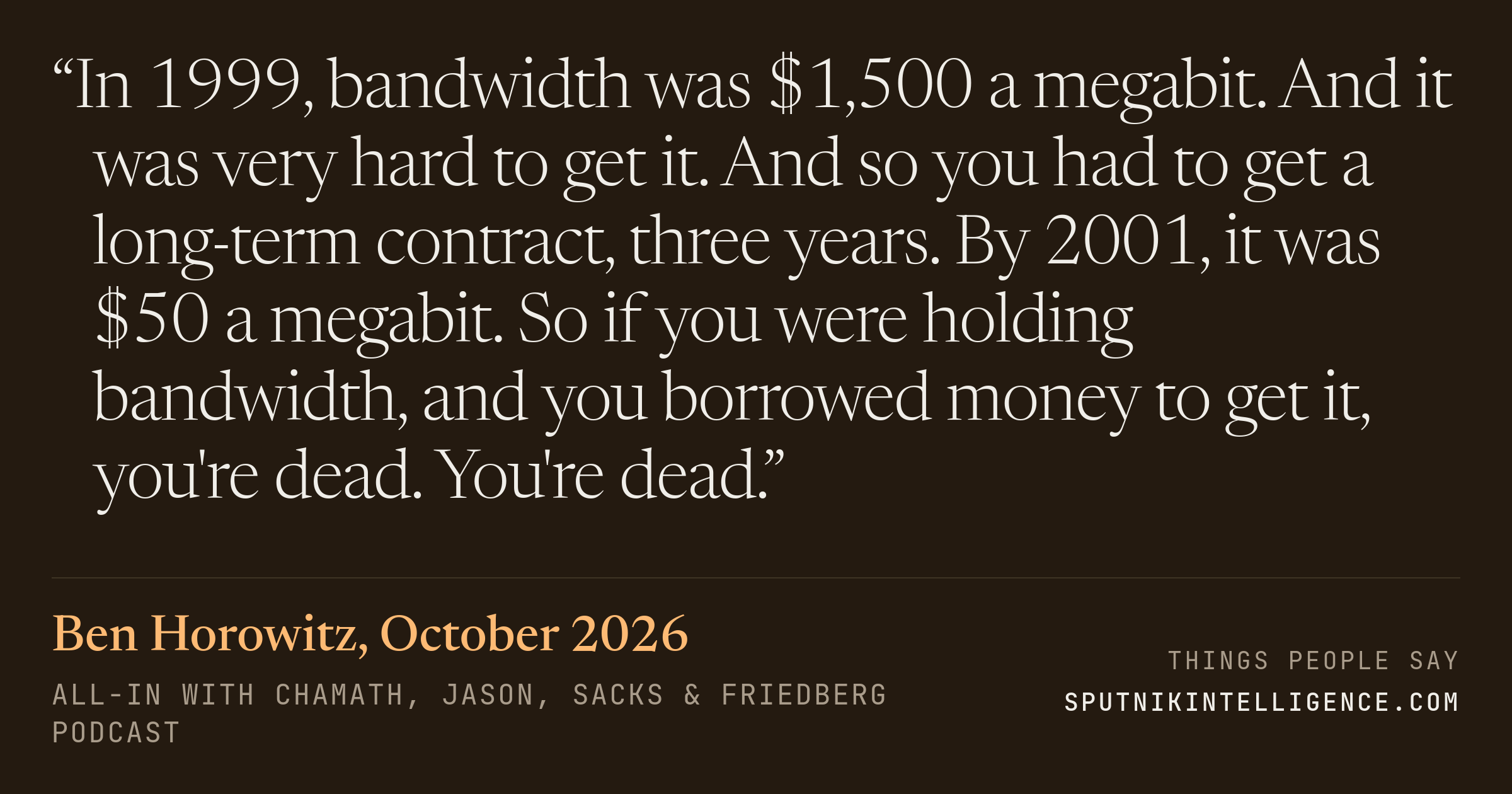
“In 1999, bandwidth was $1,500 a megabit. And it was very hard to get it. And so you had to get a long-term contract, three years. By 2001, it was $50 a megabit. So if you were holding bandwidth, and you borrowed money to get it, you're dead. You're dead.” — Ben Horowitz, All-In with Chamath, Jason, Sacks & Friedberg

Chamath asked why Horowitz's firm has stayed out of GPU clouds like CoreWeave. Horowitz answers from his LoudCloud days: a debt-financed bet on the price of capacity can flip on you. He adds that for now AI is a shortage market, which helps CoreWeave.

All-In with Chamath, Jason, Sacks & Friedberg · 2026-10-17 Permalink → Listen →
All-In with Chamath, Jason, Sacks & Friedberg Around 12:20 into the episode
Ben Horowitz

Yeah.

Chamath Palihapitiya

But it's very interesting to me that you and Mark, as the kind of primogenitor, have passed on the whole space. So I want to know why.

Ben Horowitz

Well, it's because of this. I mean, so it can end up being like a very dangerous arbitrage business where you can get upside down easily. And so if you look at LoudCloud, just as an example, just here, here's a simple thing that happened to us. In 1999, bandwidth was $1,500 a megabit. And you couldn't get it, it was very hard to get it. And so you had to get a long-term contract three years. By 2001, it was $50 a megabit. So if you were holding bandwidth, and you borrowed money to get it, you're dead. You're dead. So that, you know, that kind of thing is so out of the control of the entrepreneur and so different than what we'd like to fund that, you know, it just, it scared, it scared me to death. Now, look, I think the core dynamic of AI has been working for Core Weave, though, in terms of that, in that there's a massive shortage, not an overage of supply. So those prices don't seem to, you know, token prices have gone down, but GPU prices have not. And so things are going up. And by the way, data center space is going up in price…

Jason Calacanis

All right, Sachs. Here's your polymarket. Core weave announces bankruptcy. That's a pretty aggressive polymarket. 15% chance at the end of 27 next year, 23% at the end of 2028. Seems a little far-fetched, given the fact that they have a massive demand for their equipment, as Ben Horowitz out. Well…

Chamath Palihapitiya

look, this is dumb because I think Michael explained it. Like you have this opco-propco setup. So CoreWeave can't go bankrupt. An asset-level vehicle for a data center or a build out could theoretically go upside down, but that'll go into receivership and then just manage where you sell down the…

Jason Calacanis

Yes, he explained in that clip. He has each box independent of the next. So not a great polymarket, I think.

Speaker names from our own diarization · position estimated from where the line sits in the episode
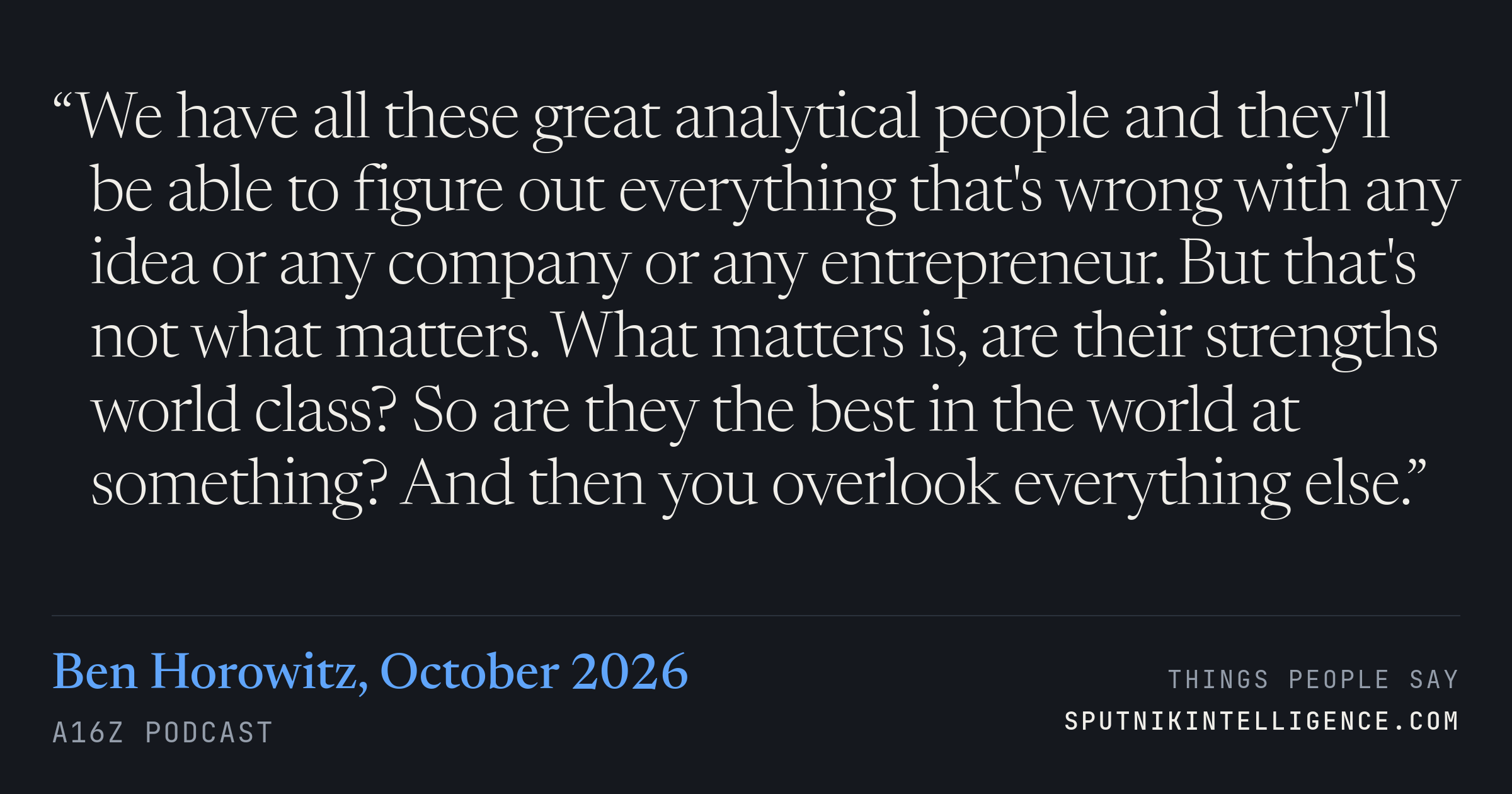
“We have all these great analytical people and they'll be able to figure out everything that's wrong with any idea or any company or any entrepreneur. But that's not what matters. What matters is, are their strengths world class? So are they the best in the world at something? And then you overlook everything else.” — Ben Horowitz, a16z Podcast

Horowitz was asked how a venture investor gets good at picking winners. He calls this a trap his own firm falls into from time to time: every great entrepreneur has something badly wrong with them, so a list of flaws tells you little. What he looks at is the size of the one strength.

a16z Podcast · 2026-10-10 Permalink → Listen →
a16z Podcast Around 20:51 into the episode
Speaker 1

should have hired Aaron. That's the one that Chris Lyons got.

Speaker 3

Being a VC is about picking winners. Tell me something about picking winners. How do you manage emotion? How do you become great at picking winners?

Speaker 1

…Like that's a mistake. Or, you know, vice versa, you're like, this is a great entrepreneur, but you don't realize his idea is no good. So probably not as good as you think. So it is tricky in that sense. And then, yeah, you don't know how they're going to perform under pressure. And then the other thing that like the other trap that, you know, we'll get into from time to time is, you know, we have all these great analytical people and they'll be able to figure out everything that's wrong with any idea or any company or any entrepreneur. But that's not what matters. What matters is, are their strengths world class? So are they the best in the world at something? And then you overlook everything else. Like kind of going back to Elon, like he's got some personality issues. You know, like he upsets people from time to time, but like his strength is so ridiculous that you put money on that every time. And I think you want to look at the magnitude of the strength. And I think that like every entrepreneur we see who gets to us is pretty good. But are they like outstanding? Are they better than…

Speaker 3

When you think about, you know, picking the person and be like, well, those things are not so good, but this person's going to make some moves. Definitely sent waves through Silicon Valley, but blowback from the culture on like, you know, the firm kind of getting behind the Trump campaign to some…

Speaker 1

So with the Trump thing, you know, like we try to be as apolitical as possible, but we had run into massive problems with the Biden administration on kind of two fronts. One was crypto and then the other was AI. So on crypto, they basically didn't outlaw to the end. They did these extra legal…

Speaker 3

who are you to ask for a meeting? You deserve a meeting with Biden.

Speaker names from our own diarization · position estimated from where the line sits in the episode

Collections They Appear In