The panel was debating how compute deals get repriced if data center supply tightens. Chamath says scarce capacity pushes prices up and hands the advantage to the biggest buyers.
All-In with Chamath, Jason, Sacks & FriedbergAround 1:19:30 into the episode
Chamath Palihapitiya
Not if you miscast what I'm saying. You can
Jason Calacanis
…or lack of one and by the loyalty of Anthropic and their success, making them a great long-term partner, especially for the space data center business. So I could see him instead of throwing it up to spot saying, hey, let's meet somewhere in the middle. That's what I think. It's a longer time.
Chamath Palihapitiya
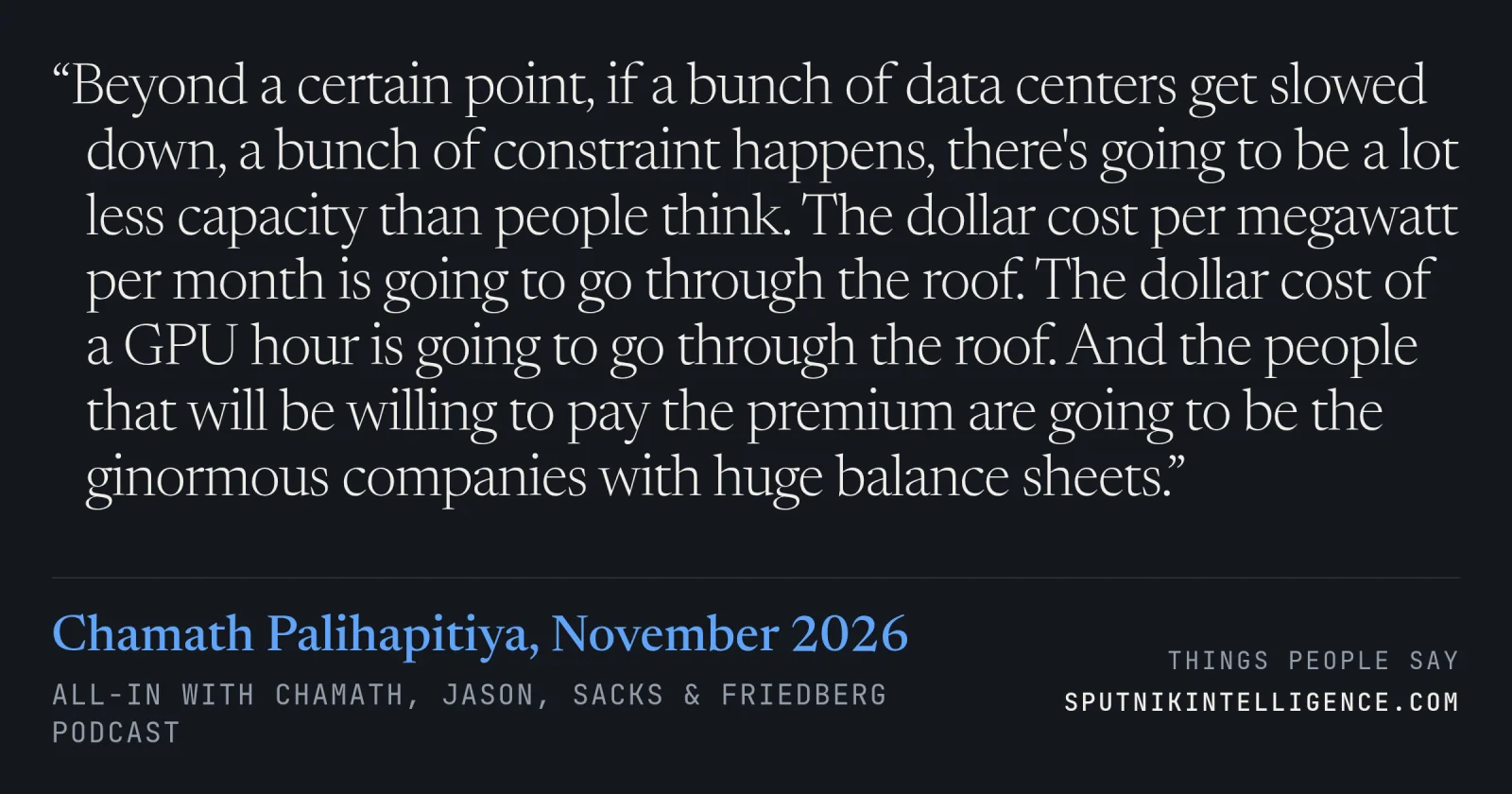
I'm not saying throw it up to spot. What I'm saying is when Spot moves sufficiently, even a long-term offtake moves so much that existing contracts are negative EV. And so you just got to move existing contracts to positive EV territory. And if you can get out in 90 days and reprice something into positive EV territory, you should. So my point is more that beyond a certain point, if a bunch of data centers get slowed down, a bunch of constraint happens, there's going to be a lot less capacity than people think. The dollar cost per megawatt per month is going to go through the roof. The dollar cost of a GPU hour is going to go through the roof. And the people that will be willing to pay the premium are going to be the ginormous companies with huge balance sheets. And so you could just sell it to Google or Meta if you wanted to. You don't have to sell it to OpenAI.
Jason Calacanis
Okay, Sachs, the really interesting part of all this, just to dip into the science corner, is this infrastructure does two things, right? Inference, people using the product every day, and then building the next model. If you want to run away with the next model, cornering compute at any price is a…
David Sacks
I'll say something very quickly. When you're talking about infrastructure of this magnitude, these gigawatt power data centers, they cost around $50 billion. Okay. Nobody can make that investment in conditions of uncertainty. The last thing you ever want to do is break ground on a project like…
Jason Calacanis
All right. Everybody has been demanding, Friedberg, that we do a science corner on this exponential time hypotheses. I guess a layman's way of explaining it would be computers can't solve important problems quickly, but there seems to be some science and some recent innovations that say maybe this…
Speaker names come from our own diarization. The position is estimated from where the line sits in the episode.
The hosts were arguing about what a new Congress and local data center limits mean for the big AI labs. Chamath says any real constraint on data centers shifts power to the companies that own capacity, not the labs that rent it.
All-In with Chamath, Jason, Sacks & FriedbergAround 1:05:17 into the episode
David Sacks
up with more power and those companies end up with regulatory protection. Moth,
Jason Calacanis
go ahead. I don't think so.
Chamath Palihapitiya
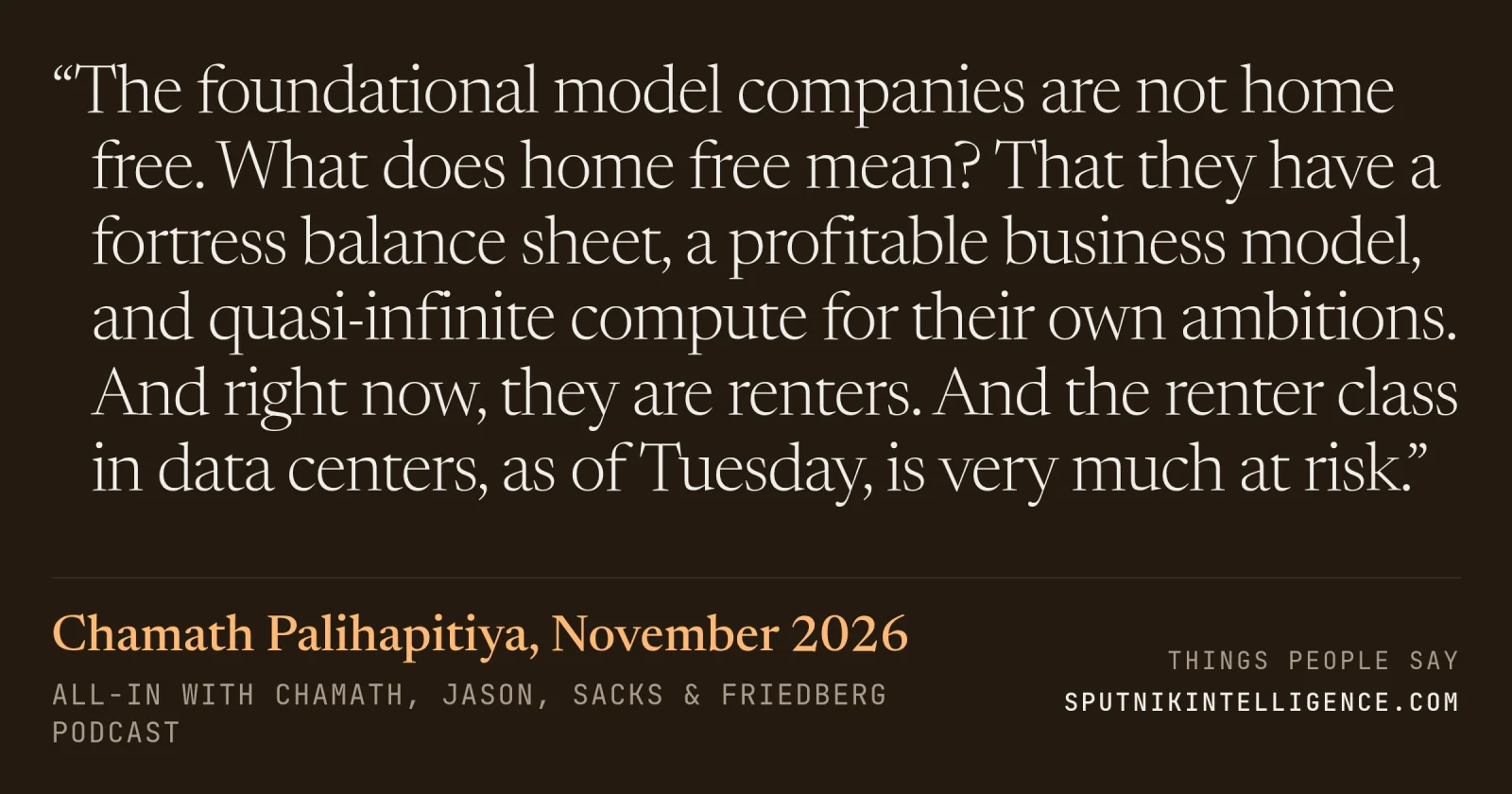
…AI, I think it's going to be broad-based and include a lot of coverage around data centers and AI factories. And to the extent that that happens, maybe you'll get some regulatory capture on the one end, but you're going to constrain the supply so severely on the other that the real people that will be in control of it are Meta, Amazon, Google, Microsoft, and SpaceX. And so you have to remember the foundational model companies are not home free. What does home free mean? That they have a fortress balance sheet, a profitable business model, and quasi-infinite compute for their own ambitions. And right now, they are renters. And the renter class in data centers, as of Tuesday, is very much at risk. And so if anything, I think what's going to happen is all the renter classes will get co-opted. For example, I don't know if you guys saw today, but Google just took over a Crusoe data center. They co-opted the renter. They're like, you're gone. We're going to take it over. They did? Yeah. So why is that happening? It's because they have all of the core critical ingredients, specifically the…
Jason Calacanis
You know, I did a calculation this week. I was looking at the phenomenal impact that agents are having inside of our venture capital firm launch. And we're spending $50,000, $40,000, $50,000. Say the name of your venture capital launch. Thank you. Where can I go to
Chamath Palihapitiya
learn more about that? To
Jason Calacanis
launch.co. Thank you. Thank you very much. I'm trying to let people know I have a day job beyond podcasting. I invest in 100 companies a year. And we have 20 people. We're spending like $50,000 a year, I think, $40,000, $50,000 on these subscriptions, Grok, Claude being the main ones. I estimate…
Speaker names come from our own diarization. The position is estimated from where the line sits in the episode.
Chamath Palihapitiya on the AI companies' borrowing needs through 2027, which he says amount to about 30% of what the Treasury is about to issue. David Friedberg follows by predicting governments will try to regulate compute.
All-In with Chamath, Jason, Sacks & FriedbergAround 37:07 into the episode
Jason Calacanis
…This is really dangerous because we're not going to be able to build out the compute we need. And what does that do to the entire industry in the next three to five years if we can't build out this? And how do we turn that narrative around? So people are like, yeah, we should have data centers.
David Friedberg
…And I think one of the ways this is going to play out, to Jamaf's point, is in the near term in capital, there's more capital going to the AI organizations and the government. The governments aren't going to want to let that happen. So they're going to try and stop the data centers because then
Chamath Palihapitiya
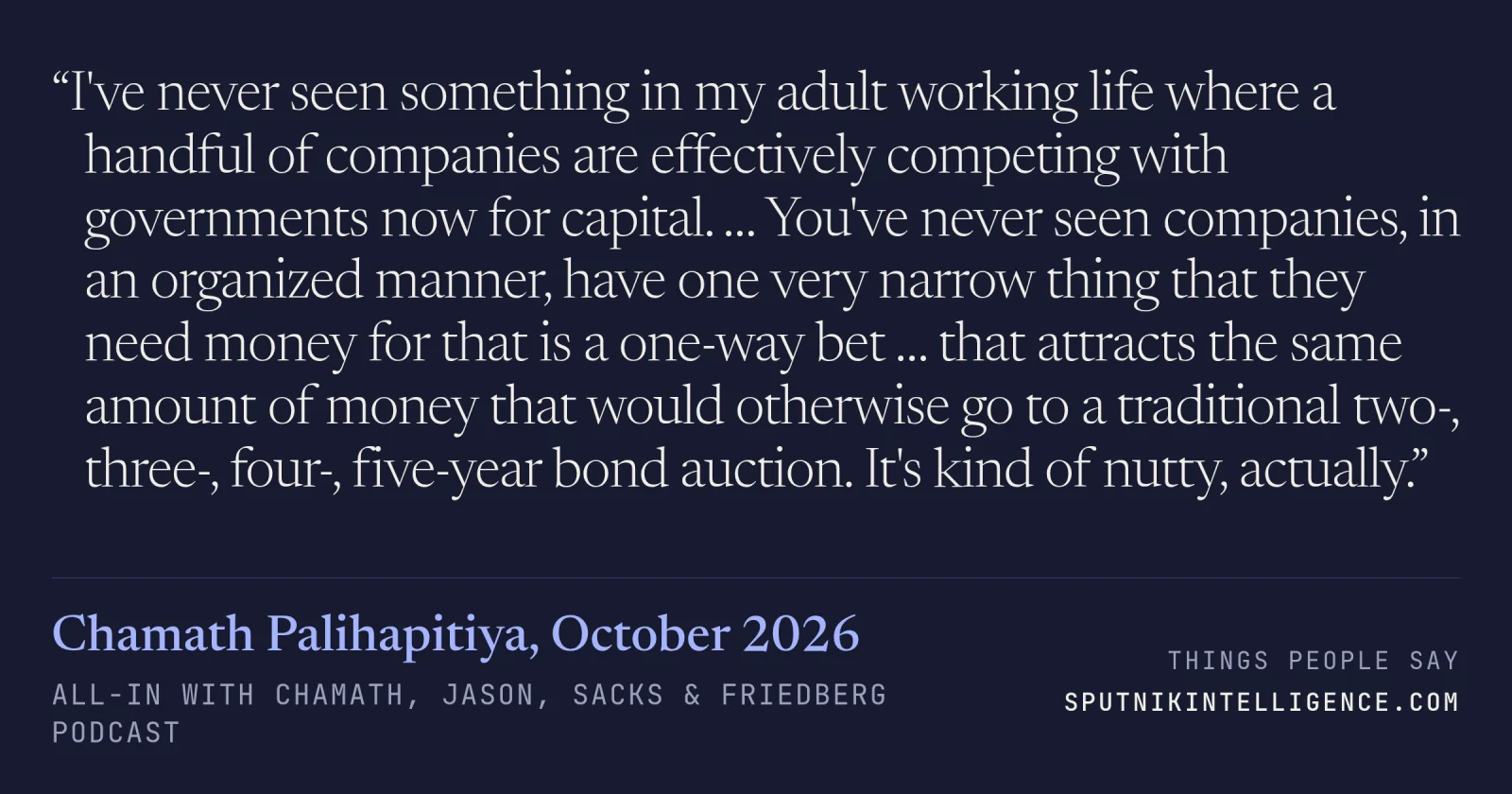
I've never seen something in my adult working life where a complex of a handful of companies are effectively competing with governments now for capital because you've never seen companies in an organized manner have one very narrow thing that they need money for that is a one-way bet on something that attracts the same amount of money that would otherwise go to a traditional two three four five-year tenure bond auction it's it's kind of nutty actually the story
David Friedberg
you're going to hear from both sides is a story of which side benefits the people more and that's going to be the narrative argument which is going to be every side's going to say the other side's lying because remember if one side's lying and another side's not lying yeah the side that's not lying…
Jason Calacanis
are for sale. And Dario and Anthropic should start buying just like the right did. Oh,
David Sacks
they already have. I don't see them with
Speaker names come from our own diarization. The position is estimated from where the line sits in the episode.
Chamath Palihapitiya gives his big takeaway from a chart-by-chart read of Anthropic's S-1. He says the risk factors show the binding constraint is compute: data centers, power and chips.
All-In with Chamath, Jason, Sacks & FriedbergAround 34:07 into the episode
Chamath Palihapitiya
…the capital markets into the IPO are going to be less, which means that they'll have more pricing power. They'll be able to manage the float better. All of these dynamics, I think, give you a constructive read going into the IPO. Okay, now let's move on because I think here's my biggest takeaway.
David Friedberg
Meta's net cash is negative too. It is 80 billion of cash and short terms and 82 billion of debt.
Chamath Palihapitiya
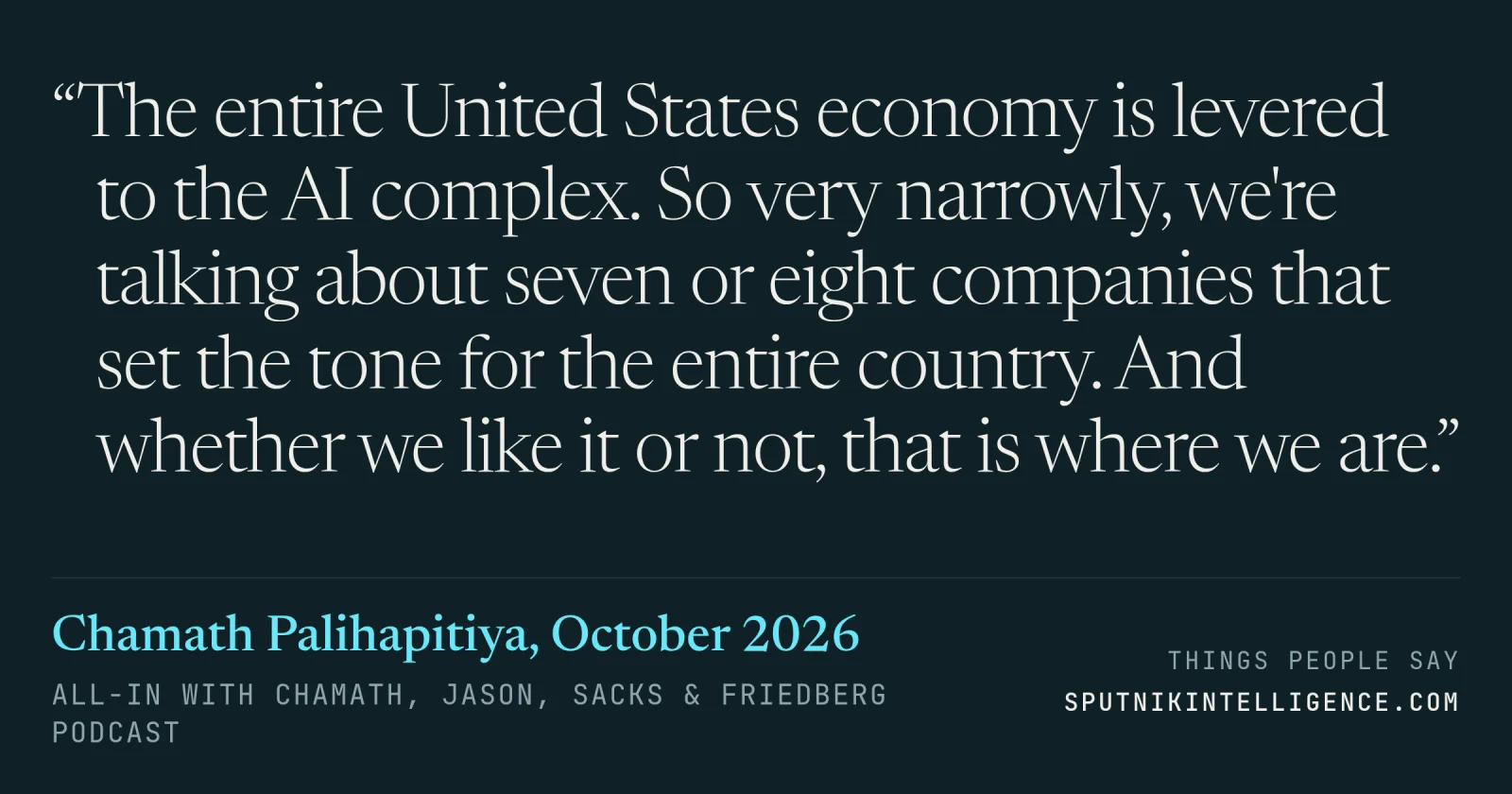
Okay, now go back to this. What is my big takeaway? It's bigger than Ant. I'm going to build on what Sak said. The entire United States economy is levered to the AI complex. So very narrowly, we're talking about seven or eight companies that sets the tone for the entire country. And whether we like it or not, that is where we are. Why do I say that? One, the most important companies in the world are in a massive spending binge, right? These were highly profitable, highly cash accretive, highly cash flow generative businesses that have said, we're going to put the foot down on spending because we believe in what's coming into the future. That's what drives GDP and it's what drives growth. Okay, next chart. Now, as they do that, though, they deplete their cash and they have to raise debt. Okay. And this is what you see. All but Microsoft. By the way, what an incredible job Satya has done. He's halved his debt while everybody else has, you know, just gone to an unbelievably crazy high number. So the AI…
David Sacks
Jamath, a lot of people are looking at that number and they're trading these stocks down based on that. I kind of view it the opposite, which is I don't, these are smart companies. I don't think they'd be making those kinds of investments unless they thought there was ROI there. And so they're…
Jason Calacanis
ROI based on the total. Token usage and the fact that only one or 2% of people in corporate America are even using these tools. We are greatly underestimating the uptick here. Quad hasn't even launched a bot yet, a Grok bot. And OpenAI just launched theirs and it's in like a small use case when 100…
Chamath Palihapitiya
You're absolutely right, Jason. The problem is the regulatory pushback. The amount of approvals and the ability for utilities to find the staff and the ability to actually turn these things on. And then the ability to get the capital equipment you need, it just isn't there right now. So we as a…
Speaker names come from our own diarization. The position is estimated from where the line sits in the episode.
Chamath Palihapitiya puts a chart from Microsoft's earnings on screen to argue AI shows up as productivity gains rather than job losses. He says headcount stayed flat while revenue grew by about two thirds.
All-In with Chamath, Jason, Sacks & FriedbergAround 26:05 into the episode
David Sacks
measure that? But by the way, I agree with you. The
David Friedberg
…to be more competitive, perhaps with cheaper tokens for cheaper, easier tasks, and then premium tasks, charge a higher price for intelligence and start to stratify the value of the intelligence that they're providing by changing the price points. And I envision that's where everyone's going to go.
Chamath Palihapitiya
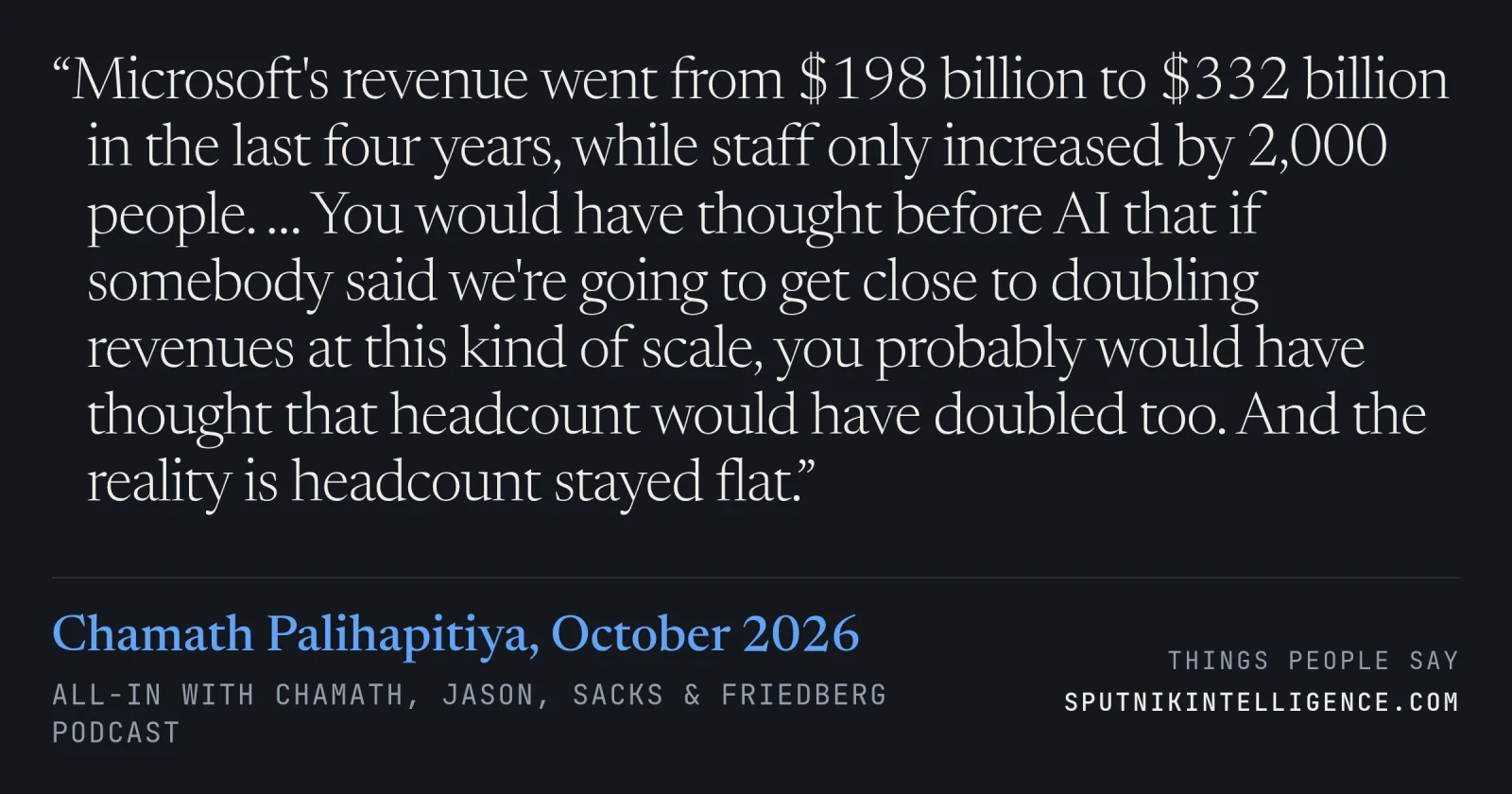
Nick, I'm going to show you. This is to Friedberg's point about what is the potential downstream productivity gains that everybody can have theoretically with AI. Just put that on the screen. This is from Microsoft's earnings. My research team put this together. It's really quite incredible. What this shows you is that Microsoft's revenue went from $198 billion to $332 billion in the last four years, while staff only increased by 2,000 people. I mean, isn't that stunning? Like you would have thought before AI that if somebody said, great, we're going to, you know, get close to doubling revenues at this kind of scale, you probably would have thought that headcount would have doubled too. And the reality is headcount stayed flat. And we don't know how many people will take this offer that Microsoft just gave for, you know, to leave…
Jason Calacanis
Okay, so based on this, your premise is they need data centers. If they don't get data centers, it can't keep growing. However, Sachs, the truth is these are the liberal of all liberals in Silicon Valley. It is the largest amount of money that has ever been made by founders outside of Elon Musk. It…
David Sacks
Maybe, but I don't think that's the Democratic Party that we have today. I mean, the old Clinton Democrats, I mean, Bill Clinton Democrats are long gone. I don't think the abundance Democrats are picking up a lot of momentum. I mean, the Democratic Party, as Gavin Dusom said, is becoming…
Jason Calacanis
So you don't need to do much, I think, Freeberg, to scuttle the Trump economy since the war, tariffs, and all that other stuff have driven inflation and all those problems. Wouldn't it be smarter for the Democrats? I mean,
Speaker names come from our own diarization. The position is estimated from where the line sits in the episode.
Peter Diamandis asks for his investment advice for the next three years. Chamath says he doesn't know. If forced to choose, he would own cash flow, own power, and use alternative ways of deploying capital.
Moonshots with Peter DiamandisAround 1:56:38 into the episode
Chamath Palihapitiya
…ebb and flow. And it was obvious that the way to penetrate AI in 2015 was in the silicon layer. And to me, but to me, it's now totally saturated and no money will be made. And now I have to go down or go up. And so I chose to do both. But I could be wrong, but that's sort of how I think about it.
Peter Diamandis
I'm going to sneak in one final question on behalf of our viewers. And if you're willing to, what's your investment advice during this hypersonic tsunami right now over the next three years? Where do people place capital? My
Chamath Palihapitiya
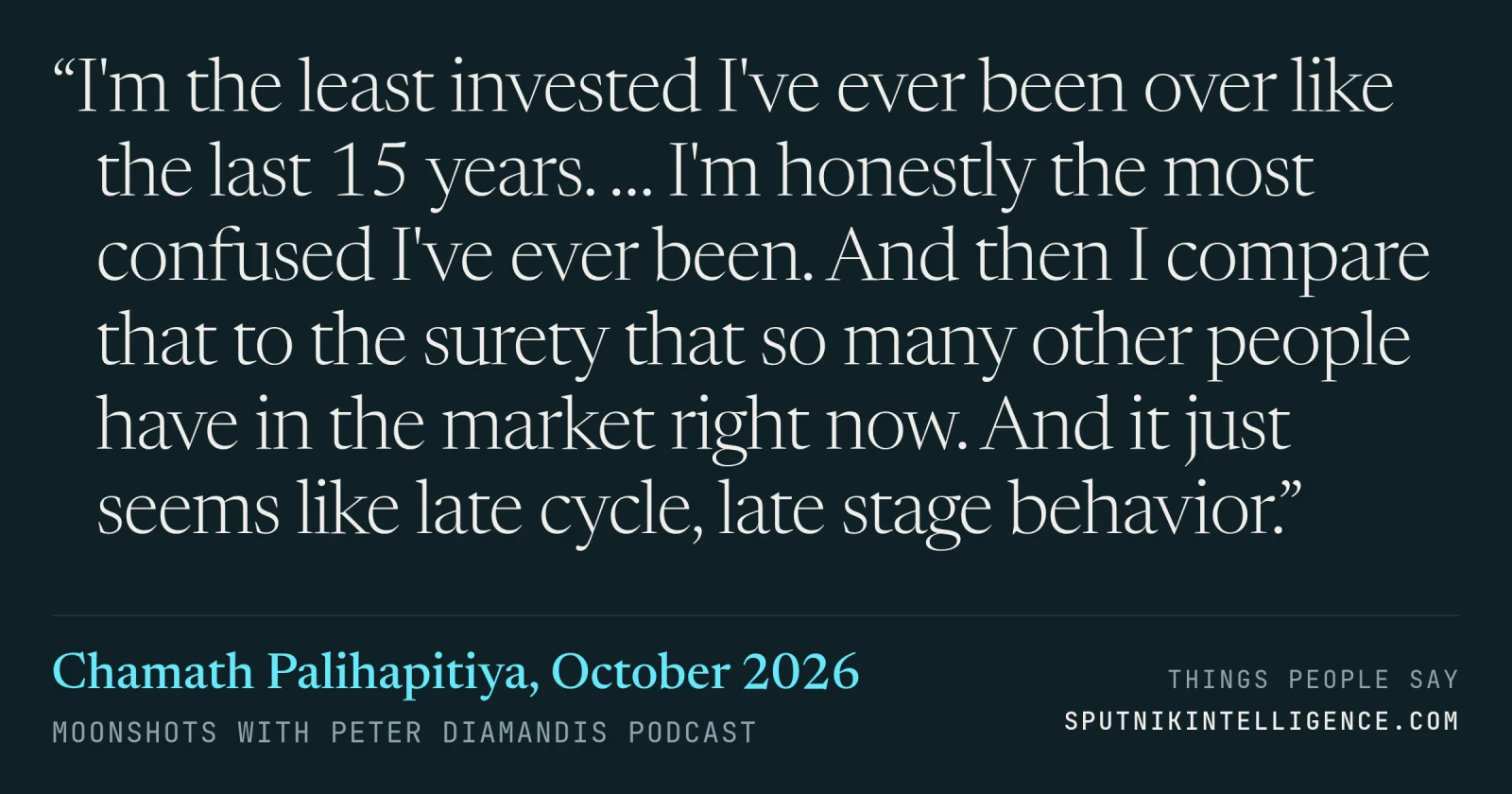
…to Salim's point, I'm in this schizophrenia about pivoting towards cash flow. You know, to Dave's question, I have gone up and down the stack. To Alex's question, I'm still trying to figure out whether there's a better way to create liquidity in the public market. So different kinds of assets that have different payoff profiles could be available in the public markets when ASI actually lands. I'm honestly the most confused I've ever been. And then I compare that to the surety that so many other people have in the market right now. And it just seems like late cycle, late stage behavior. And so I'm just kind of like, I don't know, I'm not smart enough to know. And I'd just rather bide my time and think through it all. But if I had to pick, what I would say is I like owning cash flow because I think it'll give me the oxygen to pivot to what will matter. I like owning power because I think it is the constraint, the fundamental constraint of everything for the next 10 or 15 years.…
Peter Diamandis
Yeah, it's tough. All right, we always close out with a fan video, outro song. This one is called Everything is Cooked by Douglas Lance. And just for a little bit of history, Alex has an incredible voice. Alex, you were performing in what when you were younger?
Salim Ismail
Yeah, my first career, this is not widely known, was as a boy soprano performing with the New York City opera company. I performed on stage in Carmen and Labo M, did a tour with Tarendo, and then my voice changed. And then they kicked me out of the New York City opera company. You don't get to be a…
Peter Diamandis
All right. Well, here's another. Playback of your younger self.
Speaker names come from our own diarization. The position is estimated from where the line sits in the episode.
In a conversation about compute and power shortages, Chamath argues that the limit is now physical infrastructure, not model capability. He follows by pointing to a risk factor in Anthropic's S-1: that hyperscalers may not give the company enough compute.
Moonshots with Peter DiamandisAround 54:20 into the episode
Peter Diamandis
so i love the fact that
Alexander Wissner-Gross
you said that because so many people come back and say what are we going to do what's my purpose where where's my mission everything you just for the next five years Yeah, exactly.
Chamath Palihapitiya
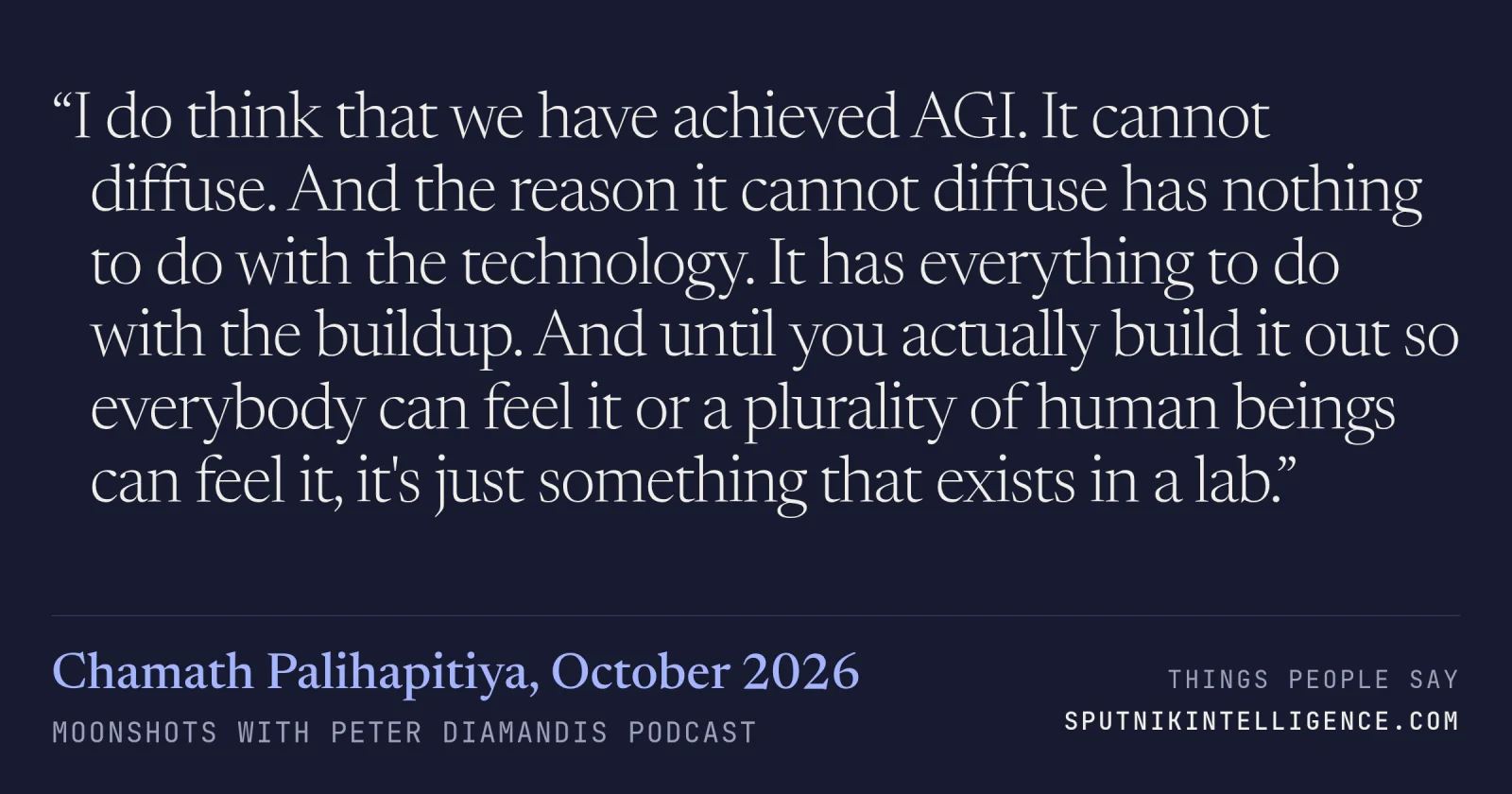
All this whole, look, I do think that we have achieved AGI. It cannot diffuse. And the reason it cannot diffuse has nothing to do with the technology. It has everything to do with the buildup. And until you actually build it out so everybody can feel it or a plurality of human beings can feel it, it's just something that exists in a lab. Now, that has value. Don't get me wrong. But I would not underestimate the difficulty. And if you look at, for example, the Anthropic S1 that just dropped today, it's shocking to me that the claim that they have to put as a risk factor, which I would never have thought would have happened for a company growing this fast and so powerful with all this money, the hyperscalers will not give them compute. I've never seen that before. Wow.
Alexander Wissner-Gross
Yeah, it's wild. No, it's a really good indicator. You know, also, Elon was saying there's 15 gigawatts of chips just waiting for liquid-cooled data centers to fall into. That's a massive asset depreciating idly.
Chamath Palihapitiya
It's worse than that. There's that. Then there's also the non-Vera Rubin stack chips, the older generation that are also still sitting. There's a bunch of these guys that have these things sitting in inventory. Those aren't being used. Then even when you try to do liquid cooling, if you saw what…
Alexander Wissner-Gross
Yeah, and it's not just trades, too. There's regulatory components. If you're a good negotiator, you can get involved. There's planning. It really involves every human skill. And it just drives me nuts that so many people are saying, well, look, math is cooked. Teaching is soon to be cooked. I…
Speaker names come from our own diarization. The position is estimated from where the line sits in the episode.
Opening a segment on Ken Griffin's AI bubble warning, Chamath describes a loop: VCs fund startups, the startups spend that money on other companies' AI, and the resulting revenue is used to raise more money. He says a Ramp economist confirmed his rough estimate.
All-In with Chamath, Jason, Sacks & FriedbergAround 01:10 into the episode
Chamath Palihapitiya
…they had was because I was doing my own math. And I tweeted this thing, Nick, maybe you can put it back up there, where I said, okay, my back of the envelope math, knowing everything that I know and everything that I see, is about 1% of all of the companies represent 90% of all the revenue. And
Jason Calacanis
revenue for AI spend?
Chamath Palihapitiya
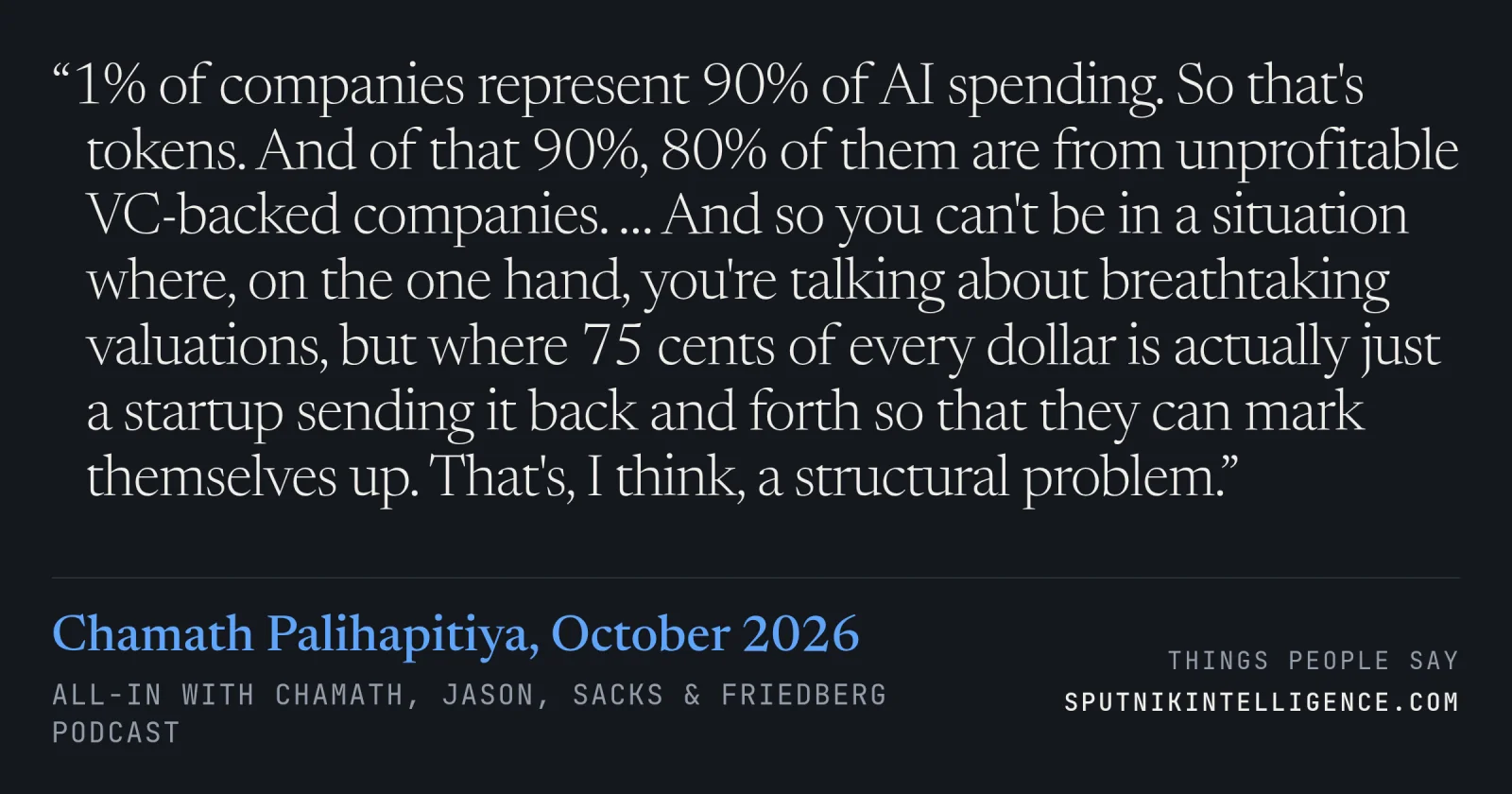
…is by consuming other people's AIs. And so that company then starts to show revenue traction. Those folks then say, hey, look how well we're doing, raises a bunch of money from the same VCs. And it's just this circularity. Why that's important is what Ken is pointing out is that for AI to really scale as a predictable driver of long-term earnings, it has to diffuse out of the startup ecosystem. And so you can't be in a situation where, on the one hand, you're talking about breathtaking valuations, but where 75 cents of every dollar is actually just a startup sending it back and forth so that they can mark themselves up. That's, I think, a structural problem. Now, we've seen that structural problem in the past. That happened in the early days of cloud when AWS initially started to expose EC2 and S3. The consumers of an EC2 instance or an S3 bucket were startups. But the difference there is that AWS was abstracted from Amazon retail, which was already then a roughly break-even profitable business, at least on a free cash flow basis. So what's…
Jason Calacanis
just to be clear for the audience, Ramp provides financial services, neobank, and credit cards primarily to startups. So they know startup data. There's a free commercial.
Chamath Palihapitiya
I think they know broad-based data from other data sources as well. And I think Aura has access to all of it. But
Jason Calacanis
there, but what he said is
Speaker names come from our own diarization. The position is estimated from where the line sits in the episode.
Asked whether he is bearish on an Anthropic IPO, Chamath says no: he calls its revenue "breathtaking" and argues only that it should price low enough to raise a very large war chest. Here he describes the shift he expects in how AI is sold, from paying for tokens to paying for results.
All-In with Chamath, Jason, Sacks & FriedbergAround 45:33 into the episode
Jason Calacanis
…hat. It's just there on the side of your AI slot background. So, Shamath, you said $1 trillion for Anthropic a couple weeks ago. What are you thinking here? Do you think they have significant headwinds or do you think this is going to be a blockbuster IPO? Where are you at? Here in October of
Ben Horowitz
2026.
Chamath Palihapitiya
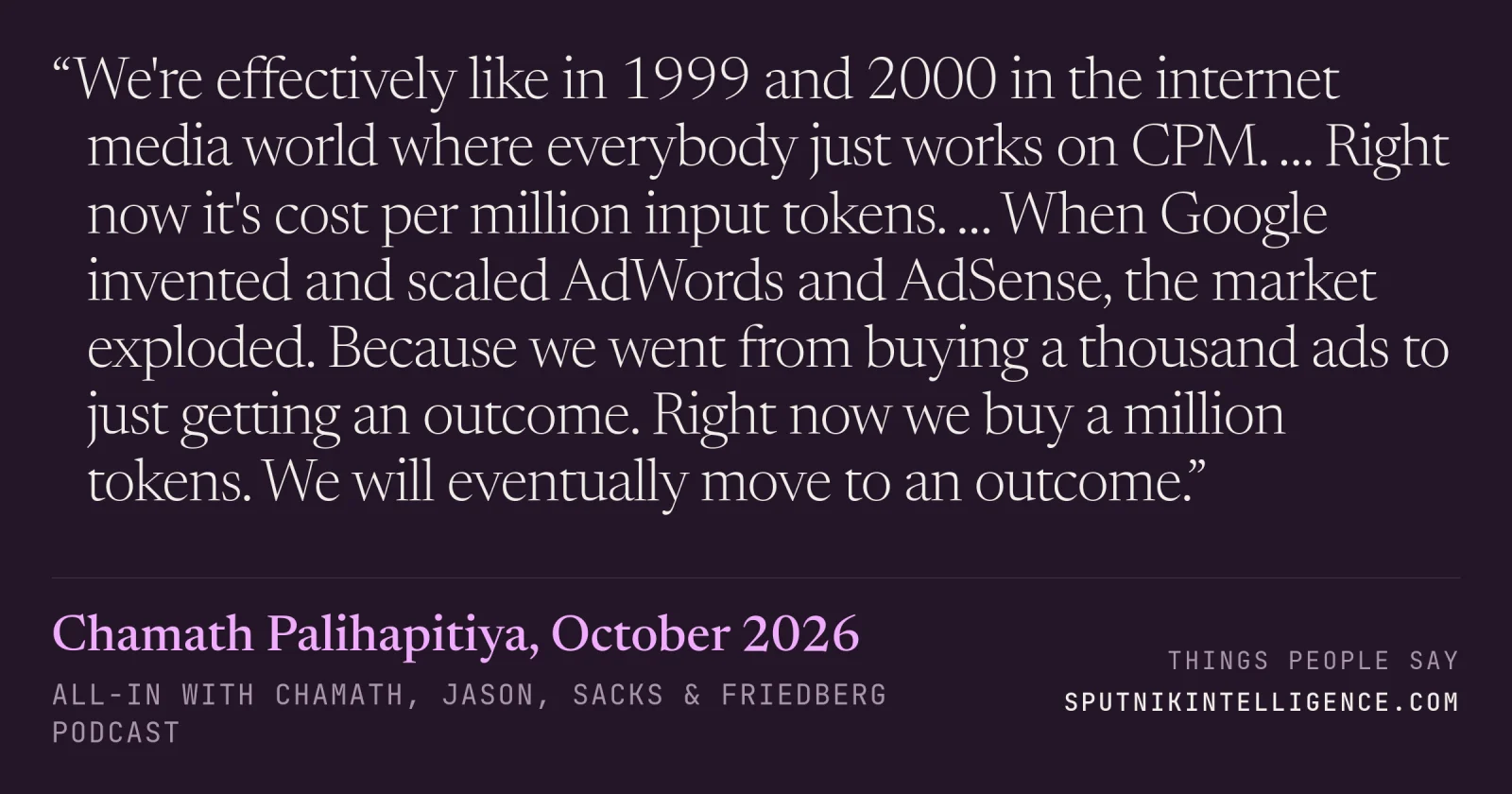
…it. I don't know how to process it. I think their products are exceptionally good. I think they're doing the hard work and to open AI's credit, they are as well, of walking down the price curve so that they're less and less at risk of open source. I still think that there's a bunch of cannibalization that has to happen on the token side. I also think the big thing that has to happen in AI is we're effectively like in 1999 and 2000 in the internet media world where everybody just works on CPM. You know, that time it was cost per thousand ads. Right now it's cost per million input tokens. We will move to CPC and CPA, right? And so when Google invented and scaled AdWords and AdSense, the market exploded. Right. Because we went from buying a thousand ads to just getting an outcome. Right now we buy a million tokens. We will eventually move to an outcome. And I think when that happens…
Jason Calacanis
So you're saying you want them to raise more money at a lower valuation so they have a war chest. $150 billion at $1.5 trillion is
Chamath Palihapitiya
not enough. It's not enough. $200 billion barely gets them a few gigawatts. And that is the bottom line math. If Anthropic IPO going to go through and survive an eventual correction, I think it's much better for them to have $200 to $250 billion today than to try to ring the bell at $1.9 or $2…
David Sacks
are you saying they should raise, Jamath?
Speaker names come from our own diarization. The position is estimated from where the line sits in the episode.