Where to Find Them
Mark Cuban
writes
a16z Podcast
,
writes
Mark’s Newsletter
,
writes
The Logan Bartlett Show
,
writes
The Bulwark
,
writes
Raising Health
,
writes
a16z
,
writes
Liftoff with Keith: Interviews with Top Movers and Shakers
and
writes
The Daily Beans
.
They have also been a guest on
TBPN
(4 times) ,
All-In with Chamath, Jason, Sacks & Friedberg
(3 times) ,
Squawk Pod
(3 times) ,
Motley Fool Hidden Gems Investing
(3 times) ,
The GaryVee Audio Experience
(3 times) ,
How I Built This (Guy Raz)
(3 times) ,
3 Takeaways™
(3 times) ,
Decoder with Nilay Patel
(3 times) ,
Relentless Health Value
(3 times) ,
The Prof G Pod with Scott Galloway
(2 times) ,
The Vergecast
(2 times) ,
Bloomberg Surveillance
(2 times) ,
Earn Your Leisure
(2 times) ,
The Twenty Minute VC (20VC): Venture Capital | Startup Funding | The Pitch
(2 times) ,
The Indicator (Planet Money)
(2 times) ,
The Heart of Healthcare | A Digital Health Podcast
(2 times) ,
Masters of Scale
(2 times) ,
Pivot (Kara Swisher & Scott Galloway)
(2 times) ,
Lex Fridman Podcast
,
Prof G Markets
,
Pioneers of AI
,
Equity
,
Billboard On The Record
,
SOA Podcasts - Society of Actuaries
,
Masters in Business
,
Uncanny Valley | WIRED
,
Prof G Media
,
Odd Lots
,
Grit
,
Closing Bell
,
Halftime Report
,
Ground Truths
,
Aspire with Emma Grede
,
On with Kara Swisher
,
NEJM AI Grand Rounds
,
Worklife with Molly Graham
,
JAMA Clinical Reviews
,
The Reason Interview With Nick Gillespie
,
The Real Eisman Playbook
,
EntreLeadership
,
Recode Media
,
TED Tech
,
unPAUSED with Dr. Mary Claire Haver
,
Crypto Critics' Corner
,
Tony Robbins Podcast Daily
,
Mixed Signals from Semafor Media
,
Breaking Bread with Tom Papa
,
The Pomp Podcast
,
Hello Monday with Jessi Hempel
,
Big Technology
,
Market Mondays
,
The Diary Of A CEO with Steven Bartlett
,
Pharmaverse Podcast
and
Reason Magazine
.
Recently:
“Mark Cuban on Starting a Business, the Most Common Startup Mistakes & Why Profit Beats Growth”
on Prof G Media (November 2026);
“Mark Cuban on Starting a Business, the Most Common Startup Mistakes & Why Profit Beats Growth”
on The Prof G Pod with Scott Galloway (November 2026);
“Mark Cuban’s Plan to Make Healthcare Affordable”
on a16z Podcast (October 2026);
“Mark Cuban: Insurance Companies Are Not Your Friend”
on Breaking Bread with Tom Papa (October 2026);
“Mark Cuban Goes Nuclear on America’s Health Care Giants”
on The Bulwark (October 2026);
“Mark Cuban Goes Nuclear on America’s Health Care Giants”
on The Bulwark (October 2026).
What They Said
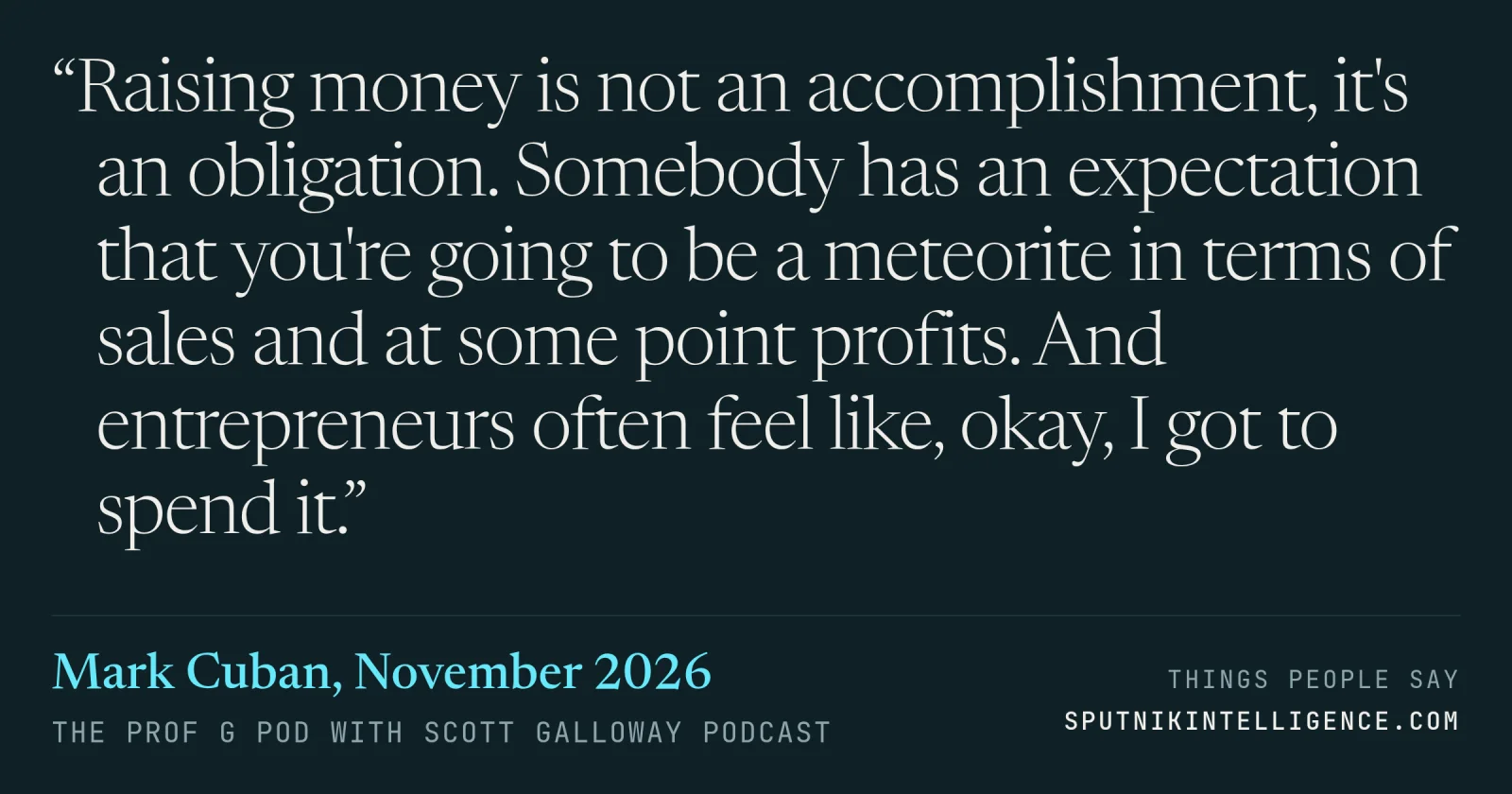
Scott Galloway had admitted that whenever he raises venture money he over-hires and takes too much office space. Cuban agrees and explains why investor expectations push founders to spend money they don't need to.
The Prof G Pod with Scott Galloway · 2026-11-16
Permalink →
Listen →
The Prof G Pod with Scott Galloway
Around 06:18 into the episode
Mark Cuban
…helping people with that product or service, you're not going to be successful. I would tell entrepreneurs all the time: sales cures all, and it's your responsibility. If you don't take that responsibility, you're going to fail. And we saw that a shockingly shocking number of times on Shark Tank.
Scott Galloway
…not very good. I just, and the vibe when you raise outside capital is put it to work, scale, grow fast. And I haven't had the ability to put capital together, to allocate capital quickly without it just being low ROI capital. I'm just spending spending money when I didn't need to. Thoughts, Mark?
Mark Cuban
Yeah, for sure. Because the person who gave you the money or the company that gave you the money has an expectation. You don't walk into a VC or PE meeting thinking or saying that, you know, our growth rate's going to be 10% a year and we're happy with that. Somebody has an expectation that you're going to be, you know, a meteorite in terms of sales and at some point profits. And entrepreneurs often feel like, okay, I got to spend it. And that in turn, the downside of just spending it is now all of a sudden, because your money's disappearing, you're burning so fast, you have to spend more time thinking about your next raise as opposed to just operating a successful business. So, you know, I always tell people that raising money is not an accomplishment, it's an obligation.
Scott Galloway
And with that, we'll take a quick break. We'll be right back. This is advertiser content from Xero. When I was starting a business, I thought that to be a business, you had to spend money like a business. I would lease these big office spaces thinking somehow that that made the business real. It…
Mark Cuban
Yeah, I do understand the question because I get it a lot. You know, it's hard to try for anybody, put aside whether or not you're an entrepreneur, to try to optimize the money they're going to spend on healthcare because there's so much certainty associated with it on one end. You don't know if…
Scott Galloway
Yeah, I love what you're doing, Mark. I think U.S. healthcare is the most disruptible business in the world right now. 17% of GDP, four out of five people are satisfied with it. I think employee-centered health insurance in some ways has been part of the problem. And that is an employer pays about…
Speaker names come from our own diarization. The position is estimated from where the line sits in the episode.
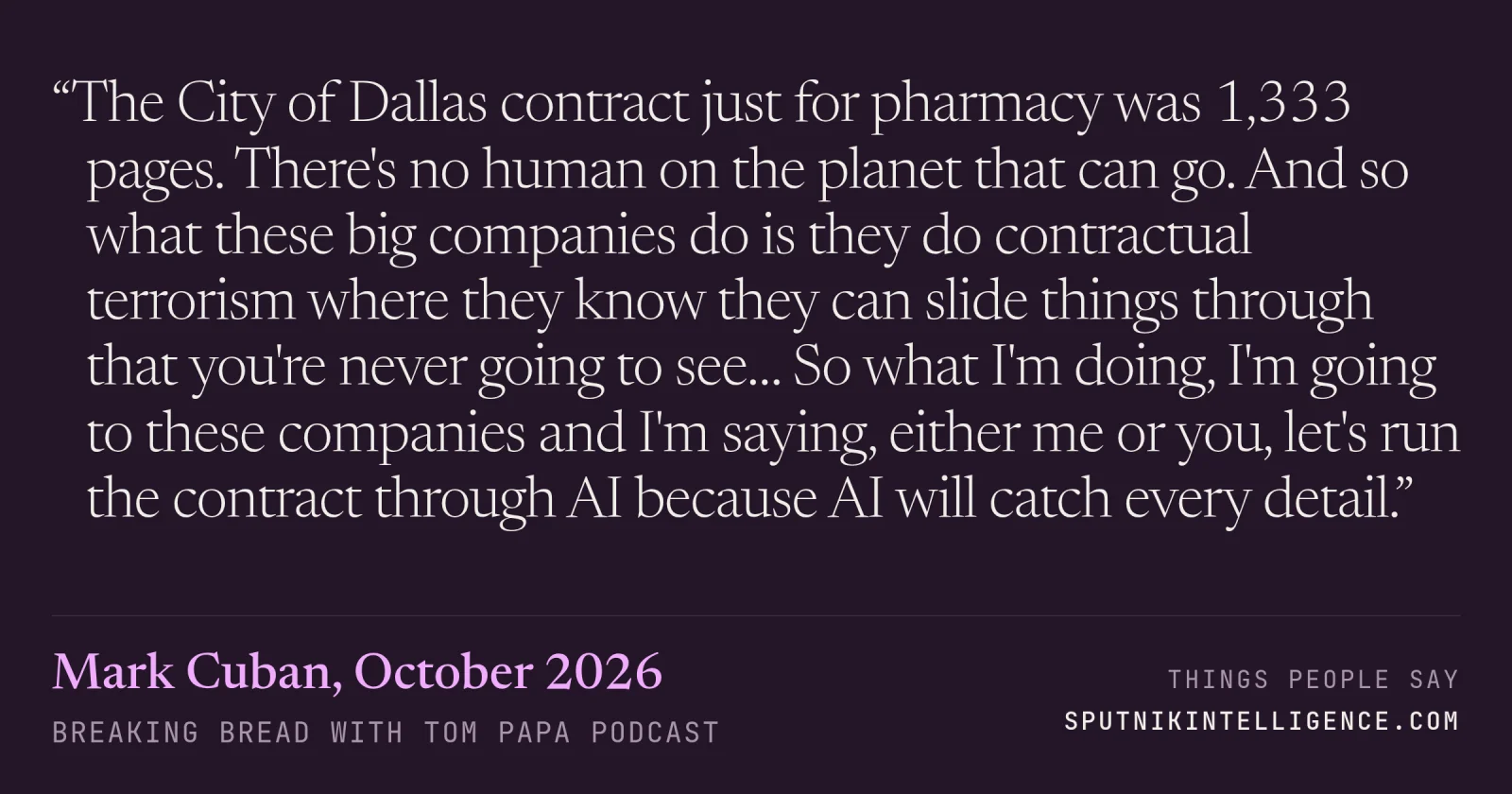
Tom Papa asked whether employer health insurance can be fixed. Cuban says most employers self-insure and hire big administrators whose contracts are too long for anyone to read, and he is now urging them to have AI read the contracts.
Breaking Bread with Tom Papa · 2026-10-27
Permalink →
Listen →
Breaking Bread with Tom Papa
Around 07:58 into the episode
Mark Cuban
that's before you have to pay out of pocket for your deductible and everything else. Right,
Tom Papa
exactly. And then I'm like, here with my little company, I'm like, how can I get insurance for everybody? It's like, you know, two to four grand per person. Yep. From crazy. It's insane. It's crazy. Yeah. Can you fix that?
Mark Cuban
…employer get it from an employer who self-insures, which means the employer actually pays the cost. They hire somebody to go through all the processes, deal with the claims and all that. Well, those companies that they hire typically these big companies that I mentioned. And like I was going through the City of Dallas contract. I'm really turned into a healthcare nerd. It's really crazy. So like the City of Dallas contract just for pharmacy was 1,333 pages. There's no human on the planet that can go. And so what these big companies do is they do contractual terrorism where they know they can slide things through that you're never going to see. And it doesn't only happen with the city of Dallas who doesn't have enough resources to fight. I've talked to huge companies. I mean, hundreds of thousands of employees and they get it wrong. They get ripped off. And so two parts to answer your question, right? Number one is, can we fix it? Number two involves, the answer is yes. And number two involves AI. So what I'm doing, I'm going to these…
Mark Cuban
And so all I say for your prompt, put the contract in as a PDF, you know, and you can do it for your insurance, everything. Yeah. Where are they fucking me? Really? That's it.
Speaker names come from our own diarization. The position is estimated from where the line sits in the episode.
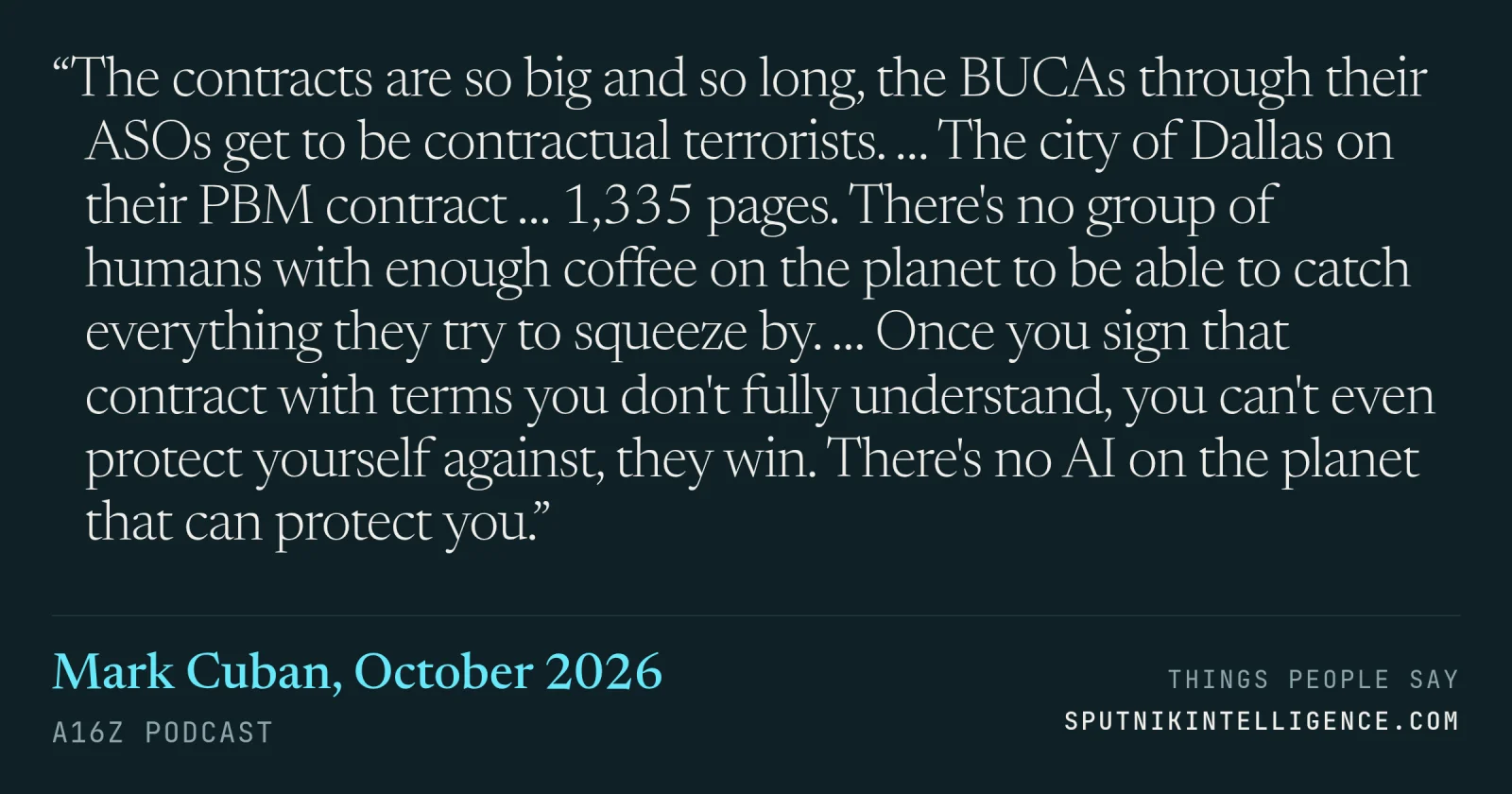
Julie Yoo suggested AI lets startups build full-stack health plans quickly. Cuban, a self-described AI fan, said AI can't fix a broken financial system once the contracts are signed; its best near-term use is stopping employers from signing bad ones. "BUCAs" is his term for the big insurers.
a16z Podcast · 2026-10-28
Permalink →
Listen →
a16z Podcast
Around 16:04 into the episode
Mark Cuban
…to those claims. And the employers have no access to it. And in many cases, they don't even have access to their own claims. It is just so rigged, to your point, Julie, trying to, you know, remove them and disintermediate them is the key, the holy grail to what's happening in healthcare right now.
Julie Yoo
…all these market forces, and again, like the economics just getting to a breaking point, is the fact that AI can play a significant role in enabling a full stack like health plan offering to be built in a way that reduces all the crux that you're describing in a very short period of time. But this
Mark Cuban
…and here's where the market, the economics really start to fall apart, and what makes it tough for AI in the short term operationally and less so clinically. The contracts are so big and so long, the BUCAs through their ASOs get to be contractual terrorists. And what I mean by contractual terrorism, the city of Dallas on their PBM contract, I haven't been able to see their ASO contract yet, 1,335 pages. There's no group of humans with enough coffee on the planet to be able to catch everything they try to squeeze by. And so as a result, no matter what AI, once you sign a contract, now hopefully you use AI to prevent yourself from signing a bad contract. And I think that's the low-hanging fruit for everybody. But once you sign that contract with terms you don't fully understand and conditions you don't fully, you can't even protect yourself against, they win. There's no AI in the planet that can protect you.…
Julie Yoo
And so you went exactly where I was going to go, Mark, which is one of the areas where AI is playing a role for better or for worse is that it is just shining a light on how broken the underlying system that Hume is designed is, right? So the whole like prior off bot war situation that's happening…
Mark Cuban
bot wars in terms of claims and upcoding and downcoding, that's short-term stuff, right? That's just like, you know, okay, I need to lose some weight. I'm not going to eat, you know, my rice, I'm not going to eat my frosted flakes every day, right? It's nice on the periphery and it's good…
Speaker names come from our own diarization. The position is estimated from where the line sits in the episode.
Explaining the real economics of owning a sports franchise, Cuban is blunt about the appeal. He credits buying the Dallas Mavericks with making him a public figure — Shark Tank included — and calls a team the ultimate vanity asset rather than an investment.
Pivot (Kara Swisher & Scott Galloway) · 2026-08-21
Permalink →
Listen →
Pivot (Kara Swisher & Scott Galloway)
Around 40:41 into the episode
Mark Cuban
neither here nor there.
Kara Swisher
Depends on the price. So explain what's happening here for me. I find this really interesting, especially, you know, you have Iger in there, which is interesting. I think he's the pretty one, and Josh is the money. Explain what's happening here. A couple
Mark Cuban
things. One, it's a vanity asset. Like if I didn't buy the Dallas Mavericks, probably wouldn't know who I was, right? I mean, you would because of tech, but most people would not. I would not be a celebrity. I wouldn't have gotten on Shark Tank, right? David Stern, rest in peace, was the commissioner of the NBA and used to always say, I made you by finding you all those times. And he was right. You know, it is the ultimate vanity asset. It wasn't your
Mark Cuban
No, you know, there's 30 NBA teams, 32 in other leagues. And so we know Jerry Jones's name, not because he was in the oil business. You know, people now know who Josh Kushner is, not just because of his brother. And so that, one, it's a vanity asset. Two, because it's a vanity asset and now the…
Kara Swisher
you don't even have to have a good basketball team.
Speaker names come from our own diarization. The position is estimated from where the line sits in the episode.
Collections They Appear In