
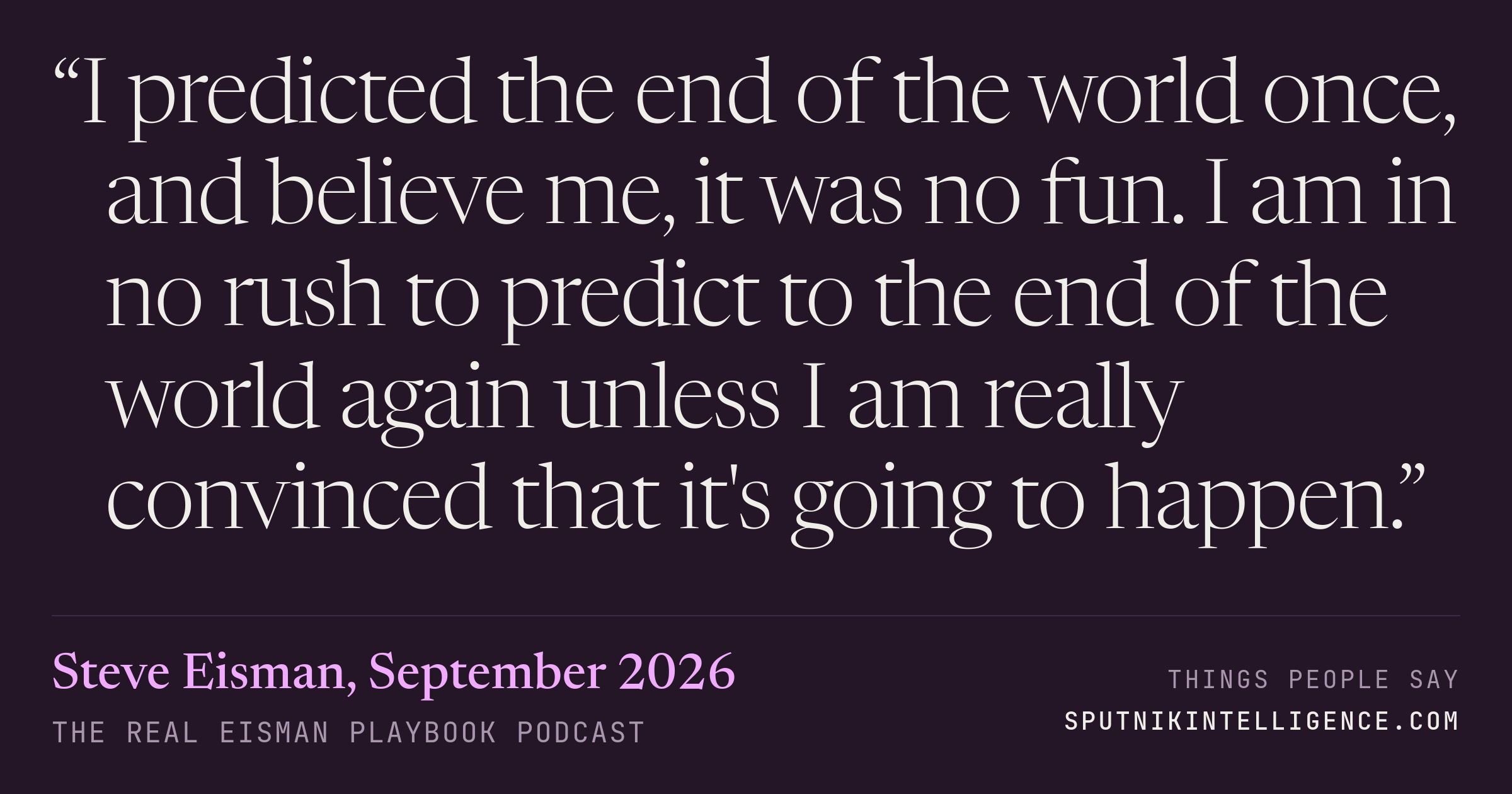
Eisman opens his weekly wrap by listing what he will cover, including what he calls the insatiable need for commentators to predict a dystopian ending to the AI bubble, and then, next on the list, why he is not there yet. He spends the rest of the episode arguing that OpenAI's troubles could tip the US into a recession, so the reluctance is not disbelief. It is the man who called 2008 declining to spend that credit twice.
The 10-year yield almost brushed against 4.8%. And there is no question that at some level of interest rates, the market will correct. The entire U.S. economy hinges on the success of AI. The amount being spent is just so large that were it to stop, the economy would go into a recession almost immediately. I think that OpenAI is potentially in trouble. Things are not moving in the right direction. So I'm starting to think that the demise of OpenAI could push the U.S. into an almost immediate recession. It's not too early to think about the ramifications of OpenAI failing. So let's think about it. Hi, this is Steve Eisman. Welcome to the weekly wrap. This is for the week ending Friday, September 4, but recorded Thursday night, September 3. First, I will take a moment to thank everyone who has joined me on Substack and subscribe to both free and premium. We'll be increasing our premium prices on September 7th at midnight to $20 per month and $200 per year. If you want to get the old pricing, subscribe now before Labor Day. Existing subscribers, your rates will not change if you stay subscribed. Thinking about switching to annual? Now is the time to lock in the price at $107.99 per year for as long as you stay subscribed. If you're interested in being a premium subscriber and receiving daily comments on the market and economy, being part of a thriving community, receiving an extra weekly episode, including a two-part masterclass on analyzing banks, which drops soon, and accessing all free episodes ad-free, consider subscribing before we raise the price on September 7th. Over the past several months, we've gotten several requests from subscribers to interview Ed Zitron, the Substack newsletter writer, who is one of the most famous critics of the entire AI story. So I'm pleased to announce that this coming Wednesday, September 9, on premium, we will post an interview with Ed Zitron.
It's OpenAI and Anthropic to account for 48% of all of Google Cloud's revenues next year. Which is huge. That's crazy. That means that Google Cloud's growth is based on whether these companies survive
or pay them. Right. We had an incredible conversation and covered every aspect of the AI story, its strengths, weaknesses, the financial shenanigans, and where and how it could fail. So please tune in. In this weekly wrap, I will discuss one, war, oil, and interest rate news. Two, the increasingly insatiable need for commentators to predict a dystopian ending to the AI bubble. Three, why I'm not there yet. Four, AI's insatiable need for capex is the major driver of GDP growth. Five, is open AI the potential catalyst for a recession? And six, some recent events. So let's get started. This week, the war heated back up and all prices spiked, thereby driving fears of mounting inflation. The 10-year yield almost brushed against 4.8%. And there is no question that at some level of interest rates, the market will correct. What that level is, no one really knows. I thought that 4.5% was the Rubicon, and I was wrong. Is it 4.8% or even higher? I don't really know, but we are certainly getting closer. I'd also point out that part of the problem is the enormous amount of AI debt being issued. This supply is putting pressure on rates. And I'd also point out that Treasury Secretary Besson's recent attempt to reduce long-term rates appears to have already failed. One more point: higher rates put pressure on any company issuing debt. However, higher rates are good for consumers who save and put their money in the bank or in a money market fund. Before we get to some of this week's events, I am going to spend some time discussing the desire by many commentators to call for the end of the world and what it would actually take to cause a recession. Now, one of the last great sitcoms on network Work TV was the Big Bang Theory. For those of you who never watched the show, it was about a group of friends who were science nerds. In the show, there was a minor character called Stuart. Stewart owned a comic book store that the main characters liked to hang out at as they all loved comic books. Now, recently, Chuck Lorry, the creator of the Big Bang Theory, created a new show on HBO called Stuart Fails to Save the Universe. In this new show, a catastrophe has enveloped the world, and humanity now lives in a horrible dystopia. Stewart finds a machine that allows him and his friends to travel to alternative universes, constantly searching for a better place to live. Thus far on the show, every universe Stewart jumps to is just another form of dystopia. Show is quite funny, but captures something essential. There is something about imagining a dystopian future that people find captivating. I've noticed that over the years, since the GFC, whenever I am interviewed, the interviewer is almost begging me to predict the end of the world. How do I feel about that? Well, I predicted the end of the world once, and believe me, it was no fun. I am in no rush to predict to the end of the world again unless I am really convinced that it's going to happen. But I'm not going to make such a prediction just because it will get a lot of press. There is no question in my mind that the entire U.S. economy hinges on the success of AI. The amount being spent is just so large that were it to stop, the economy would go into a recession almost immediately. There are several commentators who are making exactly that prediction. They could be right, but right now the data does not support the end of the AI story, at least not yet. So let me point out where the points of weakness reside, because it's time to consider how the unwind could, could occur, what the catalysts are, and what the impact could be. Now, there is no question that the large tech companies have transformed the dynamics of their businesses. They used to run businesses that threw off so much cash, they didn't know what to do with it. But because of the hundreds of billions they are each spending on AI CapEx, their cash flow has evaporated. And in some cases, they are raising both debt and equity to fund that capex. This is a topic of great concern. It gets a lot of press, but it is not necessarily the death knell of the AI story. After all, if, and it's a big if, AI generates new businesses and large returns on this capex investment, then the hyperscalers will be okay. Now, there is also a great deal of circular financing going on, mostly led by NVIDIA. And these transactions are very complicated and convoluted. But essentially, NVIDIA is either lending money or making equity investments. The companies then take that cash and buy more NVIDIA chips. Now, I'm oversimplifying, but that is essentially what is going on. NVIDIA's potential investment in Perplexity and the recent investment in poolside are only the most recent examples of such transactions. This financing circularity is also a topic of great concern. However, here too, if AI succeeds, then these financing techniques will probably turn out to be okay. So, where is the Achilles heel? I think that it resides with Anthropic and OpenAI because they are so central to the entire AI food chain. According to reports from various Wall Street firms, something like 70% of hyperscaler AI revenue comes from Anthropic and OpenAI. 70% equates to around 25 to 35% of total hyperscaler cloud revenue. I can't confirm those statistics, but they sound right, given what we actually know about Oracle. Oracle has a backlog of around $600 billion, and we know, because the information is public, that around 50%, 50% of that backlog is from OpenAI alone. And by the way, OpenAI accounts for over 20% of CoreWeave's total contracted order book. Hyperscalers are spending about $700 billion in CapEx this year and even more next year. And that spend accounts for around half of the 2% GDP growth projected for 2026. So one must conclude that the health of the US economy is extremely dependent on hyperscaler CapEx, and hyperscaler CapEx is highly dependent on the health of Anthropic and OpenAI. That's the chain. Now, between the two, OpenAI is the weaker entity and has lost several key senior employees. Let's list them because the list is kind of illuminating. One, Denise Dresser, chief revenue officer, resigned in August 2026 after only eight months on the job. That probably means she gave up all her stock options as those usually don't vest for at least a year. That's a big data point. For her, I guess, moving on was perhaps worth the lost options, and maybe she never thought they would vest because going public is being pushed further out on the timeline. Two, Brad Lightcap, former COO, resigned in August 2026 after eight years with the company. Three, Caitlin Kalinowski, head of robotics and consumer hardware, resigned in March 2026 over governance concerns regarding an agreement with the Pentagon. Four, Kate Rauch, Chief Marketing Officer, and Kevin Wilde, science research overseer, both departed in April 2026. The most concerning departures are the ones that took place this August, Denise Dresser and Brad Lightcap. Supposedly, OpenAI is getting closer to an IPO. That's the big payday for employees because it means that eventually they can sell some of their shares. That two such senior employees would leave now is an important data point. More importantly, OpenAI's financials look tepid. The Wall Street Journal reported that OpenAI's June quarter revenue reached $6.7 billion, up only 18% versus the March quarter. Compare that to Anthropic's revenue of $11 billion plus in the June quarter, which was up over 100% versus the March quarter. What's even worse than the relatively weak revenue growth is the explosion in costs. Again, according to the Wall Street Journal, OpenAI's costs reached $12.3 billion, up $3 billion versus the March quarter. So in three months, revenue increased $1 billion, but costs surged $3 billion. Things are not moving in the right direction. Now, you might ask, what is the problem at OpenAI? Part of the problem, I think, is that OpenAI made a strategic mistake. It chose to chase the business-to-consumer market, B2C. It did so by giving its product away or underpricing it with the hope that later on it could raise prices. That strategy proved to be flawed, and now OpenAI is chasing the business-to-business market, B2B. The problem is that it's late and playing catch-up with Anthropic, which chose the B2B market at the outset. Again, I think that OpenAI is potentially in trouble, and this bears continuous monitoring.
When you need to build up your team to handle the growing chaos at work, use Indeed Sponsored Jobs. It gives your job post the boost it needs to be seen and helps reach people with the right skills, certifications, and more. Spend less time searching and more time actually interviewing candidates who check all your boxes. Listeners of this show will get a $75 sponsored job credit at Indeed.com slash podcast. That's indeed.com slash podcast. Terms and conditions apply. Need a hiring hero? This is a job for Indeed Sponsored Jobs.
This episode is brought to you by State Farm. Listening to this podcast instead of doom scrolling? Smart move. Another smart move? Getting help from one of State Farm's 19,000 local agents when you choose to bundle home and auto. Bundling, just another way to save with the personal price plan. Prices are based on rating plans that vary by state. Coverage options are selected by the customer. Availability, amount of discounts and savings, and eligibility vary by state.
According to Ed Zittron, our guest in Week, to survive, OpenAI will have to raise $100 billion per year for the next several years. Now, when you lose billions upon billions, appearances matter a lot. OpenAI is completely dependent on the kindness of strangers funding its cash flow needs. When a company is growing and very profitable, appearances don't matter nearly as much. Such a company can survive quite well. But when a company is not profitable and has an insatiable need for capital, appearances matter more than anything because if the narrative turns negative, raising capital becomes much more difficult. Now, this is just me reading the tea leaves, but OpenAI's press is no longer all positive. The press is actually focused on the high level of departures and on the weak numbers I just described. That's why, as Ed Zittron wrote recently, it's not too early to think about the ramifications of OpenAI failing. So let's think about it. First of all, I want to emphasize, I'm not predicting, at least not yet, that OpenAI will fail. I still think it's too early to make that prediction, but it's not too early to think about it. If OpenAI fails, Oracle is in immediate trouble. Because of the large increase in Oracle's debt levels, Oracle's debt rating is barely above junk. Oracle's SP credit rating is BBB minus, which is quite weak. Like I said before, it has a $600 billion backlog, and half of that backlog is from OpenAI. Now, what would happen to Oracle's stock price if OpenAI failed? Well, we've already had. Something of a preview. Last year, when Oracle reported its backlog for the August quarter of 2025, what it calls Remaining Performance Obligations, RPO, it showed an RPO explosion to $455 billion. It's now $600 billion. Now, in that quarter, the RPO was up over $300 billion in just three months. People were blown away. Prior to the earnings report, stock was $230 a share. In just a few days, it jumped to $330 a share. Then, analysts started publishing reports pointing out that 50% of the RPO was from OpenAI, and the stock gave back all of its gains plus in a few months. Today, the stock is around $145, well below where it stood before it reported the August 2025 quarter results. From the peak, the stock is down over 50%. That decline is because the market perceives an over-reliance on OpenAI. Imagine what the market would do to Oracle stock if OpenAI fails. The ramifications of an OpenAI failure extend far beyond just Oracle. Remember, I said that AI CapEx accounts for 50% of US GDP growth. While the other hyperscalers are not quite as dependent on Anthropic and OpenAI as Oracle, they are dependent enough. If OpenAI failed, the hyperscalers, I am sure, would cut back on their CapEx. So I'm starting to think that the demise of OpenAI could push the US into an almost immediate recession. So what would happen to particular stocks and sectors? Well, first, the hyperscalers would go down. A failure of OpenAI would mean they would pull back on CapEx, cloud revenue growth would slow, and these stocks, Amazon, Google, Microsoft, and Oracle, NVIDIA, I'm sure as well, would all correct. Also, the whole tech sector would correct, but the ramifications are even much broader than just that. Investment banks and large banks. These stocks are at peak valuations. Also, the investment banking cycle is super strong right now, partially because of the financing needs of AI. Should those needs lessen, the investment banking cycle would weaken and these stocks would correct from their peak valuations. Industrials. There is a subset of industrial companies that are major beneficiaries of AI. They are in the power space like GE Vernova and Quanta, or they are in the electrification or automation spaces like Eaton and Rockwell. These stocks will decline as well. So what will do well? This is not a stock picking question, but a reallocation question. Investors will reallocate to safety sectors and subsectors. In the safety sector category, think about healthcare and consumer staples. I'd also point out that within almost every sector, there exists safety subsectors. For example, within financials, the property and casualty sector is considered the safety subsector. Since we are talking about capital reallocation and not stock picking, let me flag three safety ETFs. One, LVHD, the Franklin U.S. Low Volatility High Dividend Index ETF. SPLV, the Invesco SP 500 Low Volatility ETF. And finally, the KBWP, which is the Invesco KBW Property and Casualty Insurance ETF. It's still early, and I want to emphasize that I am not making a major call. Not yet. I'm just preparing. Last week, NVIDIA reported, and the results in many ways support what I'm saying about the AI story, that it continues, but is displaying potential weakness. Both apparently contradictory ideas can be true. What do I mean by that? On the one hand, NVIDIA's results show that the AI story continues. How could it be otherwise? The hyperscalers continue to increase their CapEx, and that means they are buying more chips from NVIDIA. NVIDIA's July 2026 quarter results showed revenue growth in excess of 100%, 100%. Think about it, the largest company by market cap on planet Earth just posted revenue growth in excess of 100%. And that is an acceleration from the 85% revenue growth in the April 2026 quarter. That shows that the AI story continues. However, beneath the surface, there are weaknesses. In Note 7 of NVIDIA's 10Q, it states, quote, five direct customers accounted for 22%, 14%, 13%, 11%, and 10% of our accounts' receivable balance as of July 26, 2026, end quote. That adds up to 70%. So yes, NVIDIA's revenue growth is explosive, but it is dependent largely on only five companies. Who are those companies? They must be the hyperscalers, who therefore account for most of NVIDIA's revenue. And the AI revenue of the hyperscalers, as we've just discussed, is dependent largely on Anthropic and OpenAI. Once again, it looks like the entire AI ecosystem is dependent on the future health and success of two companies that currently lose billions. Again, if Anthropic or OpenAI ever get into trouble, the whole AI ecosystem will slow to a crawl. There was also news from OpenAI that at first looked positive, but which I think was actually quite negative. OpenAI announced that its advertising business reached $1 billion in an annualized revenue run rate, ARR. Now, I have no idea what ARR means in this context. What exactly is being annualized? Is it revenue for a day, week, month, or quarter? OpenAI won't say. But leaving aside the definition of ARR, what was interesting was that this news was lauded by the business press. Not so fast. First of all, in the June quarter, OpenAI had $6.7 billion in revenue and $12.3 billion in costs. So $1 billion in advertising ARR hardly cuts those losses by much. More importantly, much more importantly, earlier this year, OpenAI projected $2.4 billion in advertising revenue for all of 2026. $1 billion ARR now means that it won't be even close to that $2.4 billion projection. In other important news, Meta reached a legal settlement with several state attorneys general. California-based lawsuit alleged that Meta harmed young adults and children via its algorithms. The size of the settlement was not large, 17 plus billion. More importantly, Meta agreed to change its conduct and alter its algorithms. Now, on June 17th, we posted an interview on our premium Substack service with law professor Ben Zaperski. In the interview, Professor Zapersky outlined the legal theories behind these social media lawsuits.