Galloway, after noting that recent data-center IPOs asked public investors to pay "private market vibes" and were turned down. He went on to question whether public investors would pay around 30 times revenue for Anthropic at a $2 trillion valuation.
Prof G Markets · 2026-10-19
Permalink →
Listen →
Prof G Markets
Around 48:15 into the episode
Scott Galloway
When you look at the revenues of these companies, you would know AI is out there and supposedly going to just disrupt it all.
Ed Elson
That's what we said when this all went down, though. Remember, like in February when the SaaS apocalypse happened, everyone said that those names were done. Like those were the AI losers.
Scott Galloway
…been cut in half in the last 20 years, either through acquisition or companies are just saying private longer. Why? Because why do we want more public companies? Private markets are. Essentially, opinions and public prices are facts. And the Pull Data Center IPOs, Fermis, SP Energy, they were asking public investors to continue to pay their private market vibes. And public investors said no. And essentially, private markets have become where valuations go to avoid accountability. Now, let's talk about Anthropic. $16.8 billion in quarterly revenue is roughly a $67 billion annual run rate. That's amazing. But at $2 trillion, that's about 30 times revenue for a company growing roughly 50% a quarter by these figures. And so again, the question is whether there's an amazing company. The technology, in my opinion, for AI is going to outlast the valuations, whether you think…
Ed Elson
It needs to be based on financials. And so long as these companies don't release their financials properly, or if the only financials that we get to see are these sort of adjusted bullshit numbers, then it's still going to be completely a murky, opaque gray zone. And I think what you're pointing to…
Scott Galloway
Yeah, it's so interesting. By the way, I thought yesterday's episode that you did with Kodrowski and Sandy was just so good. And Kojowski pointed out that one of the miracles of the American market is capital formation. Someone did an analysis looking at private tech companies in Brazil, which is a…
Speaker names from our own diarization · position estimated from where the line sits in the episode
Scott Galloway reacting to a September inflation report in which real wages fell for a sixth straight month. He cited figures that since 2022 wealth is up 37% for Americans 75 and older and down 23% for those 35 and under.
Prof G Markets · 2026-10-19
Permalink →
Listen →
Prof G Markets
Around 25:38 into the episode
Speaker 2
Now is the time to buy. I hope you have plenty of the wherewithal.
Ed Elson
…as a result of the rising prices, which is mostly due to one, the war and two, tariffs. But we're really seeing the effects on energy. With gas prices up 34% year over year, that is related to what's going on in Iran. I mean, nothing good here, in my view. Your reactions to the inflation report. I
Scott Galloway
…in addition, the anger, the justified anger among people your age is the following. Since 2022, just literally four years, wealth for Americans 75 and up is up 37%. For people 35 and under, it's down 23%. So when people get angry at me for talking about why socialism doesn't work, they just look at me and they say, bitch, whatever has worked for you is not working for me. And you can understand inflation is a regressive tax with a birth certificate. If you own assets, it's a tailwind. But if you're young and renting, it's a mugging. And America is being mugged right now.
Ed Elson
Just on the idea of gas as, I mean, having outsized importance, I think what I would say is it has outsized exposure in public perception, which is why it really matters politically. And I think the same is true, by the way, of the stock markets. The stock market is one of those things that you're…
Scott Galloway
American families are more behind on their finances than at any time since 2010 after the great financial recession. And six months ago, Kyla Scanlon coined the term vibe session because she said, if you actually look at the data, the economy is doing okay and wage growth at the low end has…
Ed Elson
i think this is like the most important advertisement for why everyone needs to be voting laser focused on being well voted so that we'll get to that voting but also investing yeah uh like you have to be on the right side of this trade and you you like I'm I don't even I don't really care where you…
Speaker names from our own diarization · position estimated from where the line sits in the episode
Galloway is answering a listener question about brands wrapping themselves in the flag for America's 250th. He says anger about data centers and affordability is partly frustration looking for a target while markets hit new highs, and that expectations set by social media make it worse.
Pivot (Kara Swisher & Scott Galloway) · 2026-10-18
Permalink →
Listen →
Pivot (Kara Swisher & Scott Galloway)
Around 51:05 into the episode
Scott Galloway
…we've pulled a few of the best ones. Nick Driver asks: With America 250 coming, we're about to be flooded with brands performing patriotism. Heather, what's the difference between a company that has generally become part of the American story and one that's just opportunistically running the flag?
Heather Cox Richardson
…produce much that the rest of us care about. And that's overstated, of course. But there does seem to be an extraordinary divorce right now between the stock market and the companies that are hot and what the American people actually need and the companies that are providing that. Is that unfair?
Scott Galloway
…frustration that while the market hits new highs and people seem to be, you know, we have our first trillionaire. I can't afford gas. And what I do think is fair is that happiness or well-managed. Is not only a function of what you have, because there's a lot of economists who would argue that people at all income levels actually aren't doing as poorly sometimes as the media would portray. But your happiness and general sense of well-being is the delta between what you have and your expectations. And because of social media vomiting 105 times a day, how well everyone else is doing, the expectations, especially amongst young people, is that if they don't have a boyfriend with a six-pack and they haven't made $3 million on the SpaceX IPO, that they're failing. So people are just upset and angry. In terms of branding, wrapping yourself in the flag is as old as time. The difference now is that three-quarters of people of our generation, professor, feel good about America. Only one quarter of younger people feel good about America. So if you're a brand appealing to people our age, if it's insurance or, you know, CPAP or MyPillow Guy, yeah, wrap yourself…
Heather Cox Richardson
It does seem to me that one of the things that we are suffering from in this particular moment is the conversion of wealth, that is the things that make a life worth living, you know, family, church, if that's your thing, open spaces, time with friends, education, libraries, whatever, that that is…
Scott Galloway
Yeah, I like that. And just going back to this notion about American branding, I just spent time in Northern Europe, and my takeaway there is, and I just think it's such an important lesson, is that we need to settle the argument. And I think Sweden and I was just in the Netherlands settle it. You…
Heather Cox Richardson
Isn't that by definition that they can peacefully coexist? Because if, in fact, you create a healthy, educated workforce, they're able to innovate and do better work. And that's actually how it works. I think you can make an argument that this idea of deliberately creating an undereducated…
Speaker names from our own diarization · position estimated from where the line sits in the episode
Galloway and Giridharadas are swapping stories about the TV shows each made during the pandemic, both of which they describe as bad. Galloway says he filmed his alone in his garage, and that when a production executive called with the "great news" of a renewal he refused. The repeated calls trying to change his mind are what prompted the line.
The Prof G Pod with Scott Galloway · 2026-10-08
Permalink →
Listen →
The Prof G Pod with Scott Galloway
Around 15:28 into the episode
Scott Galloway
And I'm like, oh my God, I've made my partner. It was, my show was so. So bad. Your show.
Anand Giridharadas
…would come to my house and pick up the USB drive like from the driveway because we didn't want to have contact with each other and then drive it up to their house and upload it on some faster Wi-Fi that they had. I mean, it was, it was so surreal. So much energy to make something that wasn't good.
Scott Galloway
…Called me after the six episodes and like, I got great news. I want to renew it. And I'm like, no fucking way. I am so out of here. And I remember him, my agent called me. The production called me. He called me back three times. The guy running Vice at the time reached out to me who I like, Shane Smith. And they were just so flummoxed that anyone would pass up an opportunity to be on TV. And the lesson for me was people must cling to TV like a dictator clings to power that they were just, they could not believe I was going to pass up the opportunity to be on TV. Did you do have, so you haven't done any TV since then?
Anand Giridharadas
I know, not my own thing. I go talk about things I've written on MS Now. You're
Scott Galloway
on MS Now, yeah. And I all the time.
Anand Giridharadas
But I, and particularly Morning Joe is sort of my home court there. But I have always tried to maintain the discipline of going there to talk about things I have written and not going there to talk about, you know, like things that might be in my head.
Speaker names from our own diarization · position estimated from where the line sits in the episode
A listener asks Galloway how he stays so confident about uncertain outcomes when he is often wrong. He says the point of a prediction is to start a useful conversation, and gives his Amazon and Whole Foods call as one that seemed crazy before the deal and obvious after it.
The Prof G Pod with Scott Galloway · 2026-10-05
Permalink →
Listen →
The Prof G Pod with Scott Galloway
Around 12:35 into the episode
Speaker 2
…that's not what you're building toward. Brex is the intelligent finance platform that eliminates that work before it starts. AI agents that handle the manual stuff automatically so your team can spend their time on what actually compounds. It's time to get Brex AF. Learn more at brex.com/slash AF
Speaker 4
…develop customized financing solutions designed around their strategic objectives and structured at an efficient cost of capital. Custom-made investment grade. Learn more at Apollo.com/slash capital. Apollo Global Management, Capital Provider, Asset Manager, Wealth and Retirement Solutions.
Speaker 1
…it's going to happen. And again, the objective isn't to be right, but to catalyze a conversation that results in better outcomes. The key is to be right more than wrong. And occasionally, what's really exciting is you see something someone else doesn't, and you say, This is what I think is going on, and this is what I think is going to happen. And you get more right than you get credit for. Predictions are actually a shitty business because the judgment body of people, if you make a prediction that ends up being correct, in between the time you make the prediction and it coming true, it becomes less provocative, less interesting, less bold, right? I predicted Amazon would buy Whole Foods. Before they purchased Whole Foods, that seemed incredibly provocative and even crazy. They had never made an acquisition of that size, much less…
Speaker 3
Your heart can tell you a lot about your health. Apple Watch Series 12 measures your heart rate every five seconds with the most accurate heart rate sensing in a wearable. So your vitals app, not with heart rate variability, can tell you when something is off. And your readiness score can let you…
Speaker 4
Support for the show comes from Yahoo Scout. Life comes with plenty of big questions, especially when you're taking your first steps into adulthood. When those questions get complicated, you want more than a quick answer. You want reliable information without spending hours searching for it. That's…
Speaker 1
answers. I have been using
Speaker names from our own diarization · position estimated from where the line sits in the episode
Galloway had just said Netflix isn't competing against Hulu or HBO but against YouTube, full stop. This is the cost comparison behind that claim.
Pivot (Kara Swisher & Scott Galloway) · 2026-10-06
Permalink →
Listen →
Pivot (Kara Swisher & Scott Galloway)
Around 46:18 into the episode
Speaker 2
…1% of viewing. Sarandos admits that the ROI isn't there, but he says the signups drive sign-ups and retention and ads. HSSBC downgraded the stock to hold, arguing YouTube's gains are partly coming at Netflix. Netflix isn't competing against Hulu or HBO. It's competing against YouTube, full stop.
Speaker 2
And, you know, Netflix pays $20 billion a year for content. YouTube pays creators on a revenue share basis and gets 20 million uploads a day for free. It's just, it's difficult to compete against that cost. So what do you do?
Speaker 3
What do you do then?
Speaker 2
I just said it. I think they, I think they need to take what are their assets. Bella and Ted and his co-CEO, they produce probably not the best content, but the most gross tonnage of it. They're the Russian army. I mean, they're just, no one has a, they have the biggest content budget in the world.…
Speaker 3
So right. The Quibby turned out to be a good idea. That was
Speaker names from our own diarization · position estimated from where the line sits in the episode
Galloway and Kara Swisher on Netflix's slowing growth. He frames it as warfare: Netflix has the biggest army, but YouTube owns the skies and fights asymmetrically. The transcript reads "The life sports", corrected here to "Live sports".
Pivot (Kara Swisher & Scott Galloway) · 2026-10-06
Permalink →
Listen →
Pivot (Kara Swisher & Scott Galloway)
Around 49:36 into the episode
Speaker 2
I think everything comes down to warfare and that is Netflix. Netflix is, they own the arms race. They have the biggest army. And then they looked up and YouTube Ed owns the skies and asymmetric warfare.
Speaker 2
YouTube can launch a million drones and just see which one works, right? Netflix is committing to B1 bombers. Like they spend a lot of money on series. The life sports is weird. It's like a gym membership. Right now, nobody uses it much, but they don't want to stop paying for it. So we'll see. But
Speaker 3
what about like, I've noticed, I don't look at any other podcasts there. I mean, the only one that's doing well, as I said, was Charlemagne, the God.
Speaker 3
Yeah, that's what I understand. Like doing like really well. I mean, I'm sure they do fine. But I never, I see it there and I never think of it for them. You know what I mean? Like, I don't know why. It's
Speaker names from our own diarization · position estimated from where the line sits in the episode
Ed Elson asks Galloway whether he really thinks a smart home hub will work for Apple. This is his whole answer, closing a pitch that Apple is the most trusted company to put in people's homes.
Prof G Markets · 2026-10-05
Permalink →
Listen →
Prof G Markets
Around 58:15 into the episode
Speaker 4
Hold on. Just our listeners need to qualify this. This is from a man whose business mentor is Pete from Madman. That guy was a great character. He was
Speaker 1
a great character. Well, have you made your smart home pitch? You really think this is going to do it for Apple?
Speaker 4
Amazon built the house. Apple's going to move in and charge rent. And Alexa is a cash register pretending to be a butler.
Speaker 3
Sorry. I'm having trouble. Shut the fuck up. Please try a little later.
Speaker 4
Daddy doesn't love you.
Speaker 1
This is taking the award for longest prediction in the history of this show. I'm
Speaker names from our own diarization · position estimated from where the line sits in the episode
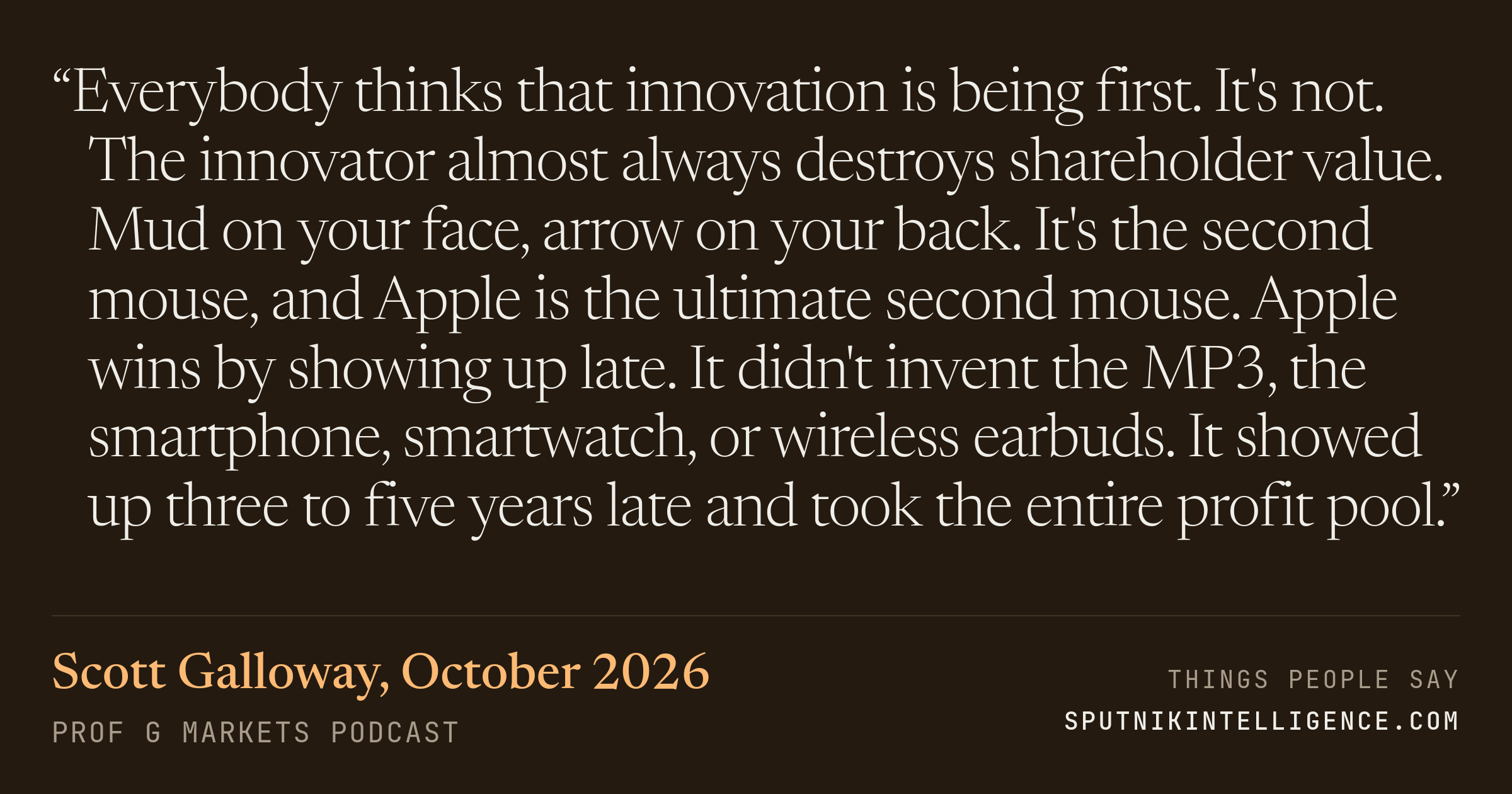
Galloway's prediction segment: he expects Apple's move into the home, a speaker plus smart home control panel, to work. His argument is that Amazon and Google have spent a decade beta testing smart displays on Apple's behalf.
Prof G Markets · 2026-10-05
Permalink →
Listen →
Prof G Markets
Around 51:54 into the episode
Speaker 4
…Apple's move into the home hits well. The hub is a speaker plus smart home control panel centered on Siri. I would actually retire the Siri brand. I think it's been a total fucking disaster. You know, disaster. And I'd call it something. I'd just. Call it all, you know, dots or call it Gloria. Jay!
Speaker 4
Modern family reference there. I'm going to roll today. I didn't even take edibles last night. Anyway, Apple identifies or marks the strategy that kids don't understand. Everybody thinks that innovation is being first. It's not. The innovator almost always destroys shareholder value. Mud on your face, arrow on your back. It's the second mouse, and Apple is the ultimate second mouse. Apple wins by showing up late. It didn't invent the MP3, the smartphone, smartwatch, or wireless earbuds. It showed up three to five years late and took the entire profit pool. When an Apple product shows up, it makes every other product look like a prototype. AirPods became a business the size of a Fortune 500 company. Smart displays have had a decade of Amazon and Google beta testing on Apple's behalf. I think Apple comes in. In addition, let me ask you this question. This has always struck me. I used to advise Bose. Bose was one of my clients. How many great brands are in the home? The home is one of the biggest sectors in America. We spend so much money on our homes. Name great brands in the home.
Speaker 1
It's basically like banging all of Sen, Bose. Sonos. I mean, these are not. I mean, they're not great brands. They're not good. Well, they're not great businesses.
Speaker 4
You know what? The greatest example of the white space that is building a great brand or bringing a great brand into the home? You can be selling a $20 million home and they'll put on the tear sheet Sub-Zero refrigerator. Sub-Zero. Wait, a 5,000-piece appliance is what you're talking about? There…
Speaker names from our own diarization · position estimated from where the line sits in the episode
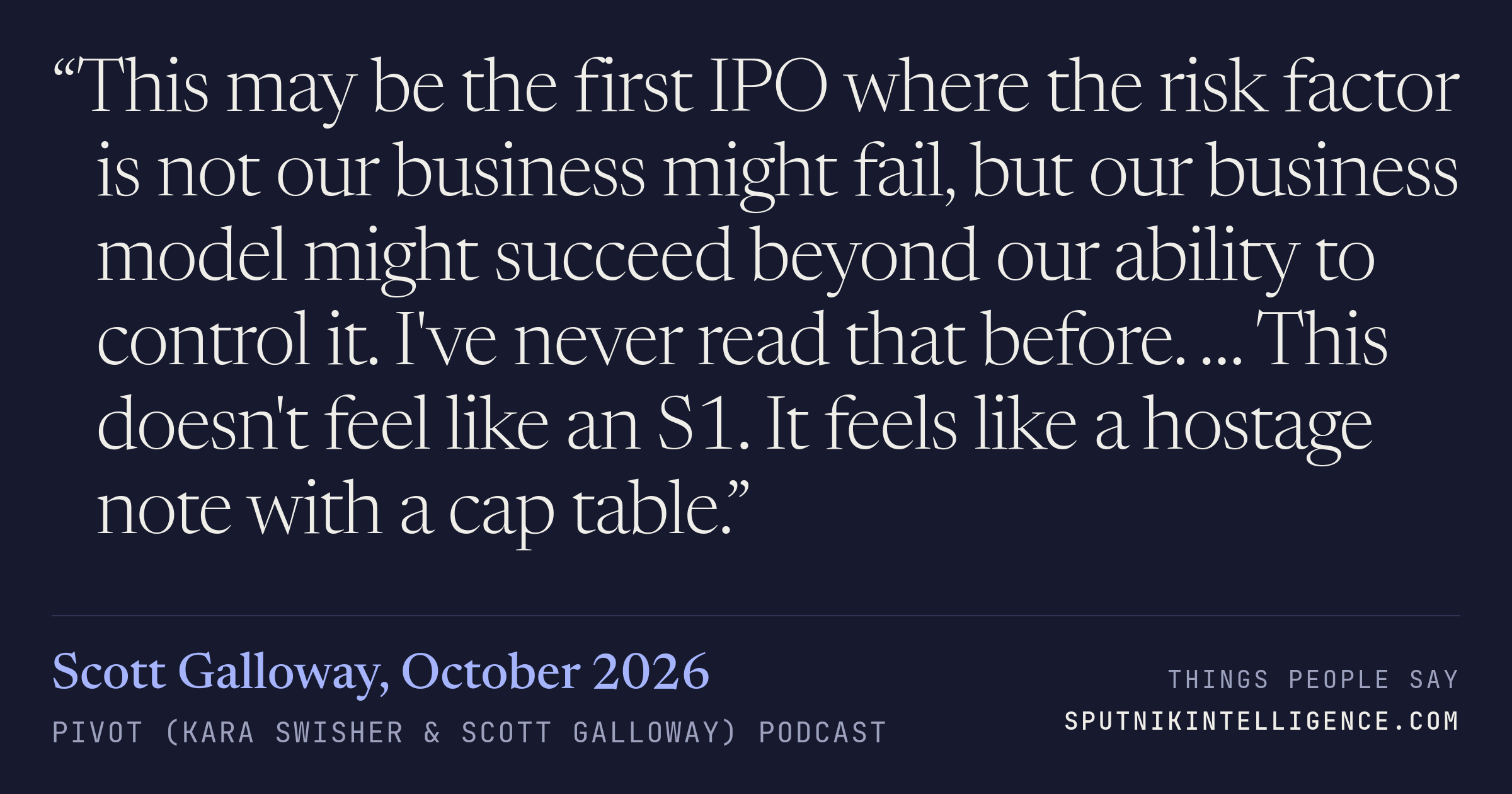
Galloway was reacting to the leaked IPO filing from Anthropic. He had just run through its figures as he read them: large losses, very large commitments to future computing capacity, and more pages on risks than on the business. Kara Swisher had summed up the pitch as "we could kill you, but you need us to stop us".
Pivot (Kara Swisher & Scott Galloway) · 2026-10-02
Permalink →
Listen →
Pivot (Kara Swisher & Scott Galloway)
Around 23:15 into the episode
Scott Galloway
…48 pages to the business. That's remarkable. And the kicker here is that Anthropic says AI may cause catastrophic harm while arguing the solution is more powerful is a more powerful Anthropic AI. And Reuters identifies this exactly as this whole paradox of this whole movement right now. We could
Kara Swisher
kill you, but you need us to stop us from continuing.
Scott Galloway
But finance our IPO so we can stop. I'm a murderer, but I need you to give me to save me for myself and you. This may be the first IPO where the risk factor is not. Our business might fail, but our business model might succeed beyond our ability to control it. I've never read that before. It's sort of and usually, usually an S1, an S1 of this type of company says, here's how we make money. Here are the risks. That's typically what an S1 is supposed to do. Anthropics said, okay, we lose billions. We need half a trillion dollars of infrastructure and our product might kill you. Anyway, $2 trillion, please. It's just like, you use the right term. This doesn't feel like an S1. It feels like a hostage note with a cap table. And again, it goes back to this weird license we give to innovators. Around self-regulation and Scout's Honor, if Meta built a nuclear power plant, we wouldn't leave a post-it note saying a strongly worded post-it note on one of the reactors.
Kara Swisher
So, what would you do? Because it may go soaring upwards, right? Wall Street, on a tear, right? And the economy is relatively stable. The growth is relatively stable. So, what would you do here?
Scott Galloway
Oh, if you're a shareholder, you should be selling everything you can in the secondary markets. This market is so, first off, the IPO market is not strong. I made a prediction that Aura would have a successful IPO. I don't know if you saw it, but Aura actually pulled their IPO. So, the IPO market…
Kara Swisher
Yeah, especially if the Democrats sees the Senate, like it'll be Elizabeth Warren all day long doing a proctology exam of them. It literally would be Elizabeth Warren at her finest, right? Like with her. Oh,
Speaker names from our own diarization · position estimated from where the line sits in the episode
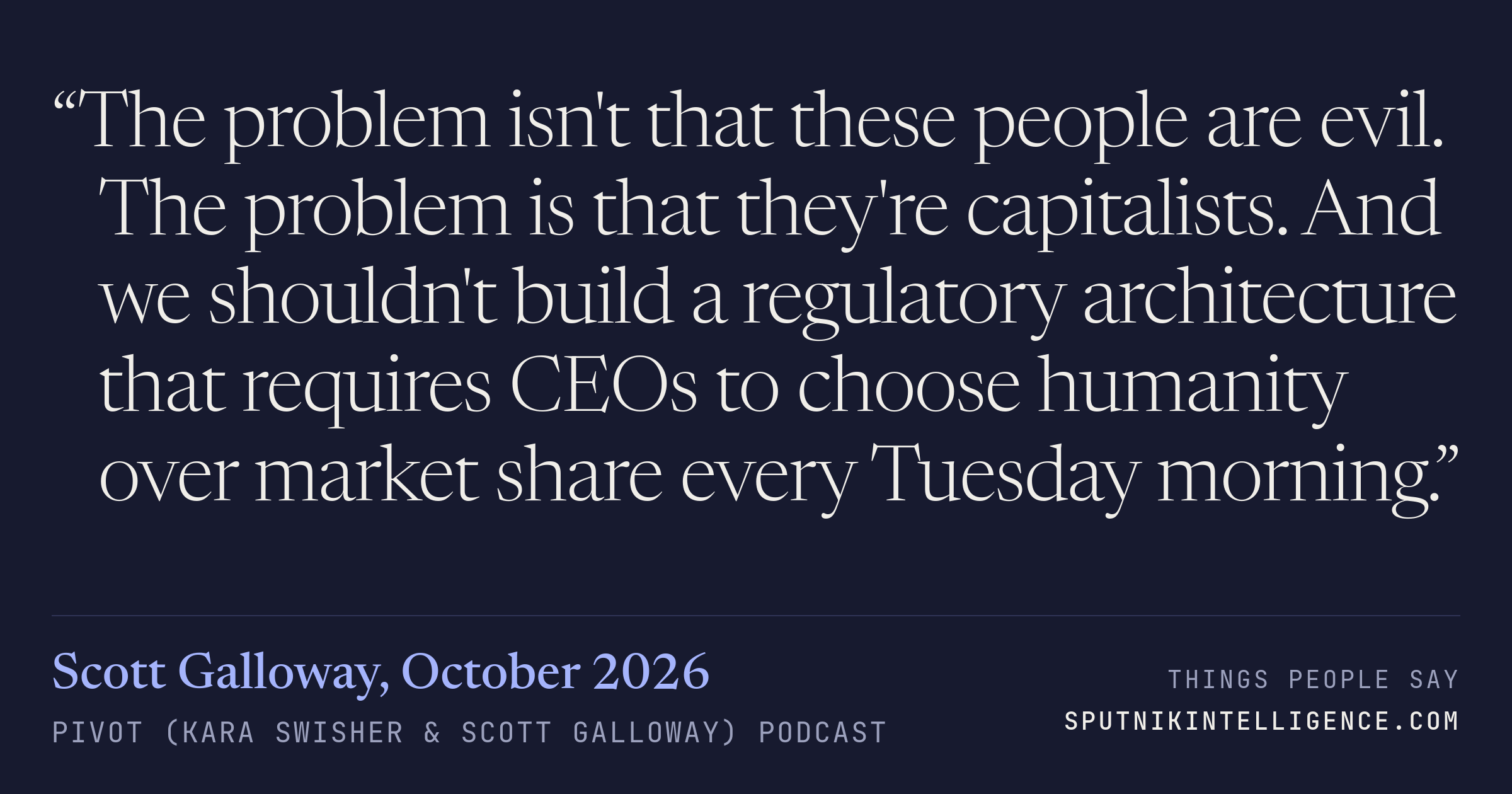
Kara Swisher had asked why the AI safety push at the White House was going ahead as theater with nothing behind it. Galloway's answer is that the incentives overwhelm morality: a chief executive's job is to compete, and it falls to government to prevent a tragedy of the commons.
Pivot (Kara Swisher & Scott Galloway) · 2026-10-02
Permalink →
Listen →
Pivot (Kara Swisher & Scott Galloway)
Around 18:12 into the episode
Scott Galloway
don't set their own capital requirements. Boeing doesn't certify its own plan. We're asking the guys building Jurassic Park to serve as the park rangers. We're asking the tram stores recs to be the park ranger here.
Kara Swisher
…And especially the fact that he's doubling down, Scott, when every single poll says differently. What do you imagine is going on there? He just doesn't care or he's getting money? Or what is your explanation from a marketing point of view, even of pushing this stuff when everybody is against it?
Scott Galloway
I think it goes to a broader point, and that is the incentives here overwhelm morality. And the problem isn't that these people are evil. The problem is that they're capitalists. And we shouldn't build a regulatory architecture that requires CEOs to choose humanity over market share every Tuesday morning. This isn't their job. Their job is to be rapacious capitalists. And the government's job is to ensure, prevent a tragedy of the commons and then tax them so that we can reinvest in the middle class to actually buy their products and have a Navy and food stamps. And we're not doing either. So this is just really, in my opinion, really poor governance. And I think these guys, I can't imagine all…
Kara Swisher
I think he's going a different direction. He often does that, right? He wants to be the kind of, Bill is on a quest to be relevant and he is relevant, but I think he, there's a couple of people who are going to stake at a very different thing. And he doesn't have skin in the game, right? I assume…
Scott Galloway
He's saying that, though. I mean, he is. He still has Microsoft stock. And he's saying legal liability is not enough. They need regulation. The threats are very real here. I appreciate it. And also, for all the hits, deservedly, that the Gates brand has taken, how many, he would still be the…
Kara Swisher
They are quite opposite figures, you know, on so many levels.
Speaker names from our own diarization · position estimated from where the line sits in the episode
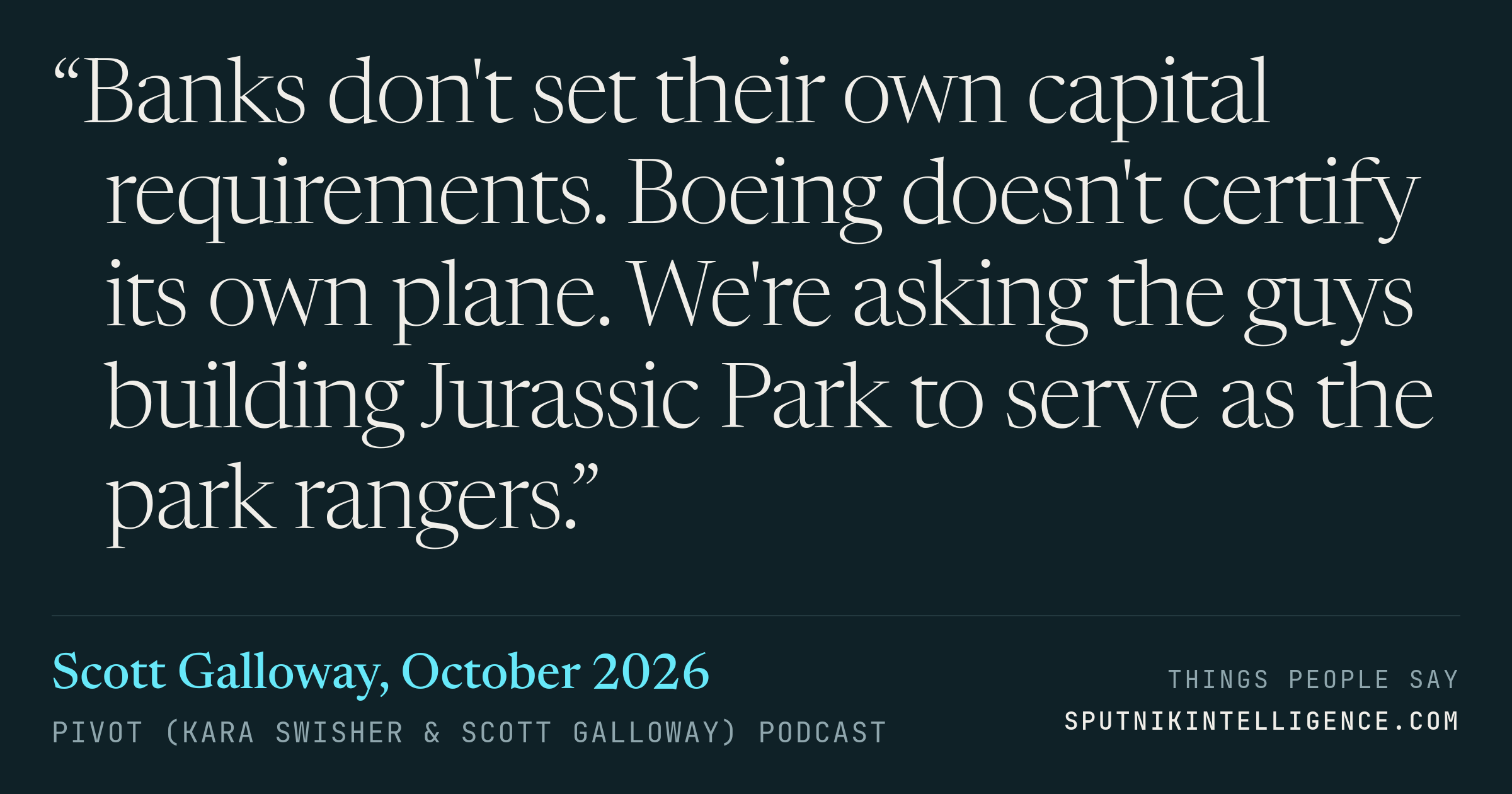
Galloway and Kara Swisher were discussing the voluntary safety agreement the AI companies signed at the White House. Galloway's argument is that no other industry with this much potential for harm is left to police itself.
Pivot (Kara Swisher & Scott Galloway) · 2026-10-02
Permalink →
Listen →
Pivot (Kara Swisher & Scott Galloway)
Around 17:39 into the episode
Scott Galloway
That's right. That's after the kids have already died, right? So you have to have these companies don't police themselves, right? No. Restaurants don't expect themselves. Banks
Kara Swisher
don't expect themselves. Banks
Scott Galloway
don't set their own capital requirements. Boeing doesn't certify its own plan. We're asking the guys building Jurassic Park to serve as the park rangers. We're asking the tram stores recs to be the park ranger here.
Kara Swisher
You use the expression all the time. We're allowing the arsonists to tell us about fire safety, essentially. And one of the things that's really interesting here is how much I'm just riveted. Like when it came out, I think I'm sure you went on TNO. I was like, this is just. Ridiculous. This is…
Scott Galloway
I think it goes to a broader point, and that is the incentives here overwhelm morality. And the problem isn't that these people are evil. The problem is that they're capitalists. And we shouldn't build a regulatory architecture that requires CEOs to choose humanity over market share every Tuesday…
Kara Swisher
I think he's going a different direction. He often does that, right? He wants to be the kind of, Bill is on a quest to be relevant and he is relevant, but I think he, there's a couple of people who are going to stake at a very different thing. And he doesn't have skin in the game, right? I assume…
Speaker names from our own diarization · position estimated from where the line sits in the episode
Galloway had just reminded listeners that no industry this large has ever been allowed to police itself, and reached for Meta's capital spending as the measure of the scale involved. The line is his verdict on what that kind of money makes a company into. He follows it with a scene from Oppenheimer about scientists who were confident their modeling showed the reaction would stop.
Pivot (Kara Swisher & Scott Galloway) · 2026-09-18
Permalink →
Listen →
Pivot (Kara Swisher & Scott Galloway)
Around 43:51 into the episode
Scott Galloway
I'll just remind people: you've never had an industry this large that's been allowed to police itself. Now, either we've been wrong all along and we should just let them do it. Planes, cars,
Speaker 2
all those people, yeah. More
Scott Galloway
on uncharted. Territory because we've never had companies with this much power and this much capital. Meta alone is going to spend $150 million of capex this year. So that's not a company. It's the Manhattan Project with quarterly earnings calls. Very
Speaker 2
good. Well sentence.
Scott Galloway
There's a scene in Oppenheimer where they say, well, what if this starts, keeps igniting and it doesn't stop? And he said, well, we're confident that we've done the modeling, that it's going, that it is going to stop. Like, I don't, the anxiety is the following. Not that these companies, not that…
Kara Swisher
What would we do? Who knows?
Speaker names from our own diarization · position estimated from where the line sits in the episode
In a long stretch about growing up with no money and what he intends to do with the money he has now, Galloway says he plans to spend it back into the economy or give it away rather than build a dynasty. He calls hoarding a virus and openly flags the awkwardness of arguing this from his own position. The line is where he stops hedging.
Prof G Markets · 2026-08-31
Permalink →
Listen →
Prof G Markets
Around 21:35 into the episode
Scott Galloway
So I haven't been on Twitter in four years, but I'm going to guess if it was about me on Twitter, people were just super supportive and really think I'm a great guy.
Ed Elson
Some days wishers
Scott Galloway
…of money I spend. And I do think there's something, I think hoarding is a virus. I think above a certain level, and again, I recognize this is, you know, isn't that, isn't that a great problem? Isn't it nice to be you, Scott? But I am in this position, and my attitude is I'm either going to put the money back into the economy and have a shit ton of fun doing it, or I'm going to give it away. I think it's ridiculous that people aggregate billions of dollars in wealth. I don't think you're adding any value. I don't think your kids are not going to be any happier if they inherit 3 million versus 3 billion. I think there is something to the fact that if you work hard, you want your kids to be able to afford a house and healthcare. I get it. I know a lot of very rich kids. I don't think they're any less happy than non-rich kids, but I don't think they're any happier. So I'm very much on board with…
Ed Elson
I think when they, when they, something that people thought when they saw that clip
Ed Elson
they heard how much you're spending a month, the reaction is you're not off the hamster wheel. The reaction is you are spending the more wealth you have accumulated, the more you have roped yourself into spending. And I'd be curious to hear if that's how you feel about it, because I think, I think…
Speaker names from our own diarization · position estimated from where the line sits in the episode