 Scott Galloway
Professor of marketing at NYU Stern and author of bestselling books including The Four and The Algebra of Wealth.
Scott Galloway
Professor of marketing at NYU Stern and author of bestselling books including The Four and The Algebra of Wealth.
“So that's not a company. It's the Manhattan Project with quarterly earnings calls.”
Pivot (Kara Swisher & Scott Galloway) · Tech Strategy & Big Tech · September 2026
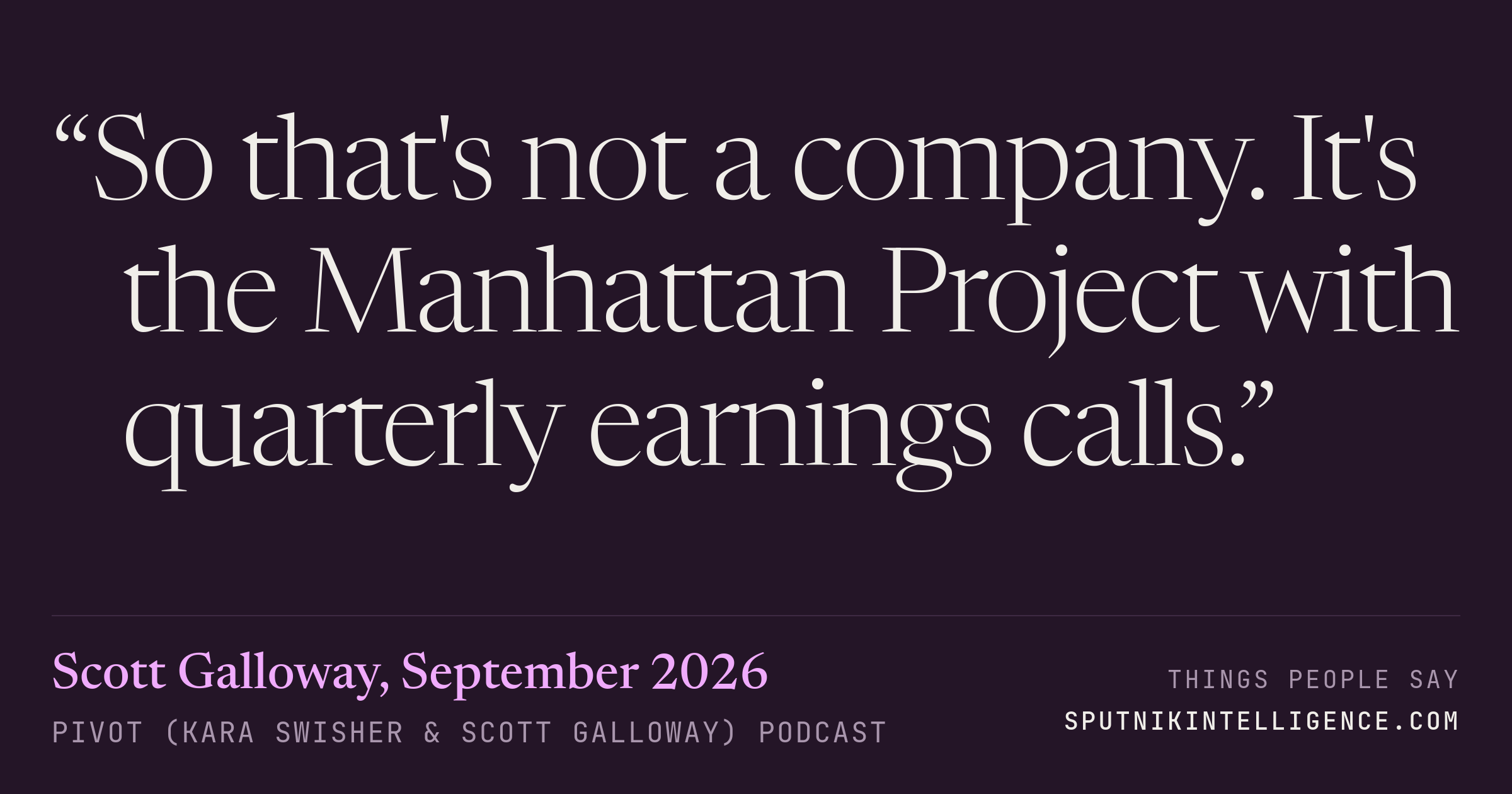
Galloway had just reminded listeners that no industry this large has ever been allowed to police itself, and reached for Meta's capital spending as the measure of the scale involved. The line is his verdict on what that kind of money makes a company into. He follows it with a scene from Oppenheimer about scientists who were confident their modeling showed the reaction would stop.
Transcript
I'll just remind people: you've never had an industry this large that's been allowed to police itself. Now, either we've been wrong all along and we should just let them do it. Planes, cars,
all those people, yeah. More
on uncharted. Territory because we've never had companies with this much power and this much capital. Meta alone is going to spend $150 million of capex this year. So that's not a company. It's the Manhattan Project with quarterly earnings calls. Very
good. Well sentence.
There's a scene in Oppenheimer where they say, well, what if this starts, keeps igniting and it doesn't stop? And he said, well, we're confident that we've done the modeling, that it's going, that it is going to stop. Like, I don't, the anxiety is the following. Not that these companies, not that these companies are evil, not 1%, 10%. The anxiety is not knowing what's going on. And what do we know works for kids? Every parenting book seems to contradict the one before it, but the one consistent thing is that kids need guardrails. And this is effectively where we are. The CDC, the Center for Disease Control, is supposed to prevent an outbreak of measles, much less an existential health threat. What if, what would they say to Moderna? If Moderna, if a scientist in Moderna came out and said, you know what? The COVID vaccine, I think there's a one in 10 chance that the COVID vaccine turns offensive and turns into a pathogen that becomes infectious and kills 10% of the world's population. That's effectively what this guy said. And then when asked about it, the CEO of Moderna said the following, well, you know what? He might have a point. He might have a point.
What would we do? Who knows?
More from Pivot (Kara Swisher & Scott Galloway)