Money & Markets · August 2026
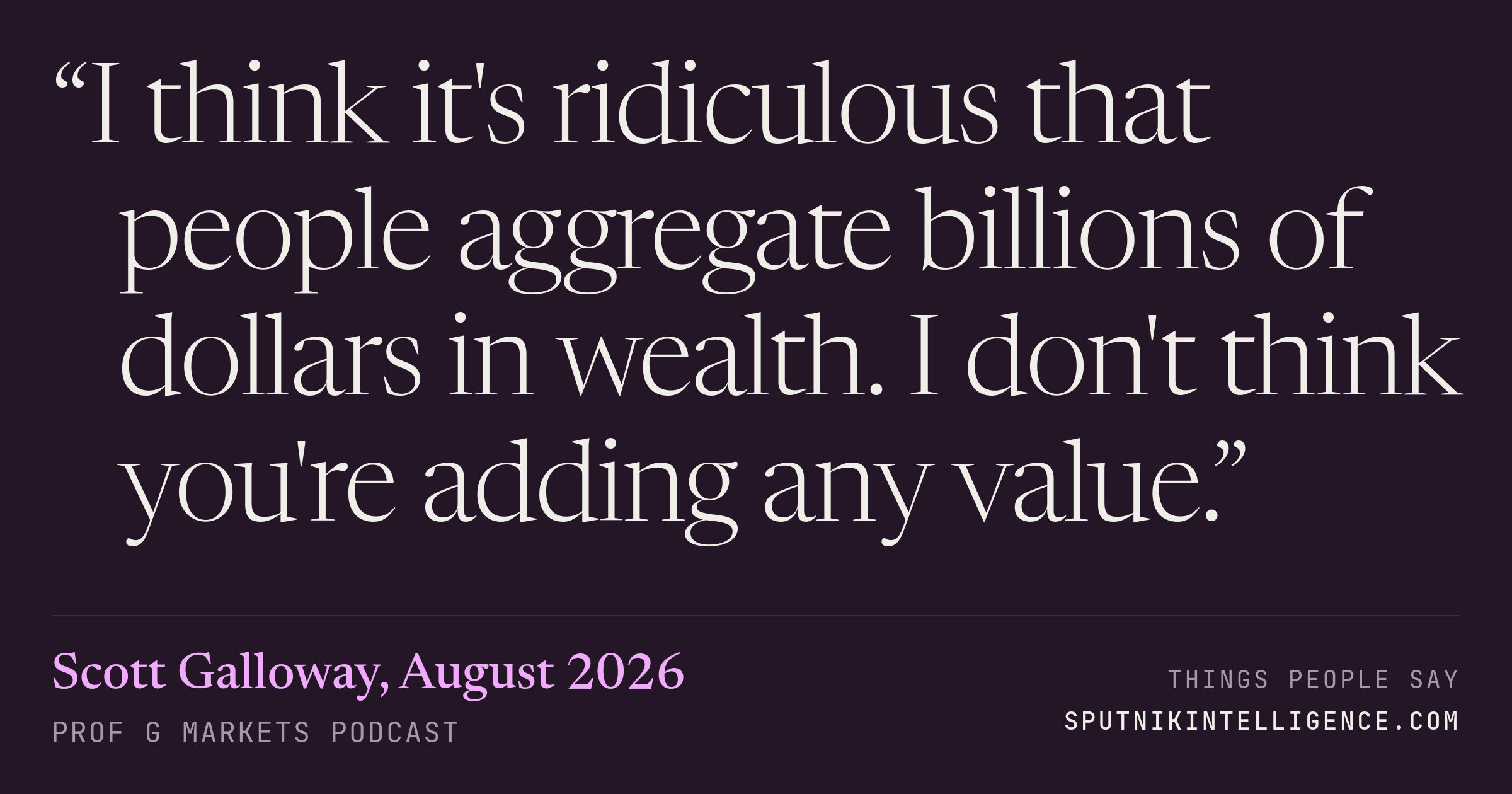
In a long stretch about growing up with no money and what he intends to do with the money he has now, Galloway says he plans to spend it back into the economy or give it away rather than build a dynasty. He calls hoarding a virus and openly flags the awkwardness of arguing this from his own position. The line is where he stops hedging.
So I haven't been on Twitter in four years, but I'm going to guess if it was about me on Twitter, people were just super supportive and really think I'm a great guy.
Some days wishers
Kara called me over the weekend and she poured me like someone had said something mean about me on Twitter. And I'm like, I haven't been on Twitter in four years. And she's like, that's probably a good idea. My understanding is I just get mauled on Twitter. Anyways, by the way, folks, just a life hack. The most accretive thing you can do for your mental health is to not go on Twitter. Look, I grew up without a lot of money. The biggest source of stress in my life wasn't that my dad wasn't around. It wasn't that my mom, you know, the biggest source of stress in my life was easy. When my mom got upset, it was just me and her in the household, and there was no, we were all upset. The household came down. And the biggest source of stress in our life was not that we were poor, but money was an issue. And it made regular things harder. I described my household growing up affectionately as upper, lower, middle class. My mom was a secretary. We were never hungry. It wasn't a sob story. I actually think it was easier to be in our economic weight class back then than it is now. I went to a decent school. I went to public schools all the way through graduate school. We took vacations every once in a while. You know, my mom had a decent car, not a nice car, but a decent car. So it's not a sob story, but the biggest source of stress in my life until even through college was money. I went to college every summer. I had to make and save $3,000 or I wasn't enrolling again. I couldn't return in the fall. And it was just, quite frankly, it was just stressful. And so, and also, I discovered, you know, I thought early on, I want to, A, take care of my mom and B, I want to be more attractive to women. And that's, I think, a natural inclination that a lot of young men feel. They have very paternal, protective feelings about the woman who raised them. I wanted to take care of my mom. By this time, my mom had been diagnosed with cancer several times and couldn't work. And money was an issue. And so I was very motivated by money. And then when I got to a certain point, I think a lot about money and happiness. I recognized in 2017 when I sold out too, and by most metrics, I was done. I think I told you this. I was planning to raise more capital because I wanted to be a billionaire. I thought Scott Galloway billionaire just has a really nice sound to it. And I read a lot about happiness. And Daniel Kahneman, one of my intellectual role models, has done this great work on the relationship between money and happiness. And to summarize, there is a correlation between money and happiness, but only to a certain point. And then it tops out. And I had something that happens to a lot of men in their early 50s. And that is a couple of my friends died that shouldn't have. And that is these weird genetic time bombs go off. And people who are otherwise healthy have something that just takes them down. One, it was this very aggressive form of leukemia. The other was pancreatic cancer. And these were two guys that you just wouldn't have ever guessed would be sick. They were in shape, young guys with good nutrition. Anyway, so that gave me pause. And I thought, all right, I have enough money to live well. So I'm going to stop. I'm going to try and get off this economic hamster wheel. I've been able to do that somewhat. I can only modulate it, not get rid of it because I still have real financial insecurities. But what I decided to do was I was going to do one of two things with any incremental income above my number, and which I hit in 2017. I was either going to spend it. I think in a capitalist society, you can do amazing things. Another life hack is spend money on experiences, not things. People overestimate the happiness they're going to get from things. They underestimate the happiness they're going to get from experiences. I don't own a car. I have a couple of panoras, but I don't spend a lot of money on clothes. I really don't spend that much money on things. I spend a shit ton of money on experiences. So of that $300,000 or $400,000 a month I spend, 150 of it is on a private plane, which gives me the ability to do things on a moment's notice and travel comfortably and professionally do things that give me a lot of leverage, lowers my anxiety on a day when I'm having dinner with Mike. I mean, I realize this is a story of privilege, but I spend a shit ton of money and I also each year give away, I try and give away as much as I've spent. Not because I think of myself as especially philanthropic, but I get a lot of psychic reward from it. It makes me feel strong. It makes me feel masculine. I feel like I'm nodding to many of the people and things that help me get where I am, whether it's the University of California, whether it's investing in programs for immigrants or financial. It just makes me feel good. But I have no desire to build. Dynasty and pass on hundreds of millions of dollars to my kids. I want to have a great time with my friends and family. I'm going to feel like I'm giving back to society. And I'm very open about the amount of money I spend. And I do think there's something, I think hoarding is a virus. I think above a certain level, and again, I recognize this is, you know, isn't that, isn't that a great problem? Isn't it nice to be you, Scott? But I am in this position, and my attitude is I'm either going to put the money back into the economy and have a shit ton of fun doing it, or I'm going to give it away. I think it's ridiculous that people aggregate billions of dollars in wealth. I don't think you're adding any value. I don't think your kids are not going to be any happier if they inherit 3 million versus 3 billion. I think there is something to the fact that if you work hard, you want your kids to be able to afford a house and healthcare. I get it. I know a lot of very rich kids. I don't think they're any less happy than non-rich kids, but I don't think they're any happier. So I'm very much on board with spending a shit ton of money and I'm very open about it and also giving a lot of money away. But I think at a certain point, you need to try and get off that money hamster wheel and ask yourself, all right, money helps me write chapters, new chapters, it helps current chapters burn brighter, but it's not your story. And you need to find another sense of purpose. But I still struggle. I still have money anxiety. And it's increased recently by kind of a different dimension. But my attitude is: if you're blessed with the right timing, the right skills, and growing up in a place like America that gave disproportionate advantage to people who look, smelled, and felt like me, you have one, the opportunity to do amazing things, and two, the obligation to try and, you know, invest in things that ensure those same ladders are present for other people. But I think a lot about money. I hate it when people, when these fucking VCs say, oh, I never really thought about money. I just thought about outcome. Those guys are obsessed with money. And it's been a source of, I don't want to call it trauma, but I have body dysmorphia. I'm constantly working out. And when I look in the mirror, I'm 6'2, 190. When I look in the mirror, I think I look emaciated because growing up, I was so painfully thin that it kind of traumatized me. It made me feel less attractive, less weak, more vulnerable. So now I can never be strong enough or big enough. And I look in the mirror and think, okay, I look terrible and skinny and scrawny. And I know intellectually that's not the case, but I have that trauma and it still impacts me now. I had, I don't want to call it trauma, but a lot of the challenges a lot of American households face around money. So when I got to having money, I really liked it and I kept going. And I still keep going, but I have tried to modulate it by either spending it, putting back into the economy and enjoying it or giving it away. Anyway, I'm sounding defensive.
I think when they, when they, something that people thought when they saw that clip
and
they heard how much you're spending a month, the reaction is you're not off the hamster wheel. The reaction is you are spending the more wealth you have accumulated, the more you have roped yourself into spending. And I'd be curious to hear if that's how you feel about it, because I think, I think, I mean, when you, I mean, just reacting to that clip, it's like, oh, wow, I guess you could spend money on private travel because I guess that is great. I guess that is nice. And it starts getting you into a space where you're kind of like, what other things are there out there? And how else can I make my life better? And what more things and what more comfort can money buy? And so how do you think about it from that perspective? Because I think a lot of people would, based on that clip, assume that you have not gotten off the hamster wheel. Or maybe that's what you're saying.