Giridharadas is describing the Grants Pass case at the Supreme Court, which tested whether there is a right to sleep outdoors, and a point he attributes to Justice Sonia Sotomayor: someone with a home who dozes off stargazing in a park is unlikely to be arrested. He goes on to give the other side, from sanitation and outreach workers who say sidewalks are public space.
And by the way, this came up in a Supreme Court case while I was working on the book. The Grants Pass case came up and it tested, is there a right to be homeless, specifically a right to sleep outdoors? And what it was a very interesting debate. Justice Sonia Sotomayor said, basically, in America, you are allowed to sleep outside as long as you have a home somewhere. In other words, if Professor G
If I go camping.
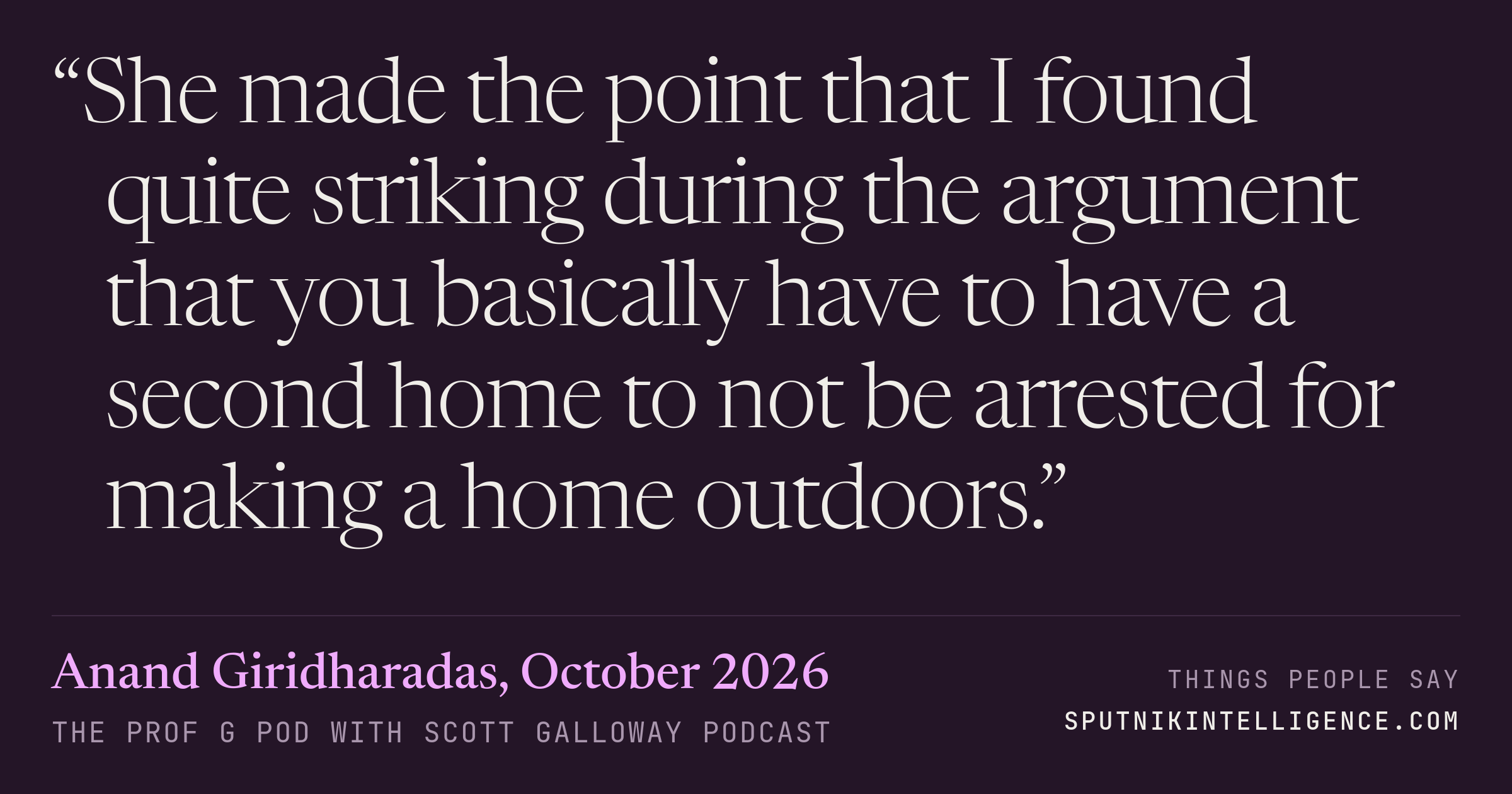
But even in a city, right? If you were laying in Central Park stargazing and you happened to fall asleep, your odds of being arrested for that are quite low. So she made the point that I found quite striking during the argument that you basically have to have a second home to not be arrested for making a home outdoors. And I think the other argument, the other side, is that this is public space. And I spent time also with sanitation workers and outreach workers who say, look, these are public sidewalks. This is people are going to the bathroom on the sidewalk. It is not sanitary. We have a century of public health, you know. And so I have, you know, my brain comes up with quick and hasty judgments as easily as anybody else. But I really tried with this book to live in the minds of. A homeless person trying to sleep outdoors. My character, Choco, who I spent time with, go in depth, Choco being swept by the NYPD. And I try to get in the mind frame of what is it like to have all your possessions in this little space and have 20 people from the NYPD and sanitation coming at you, trying to take away. And Choco, an elderly man, had grown up on the very block 60 years earlier that he was now sitting on the street of. He had grown up in an apartment on the very block. So I tried to get in his head. But then I also spent time with these outreach workers who are endlessly frustrated with people who refuse to go to shelter and who refuse any kind of help. And I spent time with folks, two different characters of mine in the mayor's office under Eric Adams, one of whom thinks you should just forcibly hospitalize lots of these people and you are doing more for their humanity and dignity by forcing them into care than you are by letting them rot. And then another guy in the mayor's office who said, no, this is all downstream of actually a healthy society and food deserts and better schools. And, you know, and so this is a book in which I am trying to kind of inhabit the fighting faiths of this country that you see on this issue, and that you see even more broadly around these questions of order, disorder, fear, safety, danger that are, I think, at the heart of this kind of era in American life.
I want to prefer to thesis and have you respond to it because I did hear from Dan Mayor Lurie. And so I did a fraction of the deep dive you've done, but I did do some at least at least some cursory research on the homeless problem. And then we'll go specifically to this case. And like a lot of people, I had stereotypes or presumptions that were just totally incorrect. I assumed that a big percentage of the homeless were veterans. And it's actually only 4%. The housing and urban development HUD and Veterans Affairs have actually been quite successful at finding housing for veterans. The largest cohort of the homeless are people who live alone, have no siblings, no connections. And it started me thinking I'm into this whole notion of the answer is each other. And that if you don't from a very early age figure out the third places, the economics, the zeitgeist to ensure people have some deep and meaningful relationships. Yeah. What determines outcomes, good and bad, of a hospital stay? Is it the hospital? Is it the doctor? No, it's that you have an advocate, that you have someone who is irrationally passionate about your well-being saying, where are the meds? Where's the nurse? And it just struck me that the people, the homeless population, the top of the funnel for the homeless is a kid who graduates from high school, works remotely, doesn't have family. And if he drops, if he or she drops off the face of the earth, nobody knows. I would just love to get your thoughts on this.
I think it is completely correct. And I think this is actually one of the people I follow in the book. I call them characters, but this is obviously a nonfiction book. These are real, real people who I followed for a couple of years. One of my four main characters is named Ashwin Vassan. He was the health commissioner of New York City under the previous mayor, meaning chief doctor of New York City. He was the first mental health expert to get that job, right? So if you think about public health, you think polio, measles, COVID, shots, sanitation drives, these kinds of things, right? His appointment was an important signal that mental health might be considered sort of public health in a more meaningful way than the past, right? Because we don't normally think about it like that. We think about it like COVID is everyone's problem, right? A measles outbreak is everybody's problem. But if you're, but if your teenager is depressed about climate change, like that's kind of your family's problem, right? We still privatize mental health in many ways. And to your point, of people isolated. And so he said, what if mental health was part of public health? What if we treated the people you were just describing as having something as collective in nature as a measles outbreak? What would it look like? And what he, he had come from an amazing organization that if you don't know, you would love it. It's called Fountain House. It is a mental health clubhouse. It is an actual giant townhouse on the west side of Manhattan. It started a long time ago. It was founded by former patients in a state psychology. Psychiatric facility in New York who found community with each other inside while they were still inside and had a kind of group where they would get together and found a lot of solace in that. And then when they came out, they were discharged. They were missing it. They fell into exactly the kind of isolation you describe. And so they recreated it and they created this group and eventually grew into this thing called Fountainhouse. Fountainhouse is not a place to stay overnight. It is a daytime clubhouse for mentally ill folks. You become a member, you have to apply, you become a member, and then you can kind of hang out there during the day. They have a wellness center. They have a kitchen where people can cook and make food. People, you know, are customers there and they also do the jobs there. They have a cafe. They have a place where you can get clothes if you have a job interview, right? There's people at varying levels of severity. They have a newspaper, the Fountainhouse Times. And the whole theory of Fountainhouse, and that also animated Ashwin Vassan's turn as commissioner of public health in New York City was exactly what you said. We think of some of these conditions as being biomedical and just beyond the reach of anything besides drugs. But actually, for some people, it is the failure to be needed. And that, again, not to minimize, like there are some people who have, you know, severe schizophrenia where like being on a newspaper is not going to help you, right? But his point and Fountainhouse's point is there's a lot of people in between full-blown schizophrenia, debilitating schizophrenia, and your teenager being a little depressed, right? And for a lot of those folks in between those degrees, being needed, being part of things, having someone wonder, why isn't Scott at the Fountainhouse Times meeting this morning? Where is he? That is such a crucial component of mental health. By the way, that I think all of our ancestors would have intuitively understood that we don't understand in modern American life for all the reasons you so often talk about. And so Fountainhouse has proved this model of creating this space where people are needed and they have a place to go. And one of the things Commissioner Vassin did when he was in office was get New York City to kind of adopt this model and build this model at the level of the city. Got $30 million of funding. There's now, you know, some clubhouses starting to grow all over the city. And there was this fascinating moment in the book where the head of the CDC, Centers for Disease Control and Prevention, came to visit Fountainhouse. And you will understand this. Your own crossroads, I think, as a belonging guy and a business guy. There was this fascinating clash that happened where the CDC woman was just like data and stats and like, show me what can be measured. Show me, you know, show me things that have a regression attached to them. And I just watched, she's looking around, she's asking people questions and she was looking around at this. She treated it. It was like this hokey kind of little larky thing. And she couldn't process it from a kind of serious dollars and cents, could Medicaid fund this kind of thing. And I think that is often the problem here, that the remedies of the kind you're talking about, how do we actually give people belonging, not as a happenstance, but in a systematized way? Fountainhouse is doing it. Clubhouses are doing it. There is a model. It's not cheap, but it's happening. It runs into a technocratic culture that's like, I don't know, I can measure like infection rates and divide the lost work days by the cost of the shot. I can't do that with belonging. So I'm not going to fund it.
We'll be right back after a quick break.