Where to Find Them
Tyler Cowen
hosts and writes
Marginal Revolution
,
hosts
Conversations with Tyler
,
hosts
TBPN
,
writes
The Free Press
,
hosts
The Marginal Revolution Podcast
,
writes
a16z Podcast
,
writes
Wisdom of Crowds
,
writes
Prof G Media
,
writes
Infinita City Times
,
writes
Civic Renaissance with Alexandra Hudson
,
writes
A Year of Bach
,
writes
Exponential View (Azeem Azhar)
,
writes
The Michael Shermer Show
,
writes
Call Me Back - with Dan Senor
,
writes
Stay Tuned with Preet Bharara
,
writes
David Perell's How I Write
,
writes
Uncomfortable Conversations with Josh Szeps
and
writes
Sinification
.
They have also been a guest on
EconTalk
(20 times) ,
Dwarkesh Podcast
(4 times) ,
The Prof G Pod with Scott Galloway
(2 times) ,
Going Big! with Kevin Gentry
(2 times) ,
GoodFellows: Conversations on Economics, History & Geopolitics
(2 times) ,
WorkLab
(2 times) ,
80,000 Hours Podcast
,
Lex Fridman Podcast
,
ChinaTalk
,
The Human Progress Podcast
,
Markus' Academy
,
Summation with Auren Hoffman
,
The Julia La Roche Show
,
Interesting Times
,
Odd Lots
,
Flow Radio
,
The Learning Leader Show With Ryan Hawk
,
Ground Truths
,
Interesting Times with Ross Douthat
,
Capitalisn't
,
The Knowledge Project (Shane Parrish)
,
Conversations with Coleman
,
Reasonably Optimistic
,
Joe Lonsdale: American Optimist
,
The Long Game with Jake Sullivan and Jon Finer
,
Manifold
,
Templeton Ideas Podcast
,
3 Takeaways™
,
The Street Porter and the Philosopher
,
AI & I
,
Two Percent with Michael Easter
,
Faster, Please!
,
FranklinCovey On Leadership
,
Ideas of India
and
Invest Like the Best (Patrick O'Shaughnessy)
.
They also write for
Tyler Cowen on Substack.
Recently:
“A simple point about the intertemporal regulation of AI”
on Marginal Revolution (October 2026);
“Do mass shootings in universities lead to permanent effects?”
on Marginal Revolution (October 2026);
“More on Elizabeth Holmes and prison”
on Marginal Revolution (October 2026);
“Wednesday assorted links”
on Marginal Revolution (October 2026);
“One reason I do not love AI writing, or even AI-assisted writing”
on Marginal Revolution (October 2026);
“The Causal Effect of Foreign Ideas on U.S. Innovation”
on Marginal Revolution (October 2026).
What They Said
Patel asked whether Cowen would be surprised if AI companies were earning over a trillion dollars a year by 2030. Cowen says he would be. He is optimistic about the companies themselves, but thinks slow-moving sectors like government, universities and FDA-regulated medicine will hold back how much AI earns.
Interesting Times · 2026-10-15
Permalink →
Listen →
Interesting Times
Around 47:15 into the episode
Tyler Cowen
…not. I don't think we'll get there by 2045. I think the human role in integrating the physical and digital worlds will remain. And the fact that people want to deal with humans for many issues, perhaps irrationally, won't go away ever. And I think the Centaur model will persist for decades.
Dwarkesh Patel
Yeah. Do you think that manifests itself in, I'd say, a cap in the maximum amount of revenue you think AI companies can earn without automating knowledge work? If I said, you know, it's 2030 and the AI companies have over a trillion dollars in revenue, are you surprised?
Tyler Cowen
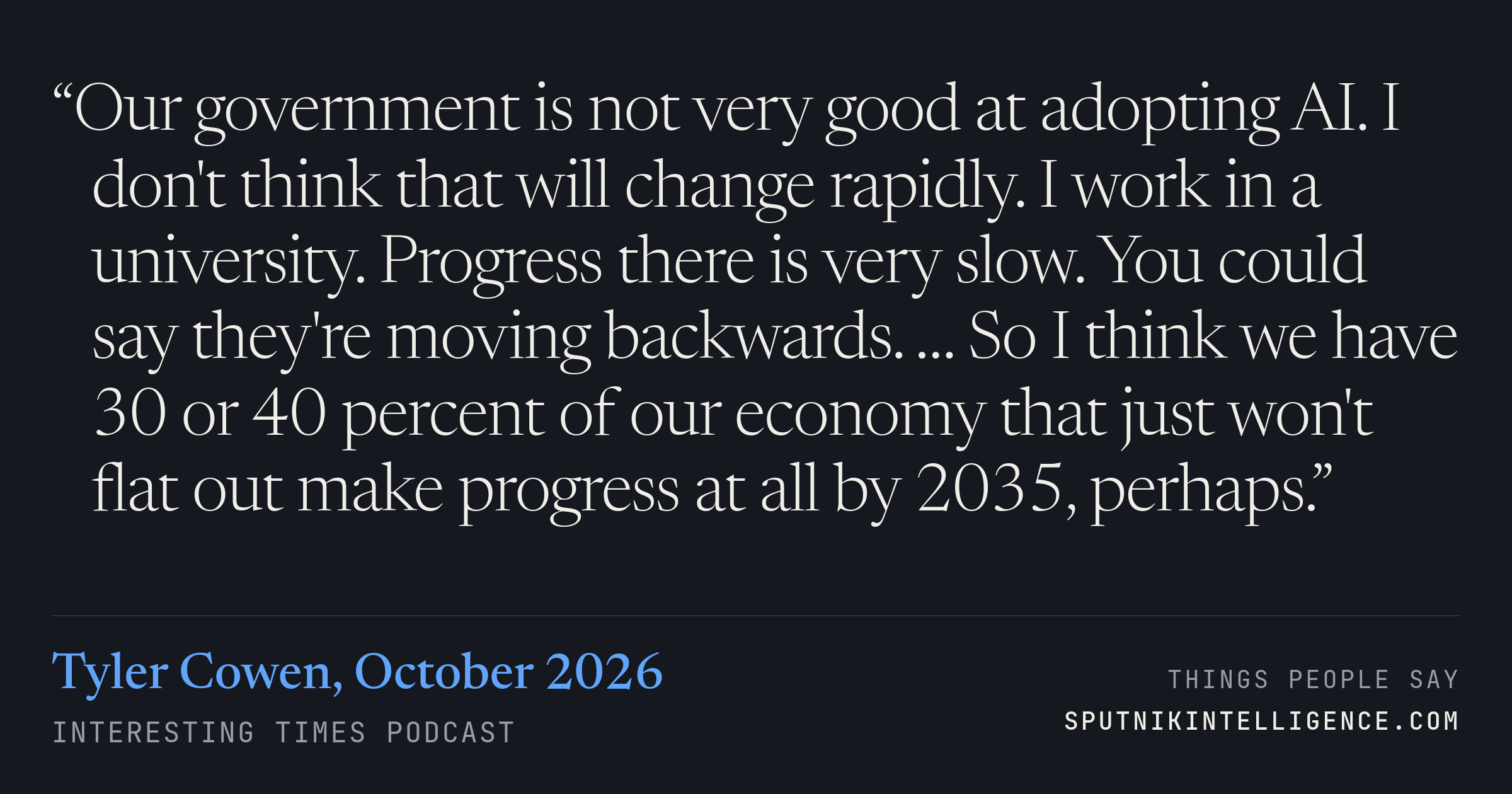
I am. I'm not bearish on the companies, but where the money will come from elsewhere in the economy. So I'm very optimistic about, say, biomedical progress. But I think with clinical trials, the FDA, you know, that can take 10 or 20 years, maybe more. And these other sectors that grow, they're often hindered. Our government is not very good at adopting AI. I don't think that will change rapidly. I work in a university. Progress there is very slow. You could say they're moving backwards. It's just a thing to stamp out because students use it to cheat. So I think we have 30 or 40. Percent of our economy that just won't flat out make progress at all by 2035, perhaps. And then these startups will slowly replace bigger companies, but that too takes a lot of time. And the number of people who can run those startups is pretty constrained. You have to work really hard. You have to be very AI aware. You have to be very smart and so on. I
Dwarkesh Patel
want to understand whether you think it's a lack of capabilities the systems will have, or just that humans will not be inclined to have AIs do jobs that they could, in fact, do. For example, it will be like at Mercatus or something. I assume that there's a lot of people you hire to do work for…
Tyler Cowen
mix of both. I think they'll still be in Mercatus then. Absolutely. But
Dwarkesh Patel
the capabilities will be lacking.
Speaker names from our own diarization · position estimated from where the line sits in the episode
Collections They Appear In