 Tyler Cowen
 is Holbert L. Harris Professor of Economics at George Mason University and also Faculty Director of the Mercatus Center.
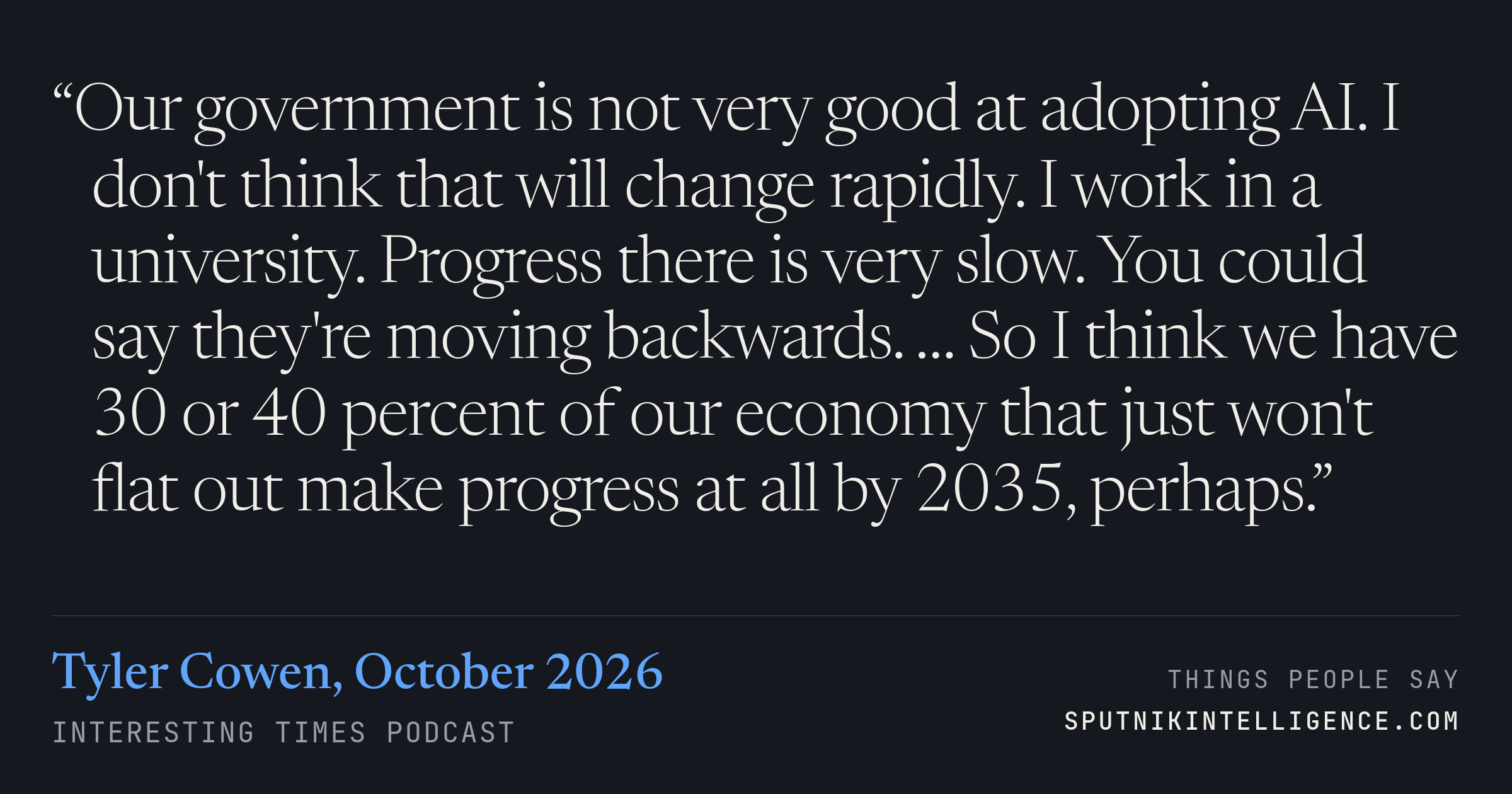
“Our government is not very good at adopting AI. I don't think that will change rapidly. I work in a university. Progress there is very slow. You could say they're moving backwards. … So I think we have 30 or 40 percent of our economy that just won't flat out make progress at all by 2035, perhaps.”
Interesting Times · Geopolitics & World Affairs · October 2026
Patel asked whether Cowen would be surprised if AI companies were earning over a trillion dollars a year by 2030. Cowen says he would be. He is optimistic about the companies themselves, but thinks slow-moving sectors like government, universities and FDA-regulated medicine will hold back how much AI earns.
Transcript
…not. I don't think we'll get there by 2045. I think the human role in integrating the physical and digital worlds will remain. And the fact that people want to deal with humans for many issues, perhaps irrationally, won't go away ever. And I think the Centaur model will persist for decades.
Yeah. Do you think that manifests itself in, I'd say, a cap in the maximum amount of revenue you think AI companies can earn without automating knowledge work? If I said, you know, it's 2030 and the AI companies have over a trillion dollars in revenue, are you surprised?
I am. I'm not bearish on the companies, but where the money will come from elsewhere in the economy. So I'm very optimistic about, say, biomedical progress. But I think with clinical trials, the FDA, you know, that can take 10 or 20 years, maybe more. And these other sectors that grow, they're often hindered. Our government is not very good at adopting AI. I don't think that will change rapidly. I work in a university. Progress there is very slow. You could say they're moving backwards. It's just a thing to stamp out because students use it to cheat. So I think we have 30 or 40. Percent of our economy that just won't flat out make progress at all by 2035, perhaps. And then these startups will slowly replace bigger companies, but that too takes a lot of time. And the number of people who can run those startups is pretty constrained. You have to work really hard. You have to be very AI aware. You have to be very smart and so on. I
want to understand whether you think it's a lack of capabilities the systems will have, or just that humans will not be inclined to have AIs do jobs that they could, in fact, do. For example, it will be like at Mercatus or something. I assume that there's a lot of people you hire to do work for…
mix of both. I think they'll still be in Mercatus then. Absolutely. But
the capabilities will be lacking.
More from Interesting Times