 James Marriott
Writer at The Times
“All these kind of irrational modes of persuasion that were very common in pre-literate political cultures were sort of banished by print because you can't shout at someone through print, you can't charm someone through print. And this stuff, I think, is rushing back into our world.”
Interesting Times · Geopolitics & World Affairs · October 2026
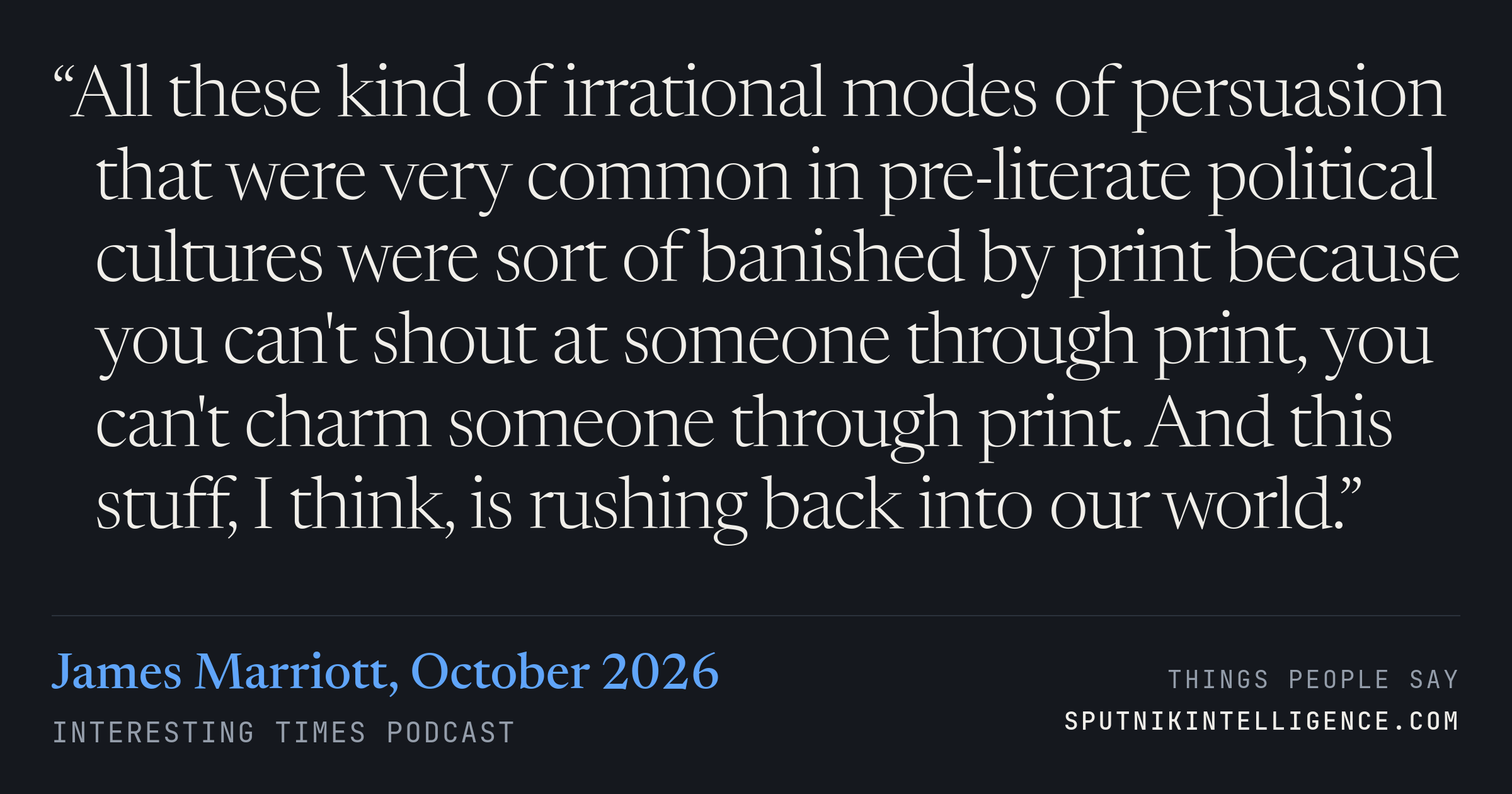
Asked why a post-literate world would be more tribal and autocratic, Marriott draws on Marshall McLuhan. Print made politics emotionally flat, which he says suited democratic argument, and video feeds like TikTok are bringing the passions back.
Transcript
…far. And I think online, people get carried away and do get very excited about the idea that we're going to have the Homer of TikTok, which I'm skeptical about. But I think looking at the world before literacy can be a way to understand what the world after sort of peak literacy might look like.
So you've suggested that this is a world. world that will be more mystical, more tribal and more autocratic. Why?
…relies on people being able to have not perfectly rational arguments, but arguments that are informed more by logic and reason and evidenced argument than by the kinds of forms of emotional persuasion that come more naturally when you can persuade someone not with your, not with evidence or with an argument, but by charming them around to your point of view or crying at them or shouting at them. All these kind of irrational modes of persuasion that were very common in pre-literate political cultures were sort of banished by print because you can't shout at someone through print, you can't charm someone through print. And this stuff, I think, is rushing back into our world. These passions that were banished by print are returning to us.
Let's go back a little bit further to the beginning of the print story. You know, we've talked, we've explored some of the implications of the transition away from print culture into a more participatory, more agonistic, more oral era. But your argument is that really the modern world was born out…
I guess there are various places at which you could begin the story of the spread of literacy. One obviously is with the invention of the Gutenberg press. That multiplies the production of books and that lays the groundwork for mass literacy. The story as I tell it in my book, I think, all starting…
So what's the mechanism then whereby all these distinctively modern phenomena bring us to democracy? I mean, this has been a central theme in your thesis, that there's this incredibly central link between democracy and long-form literacy. So really, can you talk me through what is that link?
More from Interesting Times