
James Marriott

Things James Says on Podcasts

Writer at The Times

Where to Find Them

James Marriott writes Cultural Capital and writes Whatever Works . They have also been a guest on EconTalk (2 times) , Persuasion , Interesting Times , The Common Reader , Yascha Mounk , Interesting Times with Ross Douthat and The Honest Broker Podcast . They also write for James Marriott on Substack.

Recently: “James Marriott on the End of Reading” on Yascha Mounk (October 2026); “James Marriott on the End of Reading” on Persuasion (October 2026); “Why the bronze age collapsed, did Jesus rise from the dead?, indecent medieval sculpture, are smartphones destroying love?” on Cultural Capital (October 2026); “How TikTok is destroying the future, the highly effective habits of the Victorian elite, thick art, style and civilisation” on Cultural Capital (October 2026); “That Daily Brain Rot Break Is Taking Us Back to the Dark Ages” on Interesting Times with Ross Douthat (October 2026); “That Daily Brain Rot Break Is Taking Us Back to the Dark Ages” on Interesting Times (October 2026).

What They Said

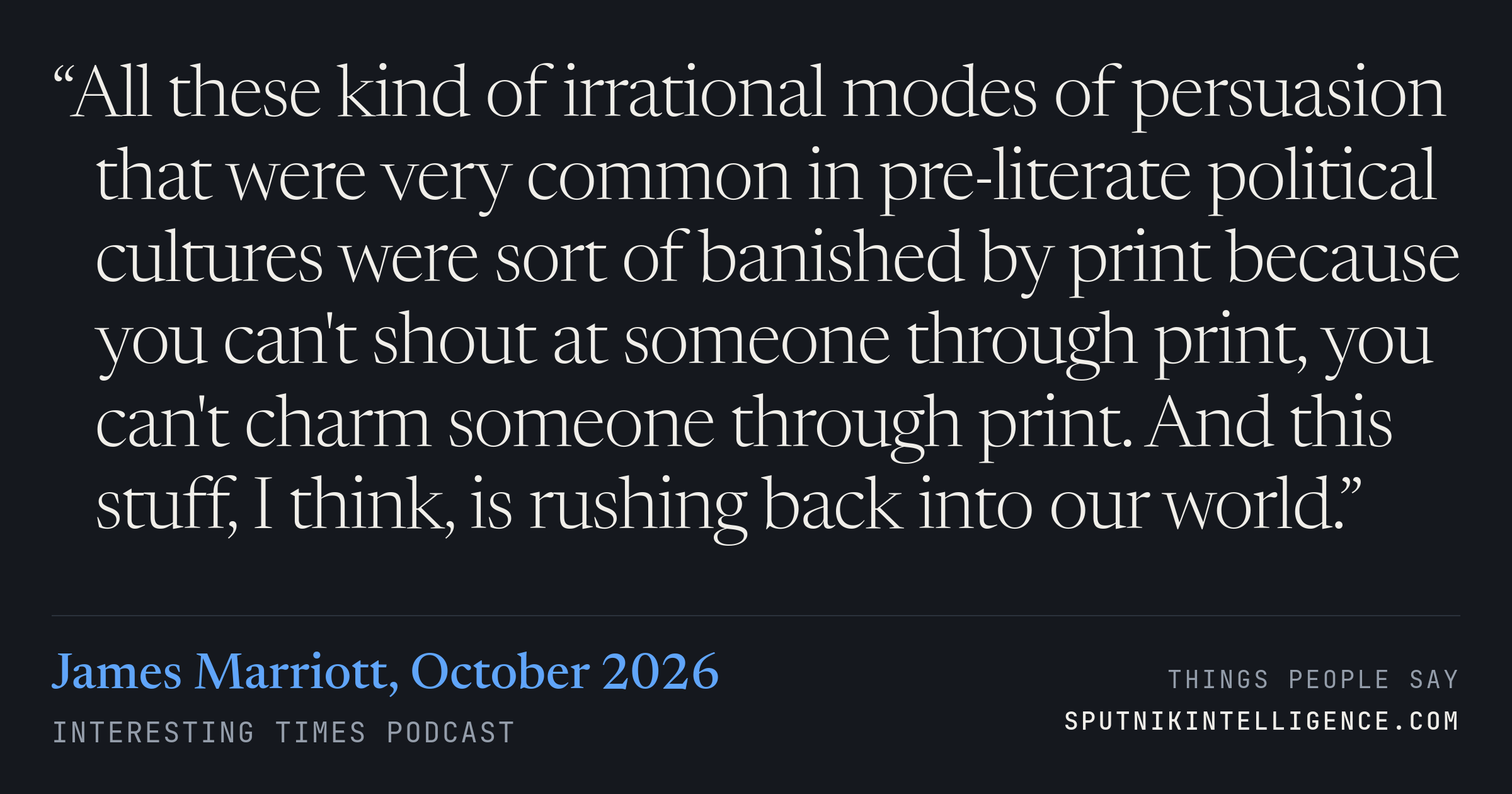
“All these kind of irrational modes of persuasion that were very common in pre-literate political cultures were sort of banished by print because you can't shout at someone through print, you can't charm someone through print. And this stuff, I think, is rushing back into our world.” — James Marriott, Interesting Times

Asked why a post-literate world would be more tribal and autocratic, Marriott draws on Marshall McLuhan. Print made politics emotionally flat, which he says suited democratic argument, and video feeds like TikTok are bringing the passions back.

Interesting Times · 2026-10-08 Permalink → Listen →
Interesting Times Around 18:48 into the episode
James Marriott

…far. And I think online, people get carried away and do get very excited about the idea that we're going to have the Homer of TikTok, which I'm skeptical about. But I think looking at the world before literacy can be a way to understand what the world after sort of peak literacy might look like.

Mary Harrington

So you've suggested that this is a world. world that will be more mystical, more tribal and more autocratic. Why?

James Marriott

…relies on people being able to have not perfectly rational arguments, but arguments that are informed more by logic and reason and evidenced argument than by the kinds of forms of emotional persuasion that come more naturally when you can persuade someone not with your, not with evidence or with an argument, but by charming them around to your point of view or crying at them or shouting at them. All these kind of irrational modes of persuasion that were very common in pre-literate political cultures were sort of banished by print because you can't shout at someone through print, you can't charm someone through print. And this stuff, I think, is rushing back into our world. These passions that were banished by print are returning to us.

Mary Harrington

Let's go back a little bit further to the beginning of the print story. You know, we've talked, we've explored some of the implications of the transition away from print culture into a more participatory, more agonistic, more oral era. But your argument is that really the modern world was born out…

James Marriott

I guess there are various places at which you could begin the story of the spread of literacy. One obviously is with the invention of the Gutenberg press. That multiplies the production of books and that lays the groundwork for mass literacy. The story as I tell it in my book, I think, all starting…

Mary Harrington

So what's the mechanism then whereby all these distinctively modern phenomena bring us to democracy? I mean, this has been a central theme in your thesis, that there's this incredibly central link between democracy and long-form literacy. So really, can you talk me through what is that link?
Speaker names from our own diarization · position estimated from where the line sits in the episode
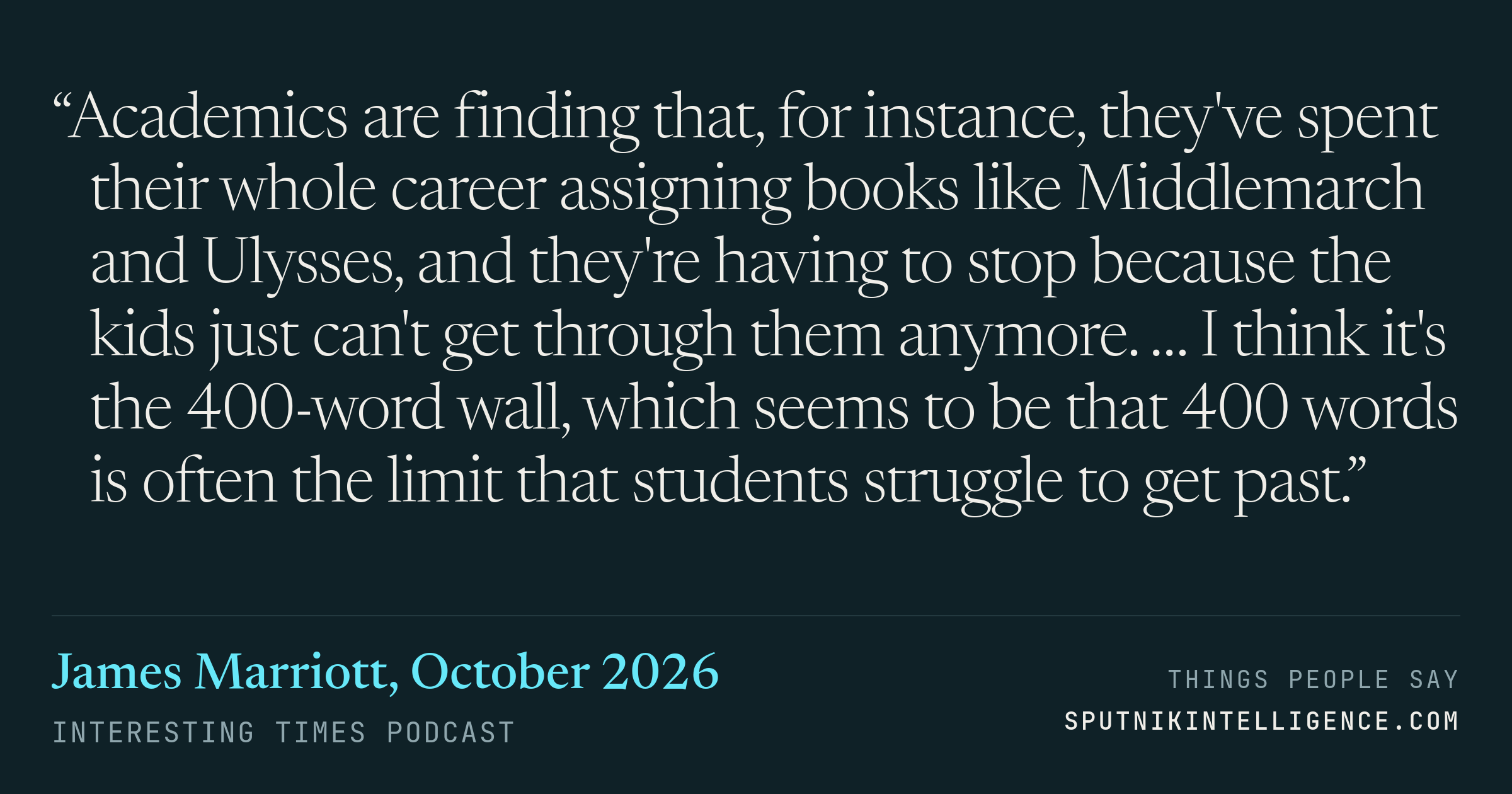
“Academics are finding that, for instance, they've spent their whole career assigning books like Middlemarch and Ulysses, and they're having to stop because the kids just can't get through them anymore. … I think it's the 400-word wall, which seems to be that 400 words is often the limit that students struggle to get past.” — James Marriott, Interesting Times

Marriott was discussing the decline of reading with Mary Harrington. He admits it can sound like "old man shouts at cloud", but argues the collapse in students' ability to read long texts is real and unprecedented.

Interesting Times · 2026-10-08 Permalink → Listen →
Interesting Times Around 11:45 into the episode
James Marriott

Yes, I think it is. I mean, I think I

Mary Harrington

am, to be honest. I'm not sure I could do it now.

James Marriott

One of my great, my great hubristic moments at university was trying to speed read Paradise Lost, which is even more mad. How long did you give yourself to do it? Not long enough. I have since read it properly. That was even more hubristic than trying to speed read Bleak House or Middlemarch, I think. Yes, I think academics are finding that, for instance, they've spent their whole career assigning books like Middlemarch and Ulysses, and they're having to stop because the kids just can't get through them anymore. There's something that you increasingly hear in these educational circles a phrase, I think it's the 400-word wall, which seems to be that 400 words is often the limit that students struggle to get past. That's apparently how long it takes to read for 90 seconds. You get through about 400 words. And that seems to be the point at which people begin to feel fidgety or need distraction or need to…

Mary Harrington

It would be ironic, but maybe appropriate to cite a meme here, which is one that gets posted online in response to a wall of what people greet as a wall of text, which they just refuse to engage with. And the standard meme that gets posted in response to that is, I ain't reading all of that. I'm…

James Marriott

Yes. The modern response to an English literature degree.

Mary Harrington

I'm reading all that. I'm happy for you. Sorry that happened.

Speaker names from our own diarization · position estimated from where the line sits in the episode

Collections They Appear In