
David George

Things David Says on Podcasts

Where to Find Them

David George hosts and writes a16z Podcast , hosts and writes a16z and writes a16z crypto show . They have also been a guest on The Twenty Minute VC (20VC): Venture Capital | Startup Funding | The Pitch (2 times) , Odd Lots , Squawk Pod and Invest Like the Best (Patrick O'Shaughnessy) . They also write for David George on Substack.

Recently: “David George & Jack Altman on AI, Autonomy, and the Next $25 Trillion” on a16z Podcast (October 2026); “David George & Jack Altman on AI, Autonomy, and the Next $25 Trillion” on a16z Podcast (October 2026); “Investing in Armadin” on a16z (October 2026); “State of Markets II” on a16z (September 2026); “The $1 Trillion AI Buildout | State of Markets” on a16z Podcast (September 2026); “The $1 Trillion AI Buildout | State of Markets” on a16z Podcast (September 2026).

What They Said

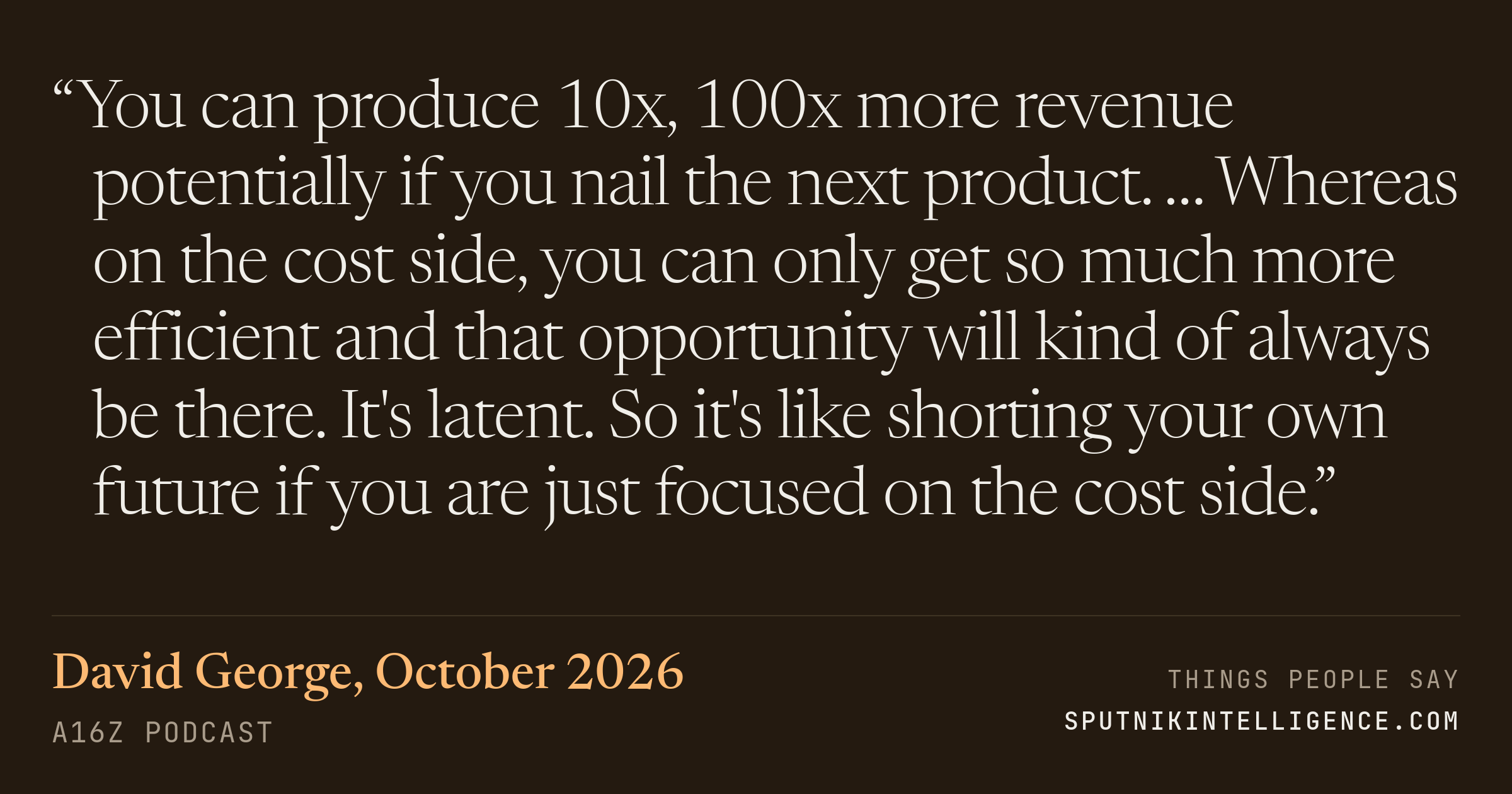
“You can produce 10x, 100x more revenue potentially if you nail the next product. … Whereas on the cost side, you can only get so much more efficient and that opportunity will kind of always be there. It's latent. So it's like shorting your own future if you are just focused on the cost side.” — David George, a16z Podcast

George was describing a question his firm is thinking about: whether companies will put their AI effort into building new products or into making the existing business cheaper to run. He says the best companies right now are focused entirely on the first.

a16z Podcast · 2026-10-04 Permalink → Listen →
a16z Podcast Around 09:45 into the episode
David George

before the big four, five breakthrough routes.

Jack Altman

My guess is if you reran that study, you would not see that anymore. Yeah.

David George

And like the best coders in the world have like fully flipped over on this. And, you know, if you talk to like the CEOs at the cutting edge companies, I think they would tell you that they feel much more productive. Like I, you know, spending time with Stripe, like they feel like there's very high returns to them being able to be a lot more efficient in writing code. You know, like is like Procter and Gamble getting big efficiency gains from what they're spending on AI today? Like probably not yet, but I think they will. They probably need a lot of hand holding. That's probably the answer is, you know, I think the labs and Databricks and Palantir, companies like that are probably thinking about it the right way where you have to do a lot of handholding to produce value, but you will produce a lot of value for the Those companies. And then there's companies like Stripe. I don't know. One of the things that we're thinking a lot about right now is where is that effort actually going to? Is it going to like front end building more products or is it going to like back end trying to make your business more efficient? And like the best companies in the world right now are singularly focused on front end. Like you can produce 10x, 100x more revenue potentially if you nail the next product. Yes. Right. Whereas like on the cost side, like you can only get so much more efficient and that opportunity will kind of always be there. It's like latent. So it's like shorting your own future if you are just focused on the cost side. Whereas like you're taking an expansive view of what you can become if you're focused on the front end. By the way, the open router

Jack Altman

idea is very good there too, just to be like, we're going to own this at the ALAR as well. Yeah. It's very smart. Yeah.

David George

Yeah. Look. And like, I think they're right that the economy is going to like oscillate between using dollars and tokens and like it's going to be a new form of currency. Totally. You know, so yeah, we're obviously, you know, we're big fans of those guys. Also to the point

Jack Altman

of like, it's all going to work. You know, it's, you know, we talk about open source a lot in relation to the frontier labs. And I guess the point there is if the, if the total token, you know, usage just goes up by 100x, it's just like these things are all going to get so big. They're
Speaker names from our own diarization · position estimated from where the line sits in the episode
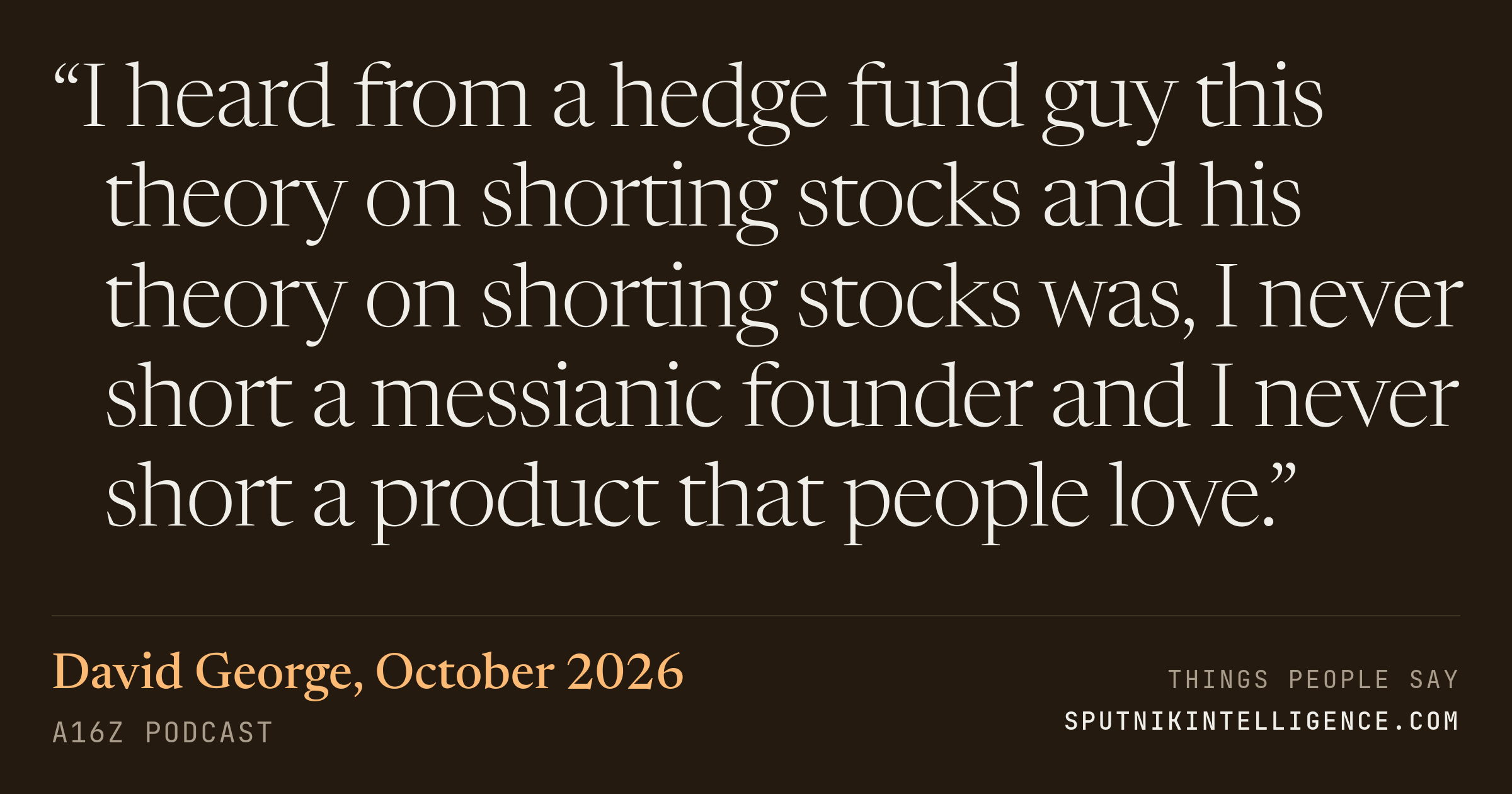
“I heard from a hedge fund guy this theory on shorting stocks and his theory on shorting stocks was, I never short a messianic founder and I never short a product that people love.” — David George, a16z Podcast

George was talking about how a strong founder story and loyal retail shareholders can hold up a company's valuation, which then helps it hire, raise money and buy other companies. He had just described a friend with a large position in one such stock whose whole explanation was "good vibes". He is passing on someone else's rule here, and adds that the inverse also holds.

a16z Podcast · 2026-10-04 Permalink → Listen →
a16z Podcast Around 48:47 into the episode
David George

even like a thing. Right. And, you know, but like the big thing, obviously. I think a lot of people

Jack Altman

don't even really know what Palantir does. Yeah,

David George

for sure. Like including like big holder retail holders of the stock. Like a friend of mine who has a huge position. And I'm like, explain it to me. And he's like, good vibes. But what has happened, right? Like they're massively accelerated and commercial and they're now seen, you know, among CEOs as like a trusted place to go implement your AI. So it actually, it has actually given them a direct benefit on the commercial side because they're seen as like the ones that will navigate the situation for you and they're trusted. The valuation is a huge benefit for them. And then it's massive for them retaining and hiring employees, similar to the Elon companies. Like Elon, you know, obviously like having a big valuation allows him to have a bigger war chest, to buy companies, to raise more capital, to have loyal followings. So you can look at like the high retail ownership stocks and there's like a correlation if they're doing well, a correlation to the valuation. It was funny. I heard from a hedge fund guy this theory on shorting stocks and his theory on shorting stocks was, I never short a messianic founder and I never short a product that people love. The inverse of that is if you have a messianic founder and there is a product that people love, you can actually like trade very high and have all these benefits. Right. Right now in AI, obviously you said why the capital side matters and valuation side matters. It is incredible that the whole market is like hanging by a thread on the performance of like two now kind of three private companies on like a monthly basis.

Jack Altman

I was just thinking as you were talking that the narrative, however strong the narrative is now, the importance of it all is about to go like hyperbolic as these companies get public.

David George

Yeah. And you can even see

Jack Altman

it, you know, there's this funny bit I mentioned to you, you know, you can see investors and people who are on the opposite side kind of jockeying about like trying to set expectations around these companies. Oh, yeah,

Speaker names from our own diarization · position estimated from where the line sits in the episode

Collections They Appear In