
Alex Rampell

Things Alex Says on Podcasts

Apps @ a16z, former entrepreneur (co-founder of Affirm, TrialPay, Point, Yub, TXN, etc)

Where to Find Them

Alex Rampell hosts and writes a16z Podcast , hosts and writes a16z , hosts and writes AI + a16z and hosts Cheeky Pint . They have also been a guest on The Twenty Minute VC (20VC): Venture Capital | Startup Funding | The Pitch (2 times) , Business Breakdowns , Summation with Auren Hoffman , The Walker Webcast , TBPN and Invest Like the Best (Patrick O'Shaughnessy) . They also write for Alex Rampell on Substack.

Recently: “Why AI Could Turn Small Law Firms Into Billion-Dollar Businesses” on a16z Podcast (October 2026); “What Happens When Al Agents Can Spend Your Money?” on a16z Podcast (October 2026); “When AI Agents Start Spending Your Money | Alex Rampell & Terry Angelos” on a16z Podcast (October 2026); “Alex Rampell on why the best companies have hostages, not customers” on Summation with Auren Hoffman (September 2026); “The AI-Native CRM” on a16z Podcast (September 2026); “The AI-Native CRM” on a16z Podcast (September 2026).

What They Said

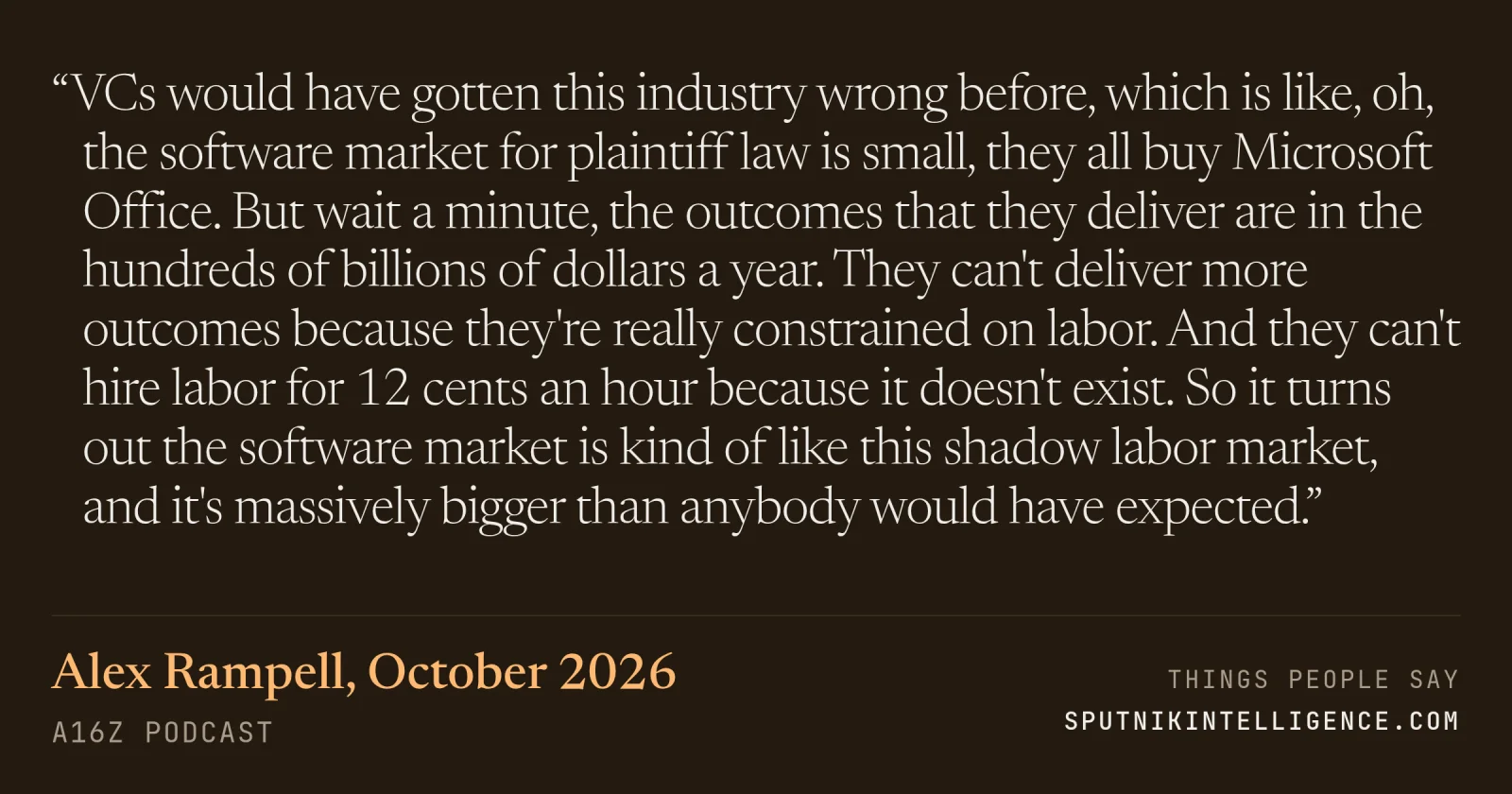
“VCs would have gotten this industry wrong before, which is like, oh, the software market for plaintiff law is small, they all buy Microsoft Office. But wait a minute, the outcomes that they deliver are in the hundreds of billions of dollars a year. They can't deliver more outcomes because they're really constrained on labor. And they can't hire labor for 12 cents an hour because it doesn't exist. So it turns out the software market is kind of like this shadow labor market, and it's massively bigger than anybody would have expected.” — Alex Rampell, a16z Podcast

Alex was asking what software plaintiff law firms used before AI tools arrived. His view is that investors misjudged the market by counting only what firms spent on software, not the labor that software can now replace.

a16z Podcast · 2026-10-30 Permalink → Listen →
a16z Podcast Around 22:07 into the episode
Alex Rampell

Wow.

Jay Madheswaran

…better job than it could do by itself. That is, I think, the future of law, right? Where you as a lawyer are really going to look more like a almost a data scientist and engineer engineering something to be better and better. And that is a shift the top law firms on EVE mentally kind of go through.

Alex Rampell

Yeah. Well, I kind of think of if you look at your average law firm where they don't really know AI. And actually, like, this is kind of an interesting kind of take on the world of AI enabled applications in general. Like, what was the software stack for law before? Well, if you're a big firm like Wilson Cincinnati, probably the most important thing is like your time tracker, right? That's just your billing by the hour. If you're in contingency law, it's like, well, your time matters, but you're not billing your customers on that. You probably need to have like a, you know, each case, here's how much money I'm spending on the case. But like, I imagine your primary tool was Microsoft Word. And there wasn't, and this is how like VCs would have like gotten this industry wrong before, which is like, oh, well, the software market for plaintiff law is small. They all buy Microsoft Office. Yeah, Microsoft Office is kind of expensive. So therefore, like the software spend is like in the tens of billions of dollars a year or something, you know, seemingly comically small. But wait a minute, the outcomes that they deliver is in the hundreds of billions of dollars a year. They can't deliver more outcomes because they're really constrained on labor. And they can't hire labor for 12 cents an hour because it doesn't exist. So it…

Jay Madheswaran

know, this is the unfortunate thing about plaintiff law and institutions is historically plaintiff law really didn't need more than a cell phone email address. Honestly, even Microsoft Word, some people on the solos would not buy it for cost reasons or other reasons. No, it's because if you think…

Alex Rampell

And to make that concrete, it's like, I'm in a car accident. I'm not at fault. You know, the adversary, if you will, like the other side's insurance company is like, oh, you weren't that hurt. We'll give you a dollar. Right. They always try to like deny, deny, deny. Like rule number one of an…

Jay Madheswaran

That's right. Because insurance is the one that's dealing with 100,000 different laws. They have the
Speaker names come from our own diarization. The position is estimated from where the line sits in the episode.
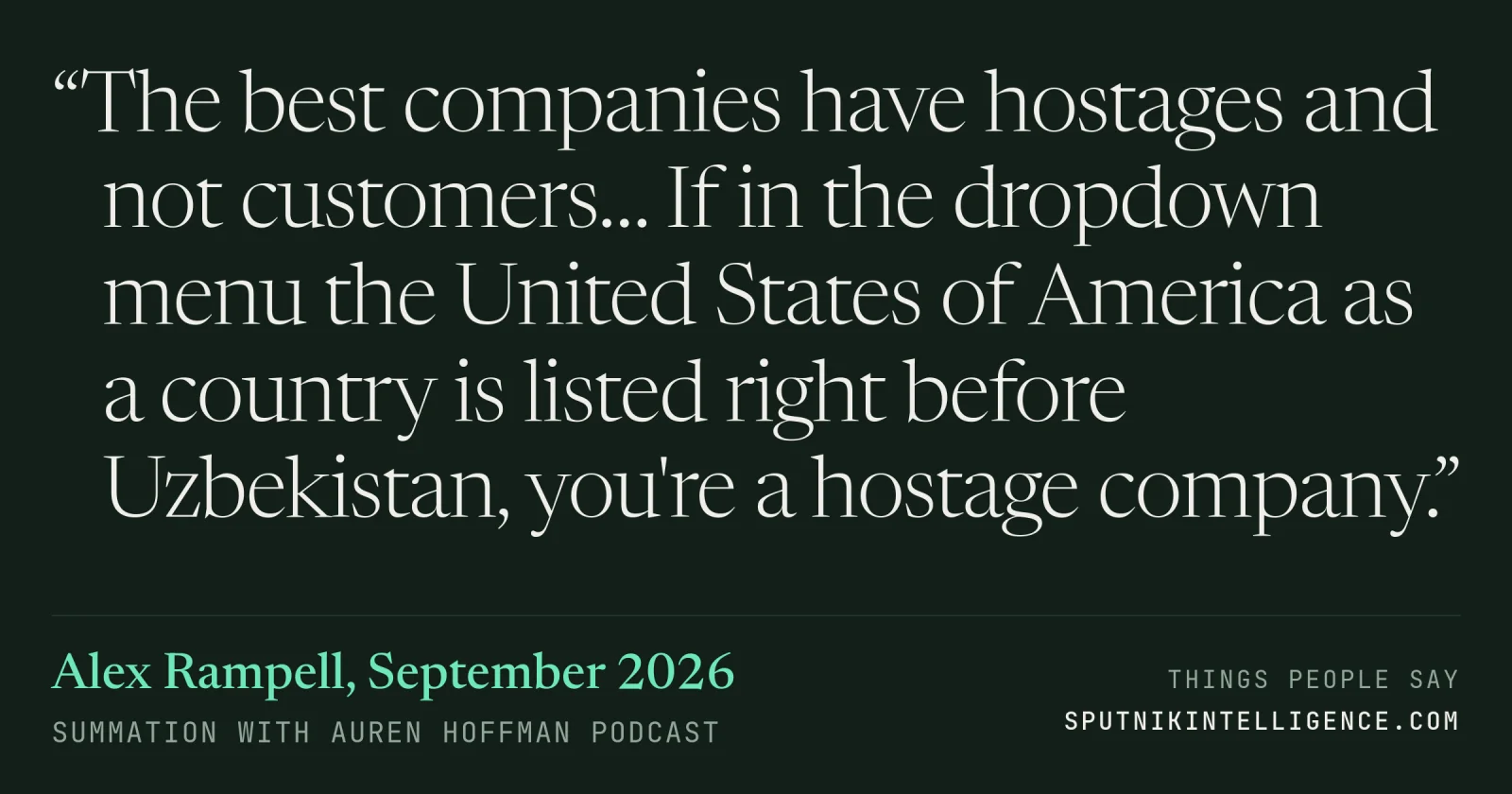
“The best companies have hostages and not customers… If in the dropdown menu the United States of America as a country is listed right before Uzbekistan, you're a hostage company.” — Alex Rampell, Summation with Auren Hoffman

Auren Hoffman had asked whether AI advantages startups or incumbents, and Rampell used the question to separate beloved products from captive ones. His test turns on the user and the payer being different people: if a CFO has already written the nine-million-dollar check, nobody has to bother moving the United States to the top of the country dropdown. He had made the same point on Twitter about Workday, and says he does not want to invest in hostage companies.

Summation with Auren Hoffman · 2026-09-22 Permalink → Listen →
Summation with Auren Hoffman Around 34:56 into the episode
Alex Rampell

…enough. And at the end, I was like, for more, read this book. And then like he got like a ton of sales. He was like, thank you, because it's like this, this book was kind of like, you know, putter your log. And then it's like, I don't know, a lot of people went to Amazon and then bought the thing.

Auren Hoffman

…because it is such a great book. It's definitely a book that I think anyone who's interested in this should read. No, okay, now let's talk. You touched on AI. I sometimes go back and forth. Like, do you think AI gives more of an advantage to the startup or more of the advantage to the incumbent?

Alex Rampell

I think it's tricky. Like there's a saying that I use a lot, which is the best companies have hostages and not customers. And one of the ways to tell the difference is, like, are you a hostage company or are you like a beloved product company? And one of the ways to think about that is, is the customer, the user, right? The user is the person that has to use the product. The customer is the person that pays for it. And then at the shorthand for all of this, I think I tweeted about this with respect to Workday. If when you're signing up for a product, if in the dropdown menu, the United States of America as a country is listed right before Uzbekistan, you're a hostage company, right? Because, you know, why do I say this? It's because if you were trying to optimize product experience.

Auren Hoffman

Exactly. You would never do that. You would just like, so you know exactly, you know, the IP address of the person, you know, you know, all these other things. Or

Alex Rampell

you just put like Canada, US, right? It's just like at the top. I know that 99% of my customers come from here. If you don't give a shit, you're like, I got you captive because your CFO cut me a $9 million check. Ha ha. You have to use Workday. It's like, by

Auren Hoffman

the way, I freaking hate that. Whenever I see like the dropdown and they know I'm coming from the US, even if it's a foreign thing, like they know I'm coming from the US. Like, why have an alphabet? Like, why not just have like the first choice be the, it's so obvious.

Speaker names come from our own diarization. The position is estimated from where the line sits in the episode.

Collections They Appear In