 Olivia Moore
Partner at a16z
Olivia Moore
Partner at a16z
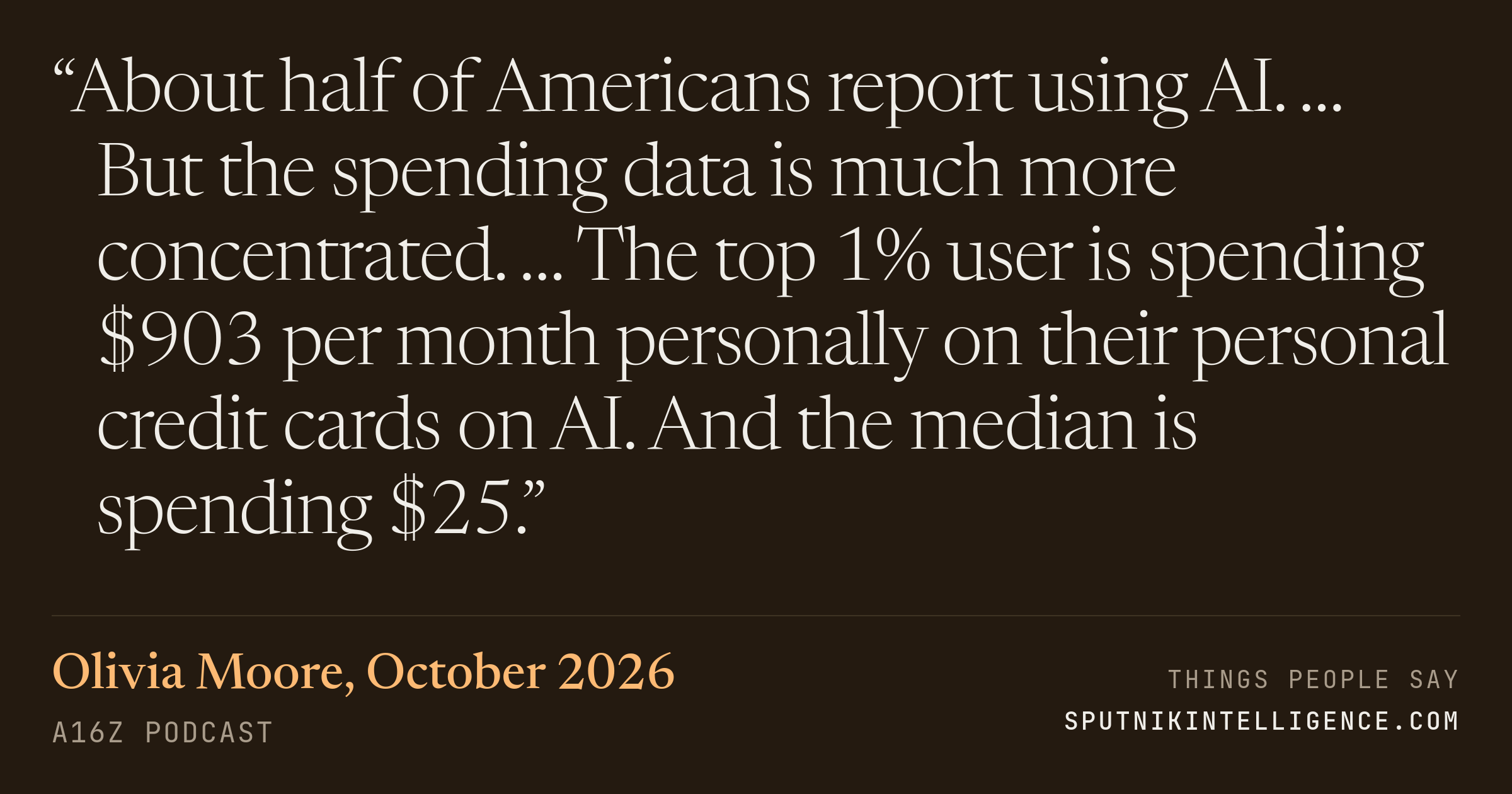
“About half of Americans report using AI. … But the spending data is much more concentrated. … The top 1% user is spending $903 per month personally on their personal credit cards on AI. And the median is spending $25.”
a16z Podcast · Startups & Venture · October 2026
Moore was presenting her firm's data on who pays for consumer AI products. By their panel, about 4.5% of US consumers pay for an AI subscription, and the top tenth of those payers account for more than half the revenue.
Transcript
when we talk to some agent or assistant products that are aimed towards the more mainstream consumer, they're seeing costs in the tens of dollars, not the thousands of dollars a month. So I think that is maybe a representation of the fact that we have a very long way to go in terms of consumers getting comfortable with these products.
And I think, you know, I think people who've been coding and have been working with AI, I mean, it's been such an incredible enhancer. And that shows up in a lot of the data on the top 100 here. Like it's incredible. And then we've, people who've been able to do that have had these great ideas for all the other things in their life. But when you just hand this to somebody new, it feels like a blank box. And it feels like, what should I do with this? And maybe there's examples of getting a reservation or booking a flight. But if you're not actively seeking a reservation or booking a flight, it's hard to figure out how to personalize it. And so much of what we do as people is we learn from others and we get these great ideas and we try the other things people tell us. So much of how social media has worked is people put things on social media and other people see that and they try the same thing. And then it kind of spawns these effects. Oh, I try, they make a little riff on it. And then those riffs become, you know, cascading snowballs. And that's how great ideas flourish. And with AI, because so much of it's so personal, we haven't even seen any of that flourishing yet, you know, outside of areas like coding and productivity, you know, all of the creative work. You know, I created this incredible video and how'd you do that? I use AI. You know, there's so many tools that do that that are, you know, been growing and are here. But it's so interesting that, you know, now we have to figure out how to mainstream this for not the millions and millions of people who are using these and paying and everything, but for the You know, tens, hundreds, and you know, hundreds and hundreds of millions.
If you look at broad usage data now, about half of Americans report using AI. And about 25% of Americans think they're interacting with AI probably on close to a daily basis. But the spending data is much more concentrated. So it depends on the source. Our Yippet panel shows probably sub 5%, around 4.5% of U.S. consumers are paying a subscription to an AI product. Some other sources say as low as two or two and a half, or maybe a little bit higher. It is expanding. So that's like doubled from a year ago. But that spend is still extremely concentrated. So even within that top 4.5% of people who do spend, the top 10% of those are like more than half of the revenue. And the top 1% are 20% of the revenue, whereas the bottom 50% are like 16%, right? So like the top 10% of users are driving this market. This was the other interesting thing about revenue data: we were able to look at it kind of like on a almost person-by-person basis, what it looks like. Who are these people who are spending on AI? The top 1% user is spending $903 per month personally on their personal credit cards on AI. And the median is spending $25. And again,
all of this is within the only 4.5% that are spending at all.
Yibit also was helpful for us because we could see what products are they actually spending on, like, on a personal basis. And probably unsurprisingly, it was mostly developer tools, productivity tools, creative tools, things used to like build, make, sell things like N8N, Granola, Higgsfield, Manus, those all were way overrepresented amongst the top spenders. I
mean, in a way, this is actually really cool. I mean, even though these numbers aren't everybody yet, like we're enabling this whole new generation of makers of people who are, you know, not just using this for work, but actually using their personal credit cards to code things they never coded before, to make art, make videos, make content, and really have this power of making. And so it's actually in some ways, you know, while it's all still so early, it's actually really cool how much making is going on that people are actually so excited they're willing to spend. I mean, if you're spending $900 a month on a set of AI tools, you're really using that to like hopefully make things faster, better, have more ideas in your head coming to life than ever before. Yeah. So that's kind of like when I, when I was looking at these categories between creativity and coding, like, you know, that's actually hopefully really, really powerful. Yeah.
More from a16z Podcast