 Olivia Moore
Partner at a16z
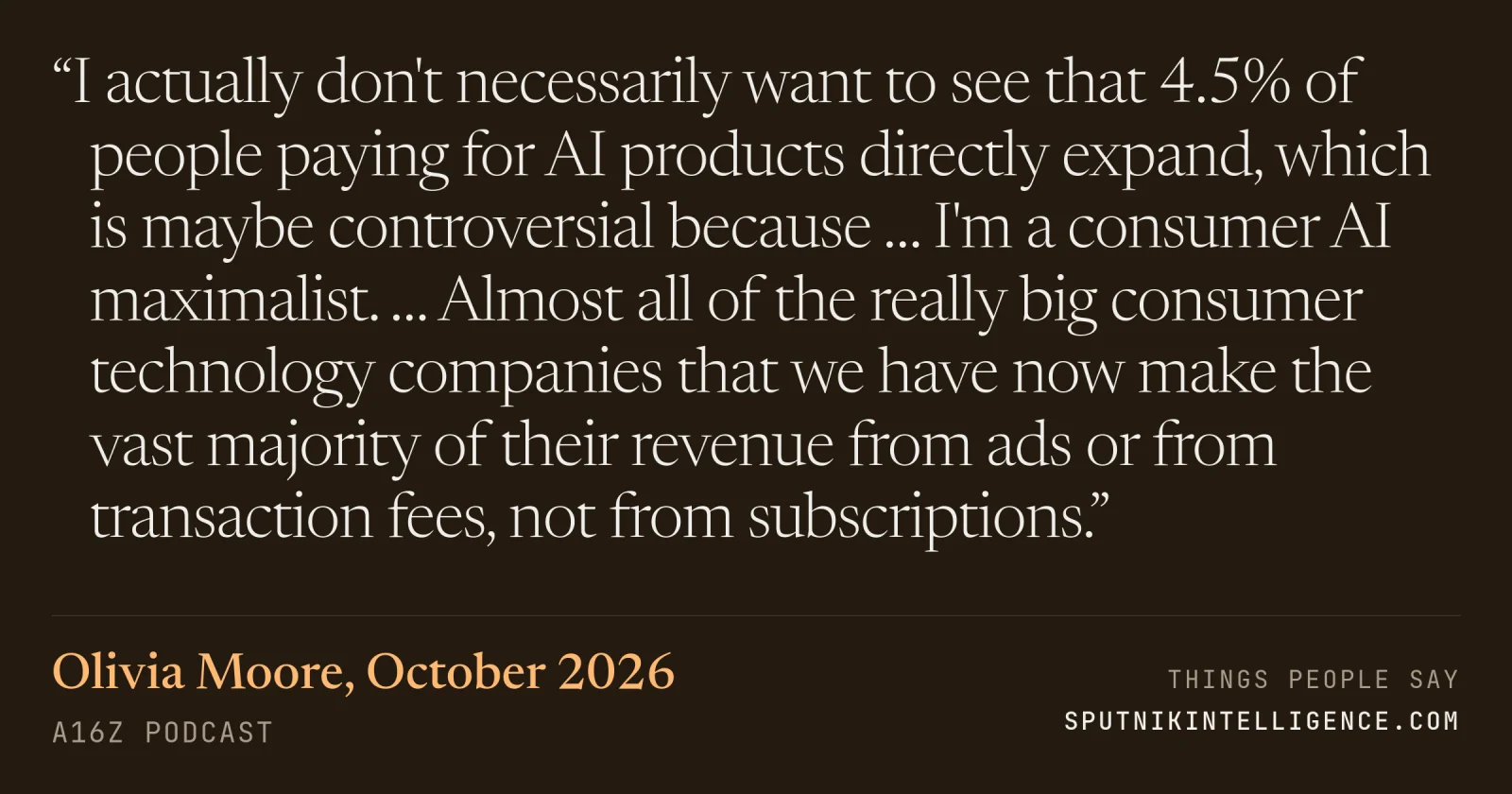
“I actually don't necessarily want to see that 4.5% of people paying for AI products directly expand, which is maybe controversial because … I'm a consumer AI maximalist. … Almost all of the really big consumer technology companies that we have now make the vast majority of their revenue from ads or from transaction fees, not from subscriptions.”
a16z Podcast · Startups & Venture · October 2026
Context
Moore's argument was that consumer AI earning nearly all its money from subscriptions is an inversion of how the consumer internet has worked, since most people won't pay for software. She wants ads and transaction fees to return as business models.
Transcript
…products that we have. And I think that much of what we've seen in AI thus far, to your point, is like, how do I do this thing a little bit faster, a little bit easier, a little bit more impressively? And that's not an incredibly compelling daily or hourly active value proposition for most people.
…with their computers and their laptops. They had to keep them open. And they were like, I'm not sleeping. I'm coding and I'm making things more than I ever have. And I think that's starting to, again, shows up at the top of the data, but I do think it's starting to show up sort of everywhere. Yes.
…looked and it was like, you know, 85% or something of our web list monetized via subscriptions. Another 62% monetize via kind of credits or token extra usage payments. Only like 13% had ads or other options where like you are the product instead of paying for the product. And that's like a, if you look back at the history of the consumer internet, that's like a pretty unnatural inversion. Like almost all of the really big consumer technology companies that we have now make the vast majority of their revenue from ads or from transaction fees, not from subscriptions. Because I think the truth of it is most similar to the fact that not everyone is looking for a coding tool to help them, you know, start a business or create and sell a product. Most people don't have the funds or don't want to spend their funds on software. If you look at the top 20 consumer subscription products globally, ChatGPT is already on there, which is crazy in like three and a half…
We're still at the early days of inference costs coming down. We're still at the early days of people finding ways to run lower cost models to build great products. And as they do that, a lot of the other business models that have always been on the internet from transaction fees and ads will…
Yes. I mean, you can probably speak to this from seeing many prior eras of the consumer internet, but like it used to be, at least for me as a consumer investor, if a company was making money in the first five years, it was like, whoa, what's happening? The rule was like, let's build density of…
No, I think this cost thing is a really interesting challenge. And companies get afraid of growing too fast. Yeah. Like they actually, if they grow too fast and they don't have meters on how they're charging for it, you can actually have out of control spend that can be very, very hard to manage.…
More from a16z Podcast