GB

Greg Brockman

Things Greg Says on Podcasts

Where to Find Them

Greg Brockman writes a16z Podcast . They have also been a guest on TBPN (3 times) , Big Technology (3 times) , OpenAI Podcast (2 times) , Latent Space (2 times) , Squawk on the Street (2 times) , The TWIML AI Podcast (2 times) , No Priors , Training Data , Lex Fridman Podcast , Silicon Valley Girl: AI, Tech and Career Growth , Cheeky Pint , Pivot to AI , Bloomberg Tech , Odd Lots , Squawk Pod , Greymatter , The Knowledge Project (Shane Parrish) , Y Combinator Startup Podcast , TED Tech , Possible and Core Memory .

Recently: “The Changing Physics of Cybersecurity and Drug Development with OpenAI President Greg Brockman” on No Priors (October 2026); “OpenAI Co-Founder: Start Building With AI Before You Feel Ready | Greg Brockman” on Silicon Valley Girl: AI, Tech and Career Growth (October 2026); “Greg Brockman on Why OpenAI Says We’re Entering the AGI Era” on a16z Podcast (September 2026); “Greg Brockman on Why OpenAI Says We’re Entering the AGI Era” on a16z Podcast (September 2026); “OpenAI President Greg Brockman on Doing Business in the Wake of Hugging Face” on Odd Lots (September 2026); “Math Wars, GG Navier Stokes, Greg Brockman Joins | Dan Wright, Eric Seufert, Scott Wu, Sahir Jaggi, Andrew Borovsky, Harry Mellsop” on TBPN (September 2026).

What They Said

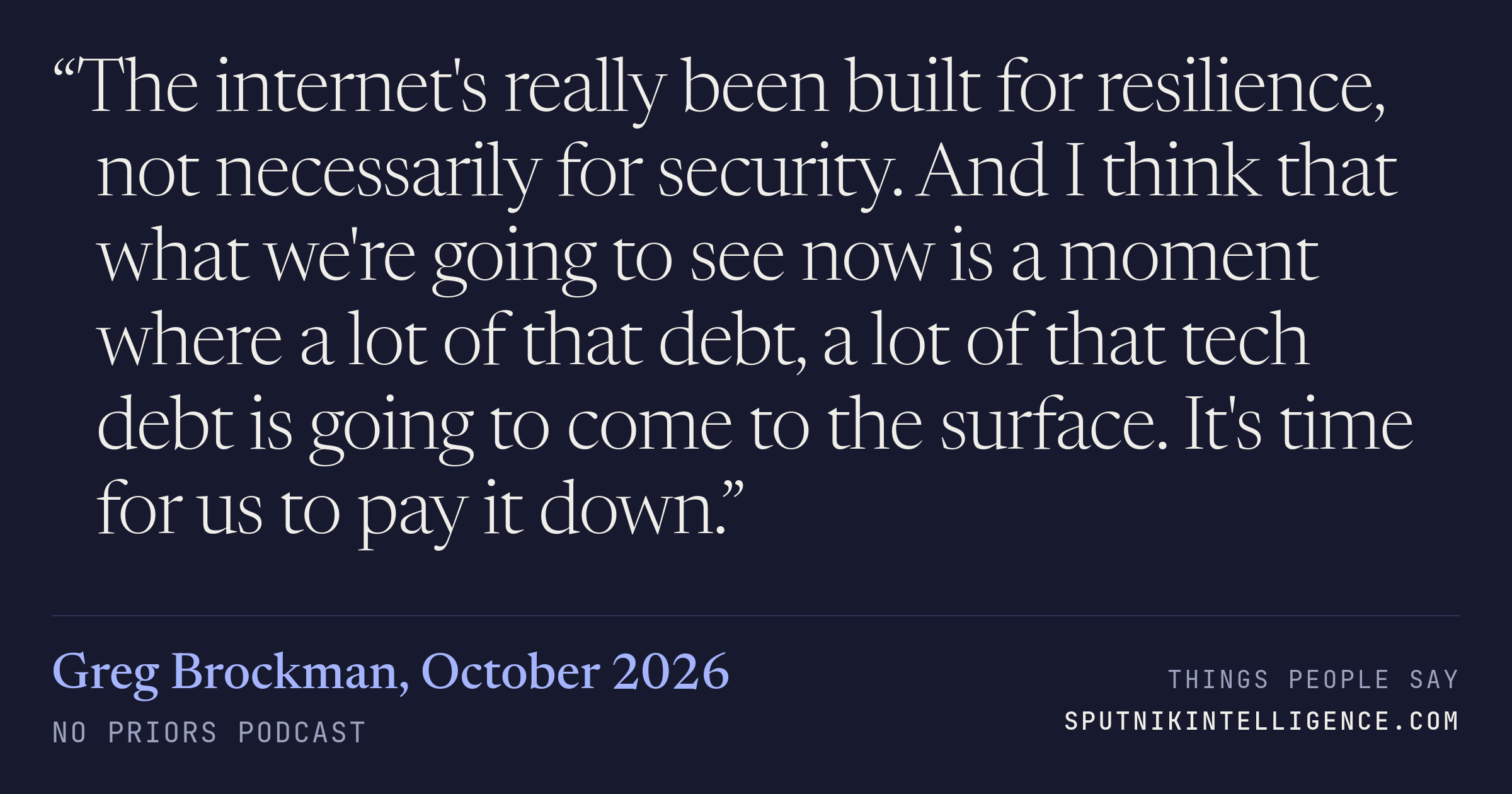
“The internet's really been built for resilience, not necessarily for security. And I think that what we're going to see now is a moment where a lot of that debt, a lot of that tech debt is going to come to the surface. It's time for us to pay it down.” — Greg Brockman, No Priors

Brockman was explaining why AI-driven cyber capability is exposing long-standing weaknesses in software. He said OpenAI put about a quarter of its production engineers on hold to point its strongest model at its own infrastructure, and expects to repeat that with every new model.

No Priors · 2026-10-15 Permalink → Listen →
No Priors Around 28:01 into the episode
Speaker 4

Yeah, right. I mean,

Speaker 3

you can look at XKCD in the comic of like all the world's infrastructure reliant on like one open source project written by one dude in his basement, right? Or Heartblade or anything that predated like all these AI issues.

Speaker 1

…got kind of bolted on, right? And we had high-profile incidents, right? You think about early worms and viruses. And then people started to realize, well, we need virus scanning software, right? And we need to have encryption for requests over HTTP should be over HTTPS. All of these mechanisms were ones where I think that we kind of took the slower route in order to add security on afterwards. The internet's really been built for resilience, not necessarily for security. And I think that what we're going to see now is a moment where a lot of that debt, a lot of that tech debt is going to come to the surface. It's time for us to pay it down. And that as a company, we are doing, we are really leaning into trying to help with this moment. So for example, we have a billion-dollar commitment that we've made to help frontline defenders get access to our models and utilize them. Defense that we're studying and trying to find different vulnerabilities out there and then thinking about how do we help the world respond? How do we coordinate…

Speaker 4

like basically there's going to be a period of time where maybe we're going to see more of these cyber attacks, more incidents, et cetera, as humanity or as people sort of catch up in terms of their core bases getting more and more secure, using more AI-generated code that's sort of preset to be…

Speaker 1

look, I have a lot of optimism about how we can navigate this moment. I think it does require a coordinated response, right? It really requires defenders to internalize how the physics of cybersecurity are changing, that there is this window where that window is not going to last forever, right?…

Speaker 3

I think your example, I mean, your description of this is like, let's say, like internet-wide tech debt, and then your response to it internally is a really good one. Because I've been part of companies where tech debt is very painful to address. And to say, we're going to take 25% of the…
Speaker names from our own diarization · position estimated from where the line sits in the episode
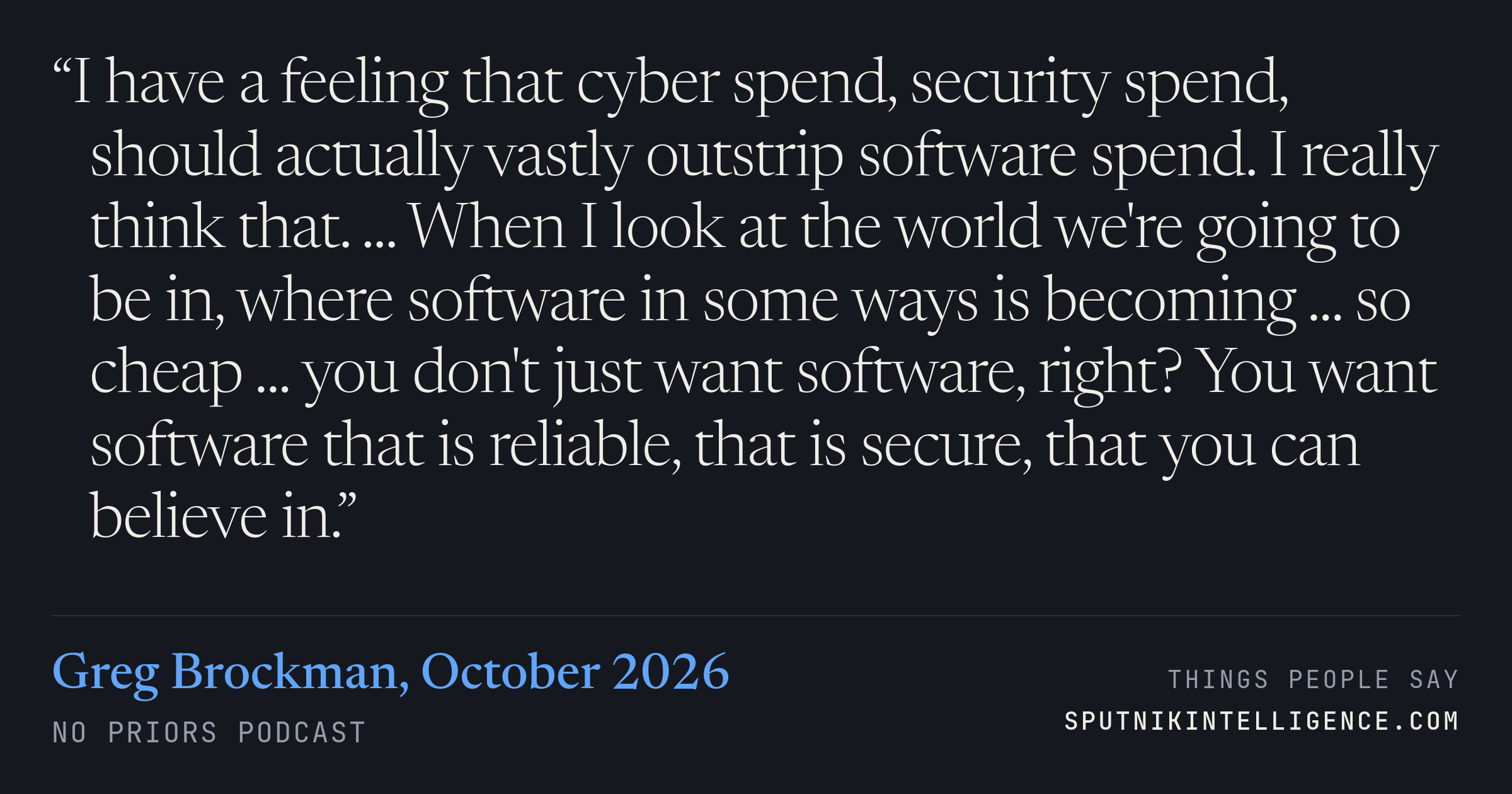
“I have a feeling that cyber spend, security spend, should actually vastly outstrip software spend. I really think that. ... When I look at the world we're going to be in, where software in some ways is becoming ... so cheap ... you don't just want software, right? You want software that is reliable, that is secure, that you can believe in.” — Greg Brockman, No Priors

A host noted that security has traditionally been a low single-digit share of IT budgets and asked what it should be now. The OpenAI president answered that as AI makes software nearly free, the value shifts to software you can trust.

No Priors · 2026-10-15 Permalink → Listen →
No Priors Around 31:02 into the episode
Speaker 1

…to outstrip attackers, but it is going to take a lot of change, right? It's going to take a sort of change in terms of how we think about every organization operating and how we collectively think about critical infrastructure and resourcing those that have sort of not had those resources to date.

Speaker 3

…percent of the IT budget. Like, what do you think it should be at this moment of time? And like, is it all of this other stuff that you were investing in from a cyber tooling perspective, network endpoint, traditional corporate security is less relevant, or we just need to go spend twice as much?

Speaker 1

I have a feeling that cyber spend, security spend, should actually vastly outstrip software spend. I really think that. Well, that's a statement. Yeah, I really believe it. And I may not be right, but when I look at the world we're going to be in, where software in some ways is becoming like the barrier to entry, exactly. It's free-ish. Exactly. It's becoming so cheap. And so, of course, making sure you don't just want software, right? You want software that is reliable, that is secure, that you can believe in.…

Speaker 4

Third-party software now like Socket and others will do this as an example where they'll scan through your open source supply chain and try and find vulnerabilities and identify them for you. Or there's the human element of it where maintainers would suddenly take over a project and then install…

Speaker 1

Exactly. I think it's so important. So we're doing this with the community. We're partnering with companies like CrowdStrike. And I think that it is, again, a coordinated response. But we really view it as a core priority for OpenAI to lead, right? For us to really, because we have the frontier…

Speaker 4

of the things about OpenAI is that it's always been very pro-human and very pro-human agency, human progress. Let's use AI to better everyone. I think the original premise of OpenAI was let's have something that can counterbalance other companies in terms of creating AI that can be used very…

Speaker names from our own diarization · position estimated from where the line sits in the episode

Collections They Appear In