The hosts were discussing how falling AI token prices are affecting revenue at the model companies. Sacks argues that cheaper tokens unlock more use cases, so demand and market size keep growing. He names agents and continuous cyber defense as new uses that burn far more tokens.
All-In with Chamath, Jason, Sacks & FriedbergAround 56:41 into the episode
David Sacks
…not just because they're giving up pricing power, right? It's not that they're losing margin. They're actually gaining margin. The reason they're able to do that is because all the algorithmic improvements they're making in order to make their models much more efficient. Yes. And here you go. Just
Jason Calacanis
…you need it. If they can keep making their second and third run models this much cheaper, 10x cheaper each year, the Jevons paradox is going to get even more pronounced because enterprises will use it more. Token cost matters, right? We're sitting here with the token max and corporate. Now, look,
David Sacks
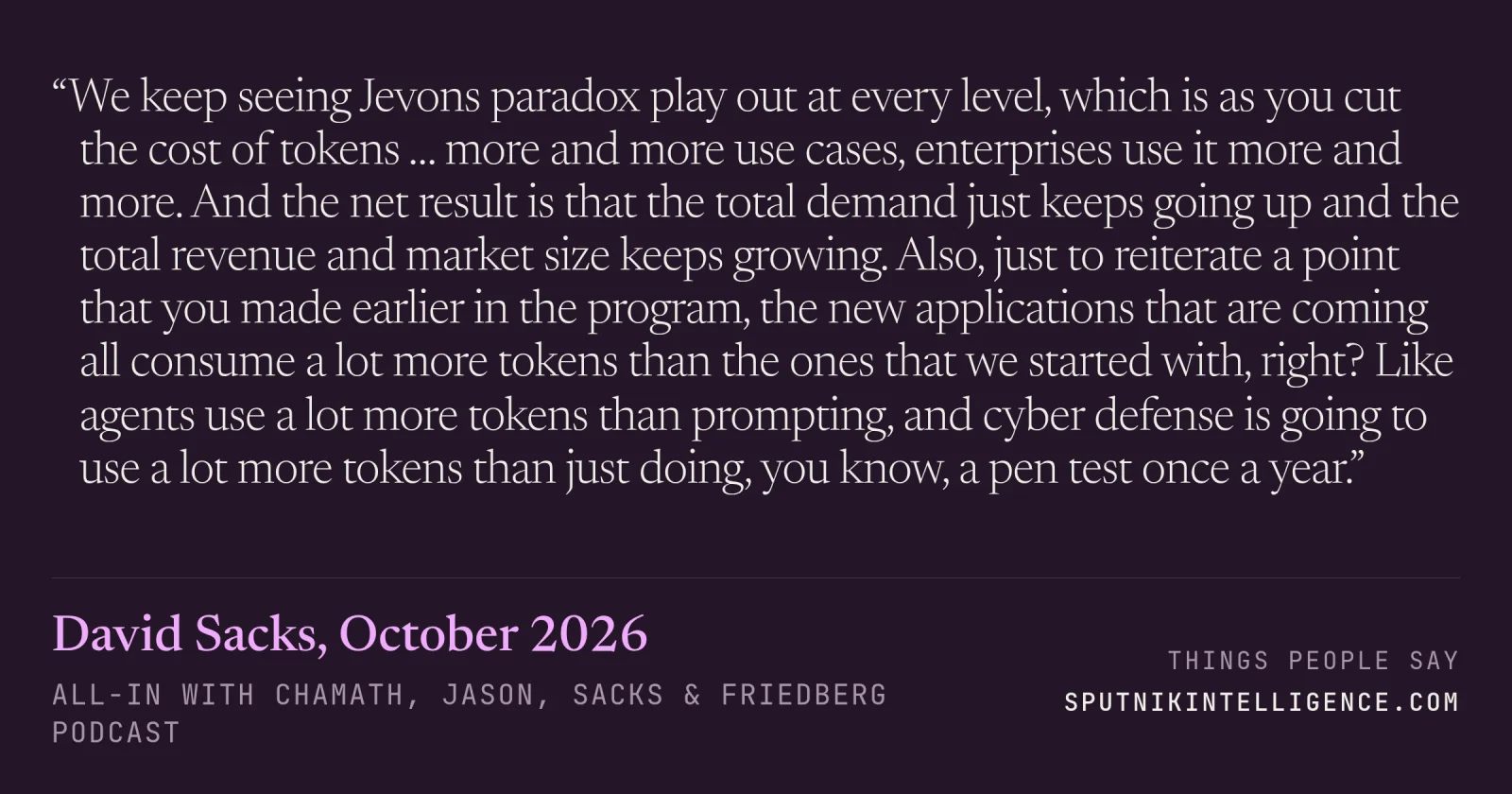
what we're seeing is that, I mean, we keep seeing Jevins' paradox play out at every level, which is as you cut the cost of tokens or more and more use cases, enterprises use it more and more. And the net result is that the total demand just keeps going up and the total revenue and market size keeps growing. Also, just to reiterate a point that you made earlier in the program, the new applications that are coming all consume a lot more tokens than the ones that we started with, right? Like agents use a lot more tokens than prompting, and cyber defense is going to use a lot more tokens than just doing, you know, a pen test once a year, right? You're going to need continuous monitoring of agents, attack surfaces, all that kind of thing. So all the new applications are going to be using exponentially more. 50 to 100 times the number
Jason Calacanis
of tokens, yes. Exactly.
David Sacks
So the price will keep going down, but the market size keeps increasing. I think the biggest risk factor to Anthropic, I do think it is some version of the open source models, maybe not catching them, but sort of saturating intelligence at a low price point for some. Commonizing
Jason Calacanis
it. Commonizing it for things like coding
Speaker names come from our own diarization. The position is estimated from where the line sits in the episode.
David Sacks reacts to Anthropic's S-1 filing, which targets a roughly $100 billion raise. He argues the company's speed from founding to exit has no precedent in venture.
All-In with Chamath, Jason, Sacks & FriedbergAround 21:04 into the episode
Chamath Palihapitiya
We'll see an Ant's S1, but like, you know, you can build a ginormous business with singles and doubles.
Jason Calacanis
…run rate, which is ARRR, like a pirate. They've got $112 billion in cash and a very unique ownership structure. Seven founders, yes, they have seven, are going to hold 50.1% of the voting power through a single class F share. Sachs, is this the greatest business in the history of capitalism?
David Sacks
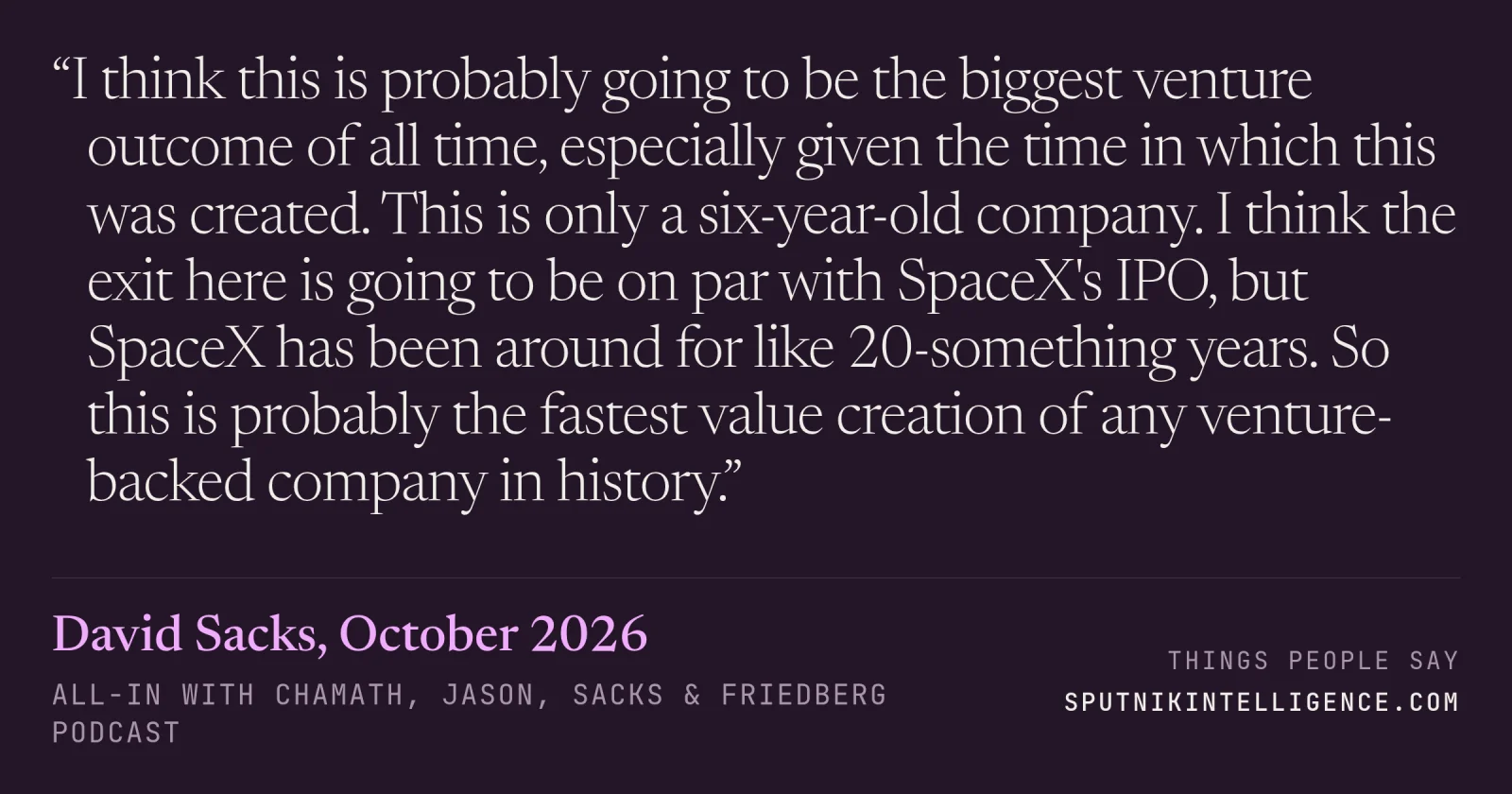
It could very well be. I mean, I think this is probably going to be the biggest venture outcome of all time, especially given the time in which this was created. I mean, this is only a six-year-old company. I think the exit here is going to be on par with SpaceX's IPO, but SpaceX has been around for like 20-something years. So this is probably the fastest value creation of any venture-backed company in history. And I don't know if you saw, but there was a tweet this morning about the distribution of wealth this is going to create among the employees. Hundreds and hundreds of employees are going to be making hundreds of millions of dollars, and then thousands of employees are going to be making $10 million plus. I mean, this is going to be an enormous wealth creation event like San Francisco and maybe all of Silicon Valley has never seen before. Now, there's a few other data points in this S1 that I think reflected the strength here. So, number one is that this $80 billion loss number that we've heard so much about, that the media has constantly been pumping and harping on as proof that Anthropic was either a fake business or that we were in this sort of…
Jason Calacanis
Freeberg, your thoughts on the impact of this massive deluge of capital coming in to Silicon Valley and then this corporate structure, 51% ownership, and what impact this might have on the technology industry, the venture capital industry, and then on democracy here in the United States. We've…
David Friedberg
Can I just comment on the economic value that's arising from AI that kind of perhaps gets revealed a little bit in this? So in the S1, Anthropic shows how many customers they have that are spending 100K or more. If we take a look at the image here, it's a pretty remarkable ramp in customers…
Jason Calacanis
What is this chart? Is this like AI output?
Speaker names come from our own diarization. The position is estimated from where the line sits in the episode.
Sacks is pushing back on the "jobs apocalypse" forecast, in which software developers were supposed to be the first job category wiped out. He argues that coding assistants have created a huge new category of bespoke software, so someone still has to manage it.
All-In with Chamath, Jason, Sacks & FriedbergAround 23:54 into the episode
David Sacks
…to manage the process. By the way, I think this is a really important point around. Remember, with the whole jobs apocalypse, the first job category that predictors of the apocalypse were saying would be eliminated were software coders, obviously. Because why didn't everybody? Everybody became
Ben Horowitz
a developer and now everybody's shipping code. Now we're
David Sacks
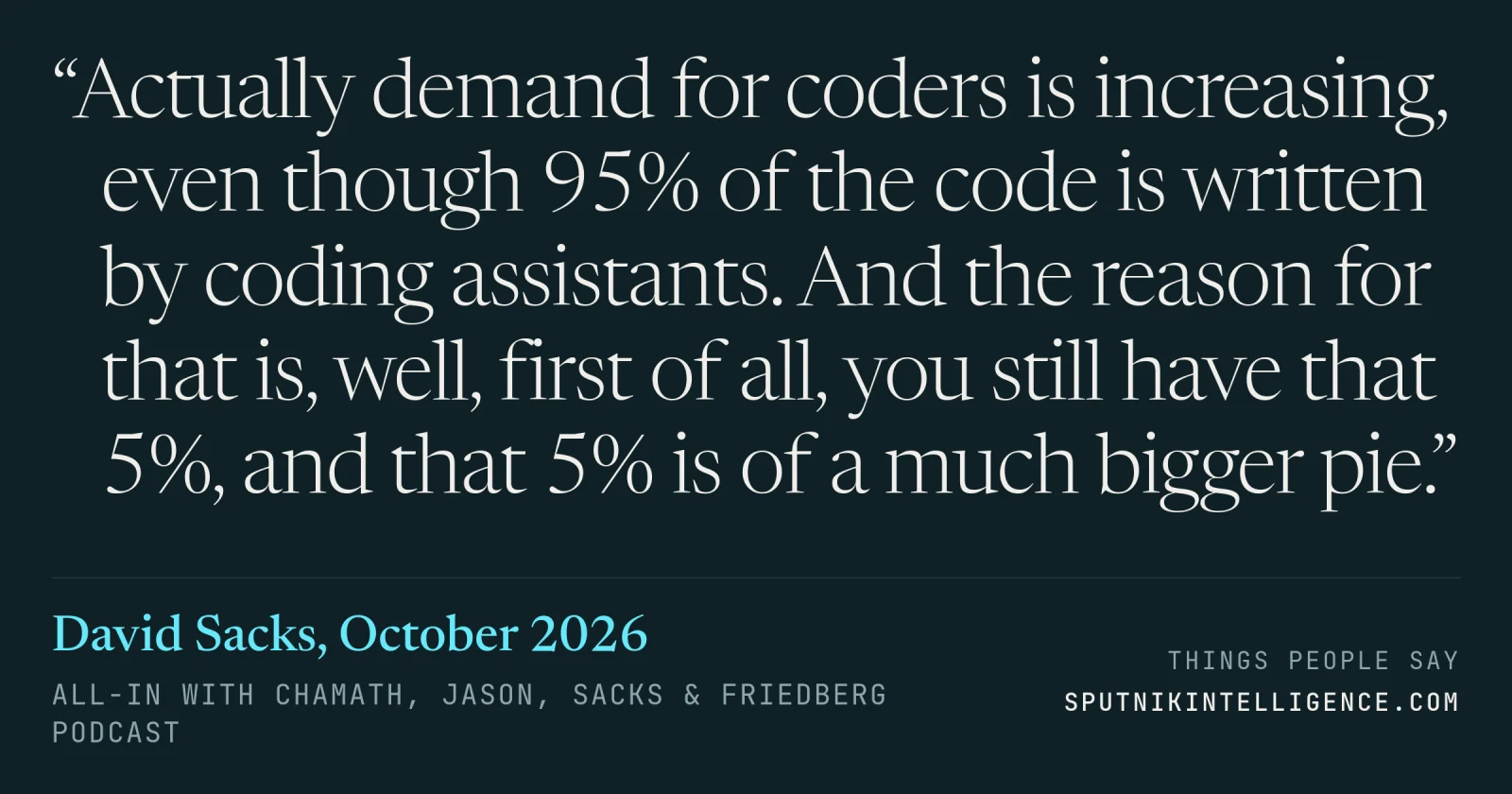
seeing that actually demand for coders is increasing, even though 95% of the code is written by coding assistants. And the reason for that, again, is well, first of all, you still have that 5%, and that 5% is of a much bigger pie. And you still need someone who can look under the hood and manage the whole process, and they need to be somewhat technical
Ben Horowitz
and maintain it. So the maintenance. So,
David Sacks
in any event, look, I think this whole, you could say, new category of bespoke software created by the proliferation of coding assistants and agents and all. All of that is just, I think it's going to be just a huge driver of productivity throughout the economy. And is that broadly deflationary?…
Jason Calacanis
country, right? That everybody is going to be more productive, Ben. But do you worry about our industry, the venture industry? And we have these great hits. And then the second they become a hit, somebody can decompile it, create a competitor, and ship it very quickly. It feels distinctly different…
Speaker names come from our own diarization. The position is estimated from where the line sits in the episode.