
Tracy Alloway

Things Tracy Says on Podcasts

Financial journalist and Bloomberg News executive editor covering capital markets and the plumbing of the financial system. She previously spent years at the Financial Times, where she was deputy editor of FT Alphaville. Co-hosts the weekly Odd Lots podcast with Joe Weisenthal, nominated for a 2022 Webby Award for best business podcast. Also a frequent moderator at financial industry events.

Where to Find Them

Tracy Alloway hosts Odd Lots , hosts Big Take , hosts Bloomberg Surveillance , hosts and writes a16z Podcast , hosts Zero: The Climate Race and hosts Notes on the Crises . They have also been a guest on Wall Street Week (2 times) , Everybody's Business (2 times) , Plain English with Derek Thompson , The Ezra Klein Show , Bloomberg Intelligence , Money Stuff: The Podcast , The Compound and Friends , What Next: TBD | Tech, power, and the future , TBPN and The Bulwark .

Recently: “What a Town Full of Vibecoders Says About the Chinese Economy” on Odd Lots (November 2026); “How AI Is Forcing China to Reshape Industrial Policy” on Odd Lots (November 2026); “How an American AI Company Uses Chinese Open-Weight Models” on Odd Lots (November 2026); “This Is The Problem With AI's Most Bullish Chart” on Odd Lots (November 2026); “How GTA VI Became the Most Expensive Video Game Ever Made” on Odd Lots (November 2026); “The Impossible Trilemma That Hangs Over the Nvidia Crisis” on Odd Lots (November 2026).

What They Said

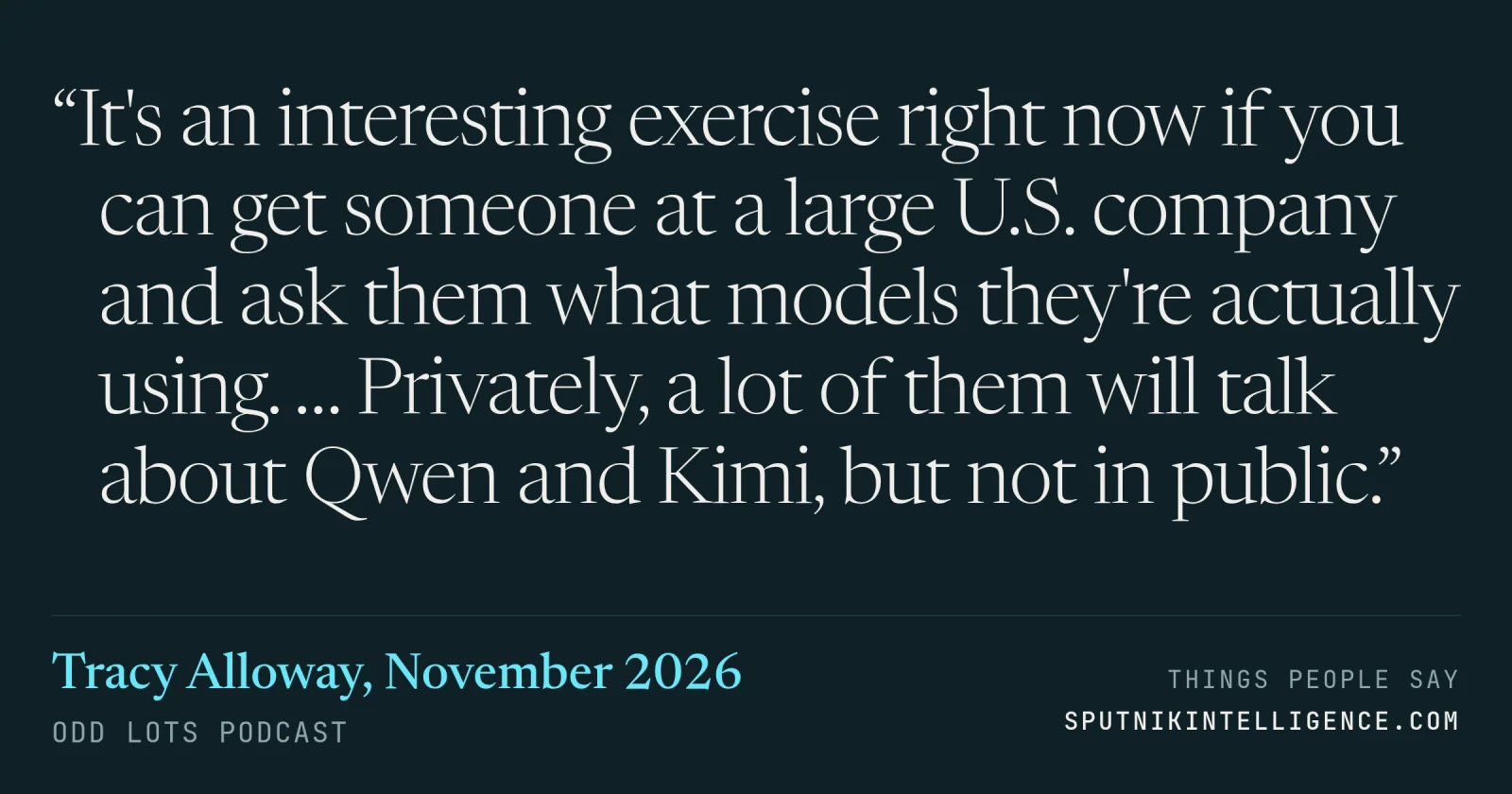
“It's an interesting exercise right now if you can get someone at a large U.S. company and ask them what models they're actually using. … Privately, a lot of them will talk about Qwen and Kimi, but not in public.” — Tracy Alloway, Odd Lots

After an interview about building on Chinese open-weight models, Tracy Alloway notes that US companies use them quietly but avoid saying so. It lands as the administration weighs requiring disclosure of Chinese AI model use.

Odd Lots · 2026-11-20 Permalink → Listen →
Odd Lots Around 39:30 into the episode
Tracy Alloway

But, you know, I would place my bets on the cheaper models winding out, but I don't know. One

Speaker 1

thing we didn't get into, and when you mentioned cheaper models, is also that the closed source labs do have cheaper versions. Yeah, that's true. So, but I agree, like at any level, presumably, I think the Chinese Open-Weight Models are cheaper. Have you been

Tracy Alloway

asking? It's an interesting exercise right now if you can get, you know, someone at a company, a large like U.S. company, and ask them what models they're actually using. Yeah. Privately, a lot of them will talk about like Quinn and Kimmy, but not in public.

Speaker 1

Yeah, it's kind of interesting. Every once in a while, you do see it, like, but usually around like what they were able to accomplish with fine-tuning, et cetera. I also think there's a kind of flip side of observed the opposite, which is I think there is this sort of like posturing to the…

Tracy Alloway

In the meantime, we have a new AI worry to think about obliteration.

Speaker 1

Oh, yeah. I got to get, I've never, I got to like get my hands on an obliterated model. I got to try out stuff. No, no, I've always been just. That

Speaker names come from our own diarization. The position is estimated from where the line sits in the episode.
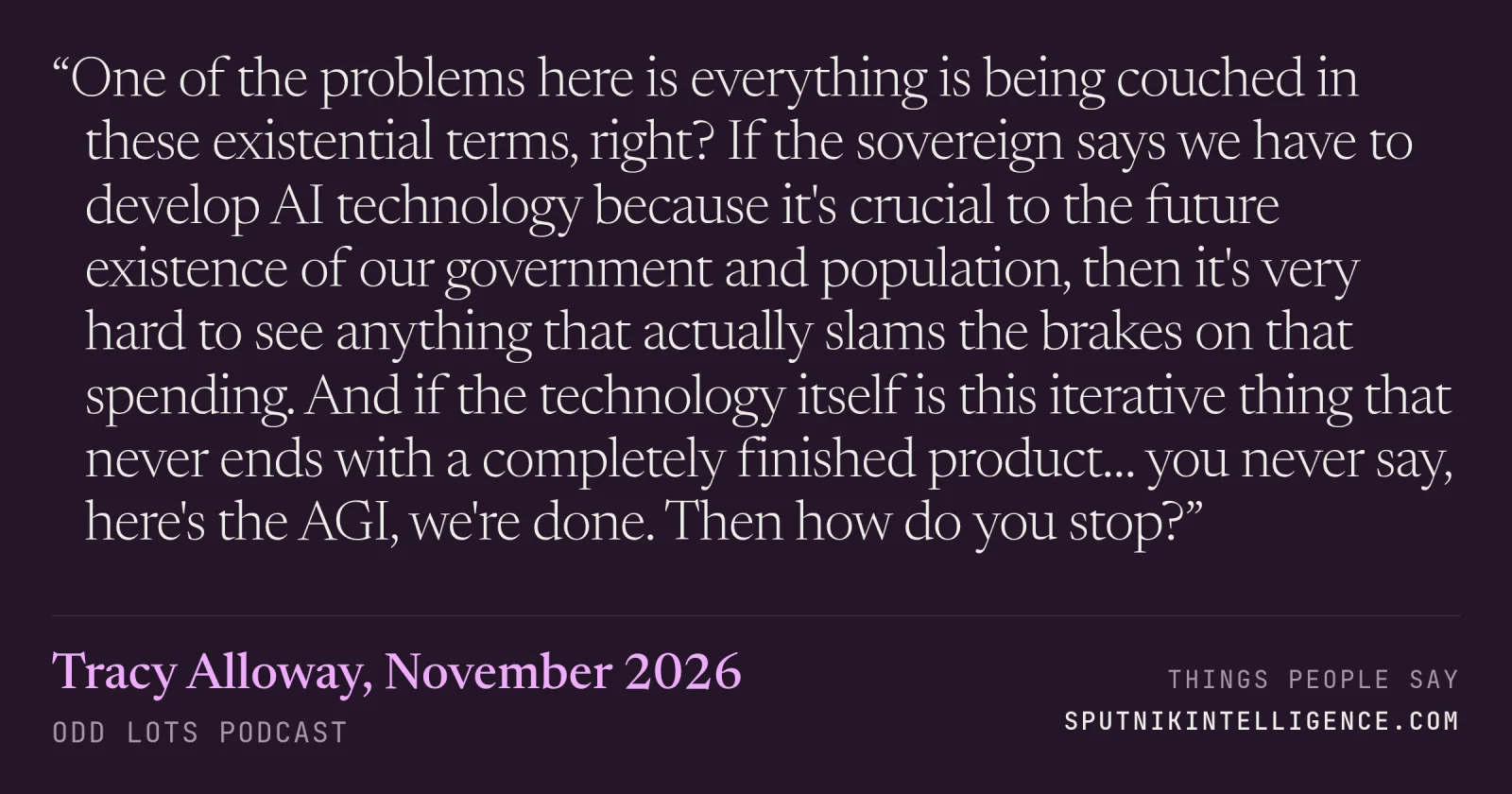
“One of the problems here is everything is being couched in these existential terms, right? If the sovereign says we have to develop AI technology because it's crucial to the future existence of our government and population, then it's very hard to see anything that actually slams the brakes on that spending. And if the technology itself is this iterative thing that never ends with a completely finished product… you never say, here's the AGI, we're done. Then how do you stop?” — Tracy Alloway, Odd Lots

After the guest left, Tracy Alloway summed up why the AI spending race is hard to slow. Governments frame it as existential, and it has no finish line.

Odd Lots · 2026-11-16 Permalink → Listen →
Odd Lots Around 41:32 into the episode
Speaker 2

thanks for having me.

Joe Weisenthal

…one kind of like proxy. Three, there is this obvious rising geopolitical tension between the U.S. and China, and it relates increasingly not just to AI specifically, which is very spending heavy. Yeah. And I don't know, feels like something kind of got to give here. And I don't know what it'll be.

Tracy Alloway

No, I agree. I find it hard to ask questions on a thesis that I broadly agree with. And I remember back in 2021, I wrote this piece, The Choke Point Economy, and this was like my big realization, which was like governments were waking up to their relative vulnerabilities when it came to crucial technology or supply chain components. And so we were going to be in a very like China-esque style race to build out those resources. I do think like one of the problems here is everything is being couched in these existential terms, right? And so if the sovereign says we have to develop AI technology because it's crucial to the future existence of our government/slash population, then it's very hard to see anything that like actually slams the brakes on that spending. And at the same time, if the technology itself is this iterative thing that never ends with a completely finished product, as we were discussing, like you never say, like, okay, we did it. Like, here's the AGI, we're done. Then, like, how do you stop?

Joe Weisenthal

Yeah. And then the other, you know, the other fact about the world that I didn't mention is we're getting older and we right like aging. Like us personally? We are, but aging populations more broadly and the obligation. There's, you know, it's a dog.

Tracy Alloway

I thought you were going to say you're aging. So you're really into gold now. Like, I mean,

Joe Weisenthal

that's where we're going. No, I'm aging and I don't really care about the future anymore. No, but like, you know, we have made promises to retirees. Yeah. A real resource promise. So that puts strains on the working share of the population. That further makes it harder to like get productivity…

Speaker names come from our own diarization. The position is estimated from where the line sits in the episode.
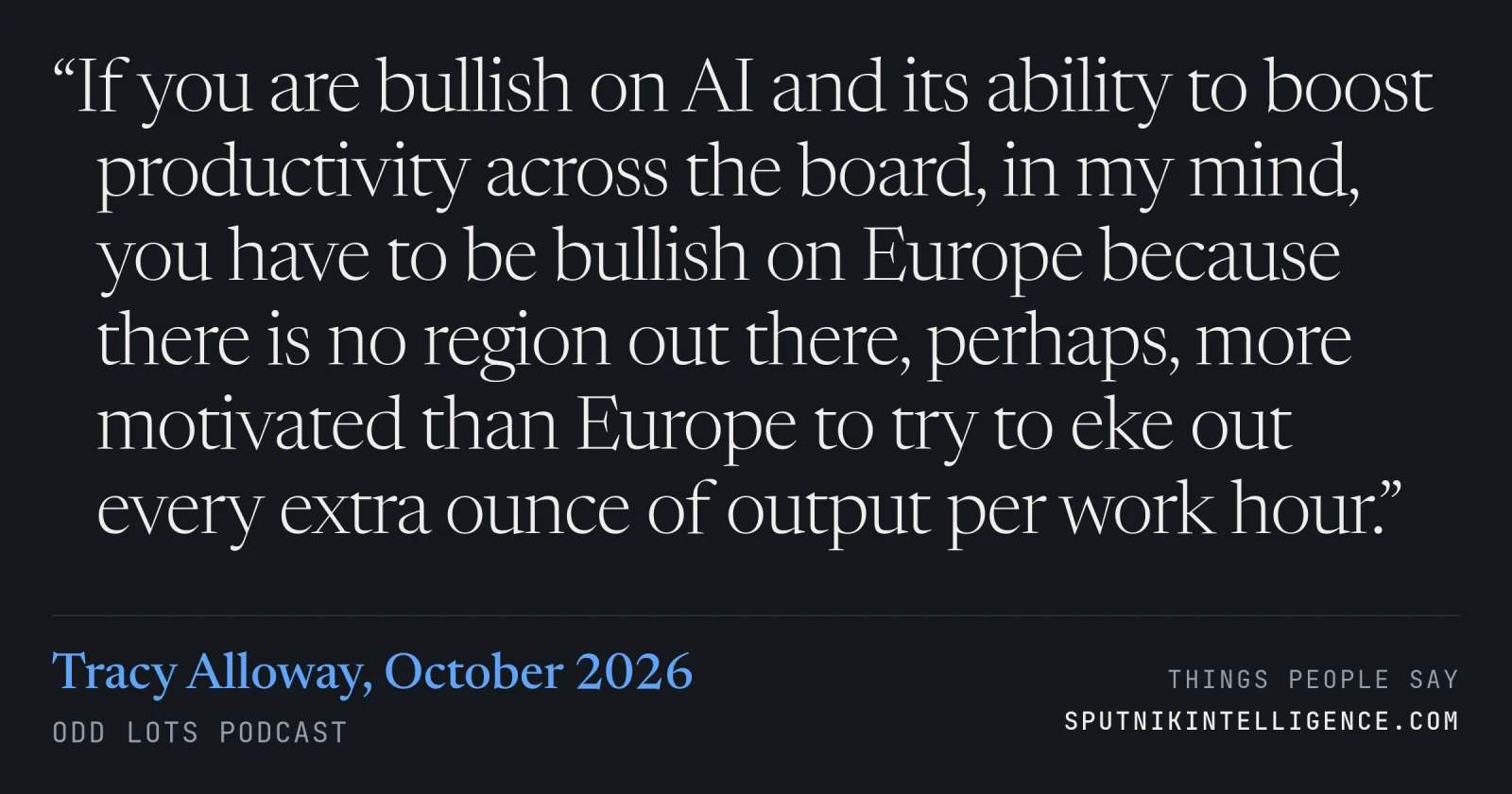
“If you are bullish on AI and its ability to boost productivity across the board, in my mind, you have to be bullish on Europe because there is no region out there, perhaps, more motivated than Europe to try to eke out every extra ounce of output per work hour.” — Tracy Alloway, Odd Lots

Joe Weisenthal opens by noting that whatever the show discusses, trade or AI or anything else, Europe seems to get the short end of the stick. Alloway pushes back with this. If you want a long lunch in France or a long August holiday, she says, you should be very interested in AI.

Odd Lots · 2026-10-08 Permalink → Listen →
Odd Lots Around 10:09 into the episode
Tracy Alloway

And I'm Tracy Alloway.

Joe Weisenthal

…no, it's not. It's like we have these conversations and then usually or frequently, whether we're talking about trade or AI or anything, there's usually, oh, and it seems like Europe is getting the short end of the stick here. Or it seems like it's all going to end up being kind of bad for Europe.

Tracy Alloway

Well, yes. I would say that. You have said this. I'm sure I have in the past. However, what I would say is if you are bullish on AI and its ability to boost productivity across the board, in my mind, you have to be bullish on Europe because there is no region out there, perhaps, more motivated than Europe to try to eke out every extra ounce of output per work hour. Like if you want a long lunch in France, if you want to, you know, take a long vacation in August, you should be very, very interested in AI. And if you think those gains are going to be like widely spread through businesses in other countries, you know, think about Europe.

Joe Weisenthal

Did you purposely just say this? Did you see the red headline that just hit as you were talking?

Tracy Alloway

No.

Joe Weisenthal

It's so surreal. So we just got a red headline the moment you were saying that BMW targets shedding a fifth of manager roles with the help of AI. I don't think that could be more perfect because A, this is, it's the two sides of the coin. So it's like you have a lot of like big industrial behemoths…

Speaker names come from our own diarization. The position is estimated from where the line sits in the episode.

Collections They Appear In