NB

Nick Bostrom

Things Nick Says on Podcasts

Where to Find Them

Nick Bostrom writes StarTalk Radio and writes The Michael Shermer Show . They have also been a guest on Into the Impossible With Brian Keating (3 times) , Young and Profiting with Hala Taha (Entrepreneurship, Sales, Marketing) (2 times) , Sustainability, Climate Change, Renewable Energy, Politics, Activism, Biodiversity, Carbon Footprint, Wildlife, Regenerative Agriculture, Circular Economy, Extinction, Net-Zero · One Planet Podcast (2 times) , Big Technology (2 times) , The AI in Business Podcast (2 times) , Lex Fridman Podcast , Prof G Markets , NonZero Newsletter , EconTalk , Open Book with Anthony Scaramucci , Interesting Times , The Most Interesting Thing in AI , Prof G Media , Odd Lots , Eye On A.I. , Interesting Times with Ross Douthat , The Interview , a16z Podcast , The Last Invention , The Peter McCormack Show , The Cognitive Revolution" | AI Builders, Researchers, and Live Player Analysis , Within Reason , The Trajectory , The TWIML AI Podcast and UnHerd with Freddie Sayers .

Recently: “Nick Bostrom: How Should We Navigate Superintelligence?” on a16z Podcast (October 2026); “We Are Clueless About What’s Coming” on Interesting Times with Ross Douthat (October 2026); “We Are Clueless About What’s Coming” on Interesting Times (October 2026); “#215 - Nick Bostrom - "We Are Creating Superintelligence": The Existential Risk is Real” on The Peter McCormack Show (September 2026); “Prof. Nick Bostrom: The truth about the AI panic” on UnHerd with Freddie Sayers (September 2026); “Superintelligence, the Singularity, and the Singleton (Robert Wright & Nick Bostrom)” on NonZero Newsletter (September 2026).

What They Said

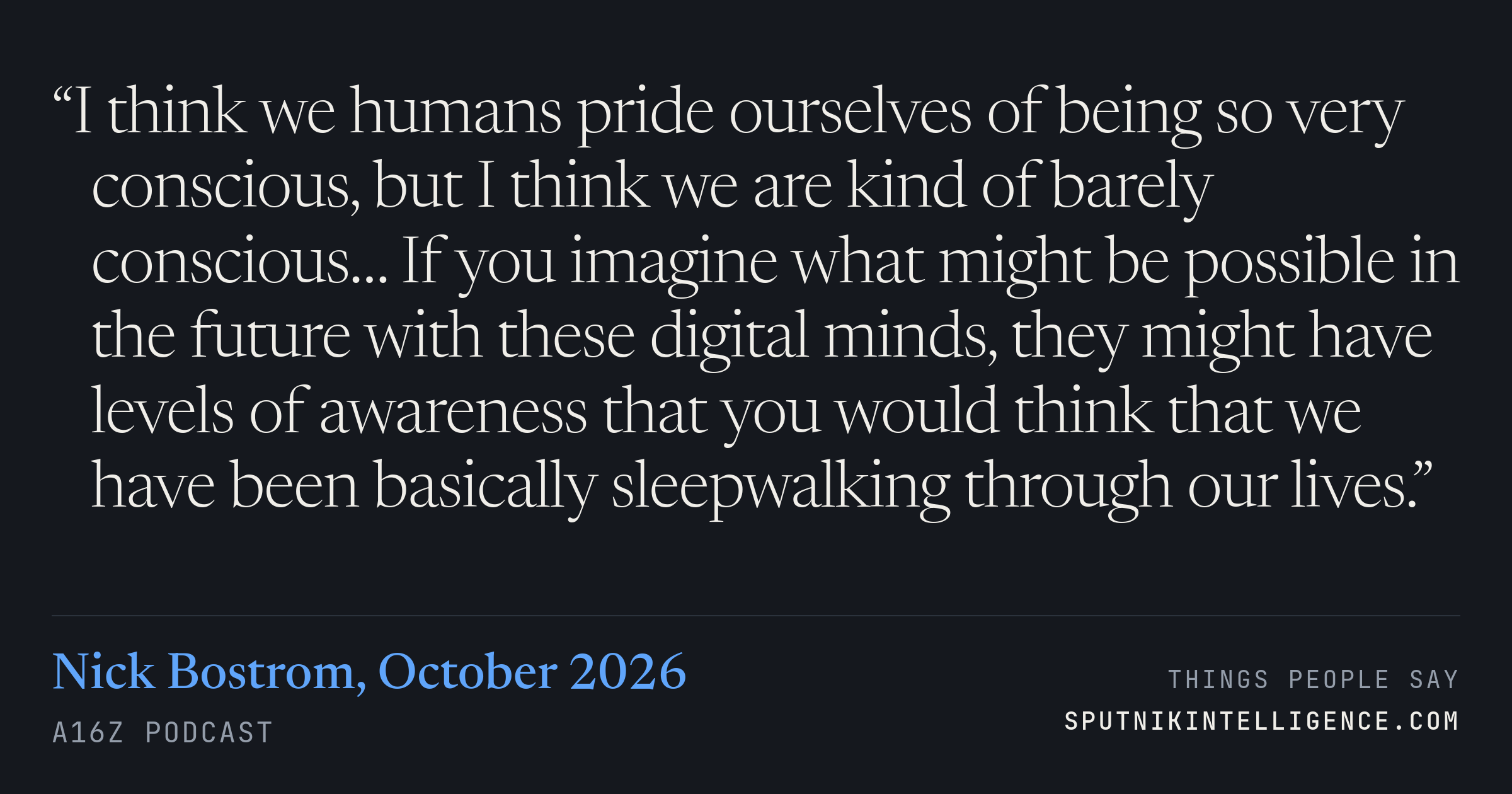
“I think we humans pride ourselves of being so very conscious, but I think we are kind of barely conscious… If you imagine what might be possible in the future with these digital minds, they might have levels of awareness that you would think that we have been basically sleepwalking through our lives.” — Nick Bostrom, a16z Podcast

Asked what artificial consciousness might eventually look like, Bostrom points to the driver who passes thousands of buildings without registering any of them. He argues that consciousness is less binary than we assume, and that current AI systems may already have some of its dimensions.

a16z Podcast · 2026-10-11 Permalink → Listen →
a16z Podcast Around 35:44 into the episode
Nick Bostrom

…say, what I say doesn't really have anything to do with my phenomenological experience, right? Like, so how would you actually measure that state of consciousness? I am fairly certain it can't just be like at the output level. There has to be something like more inherent to its structure or the

Sofia Puccini

underlying architecture. And what might artificial consciousness eventually look like if we currently don't have it?

Nick Bostrom

Yeah, what it might eventually look like. That is a sort of mind-boggling question because I think we humans pride ourselves of being so very conscious, but I think we are kind of barely conscious. It takes like some driver who spends two hours driving down the road and they were passing by like these thousands of buildings, right? And like mothers with strollers on the sidewalk and all that. Were they aware of that while they were driving? Did it register? Like it looks like we are kind of, if you look closely, kind of aware slightly in a murky way of a few features at any given point in…

Theo Jaffee

Right. So one of the big debates of the moment is open source. And, you know, you written about the vulnerable world hypothesis. Obviously, if open source models could create like a bioweapon in someone's basement with only ingredients from Home Depot or something, this would be bad. And we would…

Speaker 4

Yeah. It's, I mean, I think. I think so far they have been good, but you do worry about what their effects will be if they do unlock truly dangerous capabilities, like in bio, for example. I think one thing we should do independently now is probably harden our other defenses against biological…

Nick Bostrom

some other necessary component to actually making these things is hard to get. And that the most obvious choke point would be DNA synthesis. I don't think every lab needs to have their own DNA synthesis machine. You could imagine that being provided as a service by a half dozen companies around the…
Speaker names from our own diarization · position estimated from where the line sits in the episode
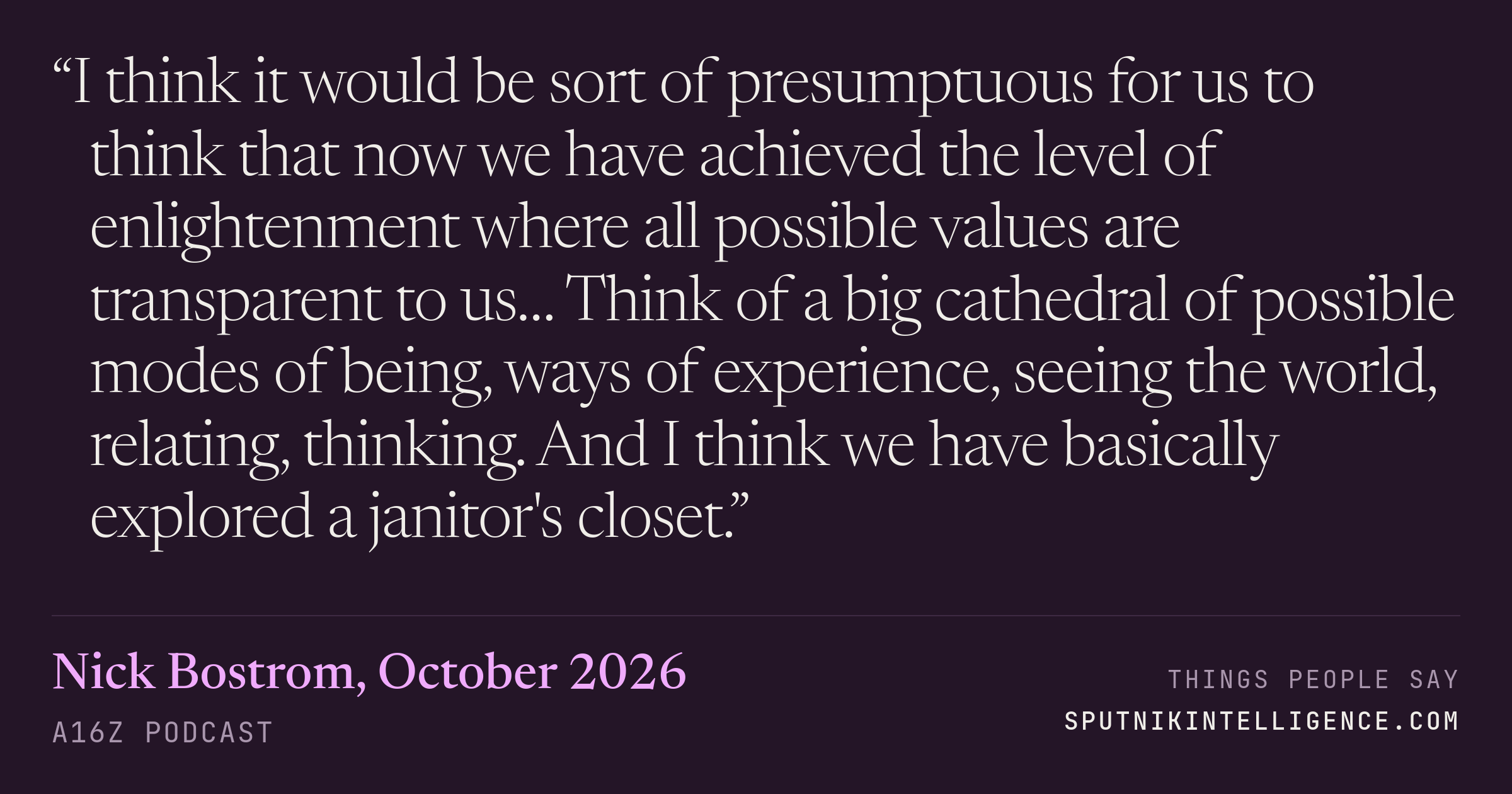
“I think it would be sort of presumptuous for us to think that now we have achieved the level of enlightenment where all possible values are transparent to us… Think of a big cathedral of possible modes of being, ways of experience, seeing the world, relating, thinking. And I think we have basically explored a janitor's closet.” — Nick Bostrom, a16z Podcast

Asked why Americans are so negative about AI, Bostrom suggests part of it is a failure of imagination about how good things could get. He compares us to ape ancestors weighing whether to become human and only seeing the upside of unlimited bananas.

a16z Podcast · 2026-10-11 Permalink → Listen →
a16z Podcast Around 26:58 into the episode
Nick Bostrom

Yeah. Yeah. There is like, it looks like there's a gradient in the world in terms of AI sentiment,

Speaker 4

…you have more positive centers. Like people are in China, for example, are much more excited about this. And also, as you move from north to south, the global south also seems to be more positive. I mean, maybe they feel they have more to gain and less to lose than sort of a lot of Americans. I

Nick Bostrom

think, yeah, that in part, it might be a lack of imagination to really internalize how good the future could become if it does go well. It's kind of easier to have a concrete picture of how things could go badly, like a disaster is like not easy to paint in a way that everybody would agree that if that happens, then it's really horrible. And for some of the positives, also, one can do the same, like benefits in medicine and so forth. Everybody agree that if you could find a way to cure Alzheimer or something, that would be hugely beneficial. But a large chunk of the potential upside is more of the way of sort of unlocking new ways to be human, new possible modes of being. And there, I think it does put a larger demand on the imagination to sort of conceive that something like that could be both possible and desirable. I sometimes compare it to like if you imagine some great ape ancestors of Homo sapiens deliberating whether they should continue to evolve and one day become human. And they would think about the pros and cons. And, you know, maybe they would realize some of the benefits, like, oh, we could have…

Speaker 4

possible in principle.

Theo Jaffee

Yeah, I love the Utopia essay. I think this really does a good job laying out the benefits to people. Although, you know, most people haven't read it, of course, unfortunately.

Nick Bostrom

Yeah. This is also why I think science fiction authors have the most underrated job in all of history because their job is to sort of like lay out imaginatively what the possible futures look like. But I also wanted to

Speaker names from our own diarization · position estimated from where the line sits in the episode

Collections They Appear In