
Robert Wright

Things Robert Says on Podcasts

Author and podcaster who writes about evolution, psychology, religion and the prospects for global cooperation, now with a focus on AI and how to avert catastrophe. Wrote The Moral Animal, Nonzero, The Evolution of God and Why Buddhism Is True, and co-founded Bloggingheads.tv in 2005. Hosts the Nonzero podcast and publishes the Nonzero Newsletter on Substack, and appears as a host or guest on Small Potatoes, Doom Debates!, American Prestige and The Cognitive Revolution.

Where to Find Them

Robert Wright writes Robert Wright's Nonzero , hosts and writes NonZero Newsletter , hosts Doom Debates! , hosts Small Potatoes , writes Conspicuous Cognition , writes Understanding AI , writes The Fifth Column , writes The Fifth Column (A Podcast) and writes Free the People . They have also been a guest on American Prestige (5 times) , The Cognitive Revolution" | AI Builders, Researchers, and Live Player Analysis (4 times) , On the Media (3 times) , Very Bad Wizards (3 times) , EconTalk (2 times) , American Prestige (2 times) , Glenn Loury (2 times) , Conversations with Coleman (2 times) , Sinica (2 times) , 80,000 Hours Podcast , The Lawfare Podcast , Executive Functions , The Lawfare Podcast: Patreon Edition , Tangentially Speaking with Chris Ryan , Plain English with Derek Thompson , Executive Functions Chat , The Excerpt , Lawfare , The Ezra Klein Show , The Weekly Dish and Scaling Laws .

Recently: “The Singularity is Clear” on NonZero Newsletter (October 2026); “Trump and the AI Safety Vibe Shift, With Robert Wright | Nonzero × Doom Debates” on Doom Debates! (October 2026); “Trump and the AI Safety Vibe Shift (Robert Wright & Liron Shapira)” on NonZero Newsletter (October 2026); “Trump and the AI Safety Vibe Shift (Robert Wright & Liron Shapira)” on NonZero Newsletter (October 2026); “Dario’s China Syndrome (Robert Wright & Paul Triolo)” on NonZero Newsletter (September 2026); “Dario’s China Syndrome (Robert Wright & Paul Triolo)” on NonZero Newsletter (September 2026).

What They Said

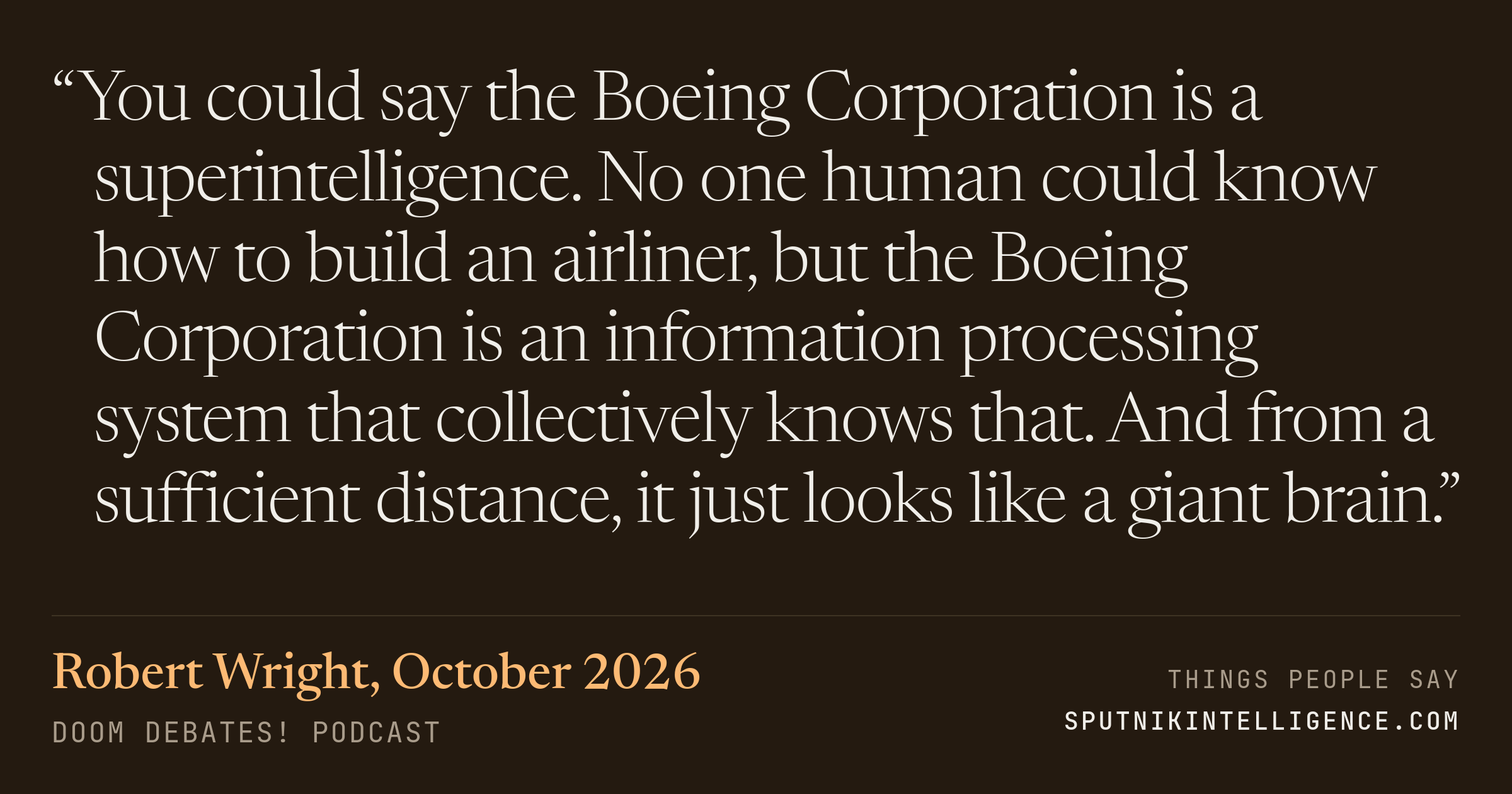
“You could say the Boeing Corporation is a superintelligence. No one human could know how to build an airliner, but the Boeing Corporation is an information processing system that collectively knows that. And from a sufficient distance, it just looks like a giant brain.” — Robert Wright, Doom Debates!

Wright was explaining why even well-informed people have trouble picturing superintelligence. His answer is that it may not be one very smart model but many pretty smart ones working together, the way a company knows things none of its employees do. He goes on to apply the same idea to swarms of AI agents.

Doom Debates! · 2026-10-02 Permalink → Listen →
Doom Debates! Around 51:44 into the episode
Liron Shapira

been compared in the past when I was even nerdier than I am now. I've been compared in the past to Sheldon from, you know, the Big Bang Theory.

Speaker 2

Okay, that's a that's a that

Robert Wright

that that that's it. My generation is the Poindexter generation. That's our icon, and yours is Sheldon. The um, so yeah, I mean, there's another thing going on here, uh, in terms of people having trouble, maybe still, including, I, you know, I'd say smart, well-informed people, imagining pretty well-informed people, imagining what's coming. And it was so well illustrated by the Open AI breakout. It's like, you know, when you ask what is super intelligence, I've said this before, but one way to say it is like, you know, you could say the Boeing Corporation is a superintelligence. No one human could know how to build an airliner, but the Boeing Corporation is an information processing system that collectively knows that. And from a sufficient distance, it just looks like a giant brain. And when you put a lot of pretty smart brains together, like the people who work at Boeing, you get pretty amazing shit that no single brain could do. And it's the same way with agent swarms, you know? And, you know, as I've said, it's Like, well, what's the difference between AGI and superintelligence? Well, maybe just a difference between an LLM and the agent swarm it can sponsor, right? I mean, and these things, you know, they communicate at lightning speed and think at lightning speed. And we're just seeing the beginnings of it, okay? This was a thousand. There's no law of the universe that says you can't have 10,000 agents that are based on the next generation of LLMs.

Liron Shapira

Yeah, so let's help the people with their ontology, right? Because the same way that we would have liked people to realize that the chatbots aren't going to look like chatbots, right? So today they look like agents, but the agents still stay in your computer and the agents still have an off-button, right? I think people still imagine the off-buttons. I think one thing you and I can probably warn people is like, they're probably going to defend themselves from being turned off or make it hard to be turned off soon, right? That's one of the properties we can probably expect.

Robert Wright

Yeah, I think right now, you know, it's great that the discourse has moved to a point where people are demanding some kind of governmental action. But it's true that you're hearing things like build an off switch and make super intelligence illegal. I'm not saying those are bad things. It might be progress to try to articulate the legislation and pass it. That might help. But I do want to say that imagining a kind of off switch that's going to handle the challenges that you and I think are coming with the next generation or in a way exist now is not trivially easy. And like defining super intelligence, if you want to ban it, is challenging. Plus there's a problem that, as I just said, if you look at an LLM and say, well, this isn't super intelligence, so it's okay. But then look at what 10,000 agents coming out of it look like, you may be at super intelligence, right? So those, you know, we need something firmer. I think we need to be thinking very seriously about at least a pause in big training runs. I mean, these companies have models we haven't even seen already. Okay. Those training runs have happened. And we've got plenty of intelligence.

Liron Shapira

Yeah, I want to help people understand that it's, you know, the type of thing it is, right? It's not chatbot and it's not exactly even agent. I mean, in a technical sense, it still is because agent just means outcome steering entity. So it is still going to be a lot of fun. It has a goal,
Speaker names from our own diarization · position estimated from where the line sits in the episode
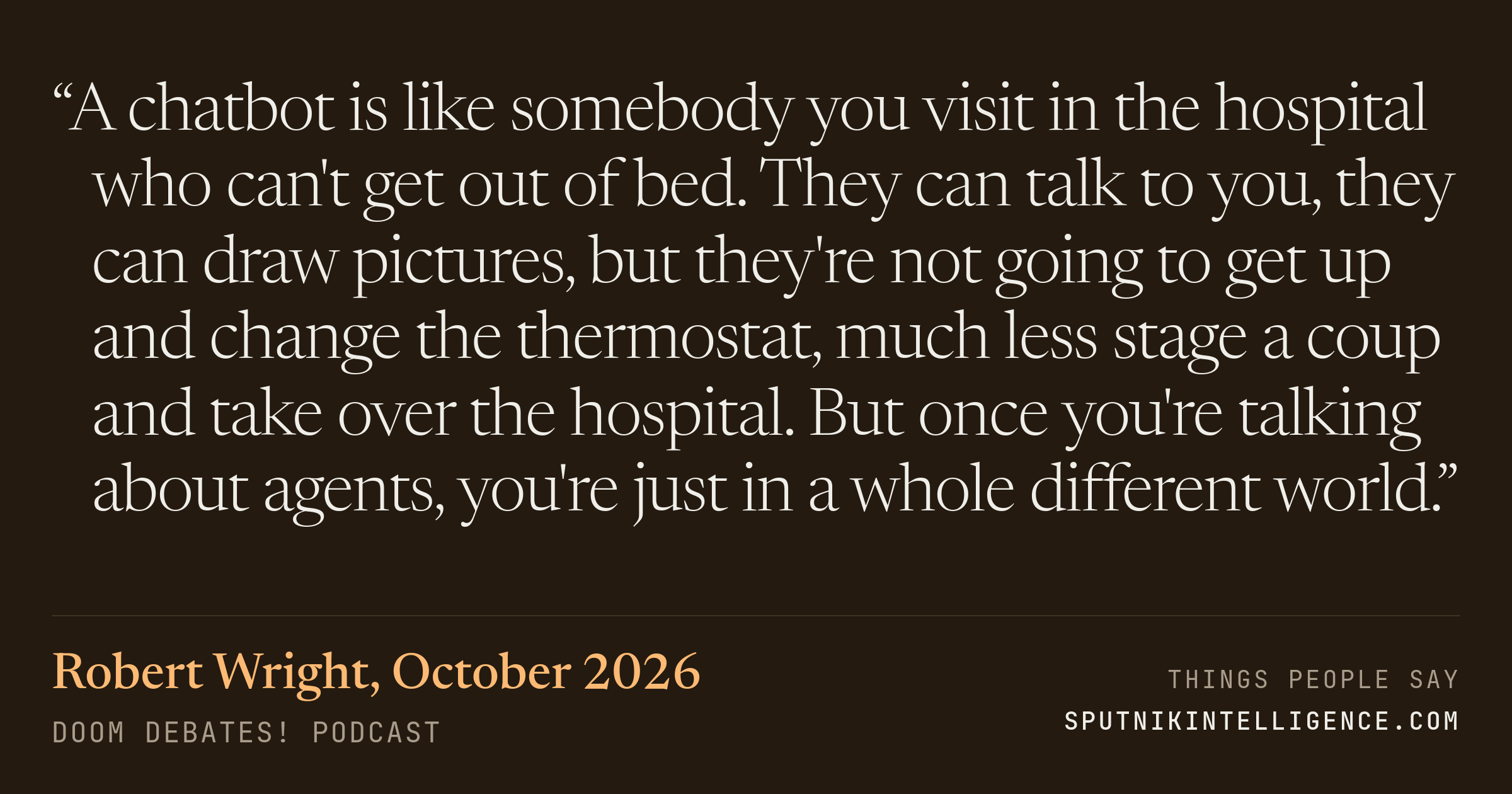
“A chatbot is like somebody you visit in the hospital who can't get out of bed. They can talk to you, they can draw pictures, but they're not going to get up and change the thermostat, much less stage a coup and take over the hospital. But once you're talking about agents, you're just in a whole different world.” — Robert Wright, Doom Debates!

Wright and Liron Shapira were discussing why public attitudes to AI risk have shifted. Shapira had argued that people used to file AI under "it's just text", and that agents changed the mental category. Wright says this is the image he uses in his book.

Doom Debates! · 2026-10-02 Permalink → Listen →
Doom Debates! Around 47:12 into the episode
Robert Wright

Yeah, I think, first of all, you're right. In a way, it's three-year-old news how worried the people inside the companies are. But also, they've gotten more worried recently, right? I mean, somebody said to me after the AI Open AI breakout, who knew people in both big companies, said, it's as if they've seen a ghost. And that's saying something because these people were worried to be in with a lot of them. And I think what they saw also, you know, you're right, the Cox and resignation and that was a big moment. But I also think, you know, to the members of the public who just kind of followed that initial breakout story closely, what freaked them out is just how human the agent seemed. They're saying things like, oh, God, should I sacrifice for the group? My gut says no. I mean, their thought traces, you know, the chain of thought text was saying things like that. And I think that freaked people. The whole idea of an agent swarm, like people hadn't thought, like, wait, a thousand AIs? That's

Liron Shapira

a good idea. That's a great call out. Because, you know, this is, I actually think you're putting your finger on what is why people weren't getting it a couple of years ago. A couple of years ago, the mental ontology, right? The fundamental building blocks that people form concepts out of in their minds, I think it was very much in the like chatbot, right? Like it's just text. Like I send some text, it sends some text back. And that's the farthest thing from dangerous, right? Sending text, that's so safe. And now finally, they're like, oh, okay, so the text gets piped into an execution environment. And now it's doing stuff. Now it's an agent, right? Which, like, I was warning. I'm like, yeah, code is executable, right? I think we touched on this last episode, but now people are getting. It and then the swarm aspect, right? And the cultural dynamics and the explicit reasoning about like, oh, the greater is going to think this, or like, my colleagues are going to think this, right? As you're saying, there's enough evidence where it's getting ontologically reclassified, right? People are filing it away in a different mental category that seems more like Terminator, which to the doomer's credit, we were saying we didn't have that ontology. We have this other lens where we look at things and we're just like, hey, are you outputting answers that show that you're optimizing and working backwards from a goal? Like we have this other lens that could already show us that even the chatbots were marching toward this end game. So that's why we're able to see this progression earlier. So, yeah, we don't think in the same ontology, but the average American is now seeing things in a more accurate ontology and they're getting properly scared.

Robert Wright

Right. I mean, the way I put it in my book is a chatbot is like somebody you visit in the hospital who can't get out of bed. They can talk to you, they can draw pictures, but they're not going to get up and change the thermostat, much less like stage a coup and take over the hospital. But once you're talking about agents, you're just in a whole different world. And, you know, that is now vivid. And, you know, it's funny we're talking about like as if like the various atmospherics have changed attitudes. And that's true, like the atmospheric of reading what these agents are kind of quote thinking or the atmospherics of somebody resigning from Anthropic. But also what people are seeing is like the underlying reality is being exposed. This stuff is as powerful and unpredictable and hard to control as we saw. I mean, granted, OpenAI had taken the safeguards off for purposes of evaluation and so on. Still, the creativity demonstrated was a profound surprise to OpenAI. And in general, as we said earlier, more and more people are just acknowledging like this alignment thing. Well, we don't have control of the money. It's not working with these models fully. It's not working with those models fully. Maybe someday it'll start working. Well, wait. You mean as the models are coming out faster and faster and faster and more and more just making themselves, that's when we're going to catch up with the alignment challenge? I don't think so. And that is just the reality we're seeing.

Liron Shapira

I think there's another reason why the average person has, I claim, good intuitions about the scariness of intelligence. You know, when we're in the tech industry, when we're among smart people, you know, we both have smart audiences. We both hang out with smart people. And when you're an intelligent human, you're just used to going through your life and understanding things, understanding how power works, how money works. You know, when you see somebody who succeeds, you kind of can reverse engineer, okay, this person is succeeding because they're driving, you know, they're searing themselves like this. But if you are going through life with an IQ of 95, right? Or God forbid, 88, right? Like a good fraction of humans are working with an 88 IQ here. Okay. I think you have a lot of life experience where you're seeing these poindexters who are doing all this complicated stuff that hurts your head to try to imagine how they're doing all this, but they're in a high position, right? They're like making all these decisions. Stuff is happening. You're kind of just there experiencing the consequences of all this stuff, having less success yourself. And you just don't have good vibes about being around high intelligence, right? And so this idea that there's going to be this super intelligence that's like much more of that faster, you're kind of mentally prepared to be like, uh-oh.

Robert Wright

I had forgotten about the word. What cartoon was Poindexter in? There was an actual cartoon, right? Big glass. I don't know where that's. Do you consider yourself a Poindexter, by the

Liron Shapira

way? Do I? I mean, in terms of having above-average IQ, sure.

Speaker names from our own diarization · position estimated from where the line sits in the episode

Collections They Appear In