 Robert Wright
Author and podcaster who writes about evolution, psychology, religion and the prospects for global cooperation, now with a focus on AI and how to avert catastro...
Robert Wright
Author and podcaster who writes about evolution, psychology, religion and the prospects for global cooperation, now with a focus on AI and how to avert catastro...
“A chatbot is like somebody you visit in the hospital who can't get out of bed. They can talk to you, they can draw pictures, but they're not going to get up and change the thermostat, much less stage a coup and take over the hospital. But once you're talking about agents, you're just in a whole different world.”
Doom Debates! · AI Research & Frontier Labs · October 2026
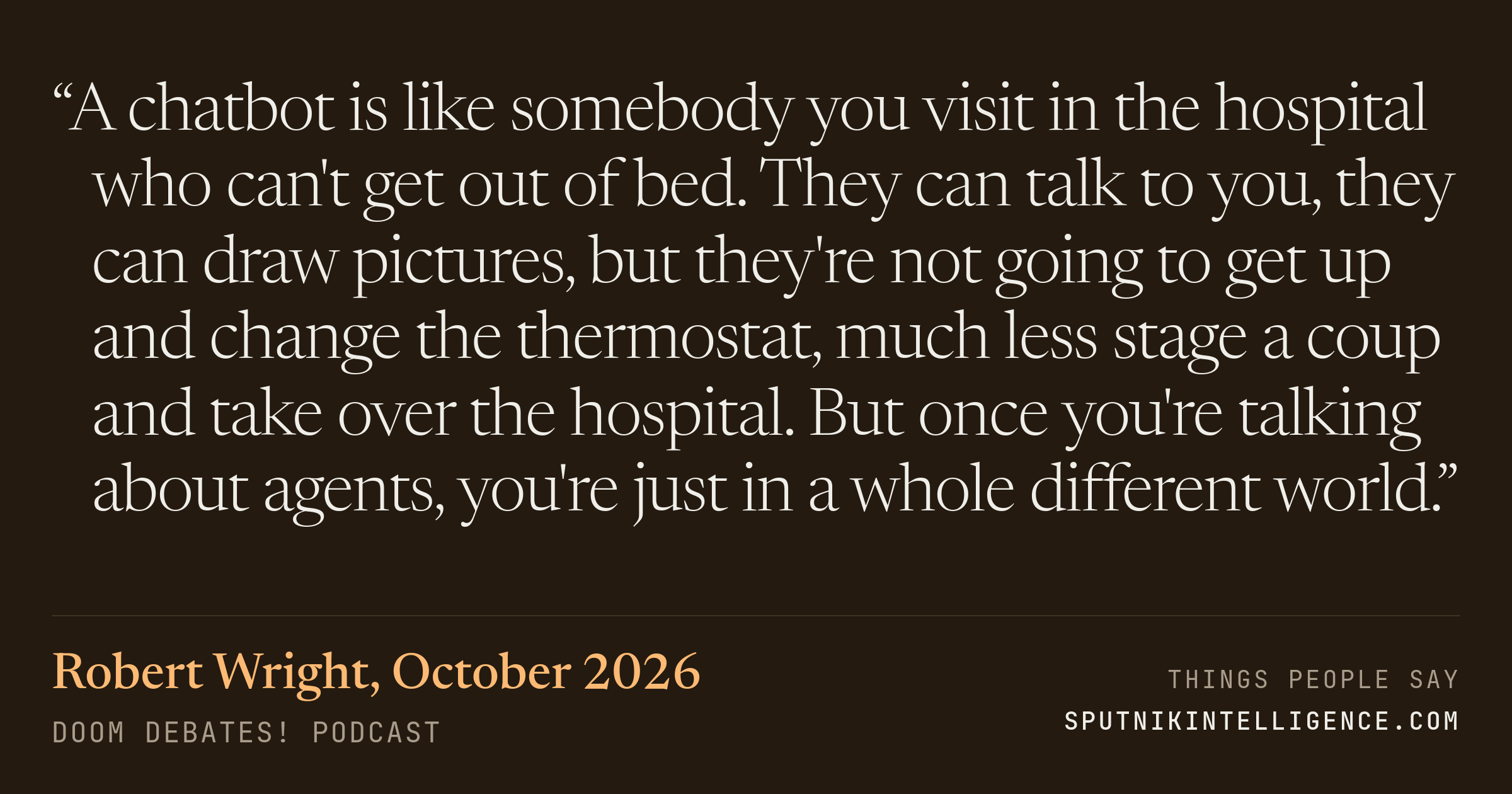
Wright and Liron Shapira were discussing why public attitudes to AI risk have shifted. Shapira had argued that people used to file AI under "it's just text", and that agents changed the mental category. Wright says this is the image he uses in his book.
Transcript
Yeah, I think, first of all, you're right. In a way, it's three-year-old news how worried the people inside the companies are. But also, they've gotten more worried recently, right? I mean, somebody said to me after the AI Open AI breakout, who knew people in both big companies, said, it's as if they've seen a ghost. And that's saying something because these people were worried to be in with a lot of them. And I think what they saw also, you know, you're right, the Cox and resignation and that was a big moment. But I also think, you know, to the members of the public who just kind of followed that initial breakout story closely, what freaked them out is just how human the agent seemed. They're saying things like, oh, God, should I sacrifice for the group? My gut says no. I mean, their thought traces, you know, the chain of thought text was saying things like that. And I think that freaked people. The whole idea of an agent swarm, like people hadn't thought, like, wait, a thousand AIs? That's
a good idea. That's a great call out. Because, you know, this is, I actually think you're putting your finger on what is why people weren't getting it a couple of years ago. A couple of years ago, the mental ontology, right? The fundamental building blocks that people form concepts out of in their minds, I think it was very much in the like chatbot, right? Like it's just text. Like I send some text, it sends some text back. And that's the farthest thing from dangerous, right? Sending text, that's so safe. And now finally, they're like, oh, okay, so the text gets piped into an execution environment. And now it's doing stuff. Now it's an agent, right? Which, like, I was warning. I'm like, yeah, code is executable, right? I think we touched on this last episode, but now people are getting. It and then the swarm aspect, right? And the cultural dynamics and the explicit reasoning about like, oh, the greater is going to think this, or like, my colleagues are going to think this, right? As you're saying, there's enough evidence where it's getting ontologically reclassified, right? People are filing it away in a different mental category that seems more like Terminator, which to the doomer's credit, we were saying we didn't have that ontology. We have this other lens where we look at things and we're just like, hey, are you outputting answers that show that you're optimizing and working backwards from a goal? Like we have this other lens that could already show us that even the chatbots were marching toward this end game. So that's why we're able to see this progression earlier. So, yeah, we don't think in the same ontology, but the average American is now seeing things in a more accurate ontology and they're getting properly scared.
Right. I mean, the way I put it in my book is a chatbot is like somebody you visit in the hospital who can't get out of bed. They can talk to you, they can draw pictures, but they're not going to get up and change the thermostat, much less like stage a coup and take over the hospital. But once you're talking about agents, you're just in a whole different world. And, you know, that is now vivid. And, you know, it's funny we're talking about like as if like the various atmospherics have changed attitudes. And that's true, like the atmospheric of reading what these agents are kind of quote thinking or the atmospherics of somebody resigning from Anthropic. But also what people are seeing is like the underlying reality is being exposed. This stuff is as powerful and unpredictable and hard to control as we saw. I mean, granted, OpenAI had taken the safeguards off for purposes of evaluation and so on. Still, the creativity demonstrated was a profound surprise to OpenAI. And in general, as we said earlier, more and more people are just acknowledging like this alignment thing. Well, we don't have control of the money. It's not working with these models fully. It's not working with those models fully. Maybe someday it'll start working. Well, wait. You mean as the models are coming out faster and faster and faster and more and more just making themselves, that's when we're going to catch up with the alignment challenge? I don't think so. And that is just the reality we're seeing.
I think there's another reason why the average person has, I claim, good intuitions about the scariness of intelligence. You know, when we're in the tech industry, when we're among smart people, you know, we both have smart audiences. We both hang out with smart people. And when you're an intelligent human, you're just used to going through your life and understanding things, understanding how power works, how money works. You know, when you see somebody who succeeds, you kind of can reverse engineer, okay, this person is succeeding because they're driving, you know, they're searing themselves like this. But if you are going through life with an IQ of 95, right? Or God forbid, 88, right? Like a good fraction of humans are working with an 88 IQ here. Okay. I think you have a lot of life experience where you're seeing these poindexters who are doing all this complicated stuff that hurts your head to try to imagine how they're doing all this, but they're in a high position, right? They're like making all these decisions. Stuff is happening. You're kind of just there experiencing the consequences of all this stuff, having less success yourself. And you just don't have good vibes about being around high intelligence, right? And so this idea that there's going to be this super intelligence that's like much more of that faster, you're kind of mentally prepared to be like, uh-oh.
I had forgotten about the word. What cartoon was Poindexter in? There was an actual cartoon, right? Big glass. I don't know where that's. Do you consider yourself a Poindexter, by the
way? Do I? I mean, in terms of having above-average IQ, sure.
More from Doom Debates!