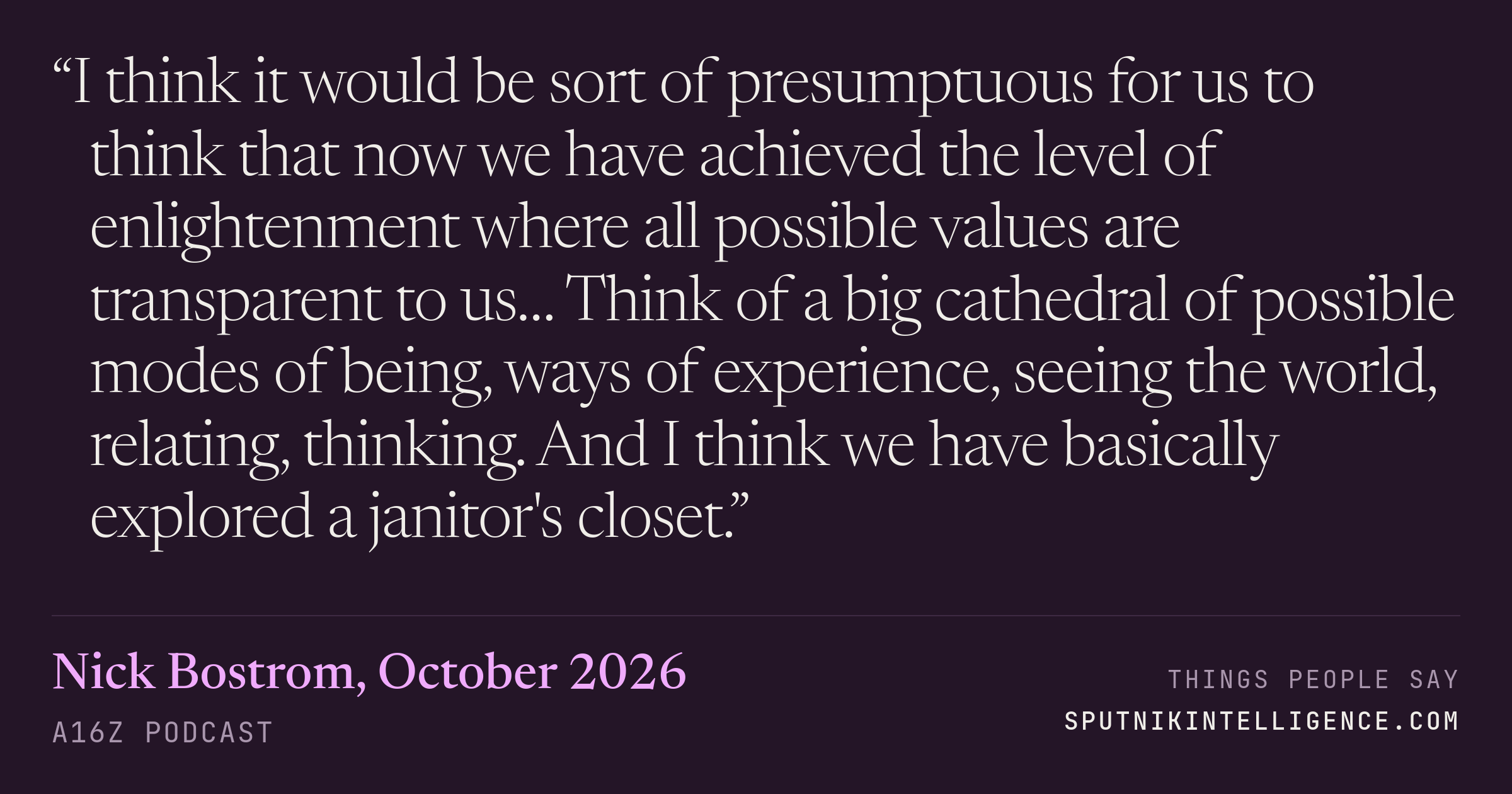
“I think it would be sort of presumptuous for us to think that now we have achieved the level of enlightenment where all possible values are transparent to us… Think of a big cathedral of possible modes of being, ways of experience, seeing the world, relating, thinking. And I think we have basically explored a janitor's closet.”
a16z Podcast · Startups & Venture · October 2026
Asked why Americans are so negative about AI, Bostrom suggests part of it is a failure of imagination about how good things could get. He compares us to ape ancestors weighing whether to become human and only seeing the upside of unlimited bananas.
Transcript
Yeah. Yeah. There is like, it looks like there's a gradient in the world in terms of AI sentiment,
…you have more positive centers. Like people are in China, for example, are much more excited about this. And also, as you move from north to south, the global south also seems to be more positive. I mean, maybe they feel they have more to gain and less to lose than sort of a lot of Americans. I
think, yeah, that in part, it might be a lack of imagination to really internalize how good the future could become if it does go well. It's kind of easier to have a concrete picture of how things could go badly, like a disaster is like not easy to paint in a way that everybody would agree that if that happens, then it's really horrible. And for some of the positives, also, one can do the same, like benefits in medicine and so forth. Everybody agree that if you could find a way to cure Alzheimer or something, that would be hugely beneficial. But a large chunk of the potential upside is more of the way of sort of unlocking new ways to be human, new possible modes of being. And there, I think it does put a larger demand on the imagination to sort of conceive that something like that could be both possible and desirable. I sometimes compare it to like if you imagine some great ape ancestors of Homo sapiens deliberating whether they should continue to evolve and one day become human. And they would think about the pros and cons. And, you know, maybe they would realize some of the benefits, like, oh, we could have…
possible in principle.
Yeah, I love the Utopia essay. I think this really does a good job laying out the benefits to people. Although, you know, most people haven't read it, of course, unfortunately.
Yeah. This is also why I think science fiction authors have the most underrated job in all of history because their job is to sort of like lay out imaginatively what the possible futures look like. But I also wanted to
More from a16z Podcast