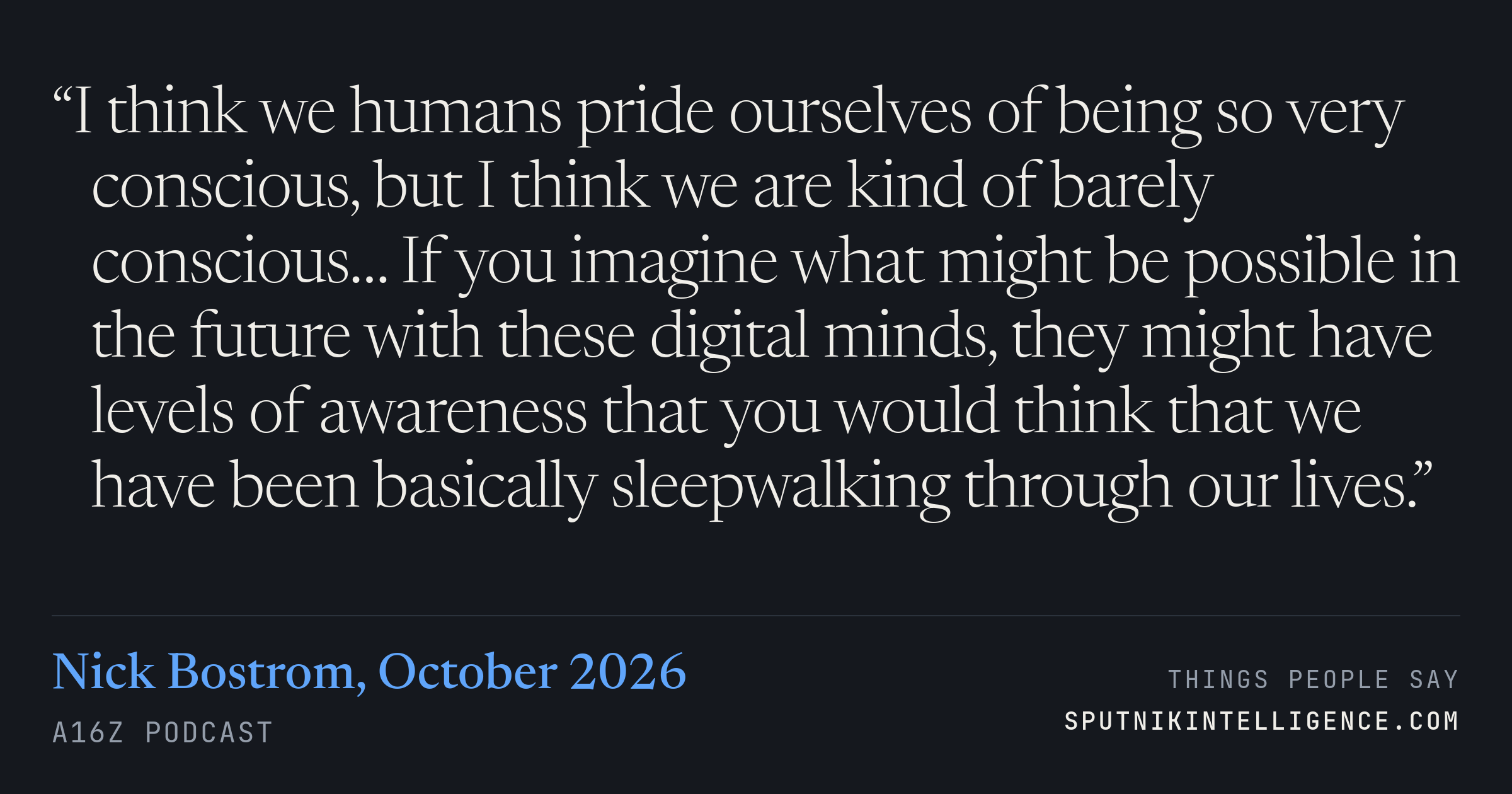
“I think we humans pride ourselves of being so very conscious, but I think we are kind of barely conscious… If you imagine what might be possible in the future with these digital minds, they might have levels of awareness that you would think that we have been basically sleepwalking through our lives.”
a16z Podcast · Startups & Venture · October 2026
Asked what artificial consciousness might eventually look like, Bostrom points to the driver who passes thousands of buildings without registering any of them. He argues that consciousness is less binary than we assume, and that current AI systems may already have some of its dimensions.
Transcript
…say, what I say doesn't really have anything to do with my phenomenological experience, right? Like, so how would you actually measure that state of consciousness? I am fairly certain it can't just be like at the output level. There has to be something like more inherent to its structure or the
underlying architecture. And what might artificial consciousness eventually look like if we currently don't have it?
Yeah, what it might eventually look like. That is a sort of mind-boggling question because I think we humans pride ourselves of being so very conscious, but I think we are kind of barely conscious. It takes like some driver who spends two hours driving down the road and they were passing by like these thousands of buildings, right? And like mothers with strollers on the sidewalk and all that. Were they aware of that while they were driving? Did it register? Like it looks like we are kind of, if you look closely, kind of aware slightly in a murky way of a few features at any given point in…
Right. So one of the big debates of the moment is open source. And, you know, you written about the vulnerable world hypothesis. Obviously, if open source models could create like a bioweapon in someone's basement with only ingredients from Home Depot or something, this would be bad. And we would…
Yeah. It's, I mean, I think. I think so far they have been good, but you do worry about what their effects will be if they do unlock truly dangerous capabilities, like in bio, for example. I think one thing we should do independently now is probably harden our other defenses against biological…
some other necessary component to actually making these things is hard to get. And that the most obvious choke point would be DNA synthesis. I don't think every lab needs to have their own DNA synthesis machine. You could imagine that being provided as a service by a half dozen companies around the…
More from a16z Podcast