SP

Sundar Pichai

Things Sundar Says on Podcasts

Where to Find Them

Sundar Pichai has been a guest on Decoder with Nilay Patel (7 times) , The Vergecast (3 times) , Closing Bell (2 times) , Hard Fork (NYT) (2 times) , How I Built This (Guy Raz) (2 times) , Pivot (Kara Swisher & Scott Galloway) (2 times) , HBR IdeaCast , All-In with Chamath, Jason, Sacks & Friedberg , Lex Fridman Podcast , Rowan's Notes , Cheeky Pint , Bloomberg Tech , Apple Bitz XL w/ Brian Tong , Squawk Pod , The Interview , Google AI: Release Notes , Big Boss Interview , View From The Top , Big Technology and The Circuit with Emily Chang .

Recently: “Google CEO Sundar Pichai: AI’s Infinite Possibilities, Compute Scarcity Dilemmas, Future AI Products” on Big Technology (October 2026); “Does Google even want to win in AI?” on Decoder with Nilay Patel (August 2026); “How Sundar Pichai is rethinking Google for the AI era” on Decoder with Nilay Patel (May 2026); “Our Field Trip to Google I/O + A Sit-Down With Sundar Pichai + System Update” on Hard Fork (NYT) (May 2026); “Sundar Pichai on Agents Replacing Engineers, Google's Future, AI's Flip Phone Moment, and More” on Rowan's Notes (May 2026); “The history and future of AI at Google, with Sundar Pichai” on Cheeky Pint (April 2026).

What They Said

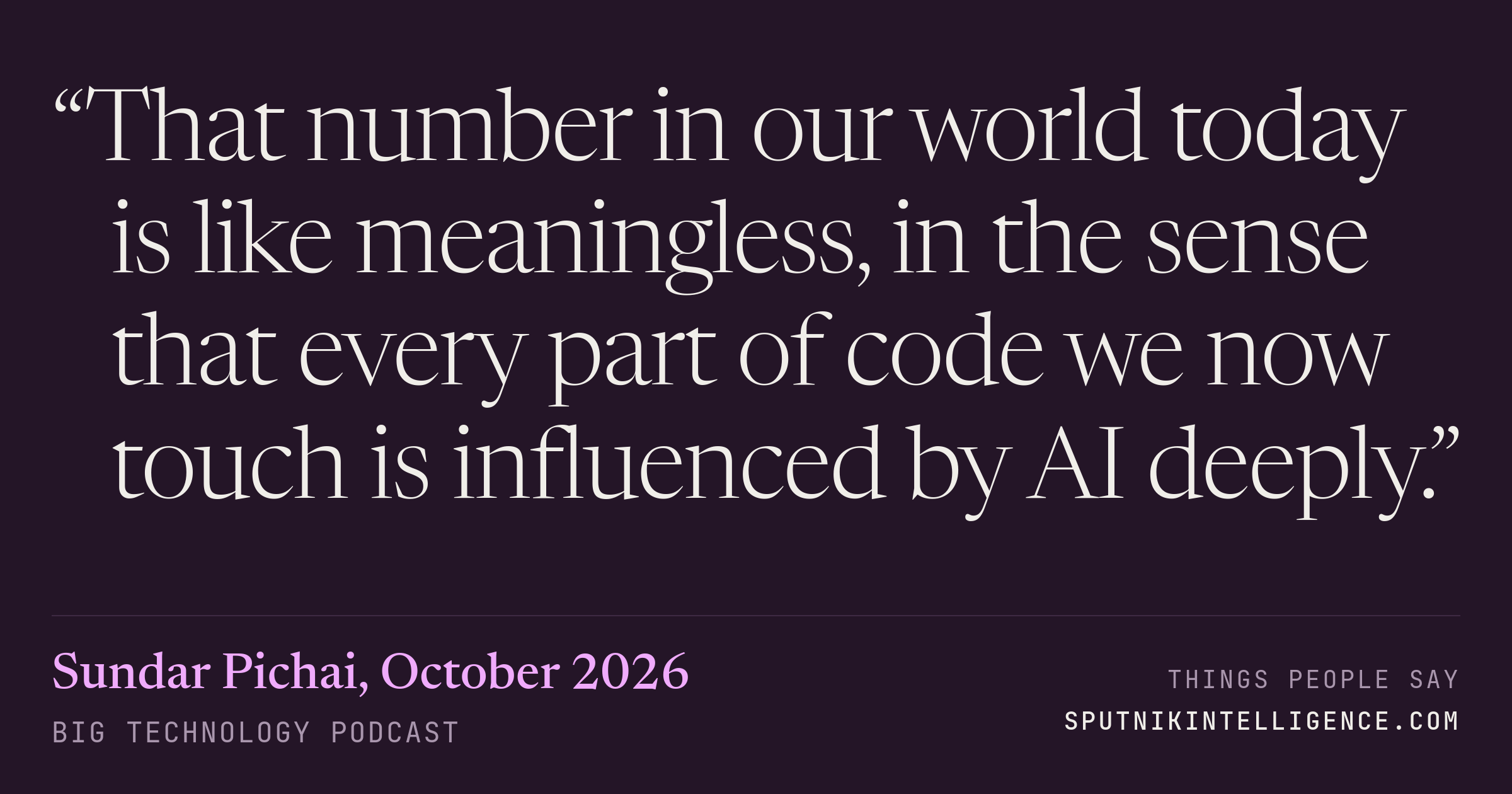
“That number in our world today is like meaningless, in the sense that every part of code we now touch is influenced by AI deeply.” — Sundar Pichai, Big Technology

Asked what share of Google's code is now written by AI (he had put it at 25% the year before), Pichai says the metric no longer means much. Google now tracks other numbers instead, such as more code changes and fewer rollbacks since launching its internal coding tool.

Big Technology · 2026-10-20 Permalink → Listen →
Big Technology Around 38:34 into the episode
Sundar Pichai

…is a challenging project. The team has disciplined milestones, and so it was a super exciting milestone to send the TPUs up to space. And sometime as we are speaking, we are expecting a hello world moment from them. And so I look forward to seeing that happen. And we'll continue investing here too.

Alex Kantrowitz

You recently, was it maybe last year you said that 25% of code written within Google was written by AI? What's the number today?

Sundar Pichai

I mean, we have far, I think we've almost, that number in our world today is like meaningless in the sense that every part of code we now touch is influenced by AI deeply. What's now what we are tracking with Argon, for example, we are now able to see. It's been a point of inflection. People are using Argon to really go tackle complex projects, right? And including projects which affects millions of lines of code. So we have definitely, in the four weeks since we've launched Orgon, we have seen a 30% increase in CLs and more importantly, almost a similar increase, one-third decrease in rollbacks, right? And so I think people are writing code more productively and better code with it, code with it. So I think we are tracking it with newer metrics now.

Alex Kantrowitz

Talking about the opposition to data centers and how do you feel that? And if you can't build data centers in the US the way that you want to, where else do you go?

Sundar Pichai

We're very committed to. Building our data centers very responsibly. I think when I look at our largest data centers in some of the communities where we have been the longest, I visit them, I talk to people, there are people who would come and tell us their kids have gone to college because of our…

Alex Kantrowitz

have been surprised by data centers showing up in their backyard.
Speaker names from our own diarization · position estimated from where the line sits in the episode
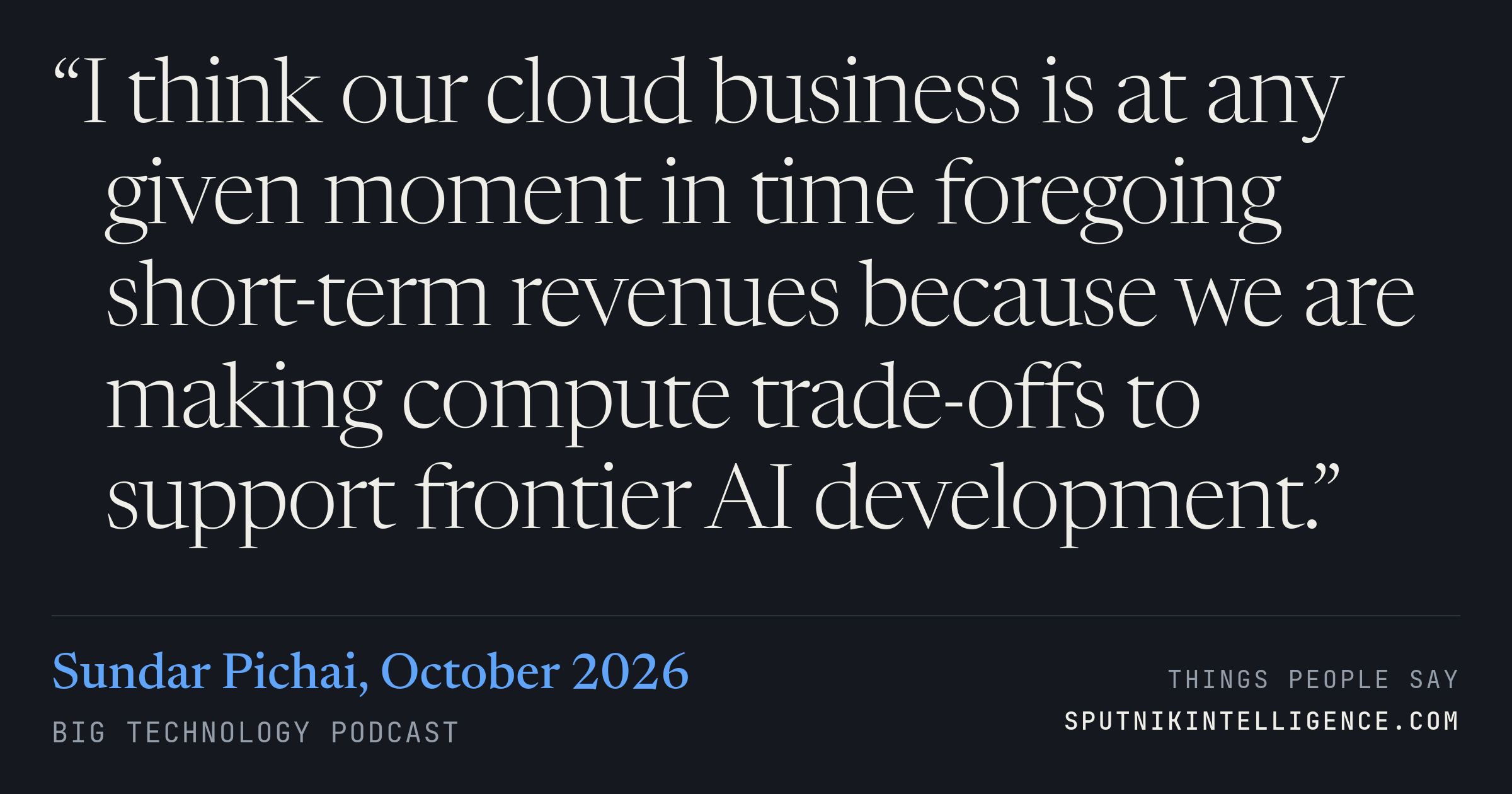
“I think our cloud business is at any given moment in time foregoing short-term revenues because we are making compute trade-offs to support frontier AI development.” — Sundar Pichai, Big Technology

Alex Kantrowitz asked whether, if AI is as profound as he claims, Google should give its researchers the biggest possible computer even at the expense of cloud profits. Pichai says that trade-off is already happening, while adding that constraints also push researchers toward more efficient breakthroughs.

Big Technology · 2026-10-20 Permalink → Listen →
Big Technology Around 20:20 into the episode
Sundar Pichai

…cause bottlenecks. And then you could have O-builds. There could be external shocks to the economy, et cetera. So there are macro risks, all that is possible at any given time. But am I confident that the compute we are planning for, we will have uses for it given enough time? Absolutely, yes.

Alex Kantrowitz

…And we all laughed at the time. And I kind of regret that laugh now. But if you're someone that actually believes that, then the thinking would be you give the researchers the biggest possible computer, even if it is to the detriment of today's profits, like the cloud business. Your thoughts.

Sundar Pichai

We're all doing some form of that, right? I think our cloud business is at any given moment in time foregoing short-term revenues because we are making compute trade-offs to support frontier AI development. So I think what you're saying is true already, right? But you want to be thoughtful, right? Even our AI researchers, constraints are also good. That's what inspires creativity. That's what helps you come with a more efficient algorithmic breakthrough, maybe to use less memory, et cetera. So what we are committed is to invest what's needed to stay at the frontier. That's how I think about it.

Alex Kantrowitz

I wonder what you think the future of the interface looks like, the way that we use computing in the future as AI Products to roll out. I was speaking with Greg Brockman, the president of OpenAI, about this a couple months ago. He had a very interesting quote. He said, what is the interface that…

Sundar Pichai

The way I think about it is I do feel computing historically has been humans adapting to computing. With AI, it'll be the other way about. The technology will adapt seamlessly to how humans live and go about their day-to-day lives. So there's an aspect of it. You want that AI to be able to speak to…

Alex Kantrowitz

Yeah, I'm just going to play the OpenAI hits. Because, you know, last year you sent them into a code read. Yeah. I'm sure you know. Gemini was doing very well and OpenAI battened down the hatches. And I was speaking with Sam Altman about the challenge from Google. What he said was he thought OpenAI…

Speaker names from our own diarization · position estimated from where the line sits in the episode

Collections They Appear In