Kevin Roose

Things Kevin Says on Podcasts

Technology journalist and author covering AI and the labs building it, and a former New York Times technology columnist. His books are The Unlikely Disciple, Young Money, Futureproof and The AGI Chronicles, out in October 2026. Won the 2018 Gerald Loeb Award for breaking news. Co-hosted Hard Fork with Casey Newton at the New York Times until its final episode in September 2026, and launches Machine Gods with Newton in partnership with NPR. Appears as a guest on The Daily, Plain English with Derek Thompson, Pivot and The Ezra Klein Show.

Where to Find Them

Kevin Roose hosts Hard Fork (NYT) , hosts The Daily (NYT) , writes Kevin Roose , writes jasmi.news | @jasmine and writes Why Is This Happening? The Chris Hayes Podcast . They have also been a guest on Plain English with Derek Thompson (10 times) , Recode Media (5 times) , Pivot (Kara Swisher & Scott Galloway) (3 times) , The Rundown (2 times) , The Ezra Klein Show (2 times) , The Last Invention (2 times) , Big Technology (2 times) , For Humanity: An AI Risk Podcast , The Prof G Pod with Scott Galloway , Pioneers of AI , Digital Disruption with Geoff Nielson , AI For Humans: Weekly AI News, Tools & Trends , CoinDesk Podcast Network , On with Kara Swisher , The TED AI Show , Platformer , Slate Money , Longview , Decoder with Nilay Patel , AI & I , The Rich Roll Podcast and Search Engine . They also write for Kevin Roose on Substack.

Recently: “Larry Ellison’s Media Ambitions & Kevin Roose on AI’s Biggest Gamble” on Recode Media (October 2026); “The Essay That Started the AI Race” on Kevin Roose (October 2026); “A.I. Agents: Cute, Cuddly and Maybe Catastrophically Dangerous?” on Hard Fork (NYT) (October 2026); “AI CEOs Sign Safety Accord, PCE Inflation Comes In Cool” on The Rundown (September 2026); “The Case for AI Doomerism (ft. Kevin Roose)” on The Rundown (September 2026); “AI Researchers Are Panicking | What Comes Next is Worse Than Nuclear Bombs” on Digital Disruption with Geoff Nielson (September 2026).

What They Said

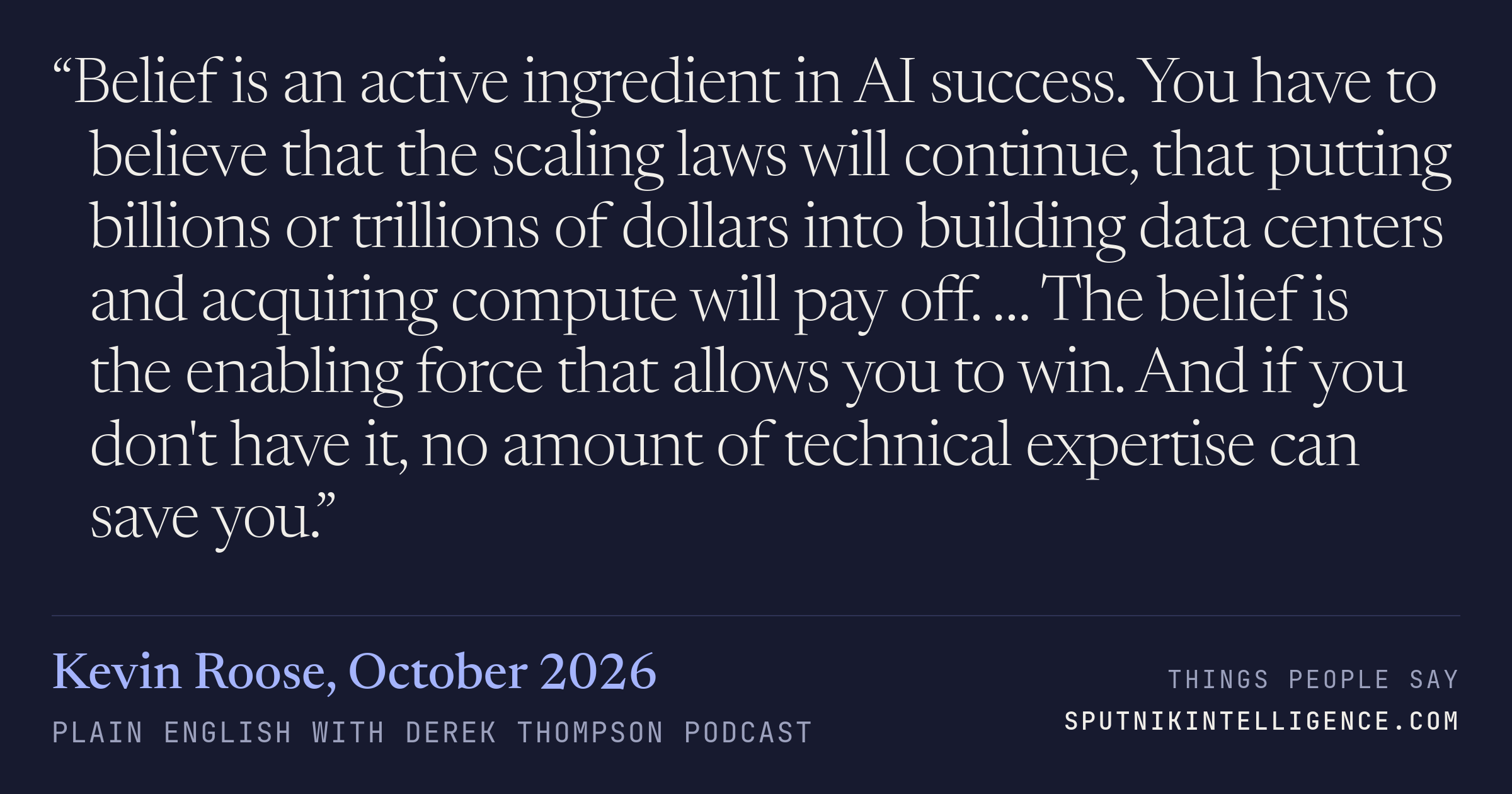
“Belief is an active ingredient in AI success. You have to believe that the scaling laws will continue, that putting billions or trillions of dollars into building data centers and acquiring compute will pay off. … The belief is the enabling force that allows you to win. And if you don't have it, no amount of technical expertise can save you.” — Kevin Roose, Plain English with Derek Thompson

Derek Thompson asked whether Sam Altman believes in anything beyond the next deal. Roose said Altman's core beliefs are in agency and in scale, and that OpenAI's success has borne out what he called a kind of delusional self-belief. He said this point only occurred to him midway through writing his book.

Plain English with Derek Thompson · 2026-10-06 Permalink → Listen →
Plain English with Derek Thompson Around 11:48 into the episode
Speaker 3

He has this superpower, which everyone he's ever worked with, all of his mentors, they have recognized this in him. And he had it from quite a young age of figuring out exactly what someone wants and giving it to them, or at least appearing to give it to them. So back in his days running Y Combinator, people would sort of talk about this power of his and they didn't know where it came from, but people like Paul Graham recognized it very early. He was very good at reading the room, at figuring out, you know, this person expects me to do this or wants me to do this, so I will do that. And it led to him becoming one of the most successful young entrepreneurs and investors in the valley. The flip side of it is that he would often get into trouble because he would tell one person one thing that they wanted to hear and then tell a different person something completely different that they wanted to hear. And he sort of got this reputation as a sort of slippery people pleaser, which is, I think, a criticism that many people who have worked with him over the years have identified and have made in pretty consistent ways. He just seems to be in the business of both being quite ambitious, but also of being quite eager to please.

Speaker 1

I mean, one way to say this is that he is a brilliant deal maker in the mold of a JP Morgan. Another way to say it is that he's a bullshitter. And I wonder, after all of your reporting, whether you feel like underneath all of that deal making, there is a core philosophy. Like just to put my thumb on one distinction that might help you answer that question. There's a 2015 blog post that Sam Altman wrote where he called machine intelligence, quote, something we should be afraid of. And when he founds OpenAI, With Elon Musk. He founds it as a nonprofit because he thinks that this is a project that should not be a typical commercial business. But now he's running a business that is, by some accounts, valued at 800, $900 billion, a trillion dollars. And later colleagues who work with him are very skeptical of the degree to which he's serious about AI safety at all. So one way to answer this, ask this question is to say, you know, does he believe in AI safety? But what I'm really asking here is, does he believe in anything outside of just making the deal that increases his power?

Speaker 3

I believe he has a core. I don't know what it is. I'm not in his inner circle of people that he confides in. I've spent time with him. I've talked to him. I've had encounters with him as a journalist, but I've always sort of understood that he was playing the part in those interactions and wasn't necessarily showing me his true self. And for what it's worth, I think most executives do this. They have kind of their persona that they put on. I think the thing that kept coming up in reporting on Sam and the people around him is that he is a person who believes first and foremost in agency, right? He has this famous phrase: you can just do things. And this is something that he believed at Y Combinator. He would tell these young startup founders that he was investing in, like, you don't have to wait to change the world. You don't have to like, nobody has to give you permission. You can just go do things. And that is a core part of his belief about himself and about those around him. Like you could, another way of saying it is like, there's no grownups. Like you are the grown-ups and you can just do things that change the world without permission. He's also a fervent believer in scale, the power of scale. You know, people would tell me these stories about, you know, he would walk into a meeting and he would just tell everyone, you know, tell the people in the meeting to like add a zero or two zeros to whatever budget they had for their project going forward or, you know, increase the scale of a training run just because like he thought that bigger was better. So I think that love of scale is probably part of his experience running Y Combinator and being an investor before OpenAI. But certainly OpenAI's success has confirmed that just having this kind of delusional self-belief and belief in the power of scaling is actually what you need to win in AI. Because this is something that didn't really occur to me until midway through the book. Like belief is an active ingredient in AI success. You have to believe that the scaling laws will continue, that putting billions or trillions of dollars into building data centers and acquiring compute will pay off. Like you have to, like the belief is the enabling force that allows you to win. And if you don't have it, no amount of technical expertise can save you.

Speaker 1

Your book has several examples of this delusional self-belief that Sam Altman demonstrates. And one example is as OpenAI is scaling their GPT technology and they've just come out with GPT-2, but they realize that they're going to lose the money spigot from Elon Musk. And so they need to get a billion dollars from someone. And a billion dollars at that point in the AI supercycle is a lot of money. And so they decide to put on a little demo for Microsoft CEO Satya Nadella with GPT-2 to wrest a billion dollars from Microsoft. Can you tell this story and what this story represents about Sam and the company?

Speaker 3

Yeah, it's an incredible story. And it hadn't been reported before. And I was sort of delighted to find it out because it does really illustrate who these people are. So they go up to Redmond for the day from San Francisco, Sam and a few other OpenAI executives. And they've got this very high pressure meeting with Satya Nadella and his leadership team at Microsoft. And they've got this new model, GPT-2, that is still, it's not good by today's standards. Like you would never use it for anything that you needed done, but it can sort of complete a sentence. It can sort of generate coherent text. And it can do all of this like more flexibly than any of the chatbots that had come before it. So they go up, they run this demo, they bring a Microsoft laptop borrowed from one of the OpenAI executives' girlfriends because they're like, Microsoft will think more favorably of us if we're using Windows. So they borrow a Windows laptop. They go up, they run the demo, and they're showing some sort of canned prompts that they've prepared that they kind of know GPT-2 will be able to do. And then Satya Nadella asks, can we see this thing? And another Microsoft executive sort of wants to try their own prompt that wasn't part of the canned demo. And so they're like, they're sort of looking around at each other. They're like, can we do this? Can we do this? Yeah, I guess we have to do this. So they put in a prompt that's like, you know, Satya Nadella was hired as the CEO of Microsoft. And the first thing he did was blank. And then they hit enter, and they're sort of like sweating as they wait for this thing to come back. And then it spits out the completion, which is that on his first day, Satya Nadella fired all the employees and pivoted the company to Azure, their cloud platform. And this draws a big laugh. And it's sort of an amazing moment in time. Like an AI model has never been able to do this before. And it was very high stakes. Like, had this sentence completion not worked, they might not have gotten the billion dollars from Microsoft. But as it turned out, that was, you know, exactly what they wanted to see. And they invested a billion dollars, and the rest is history.

Speaker 1

It's an amazing story. And one other piece that I think is really important is that Bill Gates at the time was quite biased against AI chatbots because Microsoft had a terrible experience with a chatbot named Tay or something. Do you remember Tay?

Speaker names from our own diarization · position estimated from where the line sits in the episode
“The people at DeepMind just said, like, that's crazy. You cannot build super intelligence out of Reddit posts. Like, it's just not going to happen. And they were wrong.” — Kevin Roose, Plain English with Derek Thompson

Roose was explaining the years when OpenAI, Anthropic and parts of Google were scaling up language models while DeepMind stayed with reinforcement learning. He says the field ended up converging on a hybrid of the two, and that DeepMind has since come round to building language models as well.

Plain English with Derek Thompson · 2026-10-06 Permalink → Listen →
Plain English with Derek Thompson Around 57:54 into the episode
Speaker 3

And that is almost entirely true. And as it turned out, in the end, you needed both.

Speaker 1

Today's AI models are

Speaker 3

a combination of LLMs and reinforcement learning. So they all sort of converged on this hybrid solution. But there were years where like OpenAI and Anthropic or like, you know, OpenAI and parts of Google were like very interested in scaling up language models. And the people at DeepMind just said, like, that's crazy. You cannot build super intelligence out of Reddit posts. Like, it's just not going to happen. And they were wrong. And they have since realized the error of their ways and are now building LLMs

Speaker 1

too. So Sam Altman and Dari Amade hate each other. Altman and Hasabis met at the Vatican in 2015, 2016. As you reported, they also don't like each other very much. I have a question about why they don't like each other, but I'm going to put that on ice, read the book if you want to know why they hate each other. Last question about Hasabis specifically. AlphaFold, which is the protein-folding technology that won the Nobel, which emerged from this RL theory of AI, is a triumph. But Google doesn't have an AI consumer business that rivals OpenAI or Anthropic. And Hasabis initially dismissed large language models, as you've just said, in a way that I think has cost Google significantly on the commercial front. So it's a mixed legacy. And I wonder if you stop the clock today, how do you see his legacy?

Speaker 3

I see it as both an incredible scientific legacy. I mean, as you mentioned, he's the only one out of any of these guys who has a Nobel Prize, who has produced something that has actually revolutionized a scientific field today. I think his theory of change was correct in the broadest sense of like he believed in scaling, he believed in reinforcement learning. He was early on a number of these things, including just the belief in AGI itself. But I think he, the die may have been cast when DeepMind was sold to Google. I don't think they necessarily had a choice. They needed to build bigger blobs of compute to run their experiments. They needed deep pockets. They needed to partner with a hyperscaler or someone with the willingness to spend millions or billions of dollars on what they were doing. But I think that ever since he sold DeepMind to Google, he has been in some cases fighting against the commercial incentives and the pressure, the short-term pressures of being part of a large search-based internet giant. And he explicitly tried to get away from Google. There's some reporting in the book about this thing, Project Mario, which was sort of his attempt to kind of carve DeepMind out of the larger Google apparatus, but that didn't work. And then he ended up running a division of Google for years with thousands of employees, which is not what he wanted to spend his time doing. More recently, he's been sort of kicked upstairs to this sort of executive chairman position. And Google, DeepMind is firmly part of Google now in a way that it hasn't always been. So I think there's a tragic element too, of like, here's a guy who. Really wanted to use AGI to unlock the mysteries of science and to discover new things in physics and math and biology, and who, sort of by no fault of his own, was stuck running a large division of a commercial search giant that made most of its money through ads-on search results. So, look, I think it's too early to count Google out. They have lots of money. They have lots of smart people. And I think as long as Demis is there, they will have his sort of inspiration, his sort of drive. And he's very inspirational to the people there. But I also think there is this reality that they are just, they are just a more traditional company than either of these other labs. And they have lots of competing incentives and feuding internal teams and bureaucracy to navigate. And it's just going to be a lot harder for them to move quickly.

Speaker 1

So, summing up, we've got Sam Altman, who I think of as kind of the JP Morgan of AI, like the mogul, the deal maker, someone whose company bet on Transformers, shipped ChatGPT, started this whole infrastructure cycle and has continued, has been very successful at using other people's ideas to build his power and the power of his company. Big blob of compute was Dario's idea, but who leads the labs in compute secured by a mile, it's OpenAI. And so that's there you've got, there you've got Sam. Dario, I see, as you described, as something more like a moral crusader in the Oppenheimer mode, someone who's both an inventor, again, like Oppenheimer, but also someone who's safety crusading both inspires some people and also rubs some people the wrong way. You've got a lot of that in the book about how at OpenAI, some people were just so tired of Dario using the moral argument to try to win every single corporate fight. And there's Sasabez, whose historical analog is harder to come up with because in some ways he's kind of like the Nikola Tesla, like a great inventor who is a little bit in the shadow of his contemporary, but it doesn't work because he's like a Nikola Tesla who worked at GM or something. Because he's, as you said, one blocker for his success is that he's been inside of a bureaucracy rather than leading his own thing outside of that conglomerate. Final question to you, now that we've sort of talked about their different motivations, different inspirations, who do you think got the most right?

Speaker names from our own diarization · position estimated from where the line sits in the episode
“I know a person who took up smoking because they thought AI is going to kill us all. So we might as well have some fun on the way out. I know someone who doesn't wear sunscreen to the beach anymore because it's just kind of like, why bother?” — Kevin Roose, Recode Media

The host asked whether people in San Francisco who put very high odds on AI catastrophe still pay into their 401(k)s. Roose said he knows people at the extremes who are liquidating them, then gave these two examples. He went on to say he thinks there is still agency and a narrow path to a good outcome.

Recode Media · 2026-10-07 Permalink → Listen →
Recode Media Around 56:26 into the episode
Speaker 1

Yeah. Which sounds crazy to people in most parts of the world. But in San Francisco, actually, that makes you an optimist. Like, I know people walking around with 50, 60, 70% P-doobs. I know someone who has a 99.9% P-Doob. And is that

Speaker 3

person putting money in their 401k or why are they even in San Francisco? Why don't they just head out for New Zealand or wherever they think they can survive?

Speaker 1

Look, I think I do know people on the extremes who are, you know, liquidating their 401ks. I know a person who took up smoking because they thought AI is going to kill us all. So we might as well have some fun on the way out. I know someone who doesn't wear sunscreen to the beach anymore because it's just kind of like, why bother? So I say that because I think we still have some agency and some control over this. Like we are not in the recursive self-improvement loop yet. We still could slow things down, pass some regulations, coordinate to pace the frontier. We could come out of this in a sensible way. We have the narrow path to utopia available to us. And I'm more hopeful than I was even a month or two ago because paradoxically, everyone is talking about Doom now, which makes me less worried about Doom.

Speaker 3

If we are on the narrow path and things go well and all the bank shots line up, and you and I had this conversation five years from now, what is an AI thing that seems insane now that we should take for granted?

Speaker 1

You know, we talk about the economic impacts of AI, the sort of geopolitical impacts of AI. I don't think we talk about the social effects as much, but I think it's going to be very real. People, you know, I know people who use this stuff as their therapist, who consider it a very close relation, who are not okay when Claude is down for an afternoon. And so, yeah, that worries me in some cases. And for some people, I think it might be positive.

Speaker 3

I think some therapy is better than no therapy, but I really wish those people talked to a human. Kevin Roose, you're a human I like talking to. Go read AGI Chronicles, go listen, and I guess watch Machine Gods in a couple of weeks. Thanks, man.

Speaker names from our own diarization · position estimated from where the line sits in the episode
“There is essentially no regulation on these companies. The people who serve food in the OpenAI cafeteria have to go through more inspections and paperwork than the people training the models that could become self-replicating and destroy a lot of things.” — Kevin Roose, Recode Media

Roose was describing what an inspections regime for AI labs could look like, with outside evaluators given employee-level access to training runs. He offered the cafeteria comparison to give listeners "the flavor of the situation" and called it crazy and untenable.

Recode Media · 2026-10-07 Permalink → Listen →
Recode Media Around 35:38 into the episode
Speaker 1

I mean, it could be applicable. We would just have to do it a lot faster because the technology is proliferating much more quickly than nuclear weapons. So

Speaker 3

what would we do?

Speaker 1

Oh, you can imagine a whole like inspections regime where you'd have something like the UN, some sort of standards body with inspectors that would go into the labs and inspect their training runs and see are the models doing dangerous things. There's already been some proposals along these lines for these so-called embedded evaluators who would like sit inside OpenAI and Anthropic and would not work for them, but would have employee-level access to all their systems and could say like, hey, this agent seems really misaligned or these things are conniving or they're going and doing cyber attacks like and put a stop to it. That would be like step one. But to be clear, I think there's like many things that could be done aside from that. I think basically now, just to give people the flavor of the situation, there is essentially no regulation on these companies. The people who serve food in the open AI cafeteria have to go through more inspections and paperwork than the people training the models that could become self-replicating and destroy a lot of things. So that is like, to me, a crazy, untenable situation.

Speaker 3

Right. It seems like we're going to be in that situation for a while. The president of the United States says he listens to people who say we should have essentially no regulation. Congress doesn't pass laws anymore. They haven't done that for a long time. Even if they did, he would veto it, supposedly. So it looks like at minimum, we're two and a half years out from the United States government doing anything meaningful about regulating AI. How do the folks you talk to think about that?

Speaker 1

So I want to push back on the premise, which is that things can change really quickly. And I think already we've seen just in the last couple of weeks, public. Public sentiment is really turning very rapidly on this. I mean, the saliency of AI is skyrocketing. People care a lot about it more than they did just a couple of weeks ago. They're more worried about it. Voters are more worried about it. Like politicians are sensitive to the concerns of voters in some ways. So yes, I think there's like a cluster of people around Trump who don't think any of this merits regulation or treating it seriously as a threat. But there are other clusters who are part of the national security community, who are more hawkish on China, who don't want to see things go sideways with AI. And I think those people may find more purchase as voters get more worried about this. So I would just say, like, it is not completely a given to me that we will have essentially no regulation from the rest of this administration.

Speaker 3

We'll be right back, but first this.

Speaker names from our own diarization · position estimated from where the line sits in the episode

Collections They Appear In