 Kevin Roose
Technology journalist and author covering AI and the labs building it, and a former New York Times technology columnist.
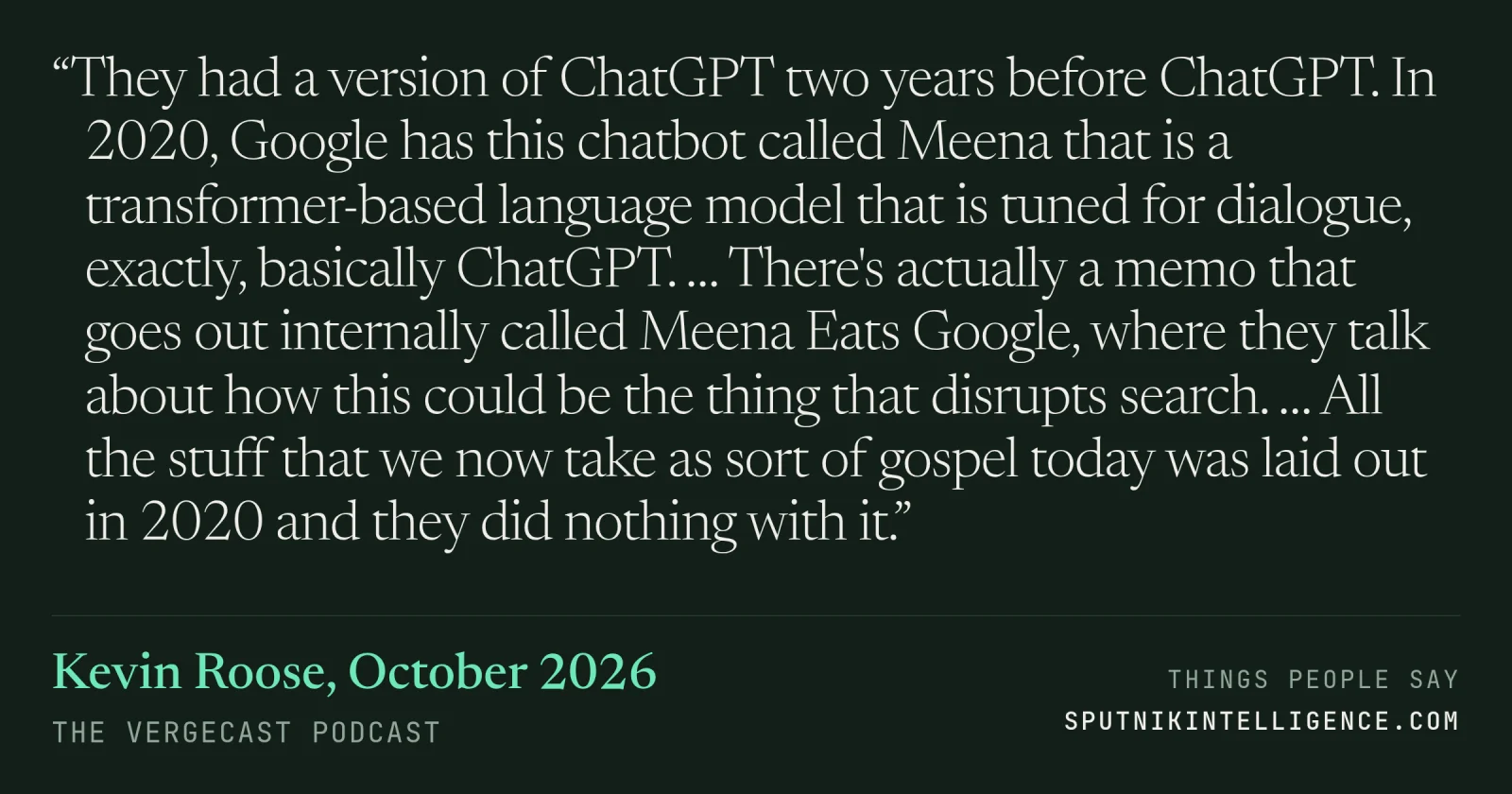
“They had a version of ChatGPT two years before ChatGPT. In 2020, Google has this chatbot called Meena that is a transformer-based language model that is tuned for dialogue, exactly, basically ChatGPT. … There's actually a memo that goes out internally called Meena Eats Google, where they talk about how this could be the thing that disrupts search. … All the stuff that we now take as sort of gospel today was laid out in 2020 and they did nothing with it.”
The Vergecast · Tech Strategy & Big Tech · October 2026
Context
Roose, discussing his book on the early AI race, was explaining why Google fell behind despite inventing the Transformer. As it was described to him, every group inside Google had a reason the chatbot couldn't ship: search worried about ads, translation about its own products, others about bias and hallucinations.
Transcript
…to turn this into more powerful language models than we have using other systems. And they really start sort of locking down. They don't share a ton of their technical research after that into these Transformer models. And I think that is what I would consider like the beginning of the actual race.
…opportunity and could have been very far ahead. But then also, Google was that same company at that same time. So was Google the potential boogeyman that it was made out to be at the time? Like all of the structural stuff that got in its way was there and real and did very much get in its way.
…higher on every test that they give it than Google's assistant. And there are people at Google who are like, this is great. We have to ship this. There's actually a memo that goes out internally called Mina Eats Google, where they talk about how this could be the thing that disrupts search because it can just give you the answer rather than making you wade through a bunch of websites. Like all the stuff that we now take as sort of gospel today was laid out in 2020 and they did nothing with it. They didn't ship it. They didn't even put out a prototype. They sat on it because every organization, as it was described to me, every group within Google had a reason that it couldn't go out. So the search people were like, this is going to cannibalize our ad business. The translate people are like, wait a minute, we sell things that can translate languages. People are worried about bias and…
Support for the show comes from Framer. Picture this. You launch a website and your whole team's celebrating. Then the support tickets
start to roll in and damper the mood. That's when you could use a website platform that lets teams build, ship, and improve their sites faster than ever while getting every detail right. For that, you could use Framer. It's a complete website platform, not just a builder, so teams can launch and…
speed and scale while people bring taste, judgment, and control. And that all takes place in the same workspace where the real site is designed, managed, reviewed, and published. Framer is an enterprise-level solution that the world's leading brands like Perplexity and Miro rely on to build their…
More from The Vergecast