 Kevin Roose
Technology journalist and author covering AI and the labs building it, and a former New York Times technology columnist.
Kevin Roose
Technology journalist and author covering AI and the labs building it, and a former New York Times technology columnist.
“The thing that actually differentiates the AI labs and the companies that are winning versus the ones that aren't is not a matter of who has the most money or GPUs or even research talent. It's: do you believe or not? Because only by believing and then only by selling that belief to others can you amass the resources and the focus to get to AGI.”
ChinaTalk · Geopolitics & World Affairs · October 2026
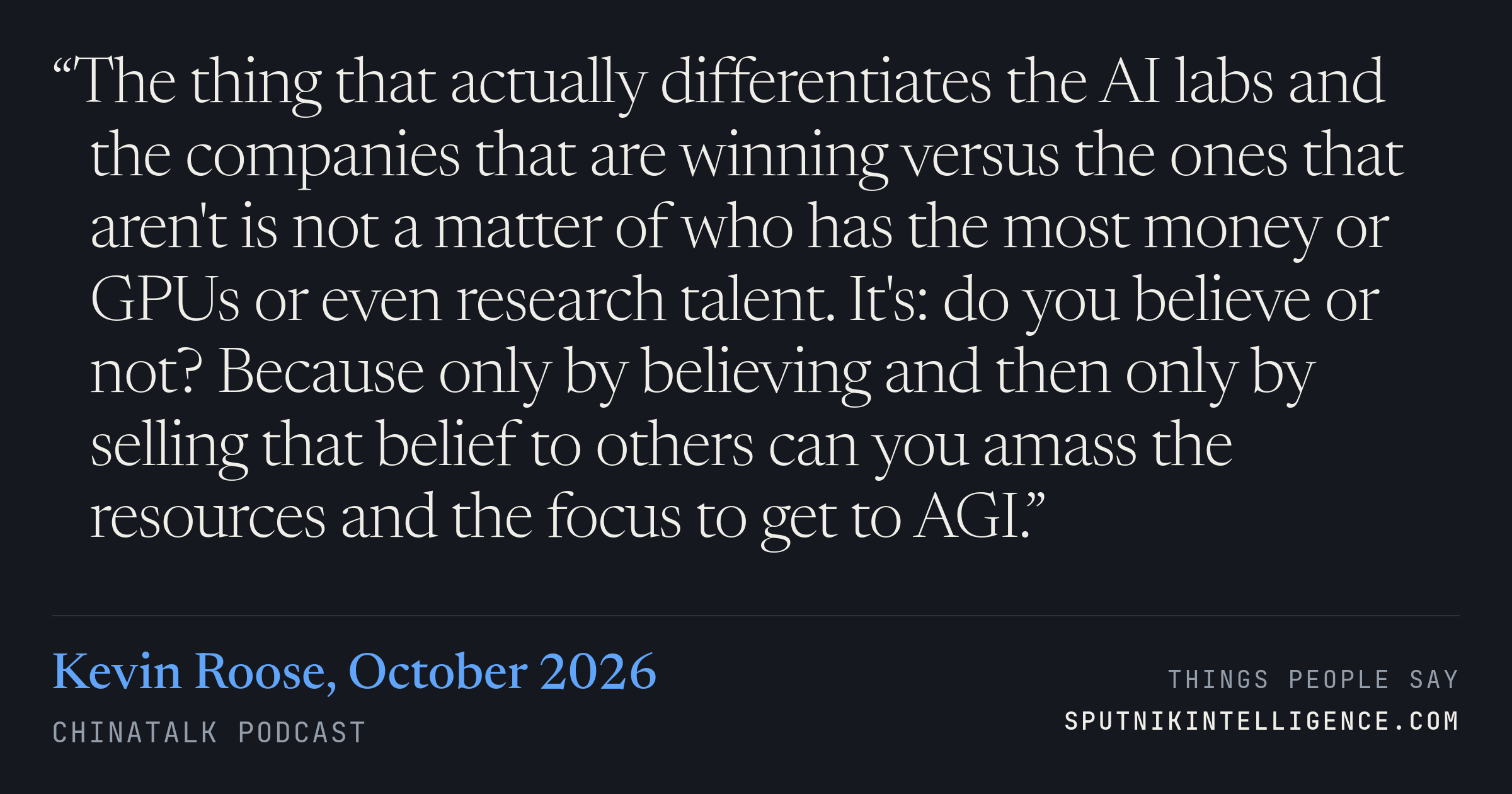
Roose is describing what he realized midway through reporting his book on the AGI race: that it was a book about belief rather than technology. His counterexample is Google, which invented much of the modern AI stack and, in his telling, had every piece except the belief.
Transcript
Yeah, I buy that. There's a little flavor of kind of dog who caught the car to it. It's like these people are so used to, because, you know, it's important to remember when these people started talking and writing and going to conferences about AGI in like the early to mid 2010s, like this was a crazy thing to believe. It was kind of disqualifying to believe if you were like part of an academic research institution. It was like, you know, showing up to your department meeting and saying, like, I'm really into astrology this week, guys. It was like that. It had that effect on your credibility. And so as a result, like, I think these people just were unusually persistent and immune to social pressure on this point. Like their conviction had to be so strong that it could overcome people that they respected telling them, like, this is crazy. It's never going to work. You know, there's this scene in the book where Bill Gates is coming to open AI and it's the early days of the language modeling thing. And he basically scoffs at it. He says, you know, this isn't going to work. You guys need to stop building language models and start doing more neurosymbolic AI. It's like, I'm sure for the researchers there, that was like an incredibly deflating thing to have like this icon of computer science tell you that you're on the wrong path. But they like, they stuck with it. And now they're kind of in this dog that caught the car position of like, well, what do we do now that people actually believe us?
Yeah, you have this great arc of like Alec Rashford as the soccer player. Alec Rosh Rashford, who, you know, is 23 years old. Like all these guys are brilliant, but he's just like doing things and it keeps not working. And then he's depressed and he's like, should I even do this? He shows it to Elon. Elon's like, your work is crap. Why are you wasting my time? And that's, that's rough, but they stick with it. And I think there's like a, there's an aspect of, okay, so we have communism. Now we're doing California. This, you know, to believe as deeply in this like, I think it's fair to say, like ideology or science, which, you know, felt much more like an ideology 15 or 20 years ago than it is today. You have to be like just really odd and really, and like having the courage of your convictions in a way that, I don't know, speaks to the Bay Area in some like mystical way. It's like there's something that lets you be this weird for this long, where nowhere else in the world can kind of allow, set you up for, for, you know, continuing down that path.
Well, totally. And I think you're, you're right to put your finger on the role that belief plays in this story, because something that I realized kind of midway into the reporting process is like, this was not a book about technology. It's about this belief. And the thing that actually differentiates the kind of AI labs and the companies that are winning versus the ones that aren't is not a matter of who has the most money or GPUs or even like research talent. It's like, do you believe or not? Because only by believing and then only by selling that belief to others can you amass the resources and the focus to get to AGI. And there's this like interesting subthread about what happened to Google, which is the inventor of most of the modern AI stack. They come up with the Transformer, they come up with Mesh TensorFlow, like all these things that just become very important pieces of the puzzle. And then they just lose it. Like they don't believe. And there's these famous like memo battles inside Google where like one person writes a memo called like, we should say AGI more. And then another person writes a memo being like, we should never say AGI. Like that's a terrible word. And so they just, they don't, they have all the pieces except for the belief. And it doesn't work for them.
I also think about China and people talk about, like, you know, what does, you know, can China innovate? Of course they can innovate. Can China build companies? Of course they can build companies. But does China have the sort of scientific intellectual ecosystem to allow something as weird as thinking, you know, AGI was a thing in 2015 and then be able to sort of seed enough money to kind of do the proof of concept? No. American exceptionalism has had a pretty rough decade, but there is something that did seem like very deeply Californian and very deeply American about these like weirdos just being able to keep at it for long enough to finally end up, you know, striking reality. Totally.
I thought about that a lot and like the sort of overcoming resistance piece of it, because there just weren't many success signals for a long time. Like if you were a person who believed in AGI in like 2010 or 2012, like there just weren't a lot of incremental things happening that you could point to and be like, okay, now we are closer to achieving the goal. Like it really was a kind of mini AI winter. And I think about this a lot in terms of Demis and DeepMind, because unlike the other labs, they were not in California. They're in London. We're like, it's even crazier to believe in this stuff. And you have even more like respectable academics telling you that you're full of shit. And you kind of have to keep going anyway. And so I think for them, it was like even harder to overcome the voices of skepticism.
Yeah. And where does the belief come from? Right. I mean, I asked ChatGPT to tell me how many sci-fi books you cited over the course of your, over the course of this narrative. We have the Foundation series. We have 1984. We have Ender's Game. I mean, you know, Ian Banks wasn't something that you shouted out, but in the Malcolm Zero. Arthur C. Clerk. I mean, Arthur C. It's like, like that is, that was the, that was the scripture, right? That was the training data. And people are citing it as like, this is the future we're working towards. And even if, yeah, like the numbers aren't necessarily going up in 2009, 2010, 2011, like, like, like, it's such a compelling narrative and vision. And it's such a compelling thing as a nerd to get to think that you are going to be Leo Slizard or, you know, Oppenheimer or, you know, the player of games that like you're just working towards that. And like, that's, and that's enough.
More from ChinaTalk