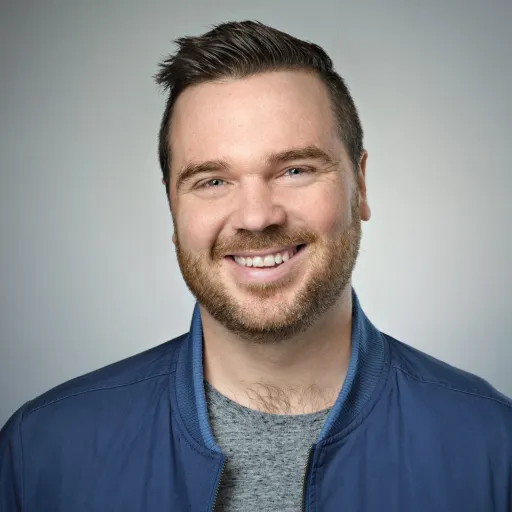
 Kevin Roose
Technology journalist and author covering AI and the labs building it, and a former New York Times technology columnist.
“We require pharmaceutical companies to test their drugs before selling them to the public. We should require AI companies to test their models before offering them to the public.”
AI & I · AI Builders · November 2026
Context
Asked what has to happen for AI regulation to work, Roose says federal action is unlikely until something bad happens. He proposes an industry certification program as the first step: safety testing for things like autonomous cyberattacks and novel bioweapons before a model is deployed.
Transcript
…we can do it. We have navigated hard challenges in our history. This is maybe one of the hardest, but I think we can do it. And I don't think anything is set in stone or predestined. And I think the choices that we make right now matter a lot in terms of how the next few years or few decades go.
…to be some level of regulation after something went wrong. And, you know, we're there, right? A few things have gone wrong. We've had the Hugging Face incident and a number of other cybersecurity concerns. How do you see this going right, right? Like what needs to happen for us to course correct?
…some kind of industry standard, right? Some kind of certification program where, in order to release your model or in order to deploy your model to the public, you have to kind of subject it to some standard safety testing to make sure it's not going to go out there and do autonomous cyber attacks or be weaponized to create novel bioweapons. That seems like basic table stakes to me. You know, we require pharmaceutical companies to test their drugs before selling them to the public. We should require AI companies to test their models before offering them to the public. So that's a first step. From there, I think you probably need some kind of a coordination mechanism for slowing down the frontier. I think this is something that I've been convinced of in the last couple of months. I didn't think it was going to be possible to slow down. I thought there were too many sort of forces pushing us toward acceleration, acceleration, acceleration. But I think we've…
And what I love about this book is that to some degree, for the majority of people that are engaging with AI, AI was something that kind of came out of nowhere for the majority of people, right? You know, we were all going about our daily lives, and then all of a sudden, this really kind of like…
Well, the moment I realized that I wanted to write this book came relatively late in the process. I was trying to avoid writing this book because I thought this is going to be very hard. Someone's going to have to go interview these 150 people and write down their stories. And I hope that Walter…
Well, thank you for writing it. I certainly found it super clarifying. And I was really amazed at the level of detail that you were able to find and get to bring this story to life. How did you do that, right? In an industry that's notoriously secretive and competitive, how did you get 150 people…
More from AI & I