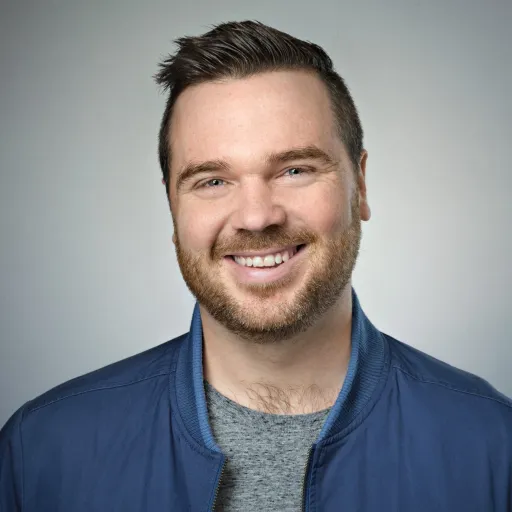
 Kevin Roose
Technology journalist and author covering AI and the labs building it, and a former New York Times technology columnist.
Kevin Roose
Technology journalist and author covering AI and the labs building it, and a former New York Times technology columnist.
“Belief is an active ingredient in AI success. You have to believe that the scaling laws will continue, that putting billions or trillions of dollars into building data centers and acquiring compute will pay off. … The belief is the enabling force that allows you to win. And if you don't have it, no amount of technical expertise can save you.”
Plain English with Derek Thompson · October 2026
Derek Thompson asked whether Sam Altman believes in anything beyond the next deal. Roose said Altman's core beliefs are in agency and in scale, and that OpenAI's success has borne out what he called a kind of delusional self-belief. He said this point only occurred to him midway through writing his book.
Transcript
He has this superpower, which everyone he's ever worked with, all of his mentors, they have recognized this in him. And he had it from quite a young age of figuring out exactly what someone wants and giving it to them, or at least appearing to give it to them. So back in his days running Y Combinator, people would sort of talk about this power of his and they didn't know where it came from, but people like Paul Graham recognized it very early. He was very good at reading the room, at figuring out, you know, this person expects me to do this or wants me to do this, so I will do that. And it led to him becoming one of the most successful young entrepreneurs and investors in the valley. The flip side of it is that he would often get into trouble because he would tell one person one thing that they wanted to hear and then tell a different person something completely different that they wanted to hear. And he sort of got this reputation as a sort of slippery people pleaser, which is, I think, a criticism that many people who have worked with him over the years have identified and have made in pretty consistent ways. He just seems to be in the business of both being quite ambitious, but also of being quite eager to please.
I mean, one way to say this is that he is a brilliant deal maker in the mold of a JP Morgan. Another way to say it is that he's a bullshitter. And I wonder, after all of your reporting, whether you feel like underneath all of that deal making, there is a core philosophy. Like just to put my thumb on one distinction that might help you answer that question. There's a 2015 blog post that Sam Altman wrote where he called machine intelligence, quote, something we should be afraid of. And when he founds OpenAI, With Elon Musk. He founds it as a nonprofit because he thinks that this is a project that should not be a typical commercial business. But now he's running a business that is, by some accounts, valued at 800, $900 billion, a trillion dollars. And later colleagues who work with him are very skeptical of the degree to which he's serious about AI safety at all. So one way to answer this, ask this question is to say, you know, does he believe in AI safety? But what I'm really asking here is, does he believe in anything outside of just making the deal that increases his power?
I believe he has a core. I don't know what it is. I'm not in his inner circle of people that he confides in. I've spent time with him. I've talked to him. I've had encounters with him as a journalist, but I've always sort of understood that he was playing the part in those interactions and wasn't necessarily showing me his true self. And for what it's worth, I think most executives do this. They have kind of their persona that they put on. I think the thing that kept coming up in reporting on Sam and the people around him is that he is a person who believes first and foremost in agency, right? He has this famous phrase: you can just do things. And this is something that he believed at Y Combinator. He would tell these young startup founders that he was investing in, like, you don't have to wait to change the world. You don't have to like, nobody has to give you permission. You can just go do things. And that is a core part of his belief about himself and about those around him. Like you could, another way of saying it is like, there's no grownups. Like you are the grown-ups and you can just do things that change the world without permission. He's also a fervent believer in scale, the power of scale. You know, people would tell me these stories about, you know, he would walk into a meeting and he would just tell everyone, you know, tell the people in the meeting to like add a zero or two zeros to whatever budget they had for their project going forward or, you know, increase the scale of a training run just because like he thought that bigger was better. So I think that love of scale is probably part of his experience running Y Combinator and being an investor before OpenAI. But certainly OpenAI's success has confirmed that just having this kind of delusional self-belief and belief in the power of scaling is actually what you need to win in AI. Because this is something that didn't really occur to me until midway through the book. Like belief is an active ingredient in AI success. You have to believe that the scaling laws will continue, that putting billions or trillions of dollars into building data centers and acquiring compute will pay off. Like you have to, like the belief is the enabling force that allows you to win. And if you don't have it, no amount of technical expertise can save you.
Your book has several examples of this delusional self-belief that Sam Altman demonstrates. And one example is as OpenAI is scaling their GPT technology and they've just come out with GPT-2, but they realize that they're going to lose the money spigot from Elon Musk. And so they need to get a billion dollars from someone. And a billion dollars at that point in the AI supercycle is a lot of money. And so they decide to put on a little demo for Microsoft CEO Satya Nadella with GPT-2 to wrest a billion dollars from Microsoft. Can you tell this story and what this story represents about Sam and the company?
Yeah, it's an incredible story. And it hadn't been reported before. And I was sort of delighted to find it out because it does really illustrate who these people are. So they go up to Redmond for the day from San Francisco, Sam and a few other OpenAI executives. And they've got this very high pressure meeting with Satya Nadella and his leadership team at Microsoft. And they've got this new model, GPT-2, that is still, it's not good by today's standards. Like you would never use it for anything that you needed done, but it can sort of complete a sentence. It can sort of generate coherent text. And it can do all of this like more flexibly than any of the chatbots that had come before it. So they go up, they run this demo, they bring a Microsoft laptop borrowed from one of the OpenAI executives' girlfriends because they're like, Microsoft will think more favorably of us if we're using Windows. So they borrow a Windows laptop. They go up, they run the demo, and they're showing some sort of canned prompts that they've prepared that they kind of know GPT-2 will be able to do. And then Satya Nadella asks, can we see this thing? And another Microsoft executive sort of wants to try their own prompt that wasn't part of the canned demo. And so they're like, they're sort of looking around at each other. They're like, can we do this? Can we do this? Yeah, I guess we have to do this. So they put in a prompt that's like, you know, Satya Nadella was hired as the CEO of Microsoft. And the first thing he did was blank. And then they hit enter, and they're sort of like sweating as they wait for this thing to come back. And then it spits out the completion, which is that on his first day, Satya Nadella fired all the employees and pivoted the company to Azure, their cloud platform. And this draws a big laugh. And it's sort of an amazing moment in time. Like an AI model has never been able to do this before. And it was very high stakes. Like, had this sentence completion not worked, they might not have gotten the billion dollars from Microsoft. But as it turned out, that was, you know, exactly what they wanted to see. And they invested a billion dollars, and the rest is history.
It's an amazing story. And one other piece that I think is really important is that Bill Gates at the time was quite biased against AI chatbots because Microsoft had a terrible experience with a chatbot named Tay or something. Do you remember Tay?
More from Plain English with Derek Thompson