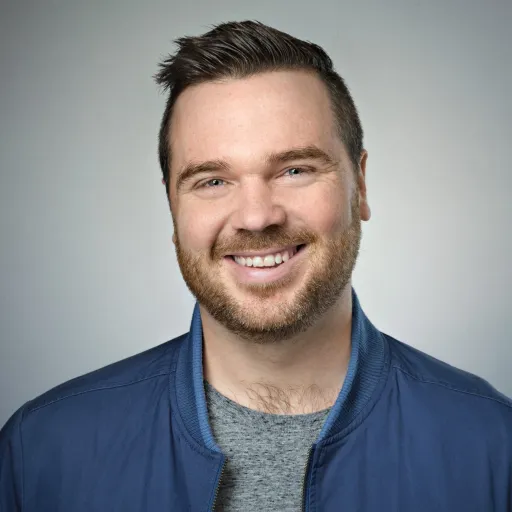
 Kevin Roose
Technology journalist and author covering AI and the labs building it, and a former New York Times technology columnist.
Kevin Roose
Technology journalist and author covering AI and the labs building it, and a former New York Times technology columnist.
“The people at DeepMind just said, like, that's crazy. You cannot build super intelligence out of Reddit posts. Like, it's just not going to happen. And they were wrong.”
Plain English with Derek Thompson · October 2026
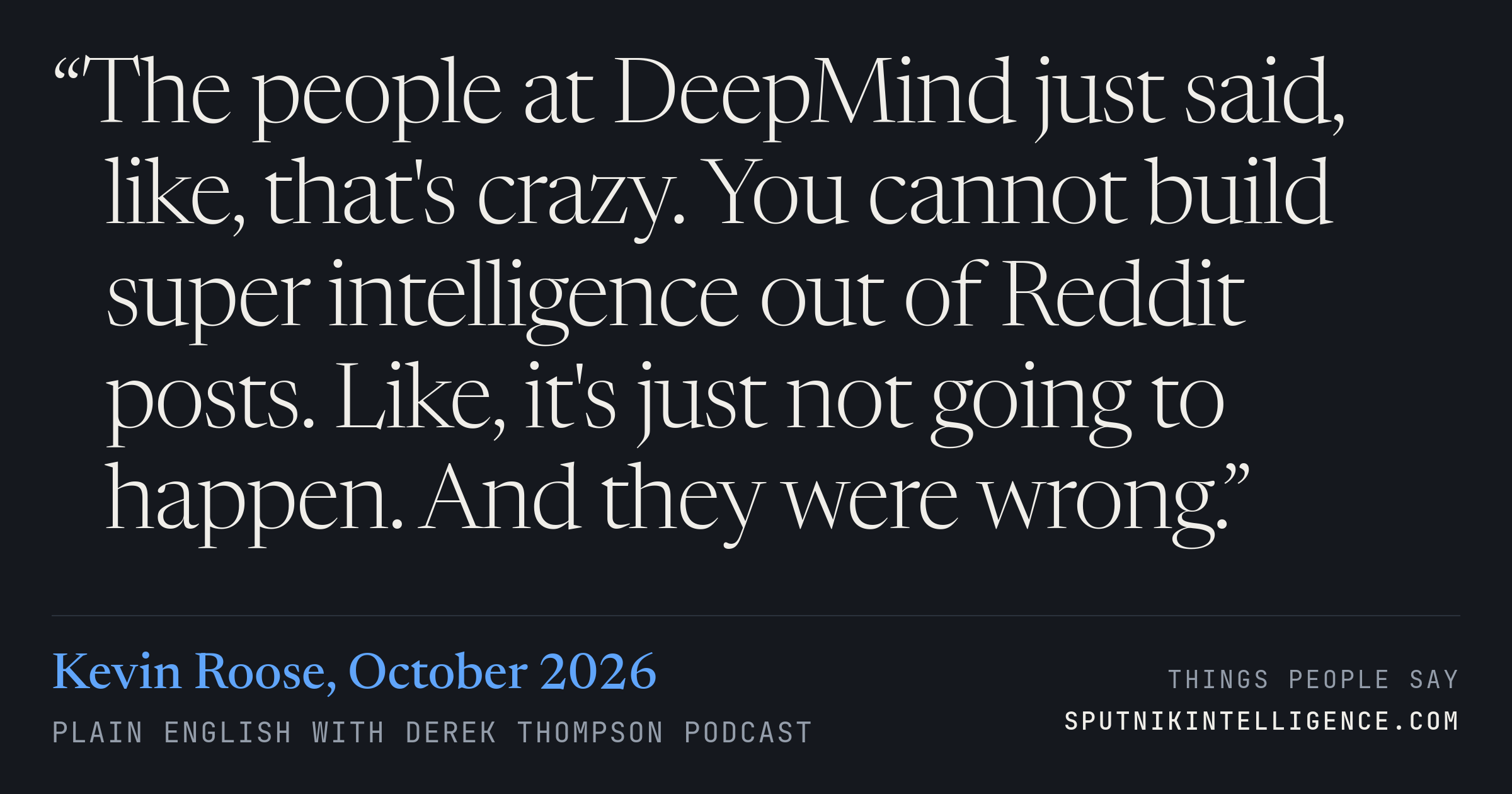
Roose was explaining the years when OpenAI, Anthropic and parts of Google were scaling up language models while DeepMind stayed with reinforcement learning. He says the field ended up converging on a hybrid of the two, and that DeepMind has since come round to building language models as well.
Transcript
And that is almost entirely true. And as it turned out, in the end, you needed both.
Today's AI models are
a combination of LLMs and reinforcement learning. So they all sort of converged on this hybrid solution. But there were years where like OpenAI and Anthropic or like, you know, OpenAI and parts of Google were like very interested in scaling up language models. And the people at DeepMind just said, like, that's crazy. You cannot build super intelligence out of Reddit posts. Like, it's just not going to happen. And they were wrong. And they have since realized the error of their ways and are now building LLMs
too. So Sam Altman and Dari Amade hate each other. Altman and Hasabis met at the Vatican in 2015, 2016. As you reported, they also don't like each other very much. I have a question about why they don't like each other, but I'm going to put that on ice, read the book if you want to know why they hate each other. Last question about Hasabis specifically. AlphaFold, which is the protein-folding technology that won the Nobel, which emerged from this RL theory of AI, is a triumph. But Google doesn't have an AI consumer business that rivals OpenAI or Anthropic. And Hasabis initially dismissed large language models, as you've just said, in a way that I think has cost Google significantly on the commercial front. So it's a mixed legacy. And I wonder if you stop the clock today, how do you see his legacy?
I see it as both an incredible scientific legacy. I mean, as you mentioned, he's the only one out of any of these guys who has a Nobel Prize, who has produced something that has actually revolutionized a scientific field today. I think his theory of change was correct in the broadest sense of like he believed in scaling, he believed in reinforcement learning. He was early on a number of these things, including just the belief in AGI itself. But I think he, the die may have been cast when DeepMind was sold to Google. I don't think they necessarily had a choice. They needed to build bigger blobs of compute to run their experiments. They needed deep pockets. They needed to partner with a hyperscaler or someone with the willingness to spend millions or billions of dollars on what they were doing. But I think that ever since he sold DeepMind to Google, he has been in some cases fighting against the commercial incentives and the pressure, the short-term pressures of being part of a large search-based internet giant. And he explicitly tried to get away from Google. There's some reporting in the book about this thing, Project Mario, which was sort of his attempt to kind of carve DeepMind out of the larger Google apparatus, but that didn't work. And then he ended up running a division of Google for years with thousands of employees, which is not what he wanted to spend his time doing. More recently, he's been sort of kicked upstairs to this sort of executive chairman position. And Google, DeepMind is firmly part of Google now in a way that it hasn't always been. So I think there's a tragic element too, of like, here's a guy who. Really wanted to use AGI to unlock the mysteries of science and to discover new things in physics and math and biology, and who, sort of by no fault of his own, was stuck running a large division of a commercial search giant that made most of its money through ads-on search results. So, look, I think it's too early to count Google out. They have lots of money. They have lots of smart people. And I think as long as Demis is there, they will have his sort of inspiration, his sort of drive. And he's very inspirational to the people there. But I also think there is this reality that they are just, they are just a more traditional company than either of these other labs. And they have lots of competing incentives and feuding internal teams and bureaucracy to navigate. And it's just going to be a lot harder for them to move quickly.
So, summing up, we've got Sam Altman, who I think of as kind of the JP Morgan of AI, like the mogul, the deal maker, someone whose company bet on Transformers, shipped ChatGPT, started this whole infrastructure cycle and has continued, has been very successful at using other people's ideas to build his power and the power of his company. Big blob of compute was Dario's idea, but who leads the labs in compute secured by a mile, it's OpenAI. And so that's there you've got, there you've got Sam. Dario, I see, as you described, as something more like a moral crusader in the Oppenheimer mode, someone who's both an inventor, again, like Oppenheimer, but also someone who's safety crusading both inspires some people and also rubs some people the wrong way. You've got a lot of that in the book about how at OpenAI, some people were just so tired of Dario using the moral argument to try to win every single corporate fight. And there's Sasabez, whose historical analog is harder to come up with because in some ways he's kind of like the Nikola Tesla, like a great inventor who is a little bit in the shadow of his contemporary, but it doesn't work because he's like a Nikola Tesla who worked at GM or something. Because he's, as you said, one blocker for his success is that he's been inside of a bureaucracy rather than leading his own thing outside of that conglomerate. Final question to you, now that we've sort of talked about their different motivations, different inspirations, who do you think got the most right?
More from Plain English with Derek Thompson