“I think our cloud business is at any given moment in time foregoing short-term revenues because we are making compute trade-offs to support frontier AI development.”
Big Technology · Tech Strategy & Big Tech · October 2026
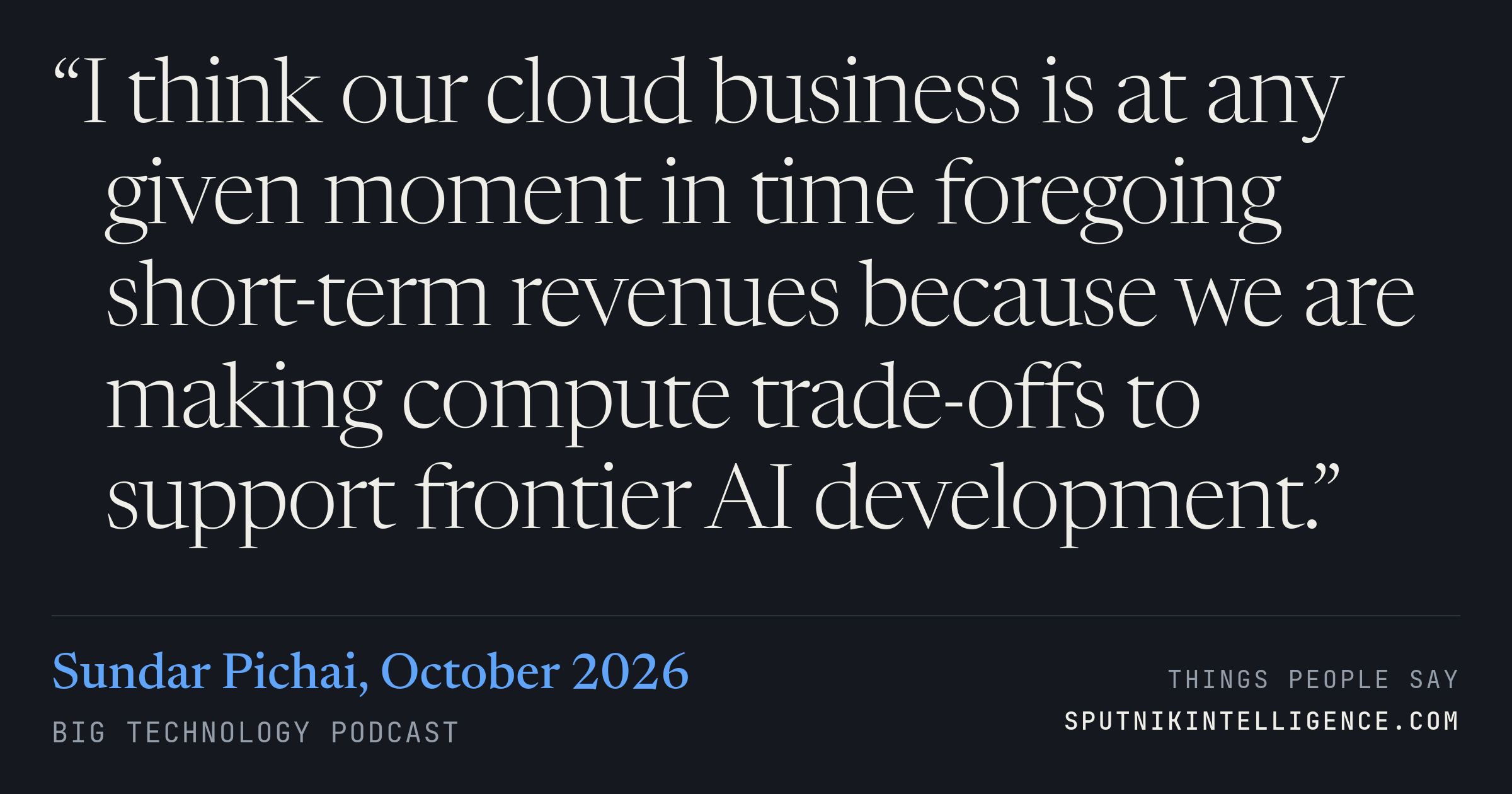
Alex Kantrowitz asked whether, if AI is as profound as he claims, Google should give its researchers the biggest possible computer even at the expense of cloud profits. Pichai says that trade-off is already happening, while adding that constraints also push researchers toward more efficient breakthroughs.
Transcript
…cause bottlenecks. And then you could have O-builds. There could be external shocks to the economy, et cetera. So there are macro risks, all that is possible at any given time. But am I confident that the compute we are planning for, we will have uses for it given enough time? Absolutely, yes.
…And we all laughed at the time. And I kind of regret that laugh now. But if you're someone that actually believes that, then the thinking would be you give the researchers the biggest possible computer, even if it is to the detriment of today's profits, like the cloud business. Your thoughts.
We're all doing some form of that, right? I think our cloud business is at any given moment in time foregoing short-term revenues because we are making compute trade-offs to support frontier AI development. So I think what you're saying is true already, right? But you want to be thoughtful, right? Even our AI researchers, constraints are also good. That's what inspires creativity. That's what helps you come with a more efficient algorithmic breakthrough, maybe to use less memory, et cetera. So what we are committed is to invest what's needed to stay at the frontier. That's how I think about it.
I wonder what you think the future of the interface looks like, the way that we use computing in the future as AI Products to roll out. I was speaking with Greg Brockman, the president of OpenAI, about this a couple months ago. He had a very interesting quote. He said, what is the interface that…
The way I think about it is I do feel computing historically has been humans adapting to computing. With AI, it'll be the other way about. The technology will adapt seamlessly to how humans live and go about their day-to-day lives. So there's an aspect of it. You want that AI to be able to speak to…
Yeah, I'm just going to play the OpenAI hits. Because, you know, last year you sent them into a code read. Yeah. I'm sure you know. Gemini was doing very well and OpenAI battened down the hatches. And I was speaking with Sam Altman about the challenge from Google. What he said was he thought OpenAI…
More from Big Technology