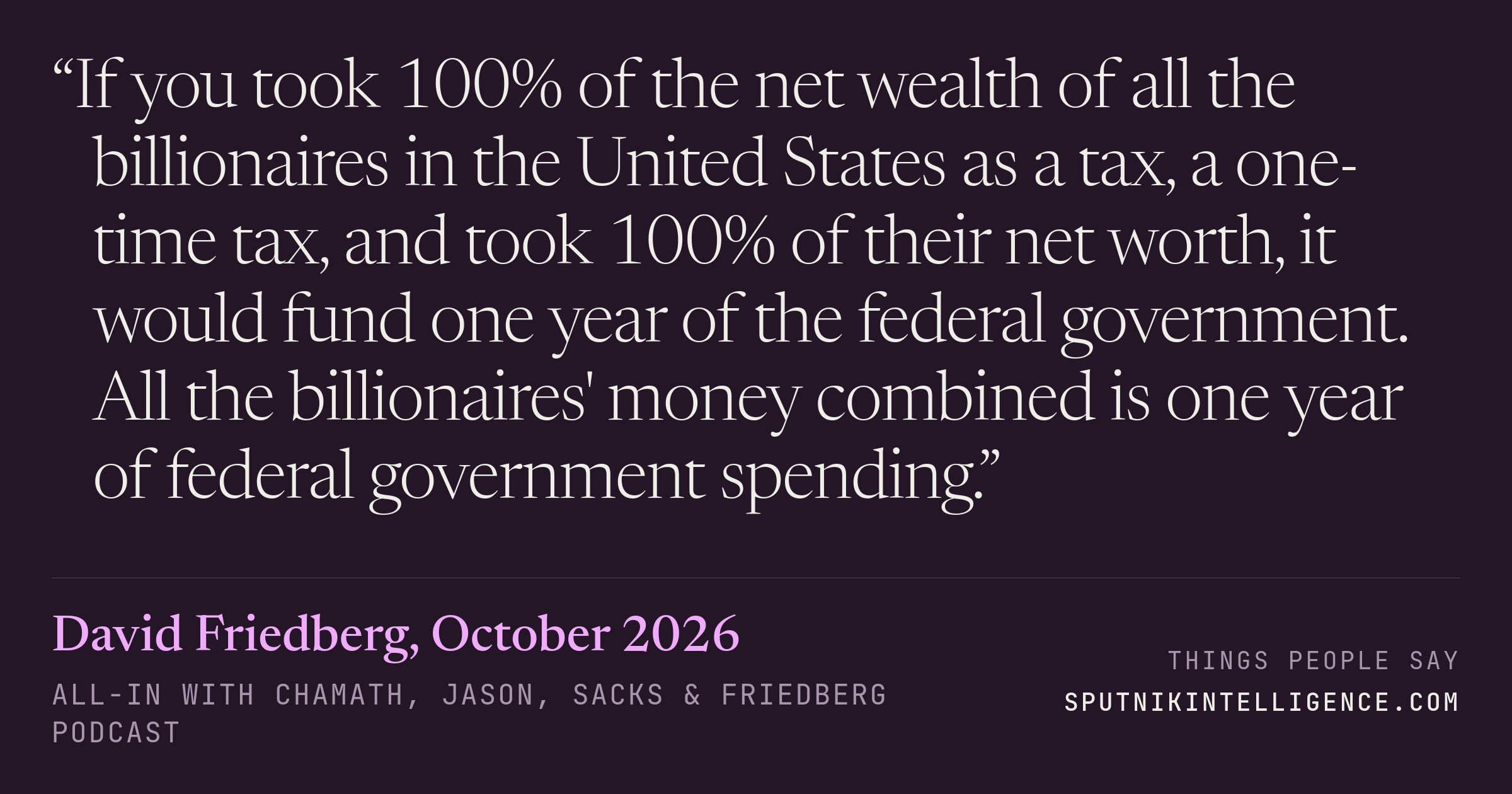
Friedberg was listing the crises he expects to shape American politics between now and 2028, among them the belief that a wealth tax would fix the budget. His argument is that the real choices are taxing the middle class, cutting spending heavily or restructuring entitlements, and that all three are deeply unpopular.
I actually don't know if that's even like, you know, remember there was a Tea Party. Like there's a whole bunch of manifestations of these social emotions, these kind of public emotions. They all kind of like fuse into different words and different parties and different groups. You know, who knows where it goes? It's certainly unlikely that the first manifestation is the one that sticks and holds and becomes the biggest one. I mean, look, I would argue the Tea Party was sort of seeded MAGA years later.
Yes, of course. Yeah.
But this kind of populist movement does not, like, if you look at the first derivative of it, it's still positive. Like the populist sentiment is still growing in America. And that's what I really care about the most, because I do think that that's where individual liberties get destroyed as, you know, populism effectively mandates a bigger kind of government to solve our individual problems. And I worry that we've got some looming crises, looming crisis number one being social security, looming crisis number two being where rates are and the impact that's going to have on affordability, looming crisis number three being that this idea of an asset tax is actually going to solve any problems. Where the truth is, like I've said in the past, if you took 100% of the net wealth of all the billionaires in the United States as a tax, a one-time tax, and took 100% of their net worth, it would fund one year of the federal government. All the billionaires' money combined is one year of federal government spending. It doesn't really move the needle to do an asset tax, that there's a fundamental restructuring of how we tax and how we spend that's going to be necessary. You either need to tax the middle class, which is where $160 trillion of America's $183 trillion net worth sits, or you've got to cut spending massively, or you've got to completely restructure these entitlement programs, all of which are deeply unpopular. All three of those paths are deeply unpopular. So when something deeply unpopular starts to kind of be the only path, what happens? And that's what I worry most about. And I think that's all going to kind of come to a head between 26 and 28. And I think it's going to frame the political calculus going into 28.
It's going to be fascinating, and we'll be here for it. I don't know if you guys had time when you were busy here, but there was a hijacking that occurred/slash terrorist attack, I think is the only way to describe it. Fly Dubai flight from Dubai to Tel Aviv. David had 174 passengers on board. An Omani co-pilot, apparently, stabbed the captain and tried to crash the plane in a 9-11 style attack. Passengers bravely. Subdued him, and there were off-duty pilots on the plane miraculously. I mean, what are the chances? And they somehow, during this terrorist trying to down the plane Friedberg, were able to not only remove him, but get these off-duty pilots into the cockpit, level the plane, and land it safely. One of the most amazing acts of bravery with this co-pilot who fought off the terrorist. And then three or four passengers were able to get into that cockpit, drag this terrorist out, and yeah, land the plane. Your thoughts, Freeberg.
Well, I mean, the eyewitness accounts came out pretty fast and furious because these guys had internet access as soon as they were able to land in Saudi Arabia and they started to provide their reports. But what really I thought was the most striking aspect of all of this, despite what I thought was incredible heroism and bravery and just a true kind of showing of human spirit, was how the media covered it. And I was deeply saddened because I remember 9-11. I remember the shock and the anger and the stories coming out during that day. I remember the media, the news channels were my source of truth. And I watched it all day. And then yesterday, this happened. And so here's an example. This is the New York Times cover the day after 9-11. Hijacked jets destroy Twin Towers and noticed this and hit Pentagon in day of terror. And it really was a day of terror. It was a truly tragic event in human history, regardless of your political or social beliefs then or now. The loss of life in this case, the loss of life in conflicts that followed, the loss of life in conflicts around October 7th and that followed that is all tragic and it's all terror and it's all awful. And the reporting yesterday on this event, which I found to be kind of emotionally distressing, was almost like a strange casting of the experience as being one of a fight between two buddies that weren't getting along in the cockpit.
Yeah, got into a scuffle of the original reporting, yes. The