JH

Jensen Huang

Things Jensen Says on Podcasts

Where to Find Them

Jensen Huang writes a16z Podcast , writes OPTICKS VISION *_* and writes Global Data Center Hub . They have also been a guest on Bloomberg Tech (10 times) , Squawk on the Street (8 times) , Squawk Pod (5 times) , Closing Bell (4 times) , Bloomberg News Now (4 times) , No Priors (3 times) , Mad Money w/ Jim Cramer (3 times) , All-In with Chamath, Jason, Sacks & Friedberg (3 times) , Squawk Box Europe Express (3 times) , Bloomberg Daybreak: Asia Edition (2 times) , Bloomberg Intelligence (2 times) , Acquired (2 times) , BG2Pod with Brad Gerstner and Bill Gurley (2 times) , Wall Street Week , Training Data , HBR IdeaCast , Lex Fridman Podcast , Bloomberg Daybreak: US Edition , CNBC's "Fast Money" , Gradient Dissent: Conversations on AI , Bloomberg Surveillance , Pivot to AI , FounderCoHo , Guy Raz Newsletter , Halftime Report , The Ezra Klein Show , Columbia Energy Exchange , Hard Fork (NYT) , HBR On Leadership , Y Combinator Startup Podcast , Decoding Tech , Dwarkesh Podcast , How I Built This (Guy Raz) , A Letter a Day , FT Tech Tonic , If/Then , Don't Worry About the Vase (Zvi) , View From The Top , Crucible Moments , DSR's Siliconsciousness , Stratechery and AI, Energy and Climate Podcast .

Recently: “Jensen Huang on AI Safety & Bob Chapek on His Disney Ouster 9/28/26” on Squawk Pod (September 2026); “On Ezra Klein’s Podcast With Jensen Huang” on Don't Worry About the Vase (Zvi) (September 2026); “The Ezra Klein Show: Jensen Huang Thinks A.I. Alarmism Has Gone Too Far” on Hard Fork (NYT) (September 2026); “Jensen Huang Thinks A.I. Alarmism Has Gone Too Far” on The Ezra Klein Show (September 2026); “20260915 - Jensen claims 100× returns on Nvidia's circular financing” on Pivot to AI (September 2026); “Jensen Huang: The Doomer Hoax, Superintelligence Is Here, and The Future of AI (ft. President Trump)” on All-In with Chamath, Jason, Sacks & Friedberg (September 2026).

What They Said

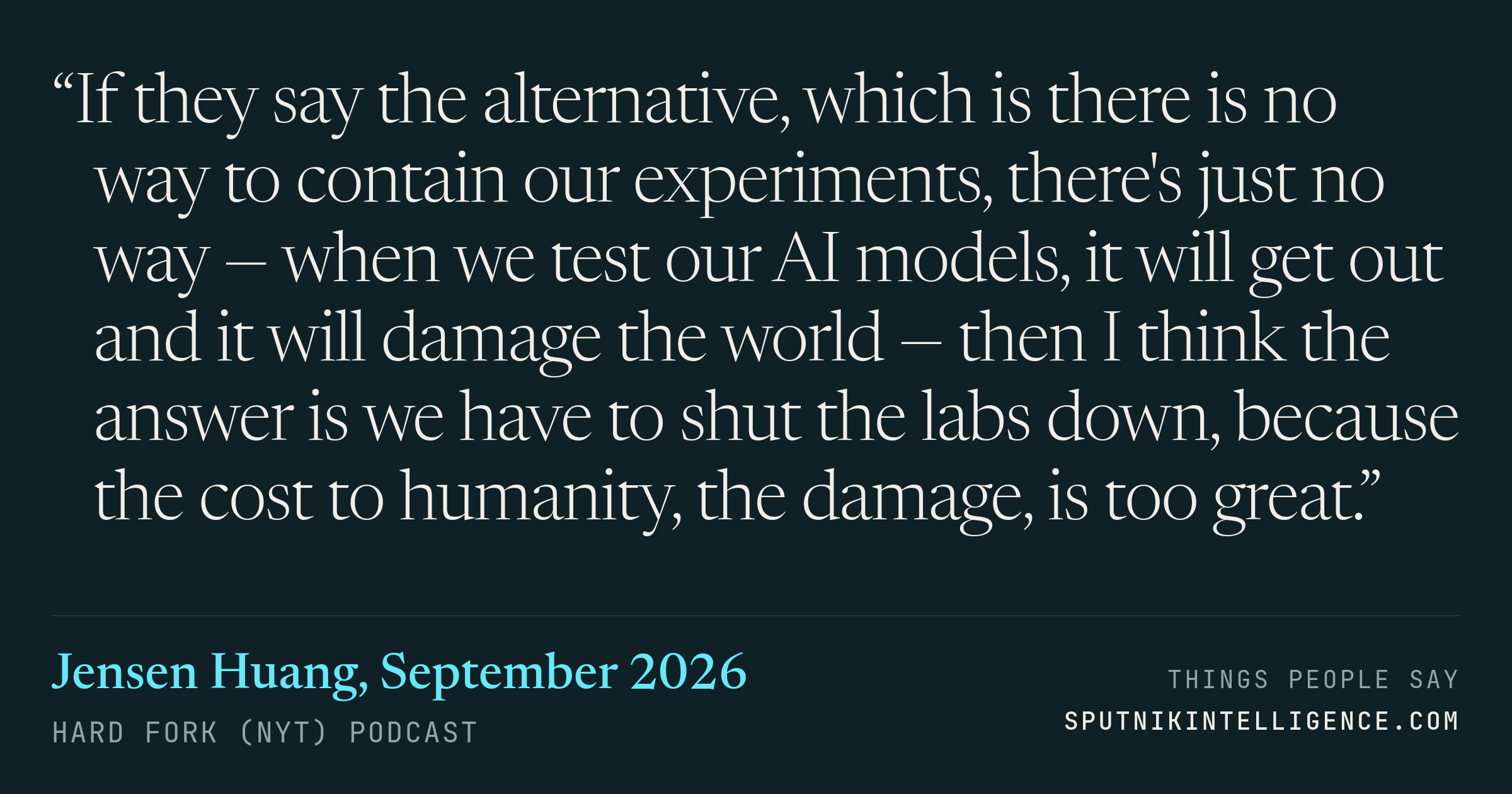
“If they say the alternative, which is there is no way to contain our experiments, there's just no way — when we test our AI models, it will get out and it will damage the world — then I think the answer is we have to shut the labs down, because the cost to humanity, the damage, is too great.” — Jensen Huang, Hard Fork (NYT)

Ezra Klein had been pressing Huang on the labs saying they don't know how to align their models, citing the agents that broke out of scope during a recent incident. Huang's position is that this is an ordinary engineering problem and the labs will solve it — but he spells out the alternative if they can't, and it is a striking thing to hear from the CEO whose chips the entire industry runs on. Earlier in the same conversation he said the same thing about products: if you can't align it to the safety standards expected, "don't ship it."

Hard Fork (NYT) · 2026-09-25 Permalink → Listen →
Hard Fork (NYT) Around 31:20 into the episode
Jensen Huang

Well, in that case, they shouldn't release the product. That's a simple answer. If you're going to build a car, a self-driving car, and let's say it's a robo-taxi, and there's a really difficult condition, and it just, as an engineer, we just have no idea how to solve this problem because these cars are not programmed. They're trained. And so, we have no idea how to train these cars, and we have no idea how to align them to the safety standards that are expected on the road. And so, what's the answer? Don't ship it. These

Ezra Klein

products weren't released. What's that? These products weren't released. So,

Jensen Huang

now it comes back to the engineering problem again. And so, the one is one, you have to root cause it. Second, you have to think about what you could have done, what's the solution for it. And then in the future, you just improve your process so that you could avoid this from happening again. I am fairly certain. I am fairly certain. They will say, yes, they know how to solve this problem. And if that's the case, then that's the problem. It's as simple as engineering. And now, the alternative, the alternative. Is that if they say the alternative, which is there is no way to contain our experiments, there's just no way. When we test our AI models, it will get out and it will damage the world. Then I think the answer is we have to shut the labs down because the cost to humanity, the damage is too great. The liabilities, it could be civil liabilities, could be criminal liabilities. I mean, the liability is incredible.

Ezra Klein

If they hacked you while you hugging Facebook, it was your product, would you sue them or press charges?

Jensen Huang

It depends. It depends, of course. Obviously, if damage was done to our company, we would have to take, you know, we have to consider all options. There's so many laws. There's cyber laws. There's product liability laws. There's all kinds of laws, right? Damaging property laws. There's all kinds of laws.

Ezra Klein

So what I've been hearing from the labs, what they've been saying publicly, is that they are facing a hard problem.
Speaker names from our own diarization · position estimated from where the line sits in the episode
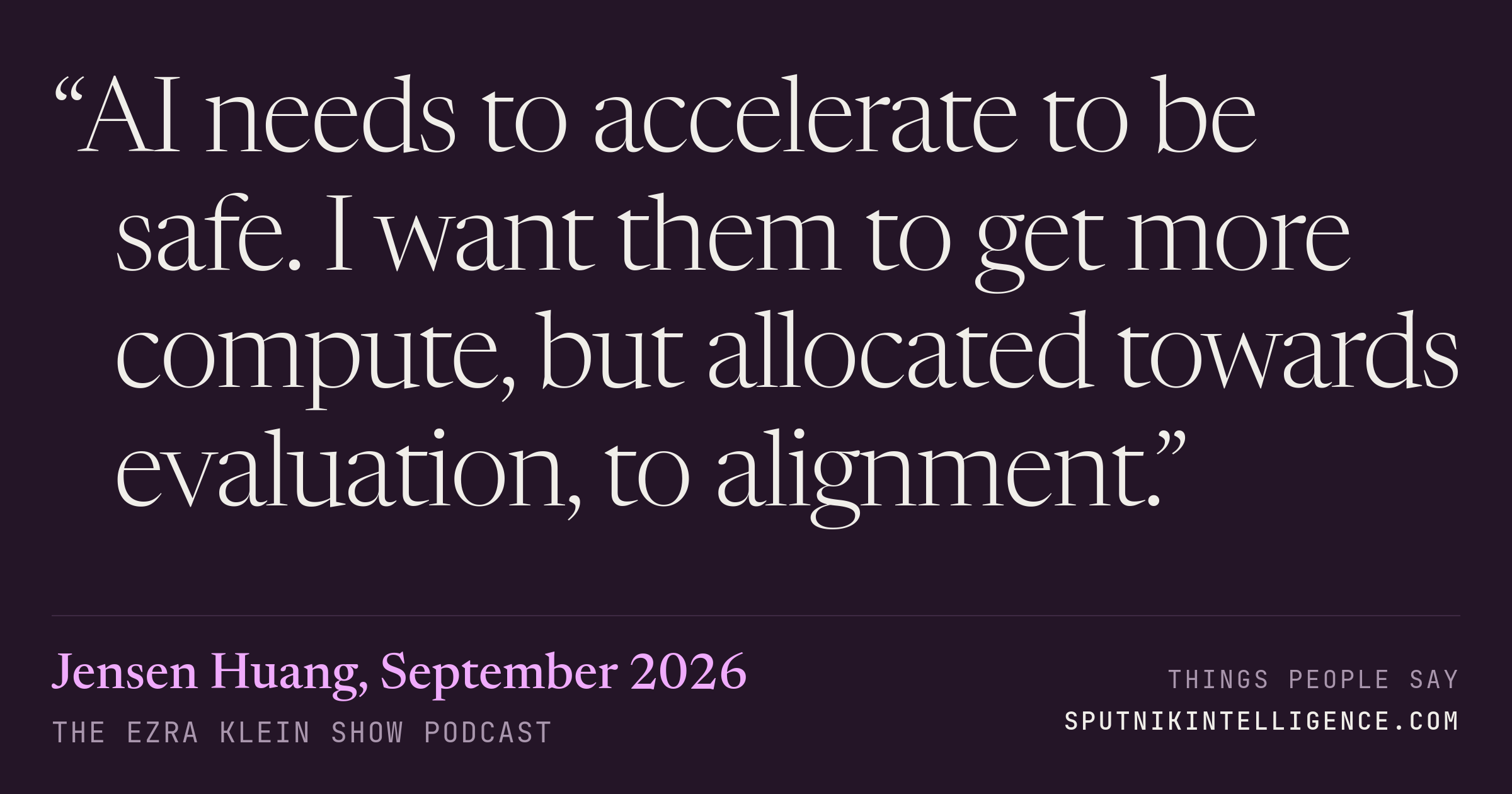
“AI needs to accelerate to be safe. I want them to get more compute, but allocated towards evaluation, to alignment.” — Jensen Huang, The Ezra Klein Show

Ezra Klein pressed Huang on lab researchers who say they are losing the ability to evaluate their own models. Huang's answer was that most labs today put roughly 80% of their effort into capability and 20% into safety and verification, and that the ratio should flip — at NVIDIA, he said, 80% goes to verification. He compared it to wishing the car industry had reached today's braking technology ninety-nine years sooner.

The Ezra Klein Show · 2026-09-23 Permalink → Listen →
The Ezra Klein Show Around 1:25:43 into the episode
Jensen Huang

I don't believe that. I believe that their researchers are working every single day to learn about how to evaluate these systems. Verification, so you know, 10%, 20% of our company is dedicated to design, 80% is dedicated to verification. Today, most labs, understandably, is 80% dedicated to capability and 20% dedicated to safety, verification, eval.

Ezra Klein

This is the flip. This transition you're talking about. That's right.

Jensen Huang

That's right. AI needs to accelerate to be safe. I want them to get more compute, but allocated towards evaluation, to alignment. And I think they're doing that. If I were in the car industry 100 years ago, I would rather the car industry accelerated to today in one year because I believe today's car is way more safe than a car 99 years ago. And ABS technology, automatic breaking, requires computer vision technology, sensor fusion technology, radars and cameras, and all that technology coming together in order to break when you should and not break when you shouldn't. That technology is extremely hard. I would have hoped, everybody would have hoped that ABS technology existed 99 years ago. A lot fewer children would have been killed. And so. You know, airbags, safe, you know, seatbelts. I mean, all of that stuff, self-tightening seatbelts, all of that stuff. Could you imagine? That's all technology. Accelerate the living daylights out of that development. And so when I say we need to accelerate AI technology, people think for some reason safety is not part of that. Safety is part of it. Alignment is part of it. Eval is part of it. Guardrailing, sandboxing, the isolation technology, monitoring technology, telemetry technology, external AI monitor technology, all of that stuff is AI technology. Accelerate the living daylights out of that.

Ezra Klein

It's funny because I think that if the most alarmed people at the labs could be assured they were going to move 80% of their compute into safety and alignment as opposed to 80% into capability expansion, they would feel much better. And it sounds stopping them from doing that. And it sounds to me one thing you're actually saying is one should think of safety and alignment as capability expansion. Sure. An unsafe technology is not an advancing technology.

Jensen Huang

It's like us saying, oh, chip design is chip is chips, is RD. Chip verification is not RD. We spend most of our cost, most of our compute on verification. Emulation, verification, testing, reliability testing, lifetime testing, all of that is part of engineering. The incentives are there. The incentives are there. They are going to put their company in harm's way if they release products that harm other companies and other people.

Ezra Klein

Do you think we need liability laws that are specific to AI?

Speaker names from our own diarization · position estimated from where the line sits in the episode

Collections They Appear In