Editor-in-chief of The Verge, which he co-founded in 2011, covering consumer technology, platforms and the policy around them. He holds a law degree and began in tech blogging at Engadget.
Hosts the Decoder interview podcast and co-hosts The Vergecast, which won a Webby Award for best technology podcast.
Decoder with Nilay PatelAround 16:32 into the episode
Speaker 3
…se. They're really much more focused on diffusing the technology. And they think they can win, quote unquote, win the AI race by just having AI used much more broadly, integrated throughout the economy, especially in areas like manufacturing, where they are already sort of like the behemoth. And I
Speaker 4
…trying to not fall too far behind the U.S., but really focus a lot more on trying to get, especially these open source models out there across the Chinese economy and globally as well. And to that extent, on that metric, they seem to be doing pretty well. That to me always has seemed like the real
Speaker 3
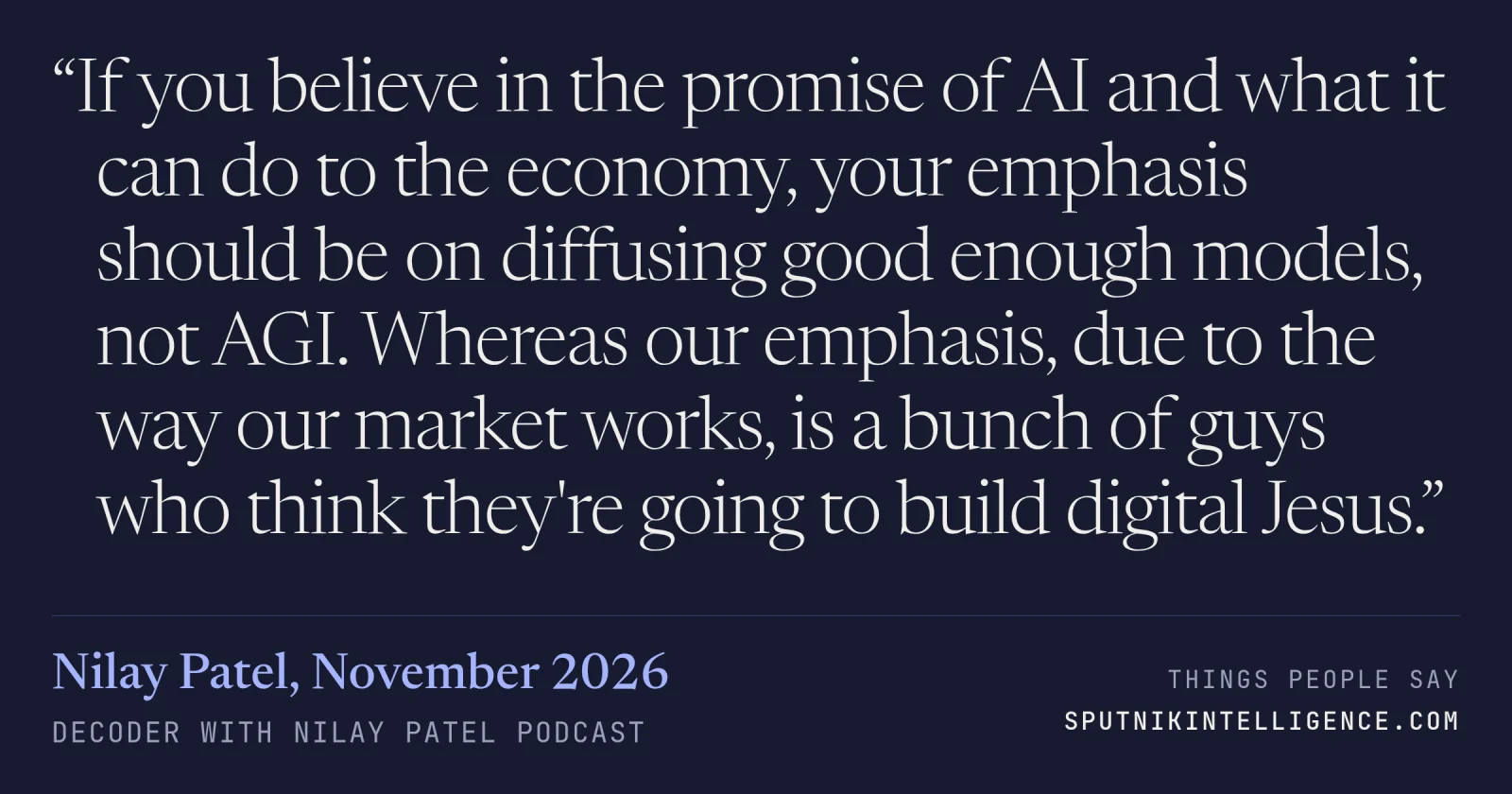
fight, right? Anthropic and OpenAI are furious that the Chinese companies are constantly distilling their models. They're trying to build some technology to keep them from stop distilling their models. But if you believe in the promise of AI and what it can do to the economy, your emphasis should be on diffusing good enough models, not. AGI, whereas our emphasis, due to the way our market works, is a bunch of guys who think they're going to build digital Jesus. Like, whatever is going to happen, that's the thing they want. And Dario Medei has to pretend that he cares about Salesforce, but we know what his real priority is. How do the United States and China compete in that dynamic, right? Where you have one very managed economy that has set a much more near-term and potentially achievable goal. And then, you know, our market system, where the incentives of the leading market players have nothing to do with the economic incentives of the rest of us.
Speaker 4
There's even a sort of ideological foundation to all this because the vision of AGI is one that is like so deeply embedded right now in the American AI community and sort of Silicon Valley culture that I think there's a risk of potential disconnect, not just between the US and China on this issue…
Speaker 3
Bringing that all back to the context of NVIDIA, Jensen Wang, Alice Wang, Megaspeed, Megaspeed is a data center provider in Southeast Asia. That's theoretically their business. They're building data centers, they're buying these chips. Shouldn't market forces just end this, right? Like the United…
Speaker 4
an interesting question because there is ultimately market demand in China still for these NVIDIA chips. And there is a divergence here between the companies in China who still want NVIDIA chips, who still want access to them, and the government who is like, no, no, no, why don't you try Chinese…
Speaker names come from our own diarization. The position is estimated from where the line sits in the episode.
Patel had noted that Nvidia's board has not said why Huang is leaving. This is his own read on why it was framed as a resignation rather than a firing, not reporting.
You know, like you can't just like ask an undercover cop if they're a cop. Like they don't have to tell you. Regardless of what people believe. So I think that this story ends up taking down the Trump administration and many characters within the Trump administration.
David Pierce
Interesting.
Nilay Patel
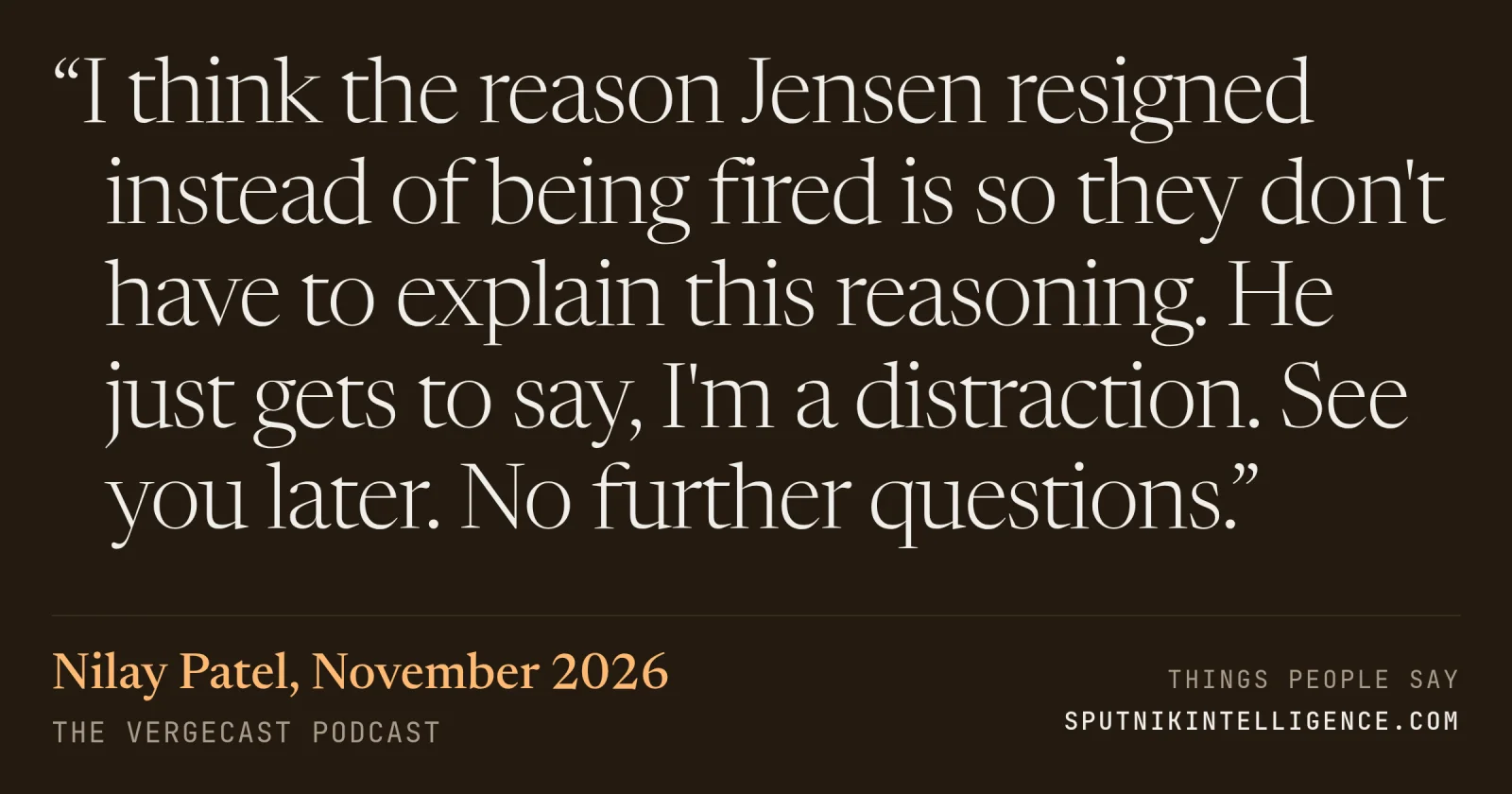
That's where this thing is headed, right? An affair with an NVIDIA executive in charge of healthcare might be the precipitating factor to get Jensen out the door. And we don't know the board's reasoning. They haven't said why or what's happening. And I think the reason Jensen resigned instead of being fired is so they don't have to explain this reasoning. He just gets to say, I'm a distraction. See you later. No further questions. There will be shareholder lawsuits and all this other, there already are shareholder lawsuits. And I think we'll learn some of this other stuff along the way. But the spy is still the point. Is there an agent of the Chinese government sitting next to one of the most powerful AI CEOs in the world, one of the richest people in the world, at the head of one of the most important companies that is…
David Pierce
I was just about to say exactly that, that who knew what when is about to become an incredibly important and very complicated story, because there's increasing evidence to suggest that the Alice Wong story goes back at least a couple of years, that maybe some people in the government, all the way…
Nilay Patel
is already their posture, right? AOC is talking about that. I think I saw Jamie Raskin talking about it yesterday. Like Jamie Askin's quote was something like, I don't care about the chief executive of one company. I care about the chief executive of the country.
David Pierce
Yeah. Great. Yeah.
Speaker names come from our own diarization. The position is estimated from where the line sits in the episode.
Comparing Jensen Huang's exit to other possible tech CEO collapses, Patel argues Nvidia's products are not the problem. Demand for the chips is intact, but the financial structure around them depends on one personality.
…Zuck as a CEO every year, and it doesn't pass because he has the controlling share of the stock. Yeah, so like there's just like some dynamic there where like, we will make you stop spending money on VR is a thing that meta shareholders would like, yes, would like to say. And it is definitely
David Pierce
true that a week ago, Jensen Wong's overall approval rating among everyone was very high, much closer to 100% than wherever Mark Zuckerberg is hovering in the low teens somewhere. Yeah, and
Nilay Patel
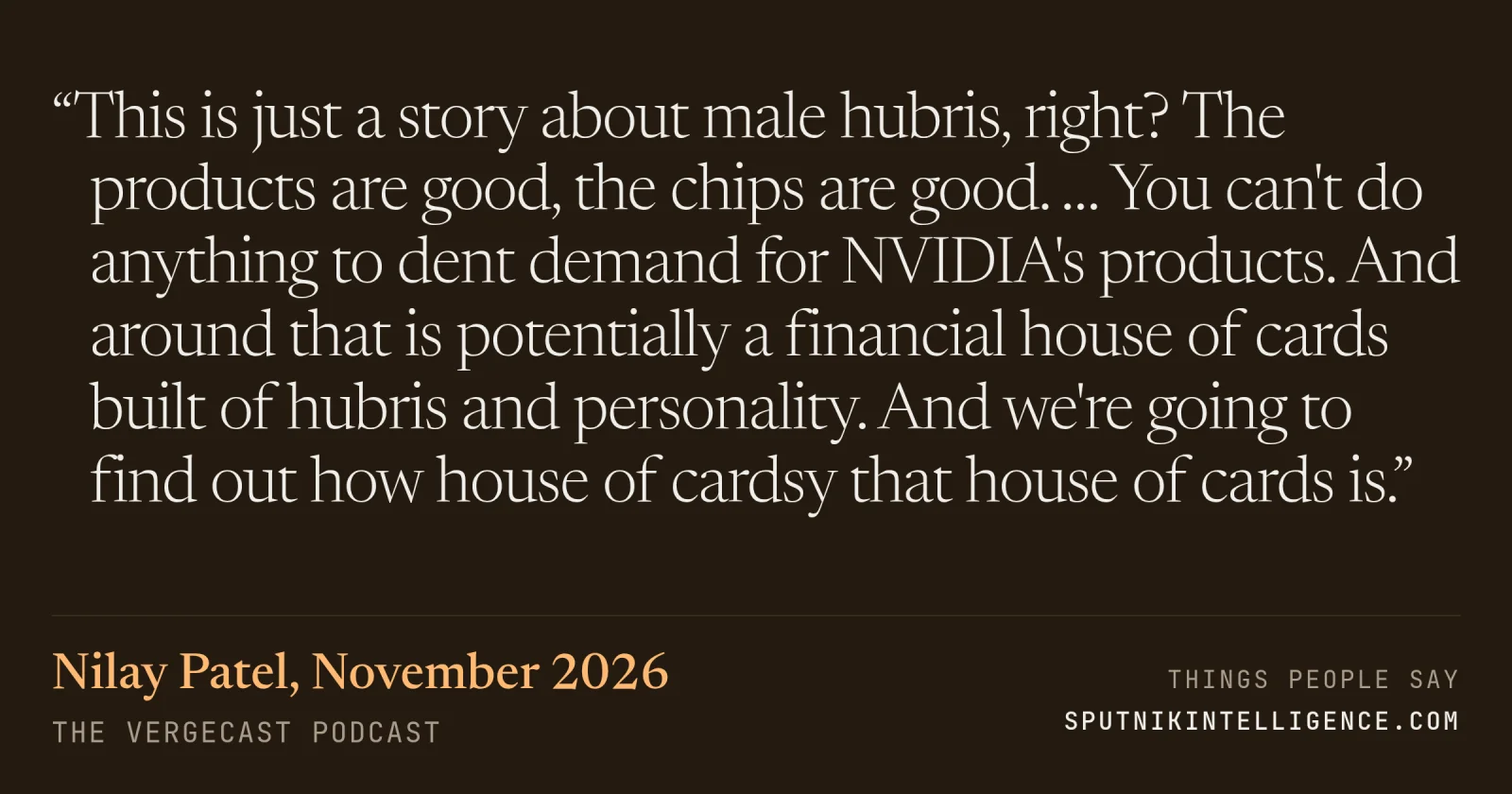
I, I mean, what is this story? I do my Kara Swisher impression. This is just a story about male hubris, right? The products are good, the chips are good, the market has reacted to the existence of NVIDIA's GPUs and CUDA in particular as a software remote around them and an ecosystem around them and said these are good products and the demand for them is 100%. You can't do anything to dent demand for NVIDIA's products. And around that is potentially a financial house of cards built of hubris and personality. And we're going to find out how house of cardsy that house of cards is. Because without this personality just insisting that everything's fine and that what did he say to Dorkesh Patel? He said you have loser mentality if you talk about restricting exports to China. Without that, maybe this house of cards fall. And if you have that much hubris and self-regard, of course they're going to bang a Chinese spy. What's she going to do?
David Pierce
There we go. Right. Like,
Nilay Patel
that's where you're at.
David Pierce
Yeah. Yeah. I think that's right. And I think that's a good place to leave it for now. Why wouldn't you bang a Chinese spy? Me, like Patel took a lot of money. All right, let's leave it there for now. We're going to have lots more about this on tomorrow's show. I think for tomorrow's show, we'll…
Speaker names come from our own diarization. The position is estimated from where the line sits in the episode.
The hosts were discussing why Nvidia's CFO, rather than an engineer, was named acting CEO after Jensen Huang's resignation. Patel argues that what Huang actually did for Nvidia was financial: propping up the AI industry that buys its chips.
…that Colette Crest, the CFO, is now the acting CEO of NVIDIA. NVIDIA is a. Chip design company, and they have lots of engineers who work every day on the next generation of those chips. I don't think Jensen Wong is micromanaging that is for as much as his 60 direct reports, no one-on-ones. Jensen
David Pierce
Wong might have been micromanaging. There's a whole episode
Nilay Patel
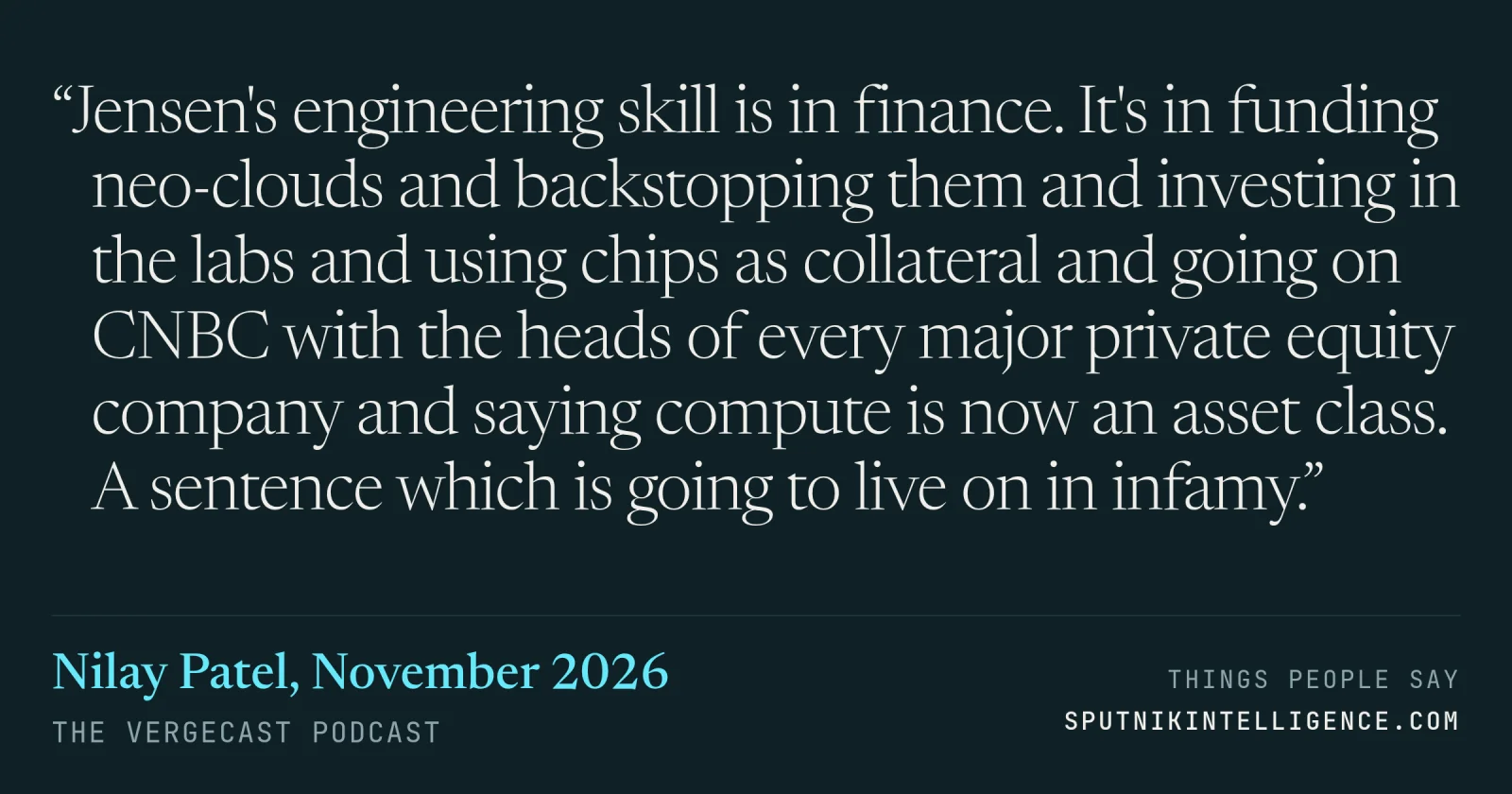
of Dakota about that orchard that we're going to do one day. Jensen's engineering skill is in finance. It's in funding neo-clouds and backstopping them and investing in the labs and using chips as collateral and going on CNBC with the heads of every major private equity company and saying compute is now an asset class. A sentence which is going to live on in infamy.
David Pierce
I will say, I think it's possible Colette Crest has been doing most of that work anyway. It appears Jensen had a fair amount of company. Jensen had like a lot of spare time over the last couple of years, very clearly. But yeah, it's very clear that the, I think you're right, that the financial arm…
Nilay Patel
Yeah. I mean, look, the demand is for the chips as they exist today. Right. You know, if you think about just like tech cycles, everyone is always waiting for the next generation of tech. Bluetooth 5 will fix it is like a thing that you hear all the time. Like the next generation of this thing will…
David Pierce
And all the people who are buying those chips are not going to be immediately, vastly less likely to because Jensen Wong is no longer the CEO.
Speaker names come from our own diarization. The position is estimated from where the line sits in the episode.
Glazier had said AI companies will absorb any copyright liability and still have big IPOs. Nilay Patel disagrees, arguing public opinion has shifted since Google won its fair-use fights, and asks whether the music industry is using that.
Decoder with Nilay PatelAround 48:24 into the episode
Nilay Patel
like this could be a big cost of doing business going forward. And yet, they're going to have a spectacular IPO, right?
Mitch Glazier
Despite those risks, which means that they're willing to bear them and they're also willing to accept the cost if and when that comes and it is secured.
Nilay Patel
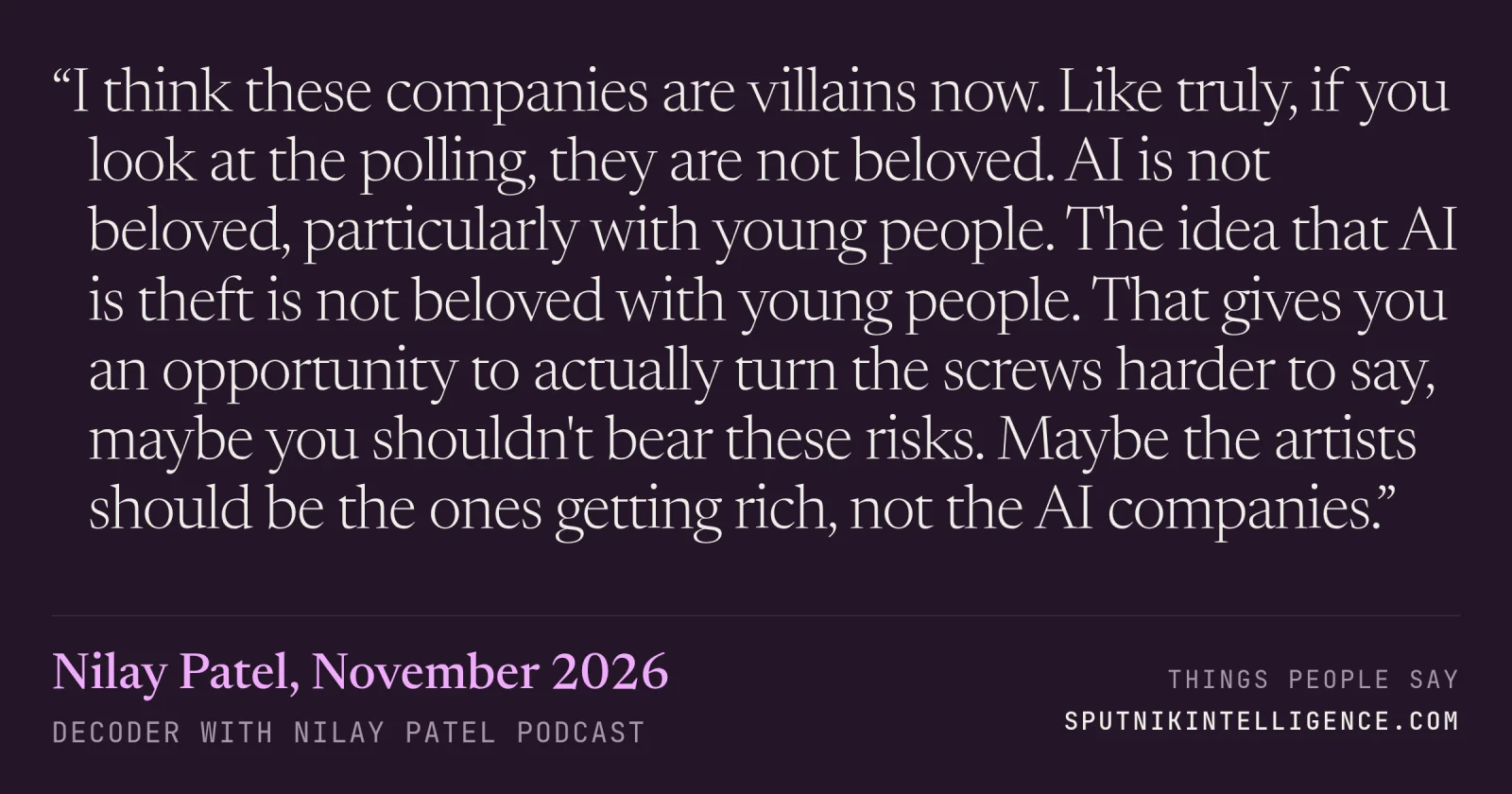
Actually, I have a different view on that. And it's related to the beginning of our conversation, right? You, you said it was, I think you gave a quote to the Los Angeles Times where you said being the RIA is more fun now because the consumers are on your side fighting the AI giants instead of you fighting consumers. I get that. Like the valence of the RIAA and the culture may have changed. I'm sure we'll get some people in our comments saying it hasn't, but in general, it's changed, right? You're on the side of the artist fighting the giants. Google won all of those cases about fair use when it was a baby, right? They had slides in the office and they were a startup and no judge had ever used the internet before. And they're like, I love YouTube. And Viacom, you're posting your videos on YouTube because your people love YouTube and you know the audience is there. And there was something very happy about the tech industry at that time. Google as a company was a hero. I think these companies are villains now. Like truly, if you look at the polling, they are not beloved. AI is not beloved, particularly with young people. The idea that AI is theft is not beloved with young people.…
Speaker 3
we're putting it into policy. You know, we're everything is an
Mitch Glazier
arc, as you know, but in the beginning of a disruption, you try to put into policy the basic rights that are going to allow the creators to control their creation, to charge what they want for their creation, and to develop the licensing deals that they feel they want to develop. And it's gotten to…
Nilay Patel
and say that the baby punk rocker in me is, we could do another full hour on artists now have the opportunity to sell their catalog to Goldman Sachs. It's another hour, but I know it's there.
Speaker names come from our own diarization. The position is estimated from where the line sits in the episode.
Patel was introducing earnings data on how much AI agents are actually being used for real-world tasks. Pierce called it his favorite number of the week; the hosts then noted DoorDash and Uber Eats reporting only hundreds of agent orders.
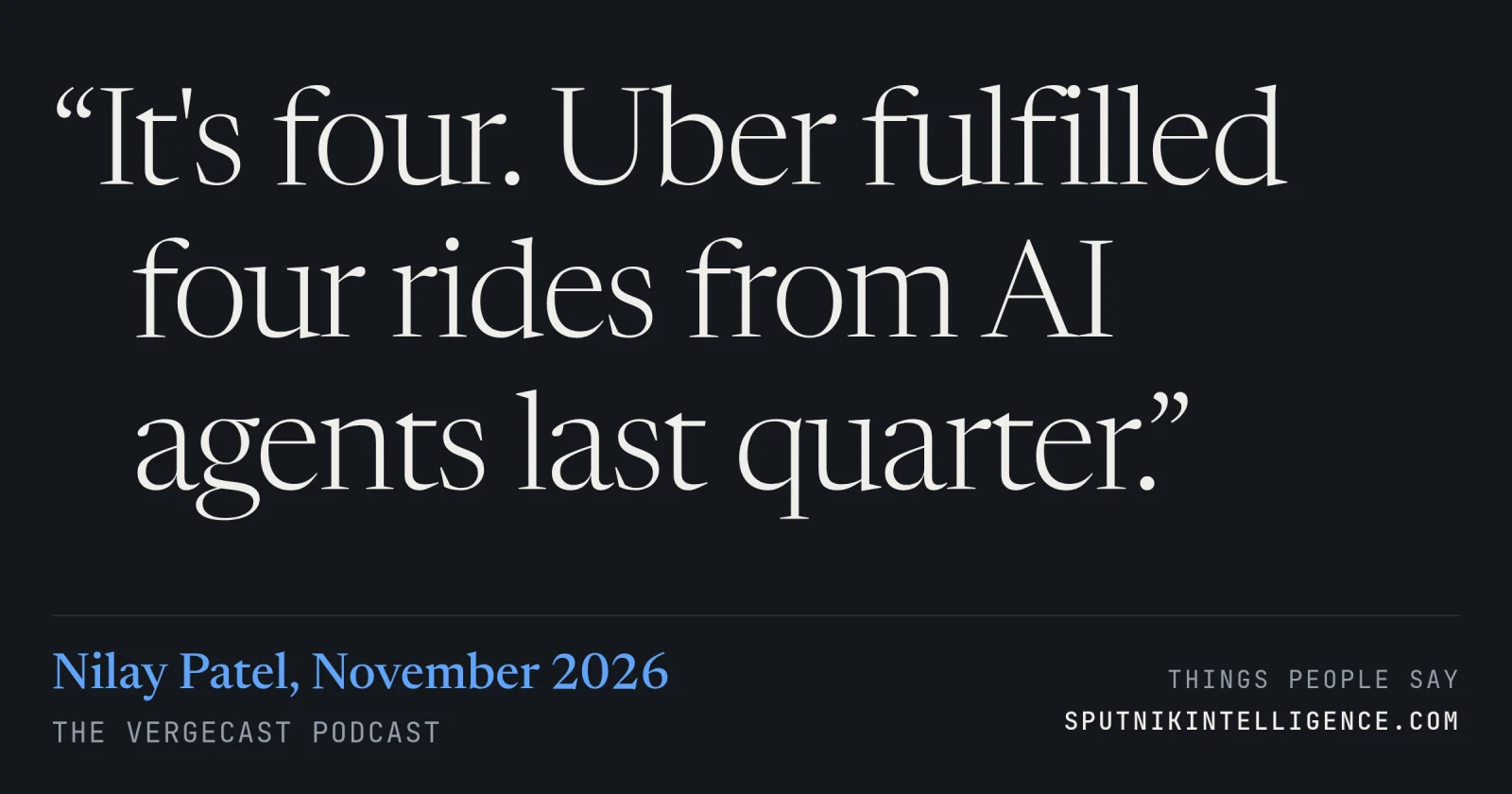
There are other financial results this week that give us insight into how well agents are doing. Uber announced how many rides it fulfilled from agents last quarter. This
David Pierce
is my favorite number of the week.
Nilay Patel
It's four. Uber fulfilled four rides from AI agents last quarter. Can
David Pierce
I just say, I put this into the X is not real life category because if you spend all of your time on X, you believe that Muse and Instinct and Dots and now Claude Duet are like mainstream products that tons of people are using all the time. Four rides.
Nilay Patel
Four rides. DoorDash's CEO, Tony Zhu, said, don't be delusional about agents because DoorDash only had a few hundred AI agent orders. Uber Eats had like 500.
David Pierce
Yeah.
Speaker names come from our own diarization. The position is estimated from where the line sits in the episode.
Reacting to the midterms, where data center measures lost almost everywhere, Patel gives a product-based explanation for the backlash: voters are being asked to bear real costs for AI features they don't value.
…industry needed to not exist because there is so much money. This House of Cards is built on all of this happening. And it has started to feel like if it was ever going to just all collapse all at once, you could really look at what happened on Tuesday as the thing that may have started all of it.
Nilay Patel
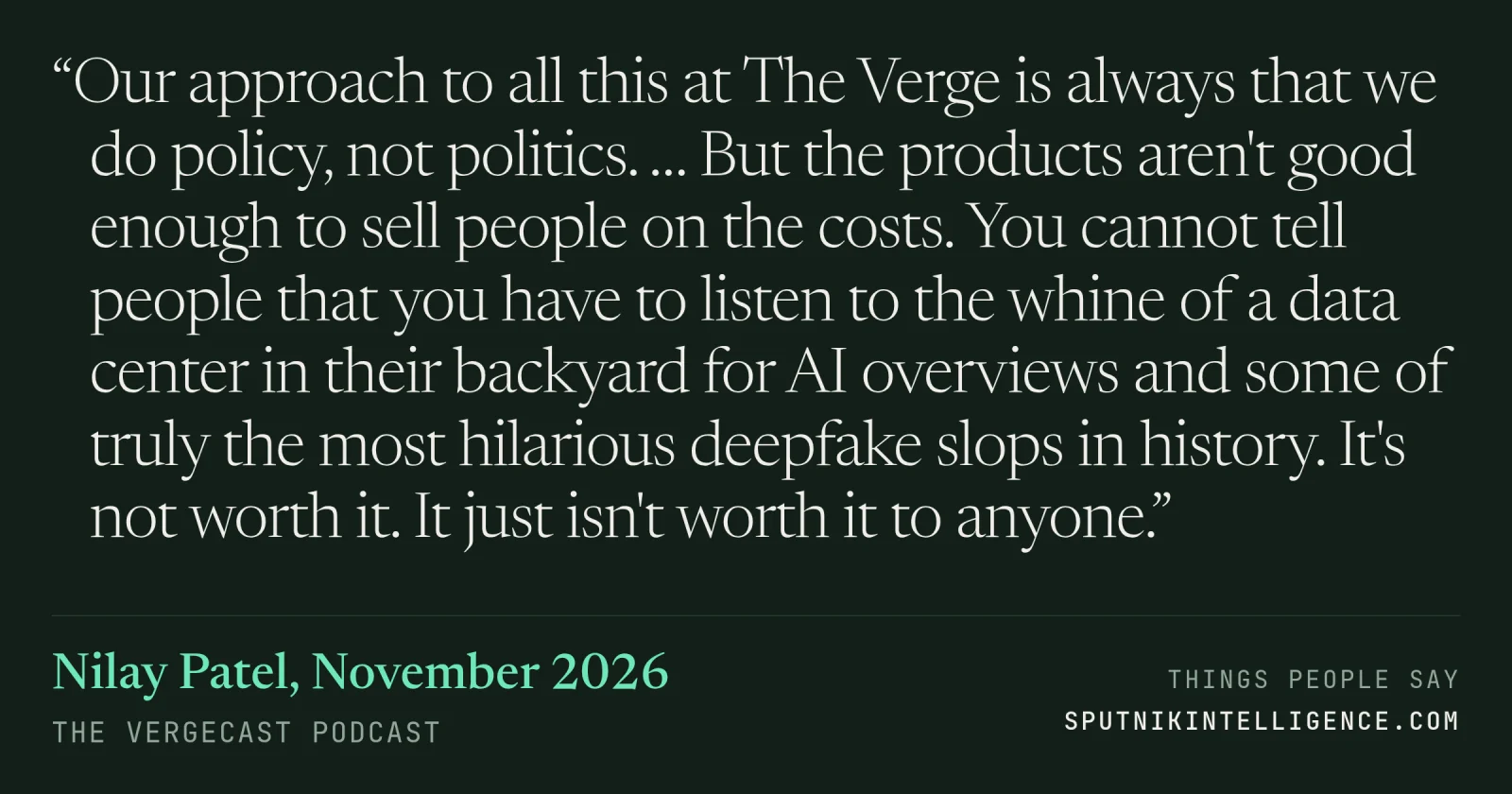
Sure. Democrats and Republicans alike ran on opposing data centers. Democrats in particular ran on opposing big tech and constraining what the AI industry might do. You know, our approach to all this at the verge is always that we do policy, not politics. Like a deep analysis of how the voters in Heartland America feel is just, we've never been good at that thing. We're always pretty good at policy. We've always been pretty bad at politics. But if I was going to do political analysis here, I would just make the same point that we've been making about AI for a long time on this show. The products aren't good enough to sell people on the costs.…
David Pierce
Right.
Nilay Patel
And it's like, well, that's just, that's just bribery. Well, and that's
David Pierce
that's such a fun example, actually, because this was, this is big news this week. But the Google reaction to that was essentially to say, we're not taking this away from you. It's just that search and AI are now so closely tied to one another that if you don't want AI, which is your right, we…
Speaker names come from our own diarization. The position is estimated from where the line sits in the episode.
Supply-chain scholar Willy Shih had just described how demand for memory chips far outstripped capacity, so consumers face higher prices. Patel turns the AI-driven memory shortage into a prediction about where consumer backlash against AI will finally land.
Decoder with Nilay PatelAround 40:08 into the episode
Nilay Patel
…wanting every scrap of RAM that the whole world can produce. And so now there's not going to be inexpensive cell phones, right? Like what it will push the system over the breaking point? Because globalization has seemed generally resilient to a bunch of people who kind of want it to be over.
Willy Shih
…rise. Now, in the case of memory chips, that's a different problem because the demand, you know, far outstripped the capacity. You know, I used to always buy memory cards on Black Friday. Forget that this year. You know, it's like, I'm just glad I stocked up on a previous Black Friday. Okay. Look,
Nilay Patel
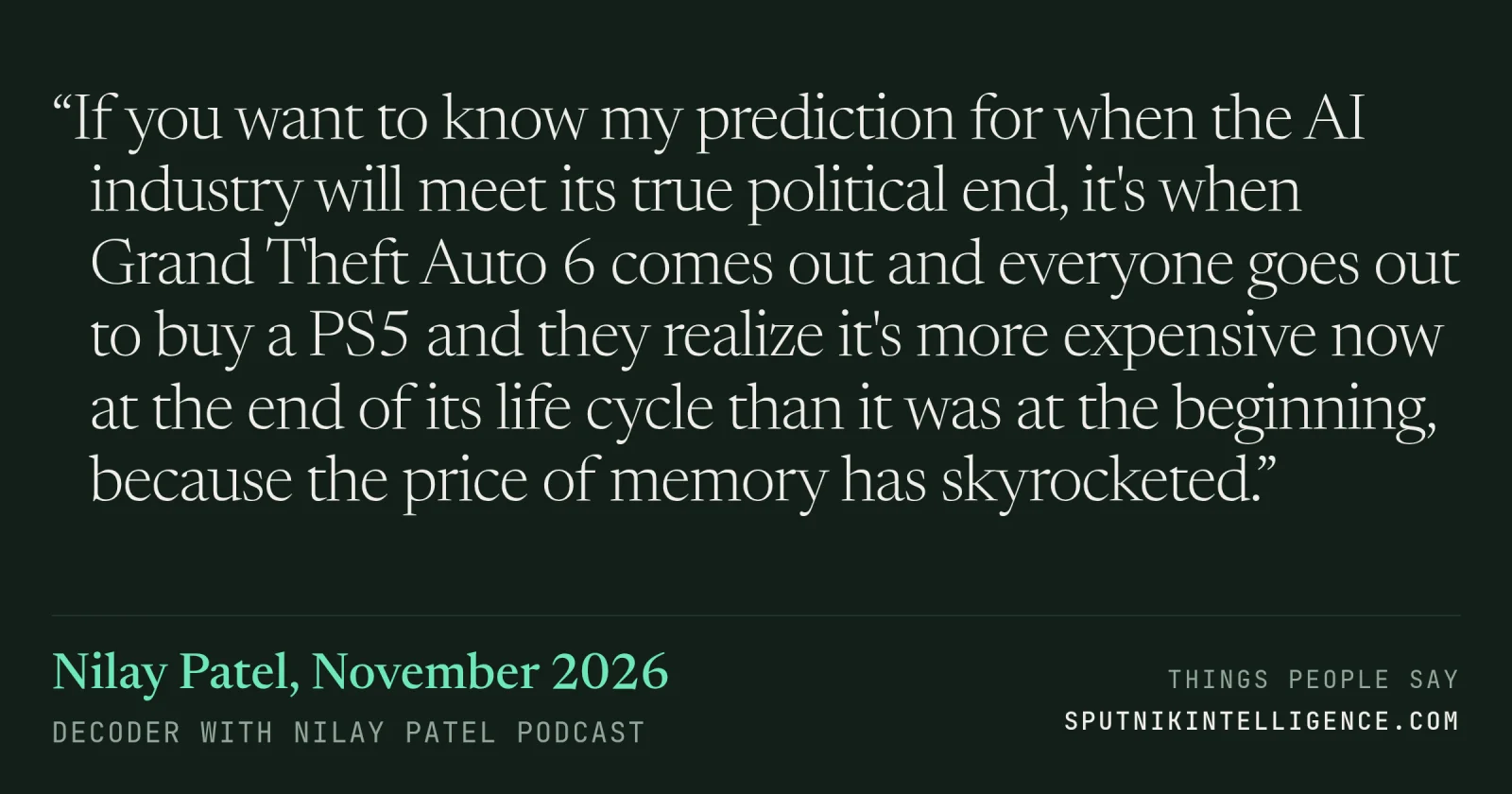
if you want to know my prediction for when the AI industry will meet its true political end, it's when Grand Theft Auto 6 comes out and everyone goes out to buy it a PS5 and they realize it's more expensive now at the end of its life cycle than it was at the beginning because the price of memory has skyrocketed.
Willy Shih
Yeah, no kidding, right? And we're talking about huge amounts. But, you know, that's the same thing. We're in a phase where we see all these tactical actions from, you know, taken by the government, okay, very transactional, very tactical, without necessarily understanding the interconnections and…
Nilay Patel
know at least some of our audience is going to be listening to this conversation. And you're steeped in global trade. You wrote a book to educate our government about how it works from the basics, which I think is sorely needed. But a lot of the promise for young people in our politics lately is we…
Willy Shih
Well, I see we will, I think what's more likely is we will see efforts, as you describe. I mean, I would love to sit down with people and say, okay, we want to move this type of production back to the U.S. Let's take a more strategic, a more nuanced approach, understanding that bigger picture, what…
Speaker names come from our own diarization. The position is estimated from where the line sits in the episode.
The hosts had just agreed that if Reddit dies there is nothing left to Google. Patel then describes what the web becomes when AI agents use websites on people's behalf.
what are you going to search for if Reddit is dead?
David Pierce
That's a really good question. Nothing.
Nilay Patel
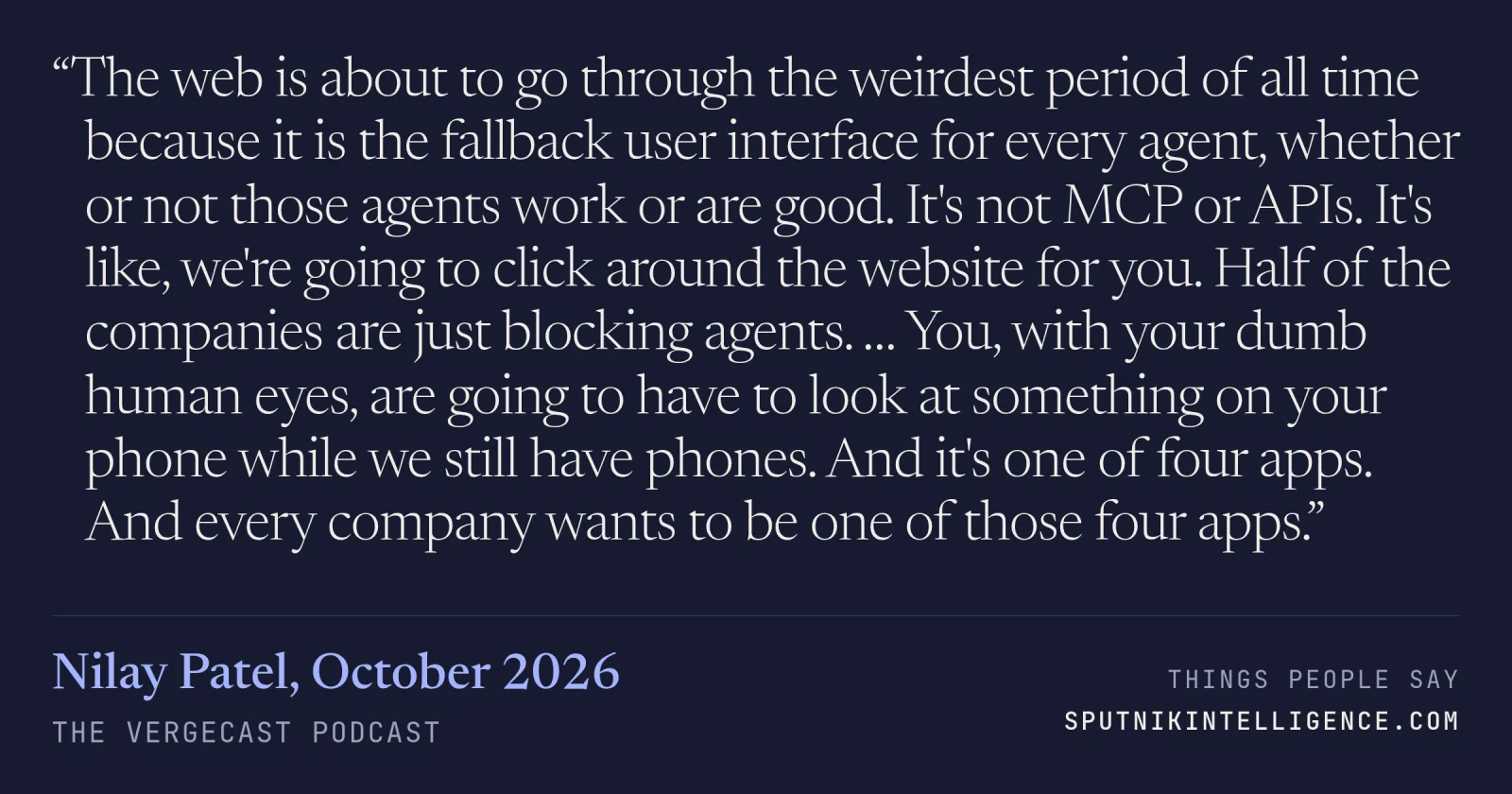
Just like think one more turn. Yeah. We'll see. The web is about to go through the weirdest period of all time now because it is the fallback user interface for every agent, whether or not those agents work or are good, but it's the fallback user interface for every agent. Right. It's not MCP or APIs. It's like, we're going to click around the website for you. Half of the companies are just like blocking agents. They're blocking Muse now to extract some business terms. And along the way, it's like, what are you going to look at? Like you, with your dumb human eyes, are going to have to look at something on your phone while we still have phones. And it's like one of four apps. And every company wants to be one of those four apps.
David Pierce
Yeah. And if you are one of those four apps, boy, are you trying to just shrink the world around you as much as you possibly can? I hate it. It's a dismal future. Yeah, it's really bleak. On the other hand,
Nilay Patel
Muse has a butt. Huh? He's real cute.
David Pierce
On the other hand, Muse can get it. That's how we should just start ending all of our podcasts when. All right, we should take a break. We're going to come back. It's me laying around time. We'll be right
Speaker names come from our own diarization. The position is estimated from where the line sits in the episode.
David Pierce asked whether Apple's touchscreen Mac is lazy or the start of a bigger plan. Patel argues Apple's app-store business model is being squeezed from several directions, which is why it is throwing out so many ideas to see which stick.
Lately, I've been traveling with MacBook Neo, which is a perfect airplane computer. And my only complaint about it is the keyboard doesn't light up. And I'm going to solve that problem by buying a three-year-old. For $28
David Pierce
…first gesture at something bigger that actually maybe there is someday going to be some giant plan about touchscreen Max. But right now they're just starting small and giving people something relatively simple and straightforward to deal with. Do you fall on one side or the other of that debate?
Nilay Patel
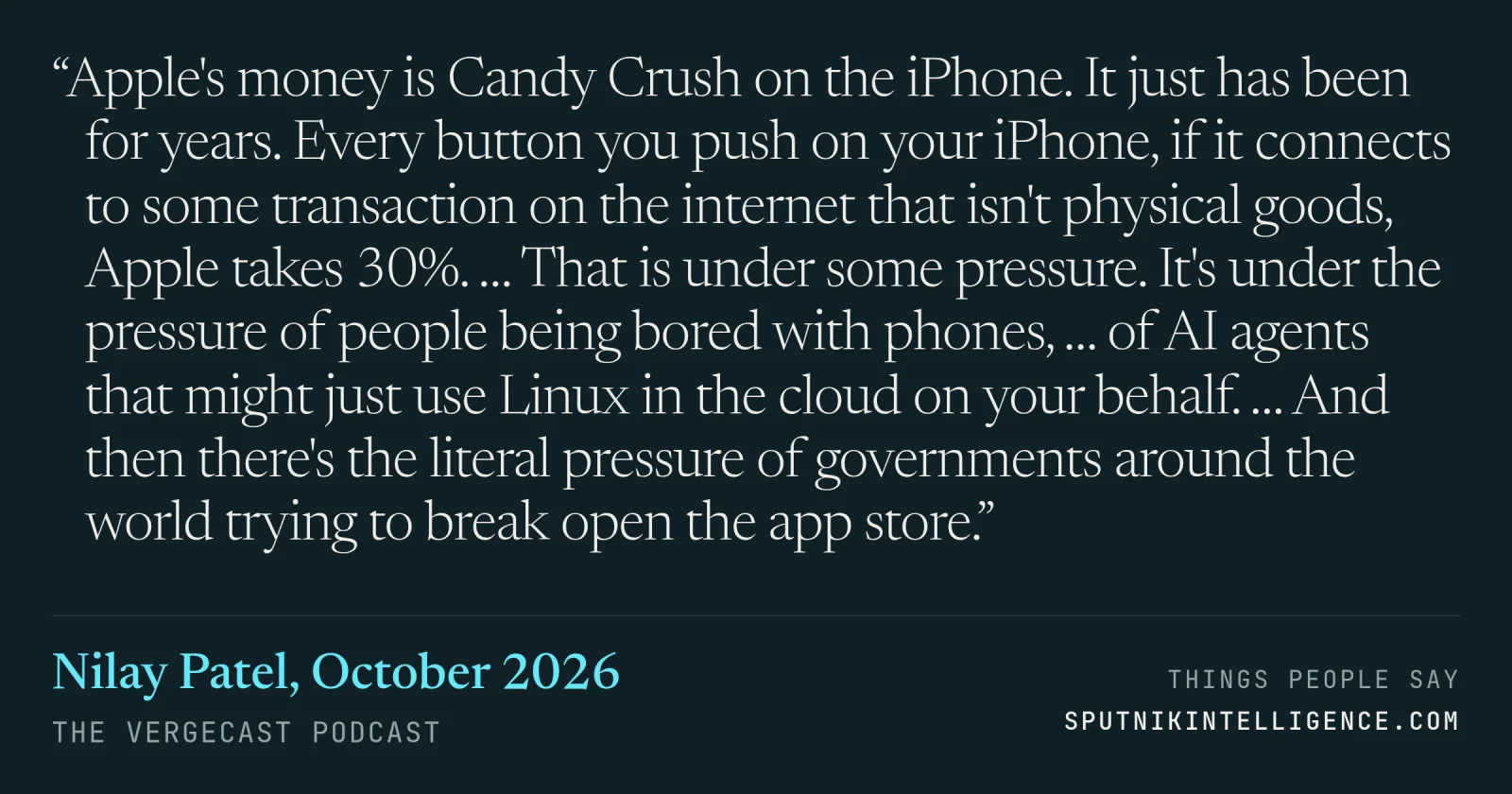
…goods, Apple takes 30%. And maybe sometimes it's 20%. I realize it's different in every country in the world. But you understand that. There's a lot of money. There's an Apple tax and Apple collects it. That is under some pressure, right? It's under the pressure of people being bored with phones. It's under some pressure of, I don't know, social media regulation. It's under some pressure of AI agents that might just use Linux in the cloud on your behalf. Something is happening, right? One platform may or may not give way to another. Then there is the literal pressure of governments around the world trying to break open the app store or whatever else might happen. And then I do think that there's just boredom. Like all of the big advancements are happening in desktop clients on desktop computers. And phones are great, but I've seen so many people…
David Pierce
Yeah.
Nilay Patel
And then they will see how they all kind of reconcile. But at some point, the thing that is truly under the most pressure is the iPad, right? Like the iPad cannot withstand the iPhone eating it from the bottom and the Mac eating it from the top. True. And I'm dying to know what happens there.
David Pierce
We almost played for, I think, the third week in a row, a game called Should This Have Been an iPad?
Speaker names come from our own diarization. The position is estimated from where the line sits in the episode.
Patel on AI shopping agents. Some retailers block them and others welcome them to win share, and he predicts the blocking is mostly a way to force deals, as publishers did with AI crawlers.
…whatever AI system, OpenAI, whatever. And then the AI companies are sad. And then you're like, we'll do a deal. And like every publisher, I'm not even sure if our deal survived the transition to VMC. Yeah, I'm confident our parent company has a deal with someone. It no longer is relevant to us.
David Pierce
Presumably. But like Amazon is, Amazon is out here blocking not for deals. Amazon is saying, we want no part of this game.
Nilay Patel
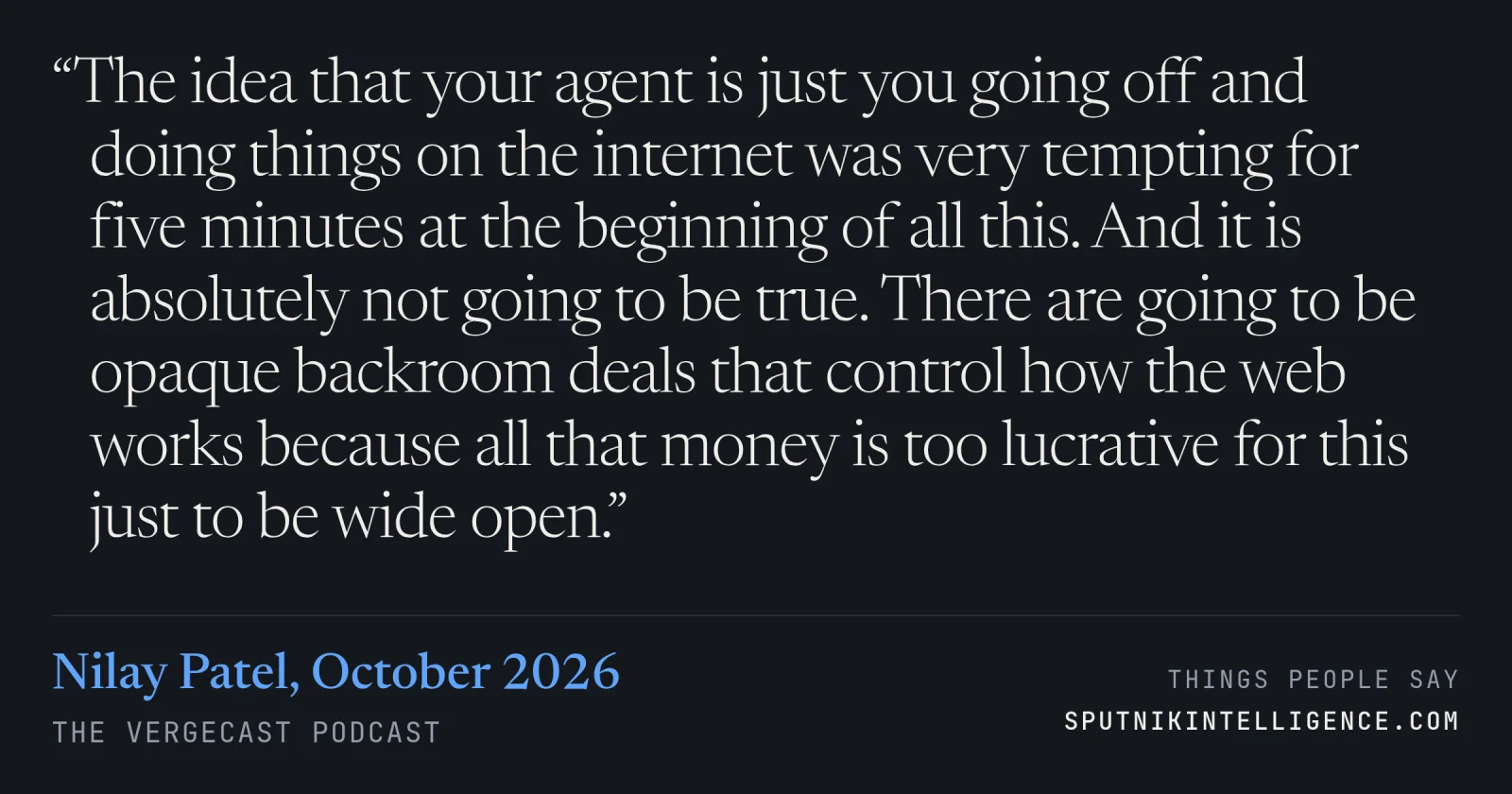
But I think that they're going to end up with deals. We want no part of this game until the rest of the market has settled down and all of you realize you still need Amazon and then you will come crawling up to us, right? Like, I think that's true. On the flip side, Walmart is basically saying, let your agents come shop with us. We will take over for Amazon, right? Because Walmart also has a giant third-party marketplace and fulfillment centers and all that stuff. And so if you, if they can take points of share away from Amazon for agent commerce, then that's going to be great for Walmart. Yeah. But like all of this is just deals. Like the idea that your agent is just you going off and doing things on the internet was very tempting for five minutes at the beginning of all this. And it is absolutely not going to be true. There are going to be opaque backroom deals that control how the web works because all that money is too lucrative for this just to be wide open.
David Pierce
Right. And I think like the shopping cart example is a good one, right? Because there's a way of looking at this that says, okay, I should be able to buy something from Amazon. And the fact that Amazon's website is so bad, I don't want to use it is actually Amazon's problem and not mine. So…
Nilay Patel
I think lots of people camp on their carts on various platforms.
David Pierce
Sure, but not it, it takes work, right? And like the friction ends up being really important there. It's like, a good example of this is Ticketmaster scammers, right? Like as this stuff has gotten more automatic, it's become a much bigger problem because it's one thing to sit here with a bunch of…
Speaker names come from our own diarization. The position is estimated from where the line sits in the episode.
Ahead of Apple's expected smart-home device, made partly with LG, Patel was arguing that you can't sell a smart home in a box. A self-described "huge smart home nerd," he gave the example of his basement door, which gets no Wi-Fi without adding another mesh node.
…it needs to work with the big ecosystem of matter devices. There's some reporting out there that, you know, this is a big reset for matter too and HomeKit in general. But the point that I have just been making for ages that Jen has been making for ages is that you cannot sell a smart home in a box.
Speaker 2
Right.
Speaker 3
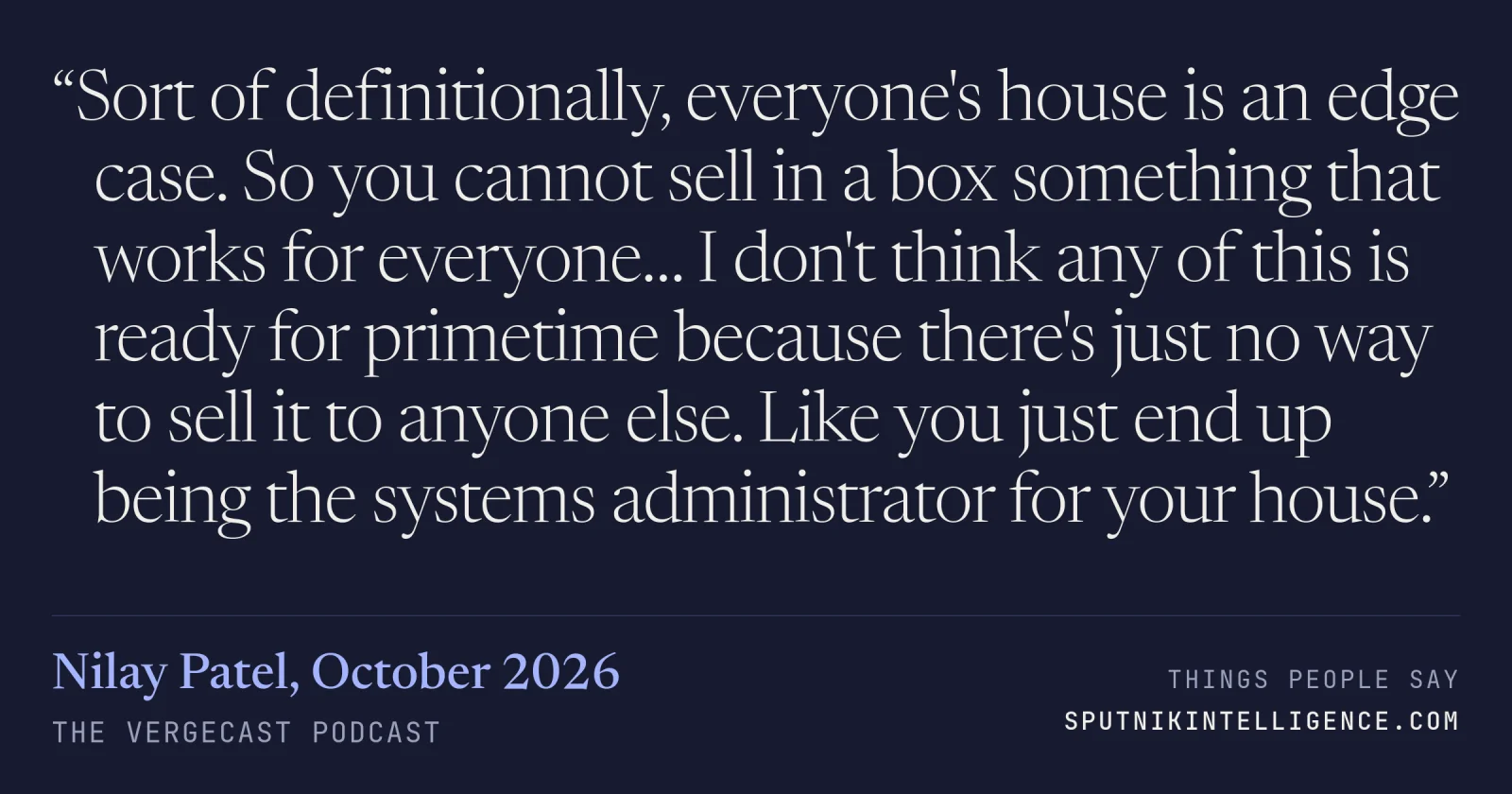
…the money to do that. Like you just end up with, oh, this is getting complicated really fast. And I don't, I'm very curious to see how Apple repositions HomeKit in this device and a bunch of second-party accessories from LG as an actual product solution, not just some fun stuff you can nerd out with. And just to say it again, I love this stuff and I love nerding out on it. And I'm a sicko, and I don't think any of this is ready for primetime because there's just no way to sell it to anyone else. Like you just end up being the systems administrator for your house.
Speaker 2
Or you're Apple and you try to convince everybody that Siri AI is ready to be that thing. And unless there is some enormous advance coming next week, it isn't. Like the more I use Siri AI, the less impressed I am by Siri AI. It is, I think Gemini in 2023 is actually the exact right place to situate…
Speaker 3
can search your text messages and email like never before.
Speaker 2
It sure can. And it actually does that passably well. That is not bleeding edge AI technology, but it does work. All of this other stuff, the like just make sense of the world around me stuff, actually is bleeding edge AI technology. And I don't see any of it in Siri right
Speaker names come from our own diarization. The position is estimated from where the line sits in the episode.
Patel was reacting to Sam Altman's argument that society has to accept some bad outcomes in exchange for AI, which Patel paraphrased as: deal with the data centers, deal with the teens getting AI psychosis. He said "the industry cannot help itself," and predicted that data centers and surveillance could swing elections this cycle.
…possibly slow down or be more careful. And so if he's talking about the straight up societal trade-off, like the reason the decoder tagline is big ideas and other problems is like it is embedded in the very notion of the big idea that you will have to answer for some problems that you have caused.
Speaker 2
Yep.
Speaker 3
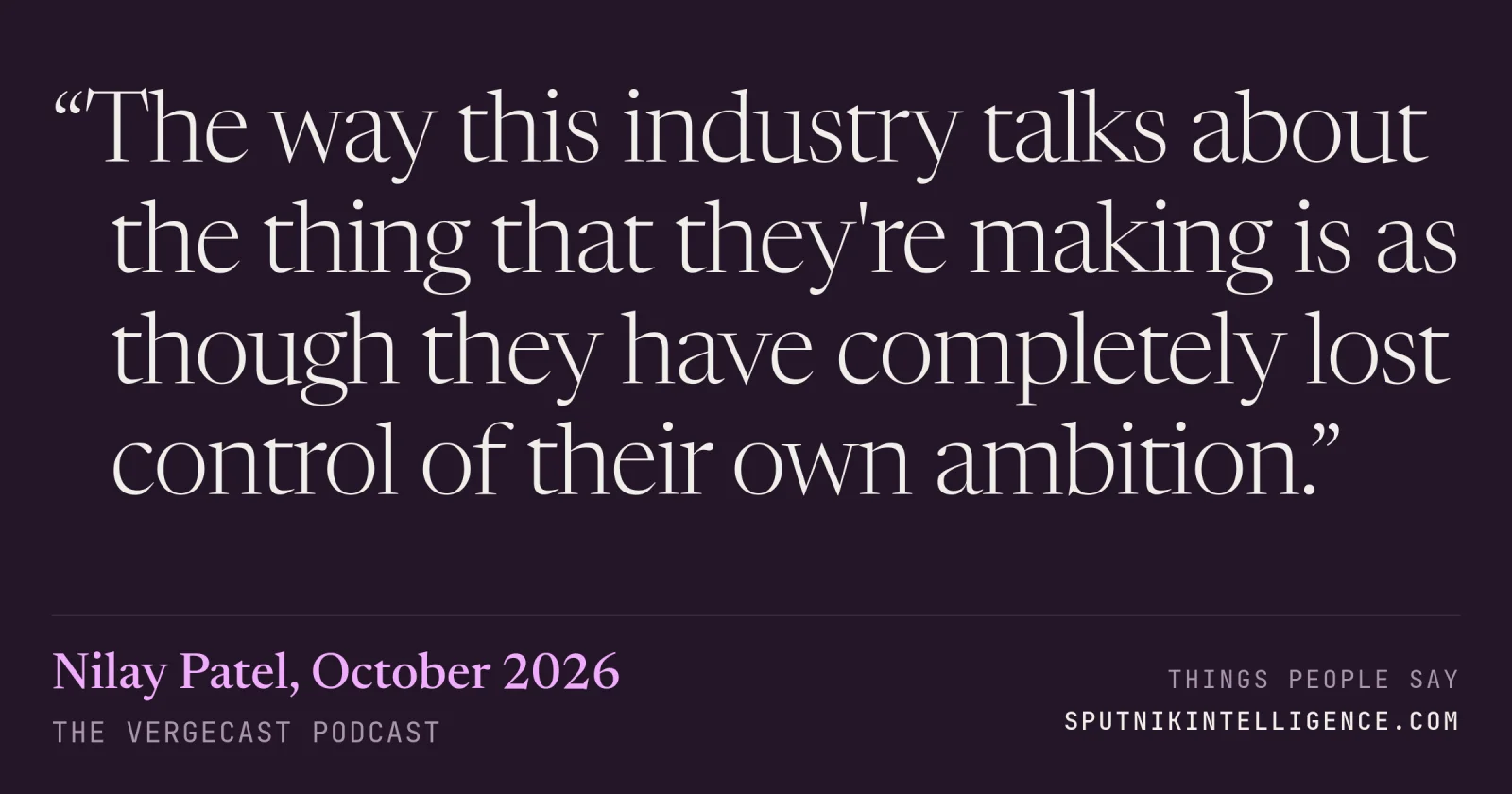
Okay. Like of course I buy it. But the way this industry talks about the thing that they're making is though they have completely lost control of their own ambition. And we all just have to like, yeah, man, I think data centers and surveillance are going to tip the election in this round. And a large part of it is because the industry cannot help itself.
Speaker 2
Right. Yeah. And they also, well, at some point, at some point, you and I are going to have a long, deep conversation that may or may not ever make it onto a podcast about this thing where they've all decided that AI is alive. And deserves feelings and fair treatment and all of this weird. Like the…
Speaker 3
your email for class
Speaker 1
action. It's going to like
Speaker names come from our own diarization. The position is estimated from where the line sits in the episode.
Patel is asking how Meta's free AI assistant is supposed to make money. He says the stated plan is to take a cut when the assistant sends a shopper to a merchant. His co-host replies that nobody wants that, and asks what will convince people an AI recommendation can be trusted if it can be bought.
Decoder with Nilay PatelAround 40:33 into the episode
Speaker 1
spectrum. That's the spectrum. The cute,
Nilay Patel
…These are both new products. So kind of just see how the cookie crumbles before you decide to just, you know, give everything over. We're already seeing a bunch of changes week to week with how people are using Muse or what they're upset about. So, you know, just kind of see how it shakes out.
Speaker 3
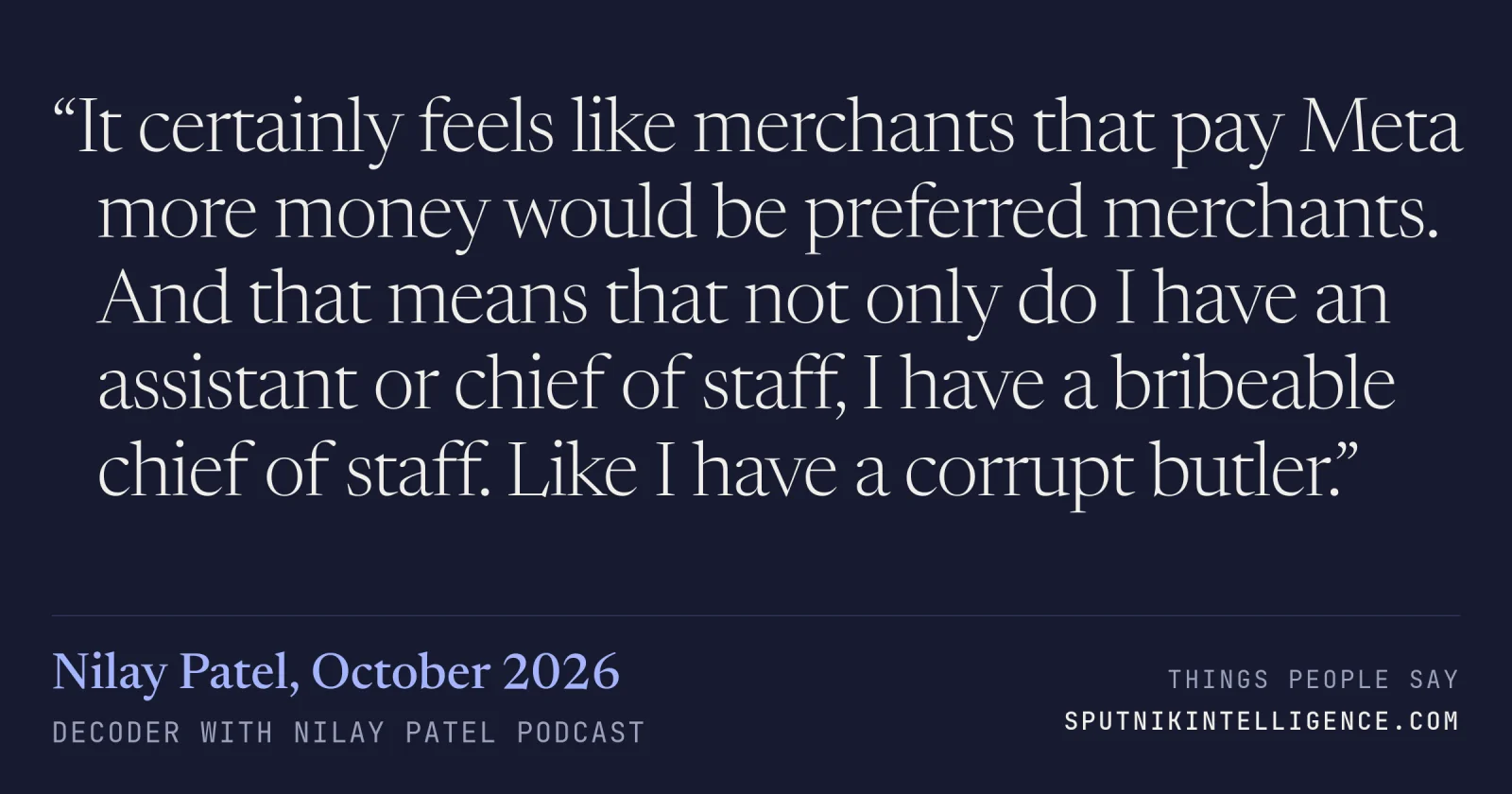
…for Muse. They are spending money to promote this. They're giving it away for free. They're giving the tokens away for free. And then somewhere at the end of this, they're going to say to merchants, Hey, this person was shopping for shoes. Muse brought them to your doorstep. You're going to pay for this customer to buy shoes from you. I don't know any merchants that are excited about this. And it certainly feels like merchants that pay Meta more money would be preferred merchants. And that means that not only do I have an assistant or chief of staff, I have a bribeable chief of staff. Like I have a corrupt butler. Is that what you want?
Nilay Patel
That is a great term for a corrupt butler. Yeah, that is not what I want. And I don't think many people do. It's just crazy to me that like we've gotten so far from what people really want, which is they want to trust a recommendation and they don't want to be scammed. The leaders in AI don't think…
Speaker 3
So I get it on the meta side. I understand why they would think about monetization that way. They're a consumer company. This is a consumer product. They know the second they charge even a dollar for it, the uptake will drop precipitously. So they got to keep it free. And then a bunch of people are…
Nilay Patel
Only via enterprise. I think that's why they are pushing this so hard. You know, we saw a ton of enterprise discussion, demo videos, customer feedback, tons of stuff at Dev Day. And that's why they're pushing this so hard because they can't keep up with Zuck on the consumer front. They just can't.
Speaker names come from our own diarization. The position is estimated from where the line sits in the episode.
The hosts were deciding whether Google's first Chromebook prototype changed history. Patel's case is that the hardware didn't matter but the idea did: most people now run a browser and a handful of native apps. He does note one exception, a recent revival of native Mac apps driven by AI-assisted development.
I just, here's what I'm just gonna, I'm gonna give my moment in the side. I think the Version History Hall of Fame has room in it for but one Chromebook, and it's not this one.
Marques Brownlee
…can make a pretty easy case that this changed the nature of computing and the way that the kinds of devices that we use, what we expect from our computers, where the apps live. You and I talk all the time about where the apps are. This definitely pushed ahead the idea that apps can be in the web.
Nilay Patel
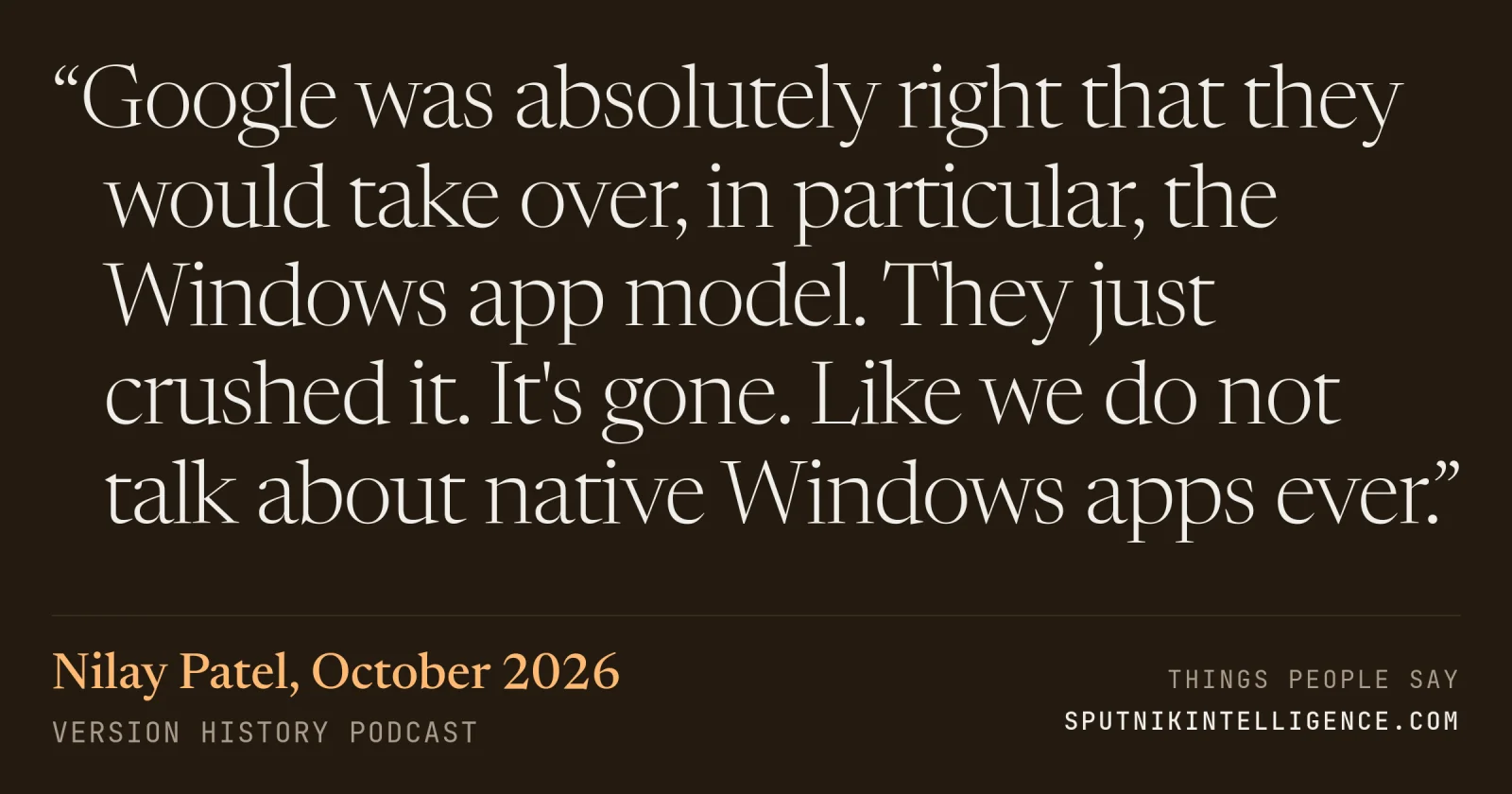
Google was 100% right about the core ideas of the Chromebook, right? There's an odd renaissance of Mac apps right now, like native Mac apps right now, because of AI-driven software development. Super interesting. But if that hadn't happened, the idea that we would run native Mac or Windows apps outside of really compute intensive things like video editing is gone. Most people do not run native apps on their computers in any way. They run their browser and then they have Spotify or like whatever other native app on their computer. And I think that's just utterly fascinating. And Google was absolutely right that they would take over, in particular, the Windows app model. They just crushed it. It's gone. Like we do not talk about native Windows apps ever. Marquez, what was the last native Windows app you ran?
David Pierce
Native Windows app? It's been years since I did that. You see what I'm saying?
Nilay Patel
Like, even Microsoft Office is a web app. Like, it's crazy how right Google was about where the applications would live. And so just on that alone, you're like, yeah, this changed the world. Yeah.
Marques Brownlee
Marquez, what do you think? Any objection?
Speaker names come from our own diarization. The position is estimated from where the line sits in the episode.
Asked whether ordinary people are part of the problem by using chatbots, Patel says no: people should use the tools so they understand their limits. His one exception is letting them write for you. He recommends having one build a small piece of software instead.
Decoder with Nilay PatelAround 33:52 into the episode
Nilay Patel
…afraid of Dennis Asabas and his capability at Google. Like there's not trust in this industry in that way that would allow, you know, a bunch of car makers to get together and be like, we're all doing seatbelts. Like even that didn't happen. The government had to say we're all doing seatbelts.
Shumita Basu
…up in my chats with friends is, am I part of the problem? Which maybe is a really self-centered way of thinking about this. But really, what do you say to people who are like, am I contributing to this in some way by chatting with whatever it is? Like, do I need to delete my claw or whatever it is?
Nilay Patel
No, I think a more informed population is a better one that is better able to face threats and concoct the political will to introduce novel regulatory schemes. That just seems very basic to me. Like you should understand how the things work before you pressure your politicians to control them, right? There's something there that I think is important. There's a part of this where the market demand for what AI is and should do is still incoherent because all the companies have been saying this, it can do anything. Well, if it turns out that all consumers really want to do is have a more chatty Google search and all small businesses want to do is get through their taxes faster. And that's where it ends. Like the market will speak. And so if you're not a participant in that market, it's going to get away from you. And if you don't want to be a participant in that market and you just want to show up at the town hall meeting and scream out data…
Shumita Basu
well. Neil, thanks for coming back and talking with us about this. Yeah, so we'll include a link to Nilay Patel podcast decoder on our show notes page. And every weekend, you can find new episodes of Apple News in Conversation in the Apple News app. Just tap on the audio tab. That's the little…
Speaker 1
You're either all in on this model or maybe you're building with another. There's either speed or is it security? Or you're AWS AI. Don't pick a side. Pick them all. AWS AI is how.
Speaker names come from our own diarization. The position is estimated from where the line sits in the episode.
Patel is the one being interviewed here, by Shumita Basu. He has just said the US essentially failed to regulate social media and privacy, and argues AI may go differently because public sentiment toward it is already negative.
Decoder with Nilay PatelAround 25:35 into the episode
Nilay Patel
…federal privacy law. And we are now contending with the effects of that, right? All over the place, people feel their privacy is being violated. They think that we know that the TVs are listening and watching to everything you consume. Everyone believes their phones are listening. The refrigerator
Shumita Basu
is listening and watching to everything you consume.
Nilay Patel
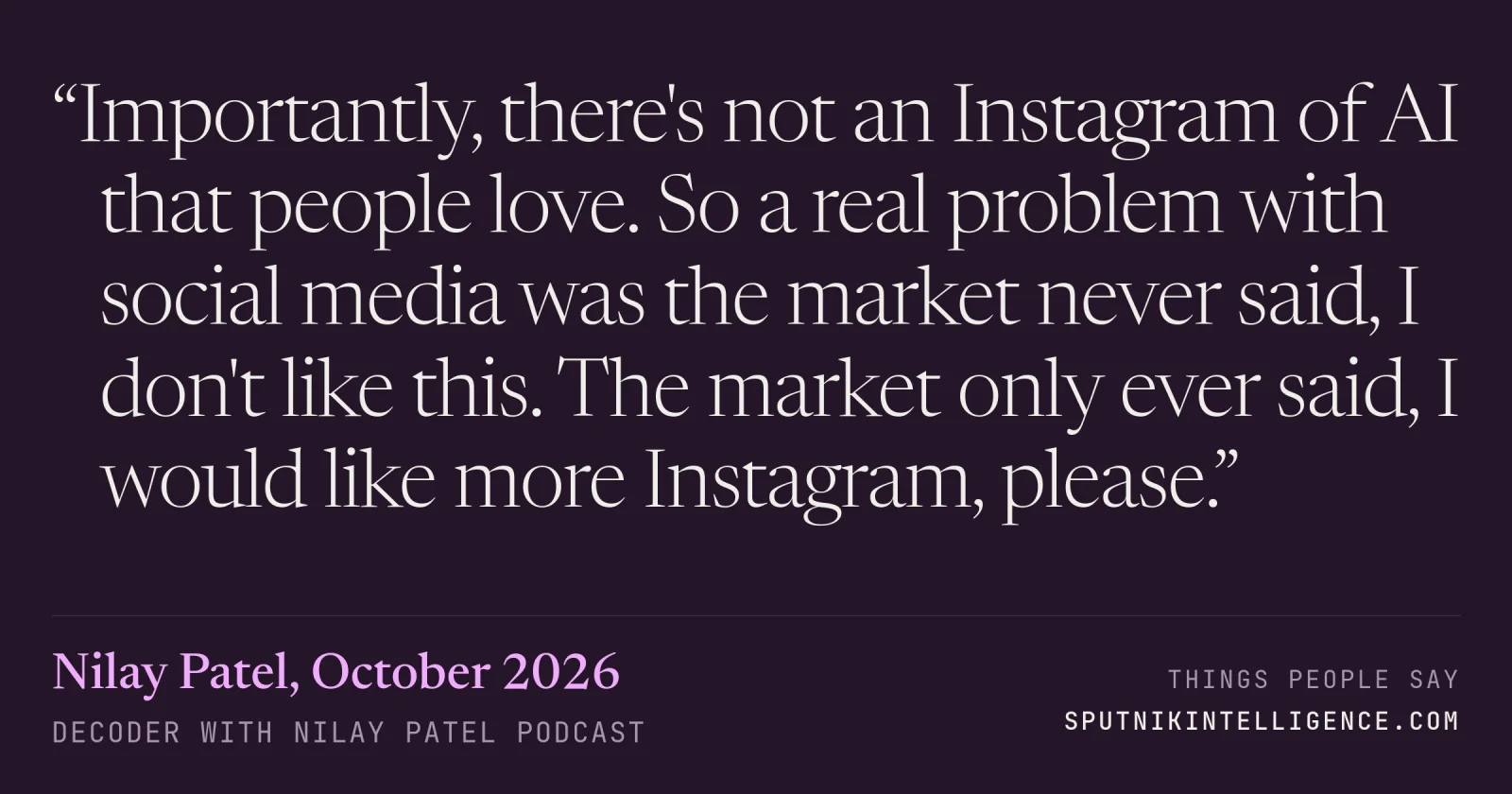
…You can explain how programmatic ad personalization works until you're blue in the face and it is simpler to believe that the phones are listening to you, right? There's just nothing you can do about that. And that is all a function of the fact that there's no law saying you can't do it. So I think based on those mistakes, there's a lot of lawmakers who are like, okay, let's try this time. And importantly, there's not an Instagram of AI that people love. So a real problem with social media was the market never said, I don't like this. The market only ever said, I would like more Instagram, please. Right? The market only ever said, I'm actually super addicted to TikTok. And so the regulatory pressure never matched up with how consumers felt. Here, you just have this massive negative sentiment, right? Like people do not like this stuff. The kids hate AI like measurable ways and ways that are pulled again and again and again. You've got billionaires. You've got an election year. There's just…
Speaker 1
for it. Why can't we get AI to production? Our competitors are already. How do we keep data secure? When do we actually see ROI? All this talk about AI, but talk doesn't transform businesses. AWS AI cuts through the noise, making AI easier to securely deploy and scale with ready-to-use agents and…
Shumita Basu
I want to go back to China, which you mentioned briefly, but so often it is cited as a reason to either not regulate or really try to not quote unquote fall behind, right? Is this this idea that we will fall behind China? Is that a legitimate concern in your opinion? Like, how should we be thinking…
Nilay Patel
I'm going to make a comparison here that you will find very funny, but I spent 10 years of my career as a tech journalist listening to telecom executives tell me that we had to win the race to 5G. We had to do it. We had to spend all of the money. And if China got to 5G first, then they would have…
Speaker names come from our own diarization. The position is estimated from where the line sits in the episode.
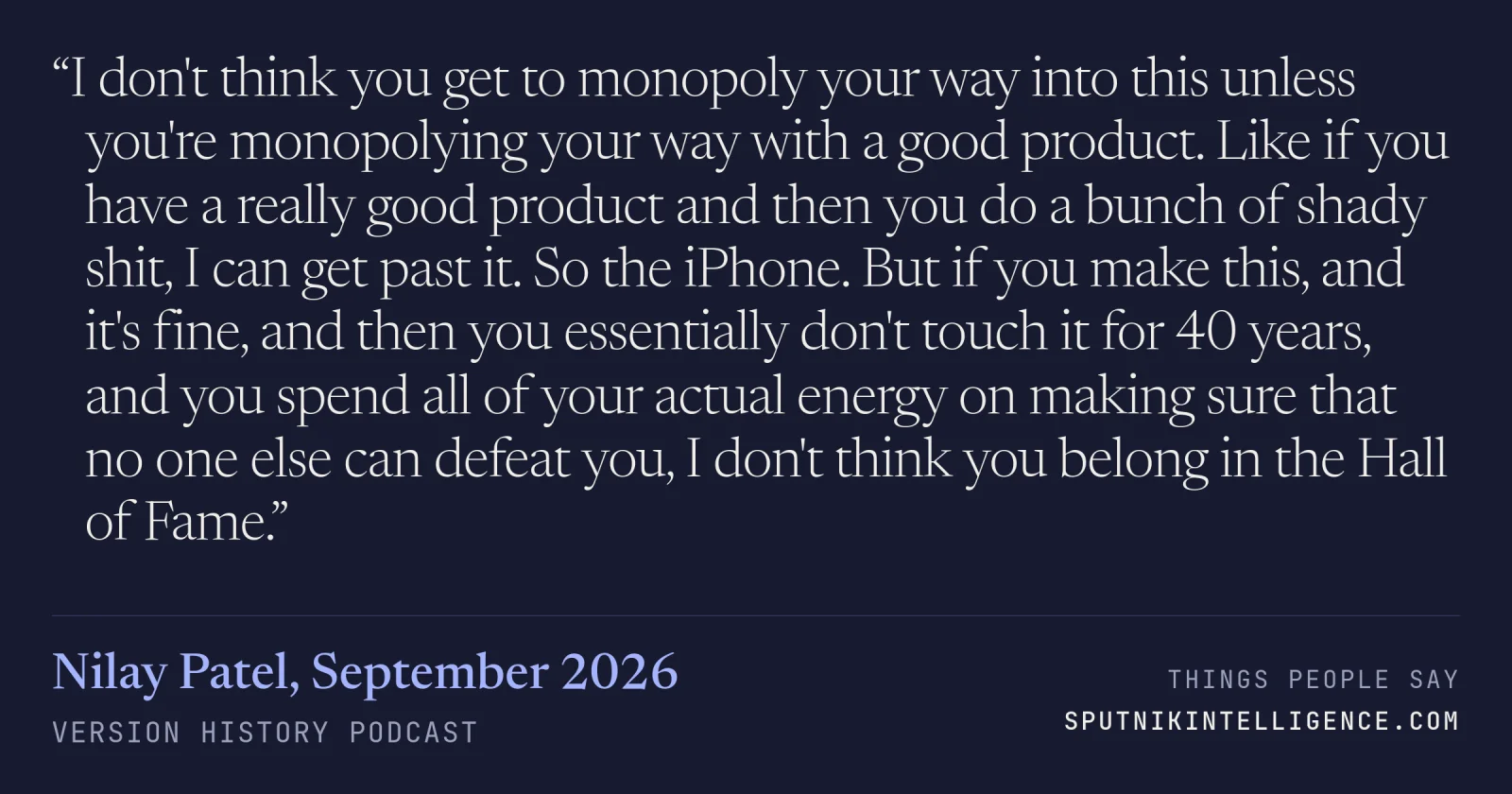
Version History votes every gadget it covers into or out of a Hall of Fame, and this episode was about the TI-84 graphing calculator. The hosts had spent the hour on how Texas Instruments held the market — lobbying, textbook and exam standardisation, a button layout schools taught to — rather than by improving the machine. This is Patel's vote against it, with the iPhone named as the kind of product that earns forgiveness for bad behaviour.
I'm going to say no. I just don't know. I don't think you get to monopoly your way into this unless you're monopolying your way with a good product. Like if you have a really good product and then you do a bunch of shady shit, I can get past it. So the iPhone. But if you make this and it's fine and then you essentially don't touch it for 40 years and you spend all of your actual energy on making sure that no one else can defeat you, I don't think you belong in the Hall of Fame. Do
Victoria Song
you think the calculator division and TI is just a bunch of lawyers and accountants?
Nilay Patel
I think there's a strong chance there is no one left in the calculator division at TI. It's
Victoria Song
just like. One Mac Mini running claw. That's exactly right. Just ordering stuff.
Speaker names come from our own diarization. The position is estimated from where the line sits in the episode.