 Nilay Patel
Editor-in-chief of The Verge, which he co-founded in 2011, covering consumer technology, platforms and the policy around them.
Nilay Patel
Editor-in-chief of The Verge, which he co-founded in 2011, covering consumer technology, platforms and the policy around them.
“Importantly, there's not an Instagram of AI that people love. So a real problem with social media was the market never said, I don't like this. The market only ever said, I would like more Instagram, please.”
Decoder with Nilay Patel · Tech Strategy & Big Tech · October 2026
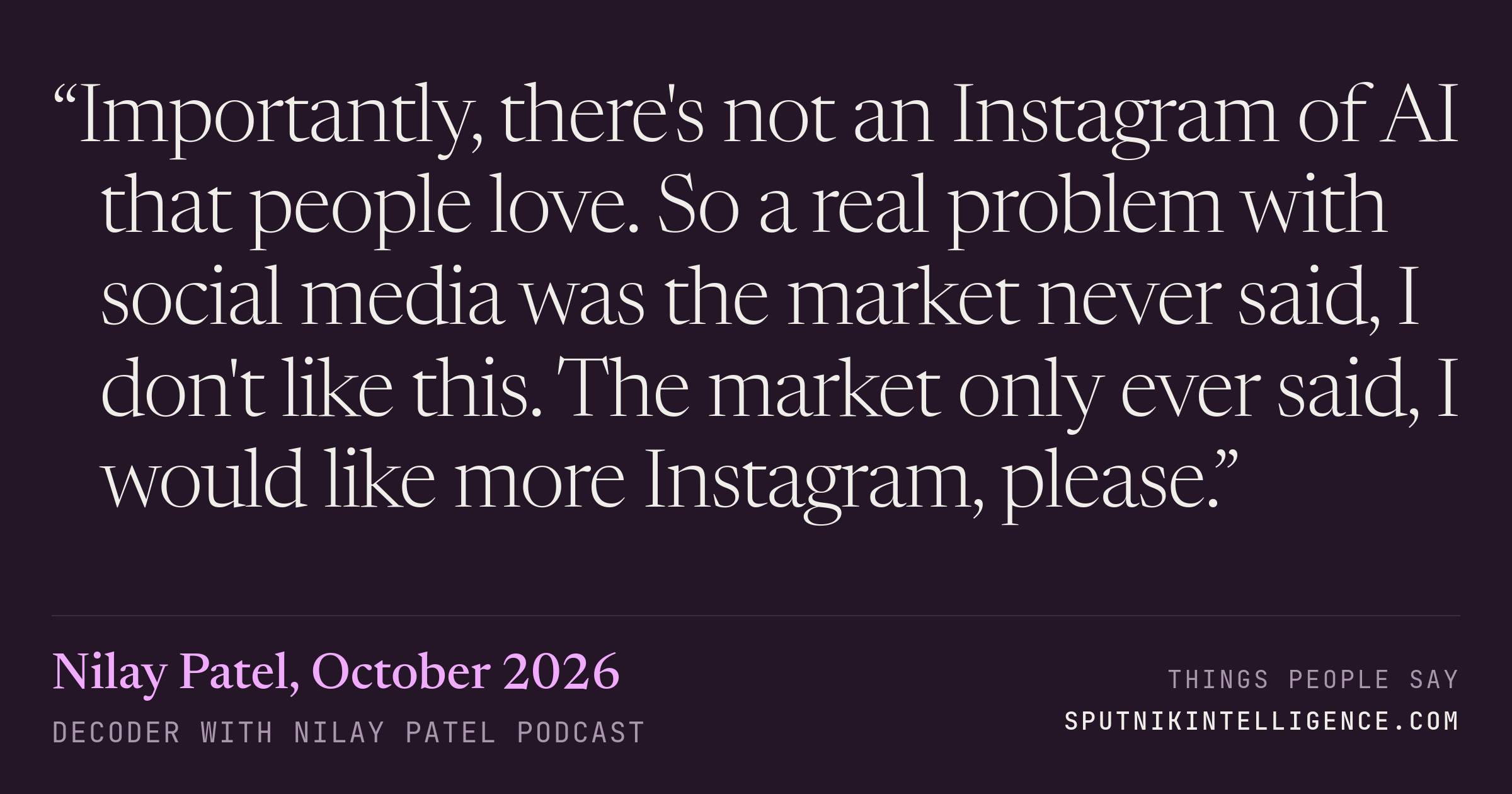
Patel is the one being interviewed here, by Shumita Basu. He has just said the US essentially failed to regulate social media and privacy, and argues AI may go differently because public sentiment toward it is already negative.
Transcript
I do. And I think we essentially failed to regulate social media. We essentially failed to regulate privacy. It is just a pure failure of our politics. There's not a privacy law in the United States of America. There's not a federal privacy law. And we are now contending with the effects of that, right? All over the place, people feel their privacy is being violated. They think that we know that the TVs are listening and watching to everything you consume. Everyone believes their phones are listening. The refrigerator
is listening and watching to everything you consume.
Everyone in the world believes their phones are listening. I have written the explainers. Our team has written the explainers. You can explain how programmatic ad personalization works until you're blue in the face and it is simpler to believe that the phones are listening to you, right? There's just nothing you can do about that. And that is all a function of the fact that there's no law saying you can't do it. So I think based on those mistakes, there's a lot of lawmakers who are like, okay, let's try this time. And importantly, there's not an Instagram of AI that people love. So a real problem with social media was the market never said, I don't like this. The market only ever said, I would like more Instagram, please. Right? The market only ever said, I'm actually super addicted to TikTok. And so the regulatory pressure never matched up with how consumers felt. Here, you just have this massive negative sentiment, right? Like people do not like this stuff. The kids hate AI like measurable ways and ways that are pulled again and again and again. You've got billionaires. You've got an election year. There's just a swirl here of, well, we can take some shots at this and then we can actually come to a regulatory framework, not least because they are asking
for it. Why can't we get AI to production? Our competitors are already. How do we keep data secure? When do we actually see ROI? All this talk about AI, but talk doesn't transform businesses. AWS AI cuts through the noise, making AI easier to securely deploy and scale with ready-to-use agents and the broadest set of AI tools and services. You can build, buy, or partner your way. Stop overthinking. Start building. AWS AI is how.
I want to go back to China, which you mentioned briefly, but so often it is cited as a reason to either not regulate or really try to not quote unquote fall behind, right? Is this this idea that we will fall behind China? Is that a legitimate concern in your opinion? Like, how should we be thinking about the U.S.'s AI development vis-a-vis China?
I'm going to make a comparison here that you will find very funny, but I spent 10 years of my career as a tech journalist listening to telecom executives tell me that we had to win the race to 5G. We had to do it. We had to spend all of the money. And if China got to 5G first, then they would have robot surgery and self-driving cars or whatever nonsense it was. And about halfway through that, I started asking every single politician, FCC chairperson, telecom executive that I came across, what happens if we lose? Like what, tell me what this race is to. What is the finish line of this race? And if we lose and I get a robot surgery self-driving car a year after the people in China, like what, what's the problem? Yeah. There was never an answer to this, right? It was the specter of the foreign power getting something before we did. And the best version of this was then all the startups will go to China because they'll have better infrastructure. None of this happened. And for the vast majority of people, their experience with 5G here in 2026 is this is pretty slow. Like it's not great. Like New York State is like a highly dense area with lots of cell towers. I'm like, this is still pretty slow, right? So the specter of China just looms in these kinds of races where you're trying to deploy a lot of capital and you just need an excuse. And so that's one framework for looking at it. The other framework, which I think many of the people in the industry are using and potentially Donald Trump is using is, well, if China gets to AGI first, they will have an offensive cyber capability. They will have an economic capability to develop new things and new manufacturing capabilities and new drugs that we will not be able to compete with. And something bad will happen to us because China will get to some capability before we do. And maybe you think that's true. Maybe you think China is going to get to an offensive cyber capability that is overwhelming. And then they, for some reason, choose to destroy the world with it. It is unclear why they would do that, given that we are their largest trading partner and like all the things are made there and sold here. Like you have to get to some next step that no one can quite articulate to me. And so I think the specter of China just looms as a way to say something scary that ends a conversation. China getting there first. I think anybody who makes that claim has to really articulate what about it is so scary that it prevents us from being responsible.
More from Decoder with Nilay Patel